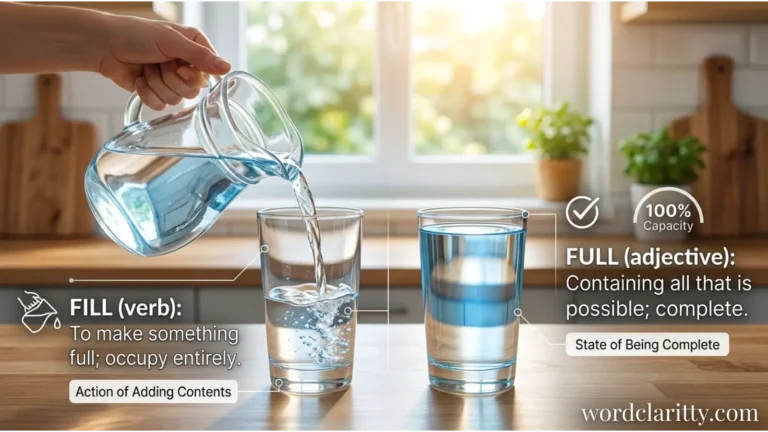
Full vs fill is a common English confusion because the two words look very similar and are closely connected in meaning. However, they belong to different parts of speech and are used in different ways. Many English learners accidentally write full when they mean fill, or vice versa, especially because both words relate to putting something into a container until there is no more space. Understanding the difference between full vs fill will help you write more accurately, speak more naturally, and avoid common grammar mistakes in everyday English. This guide explains both words in simple language with examples, memory tips, and practice exercises.
Why “Full” and “Fill” Are Confusing
Many English learners mix up full and fill because the words are closely related in meaning. Although they are different words, they often appear in the same situations.
Here are the main reasons people confuse them.
Similar Pronunciation
The words sound very similar in everyday speech. Depending on the speaker’s accent, the vowel sounds may be difficult for learners to distinguish.
Similar Spelling
The words differ by only one letter:
- Full
- Fill
Because they look almost identical, they are easy to confuse while writing.
Context Confusion
Both words are connected to containers, space, and quantity.
For example:
- Fill the bottle.
- The bottle is full.
Since they describe the same situation from different perspectives, learners often replace one with the other.
Common Learner Mistakes
Some frequent errors include:
- ❌ Please full the form.
- ❌ The glass is fill.
- ❌ Fill means completely occupied.
These mistakes happen because learners confuse an action with a state.
Full vs Fill Explained Simply
The easiest way to understand the difference is this:
Full means completely occupied or containing as much as possible, while fill means to put something into a space until it becomes full.
One-Line Distinction
Fill is the action. Full is the result.
Example Sentences
Full
- The basket is full of apples.
- My schedule is full this week.
Fill
- Please fill the basket with apples.
- Can you fill this bottle with water?
Understanding Homophones in English
What Are Homophones?
Homophones are words that sound the same or nearly the same but have different meanings and often different spellings.
Example:
- Two
- Too
Although full and fill are not perfect homophones in every accent, many learners hear them as very similar, which causes confusion.
Why Homophones Cause Confusion
When two words sound alike, learners often choose the wrong spelling.
Example:
Someone hears:
Fill the glass.
But writes:
❌ Full the glass.
Learning each word’s meaning and grammar helps avoid this mistake.
What Does “Full” Mean?
Definition and Core Meaning
Full is an adjective.
It describes something that contains as much as it can hold or has no empty space left.
It can also describe being satisfied after eating or having a busy schedule.
Examples
- The cup is full.
- I’m full after dinner.
- The hotel is full.
Origin and Historical Use
The word full comes from Old English full, meaning “filled, complete, or abundant.”
It has been used in English for over a thousand years.
Modern Usage and Synonyms
Today, full is commonly used to describe:
- Containers
- Rooms
- Schedules
- Feelings of satisfaction
- Amounts
Synonyms
Quick Points
- Adjective
- Describes a condition
- Opposite of empty
- Cannot usually be used as a verb
Example Sentences
- The parking lot is full.
- My inbox is full.
- She gave me her full attention.
- The moon is full tonight.
- The bag is full of books.
What Does “Fill” Mean?
Definition and Core Meaning
Fill is mainly a verb.
It means to put something into a container or space until there is little or no room left.
Origin and Historical Context
Fill comes from Old English fyllan, meaning “to make full.”
Interestingly, both words share the same historical root.
Modern Usage and Synonyms
Today, fill is used in many situations.
Examples include:
- Fill a bottle
- Fill a form
- Fill a vacancy
- Fill a prescription
Synonyms
- Complete
- Load
- Pour into
- Occupy
- Supply
- Pack
Quick Points
- Usually a verb
- Shows an action
- Means to make something full
- Often followed by with
Example Sentences
- Please fill the tank.
- She filled the vase with flowers.
- Can you fill out this application?
- They filled the room with music.
- We need to fill the empty shelves.
Full vs Fill: Key Differences at a Glance
| Word | Part of Speech | Meaning | Example Context |
|---|---|---|---|
| Full | Adjective | Completely occupied or containing as much as possible | The glass is full. |
| Fill | Verb | To make something become full | Please fill the glass. |
How to Remember the Difference Between Full and Fill
Here are some easy memory tricks.
Memory Trick 1
Think of this sentence:
You fill something until it becomes full.
Action first.
Result second.
Memory Trick 2
Remember:
- Fill = Verb = Action
- Full = Adjective = Description
Memory Trick 3
If the sentence needs an action, choose fill.
If it describes a condition, choose full.
Memorable Example
Fill the cup until it is full.
This sentence contains both words correctly.
Common Mistakes and Confusions
Mistake 1
❌ Please full the bottle.
✔ Please fill the bottle.
Explanation: You are describing an action.
Mistake 2
❌ The bottle is fill.
✔ The bottle is full.
Explanation: The sentence describes the bottle’s condition.
Mistake 3
❌ My stomach is fill.
✔ My stomach is full.
Explanation: You describe how you feel.
Mistake 4
❌ Can you full this form?
✔ Can you fill this form?
(In American English, “fill out the form” is even more common.)
Examples Section: Correct and Incorrect Usage
Example 1
✔ Correct: Please fill the bucket with water.
✘ Incorrect: Please full the bucket with water.
Example 2
✔ Correct: The bucket is full.
✘ Incorrect: The bucket is fill.
Example 3
✔ Correct: She filled the box with toys.
✘ Incorrect: She fulled the box with toys.
Example 4
✔ Correct: The classroom is full of students.
✘ Incorrect: The classroom is fill of students.
Example 5
✔ Correct: We need to fill the empty seats.
✘ Incorrect: We need to full the empty seats.
Example 6
✔ Correct: After lunch, everyone felt full.
✘ Incorrect: After lunch, everyone felt fill.
Self Assessment: Test Your Knowledge
Choose the correct word.
1.
Please _____ the glass with milk.
2.
The theater was completely _____.
3.
Can you _____ out this application form?
4.
My backpack is _____ of books.
Self Assessment Answers
- fill
- full
- fill
- full
FAQs About “Full and Fill”
1. Is it “full” or “fill” the bottle?
Use fill because it is an action.
Correct: Fill the bottle.
2. Is “full” a verb?
No. Full is mainly an adjective.
3. Is “fill” always a verb?
Usually yes, although it can occasionally be used as a noun in specialized contexts, such as “a fill” in construction or sewing.
4. Can I say “the glass is fill”?
No.
The correct sentence is:
The glass is full.
5. Which word means “not empty”?
Full means not empty.
6. How can I remember the difference?
Remember this simple sentence:
You fill something until it becomes full.
7. Do “full” and “fill” come from the same origin?
Yes. Both words developed from related Old English words, which is why they are connected in meaning even though they serve different grammatical roles today.
Final Conclusion: Using “Full” and “Fill” Correctly
Understanding full vs fill becomes much easier once you remember that the two words play different roles in a sentence. Fill is a verb, so it describes an action. You fill a glass with water, fill a form with information, or fill a room with laughter. Full, on the other hand, is an adjective that describes a state or condition. A glass can be full, a theater can be full, and after a large meal you may feel full. In other words, fill is what you do, while full is what something becomes after the action is complete.
In everyday English, these words appear in conversations, emails, school assignments, and professional writing. Using the correct one helps your sentences sound natural and grammatically accurate. A simple memory trick is to repeat the phrase, “Fill the cup until it is full.” This single sentence reminds you that fill expresses the action and full describes the final result. Reading, writing, and speaking with these words regularly will strengthen your understanding over time. Every small grammar improvement builds greater confidence, so keep practicing with real-life examples. Before long, choosing between full and fill will become automatic, helping you communicate more clearly and effectively in English.

Bilal Hassan is a Master’s graduate, content writer, and author at WordClaritty.com. He specializes in creating clear, informative, and reader-friendly content focused on language, word meanings, and educational topics. With a passion for accuracy and simplicity, he helps readers expand their knowledge through engaging and easy-to-understand articles.