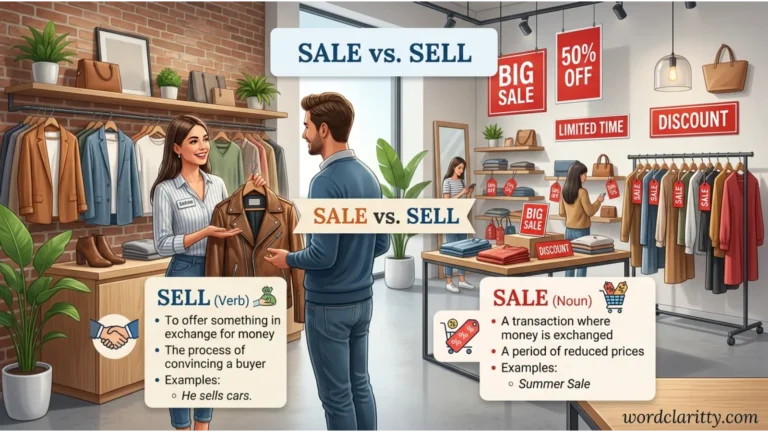
Sale vs Sell is one of the most common word pairs that confuses English learners because the two words look similar but have different meanings and uses. Many people mistakenly use one in place of the other, leading to grammar mistakes in everyday conversations and writing. Understanding Sale vs Sell is important because sale is a noun that refers to the act or event of selling, while sell is a verb that means to exchange something for money. Once you learn this simple difference, you can communicate more naturally and avoid common errors. In this guide, we will explain Sale vs Sell with clear definitions, easy examples, practical grammar tips, and common mistakes so you can use both words with confidence.
Why “Sale” and “Sell” Are Confusing
Many English learners mix up sale and sell because the words look and sound very similar. They are connected in meaning, but they are used differently in grammar.
Similar Pronunciation
The words have nearly the same pronunciation, especially in fast speech. This makes it difficult for learners to hear the difference.
Similar Spelling
Both words begin with sel-, and only the final letter changes. This similarity often causes spelling mistakes.
Context Confusion
Both words relate to buying and selling products. Since they appear in shopping, business, and advertising, learners sometimes think they are interchangeable.
Common Learner Mistakes
People often write:
- “The store is going to sell this weekend.” ❌
- “I want to sale my old laptop.” ❌
These mistakes happen because learners confuse the noun and the verb.
Sale vs Sell Explained Simply
Sale means a transaction or a discount event, while sell means to give something to someone in exchange for money.
One-Line Distinction
Sale is a noun, while sell is a verb.
Examples
Sale
- The furniture store is having a sale this weekend.
- The house is now for sale.
Sell
- They sell fresh vegetables every morning.
- I want to sell my bicycle online.
Understanding Homophones in English
Although sale and sell are not perfect homophones for every speaker, they sound very similar in many accents, making them easy to confuse.
What Are Homophones?
Homophones are words that sound the same or almost the same but have different meanings and spellings.
Example:
- Sea
- See
Both sound alike but have different meanings.
Why Homophones Cause Confusion
When learners hear similar-sounding words, they may choose the wrong spelling because they focus on pronunciation instead of meaning.
For example:
- I want to sell my car. ✔
- My car is for sale. ✔
These expressions sound similar but use different parts of speech.
What Does “Sale” Mean?
Definition and Core Meaning
Sale is a noun.
It refers to:
- The exchange of goods for money
- A discount event
- Something available to purchase
Origin and Historical Use
The word sale comes from the Old English word sala, meaning the act of selling or transferring ownership. It has been used in commerce for centuries.
Modern Usage and Synonyms
Common synonyms include:
- Purchase
- Transaction
- Discount event
- Clearance
- Bargain event
Key Points
- It is always a noun.
- It describes an event or transaction.
- It often appears with “for.”
Example Sentences
- The shoes are on sale today.
- Our biggest sale starts tomorrow.
- The painting is for sale.
- Last month’s sale increased profits.
What Does “Sell” Mean?
Definition and Core Meaning
Sell is a verb.
It means:
- To exchange something for money
- To persuade someone to buy something
- To convince someone to accept an idea
Origin and Historical Context
Sell comes from the Old English word sellan, meaning to give or hand over. Over time, it became closely associated with commercial trade.
Modern Usage and Synonyms
Common synonyms include:
- Market
- Trade
- Offer
- Exchange
- Promote
Key Points
- It is always a verb.
- It describes an action.
- It usually needs a subject.
Example Sentences
- They sell handmade jewelry.
- I want to sell my phone.
- Good advertisements help companies sell products.
- She hopes to sell her artwork online.
Sale vs Sell: Key Differences at a Glance
| Word | Part of Speech | Meaning | Example Context |
|---|---|---|---|
| Sale | Noun | A transaction or discount event | The store has a summer sale. |
| Sell | Verb | To exchange something for money | They sell books online. |
How to Remember the Difference Between Sale and Sell
Here are a few simple tricks that make the difference easy to remember.
Easy Memory Tricks
- Sale = Something
- A sale is a thing or event.
- Sell = Action
- Sell is something you do.
Association Technique
Remember:
- You sell products.
- Products go on sale.
The action comes first, and the event or result is the sale.
Memorable Example
- I sell clothes.
- My clothes are on sale.
This sentence shows both words working together correctly.
Common Mistakes and Confusions
Wrong
I want to sale my old bike.
Correct
I want to sell my old bike.
Explanation: Selling is an action, so use the verb sell.
Wrong
The supermarket will sell next Friday.
Correct
The supermarket will have a sale next Friday.
Explanation: A discount event is called a sale.
Wrong
The car is for sell.
Correct
The car is for sale.
Explanation: “For sale” is a fixed English expression.
Wrong
This sell was very successful.
Correct
This sale was very successful.
Explanation: The result or event is a sale, not a sell
Examples Section: Correct and Incorrect Usage
Example 1
✔ Correct: I want to sell my old computer.
✘ Incorrect: I want to sale my old computer.
Example 2
✔ Correct: The store is having a big sale.
✘ Incorrect: The store is having a big sell.
Example 3
✔ Correct: They sell fresh flowers every morning.
✘ Incorrect: They sale fresh flowers every morning.
Example 4
✔ Correct: That apartment is for sale.
✘ Incorrect: That apartment is for sell.
Self Assessment: Test Your Knowledge
Fill in the blanks with sale or sell.
- We want to ______ our old sofa.
- The department store is having a summer ______.
- Is this house for ______?
- Many websites ______ electronic devices.
Self Assessment Answers
- sell
- sale
- sale
- sell
FAQs About “Sale” and “Sell”
1. Is it “for sale” or “for sell”?
Always say for sale because sale is the noun used in this fixed phrase.
2. Is “sell” a verb?
Yes. Sell is always a verb that describes the action of exchanging something for money.
3. Can “sale” be used as a verb?
No. Sale is only a noun.
4. Which word is used for discounts?
Sale is used for discount events, such as “Black Friday sale.”
5. How do I remember the difference?
Think of this rule:
- Sell = action
- Sale = event or thing
6. Can I say “I made a sale”?
Yes. That means you successfully sold something.
7. Can “sell” also mean persuade?
Yes. Besides selling products, sell can also mean convincing someone to accept an idea.
Example:
“She couldn’t sell the proposal to the committee.”
Final Conclusion: Using “Sale” and “Sell” Correctly
Understanding the difference between sale and sell is much easier once you remember their grammatical roles. Sell is a verb, so it describes the action of giving something in exchange for money. Sale, on the other hand, is a noun that refers to the event, transaction, or item being offered for purchase. Although these words are closely connected and often appear together in shopping, business, and advertising, they are never interchangeable. A person sells a product, while that product may be for sale, or a store may hold a sale to attract customers with lower prices.
A simple memory trick can help you every time: sell means action, sale means thing or event. If you ask yourself whether you’re describing what someone is doing or naming an event or condition, you’ll almost always choose the correct word. Reading advertisements, business articles, and everyday conversations will also reinforce the correct usage.
Like many commonly confused English words, mastering sale and sell takes practice rather than memorization alone. Keep writing your own example sentences, pay attention to how native speakers use these words, and review the examples in this guide whenever you’re unsure. With consistent practice, you’ll use sale and sell naturally and confidently in both speaking and writing, making your English clearer, more accurate, and more professional.

Bilal Hassan is a Master’s graduate, content writer, and author at WordClaritty.com. He specializes in creating clear, informative, and reader-friendly content focused on language, word meanings, and educational topics. With a passion for accuracy and simplicity, he helps readers expand their knowledge through engaging and easy-to-understand articles.