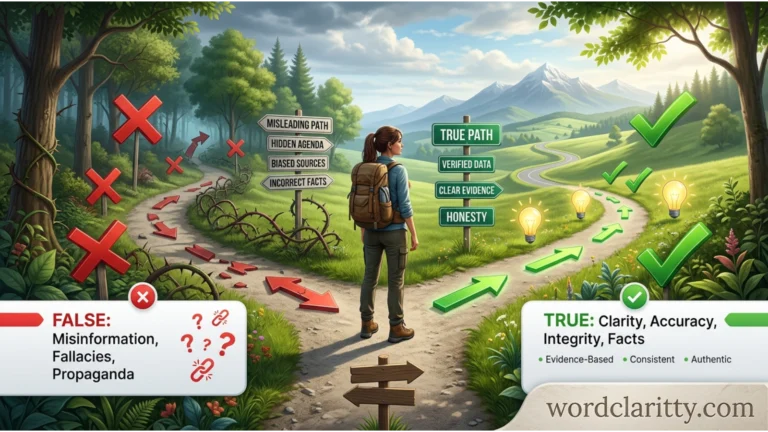
True and false are two common English words that learners encounter almost every day. They look simple, but understanding exactly how they work is important because they are often used to describe facts, statements, beliefs, answers, and information.
Unlike many confusing word pairs, true and false are not homophones, and their meanings are usually opposite. However, learners may still confuse them when answering questions, checking information, or describing whether something is correct. In this guide, you will learn the difference between true and false, how to use each word naturally, common mistakes to avoid, and easy ways to remember which word fits a sentence.
Why “True” and “False” Are Confusing
True and false are confusing for some English learners because both words are used to judge or describe information. However, they have opposite meanings.
Similar pronunciation
True and false do not sound alike. In fact, their pronunciation is quite different:
- True sounds like /truː/.
- False sounds like /fɔːls/ in many varieties of English.
Because both words frequently appear in questions and tests, learners may sometimes focus on the context rather than the meaning.
Similar spelling
The spelling of true and false is not particularly similar. However, learners often learn them together because they represent two opposite answers.
For example:
Is this statement true or false?
This common phrase makes the two words closely associated in learners’ minds.
Context confusion
The biggest difficulty is usually understanding what information is being judged.
For example:
The Earth is round. True or false?
The statement is true because it agrees with reality.
But:
The Earth is flat. True or false?
The statement is false because it does not agree with established facts.
Common learner mistakes
Learners sometimes use true when they mean “correct” in every situation or use false simply to mean “wrong.” Although these meanings can overlap, the words are not always interchangeable.
For example, we normally say:
Your answer is correct.
rather than:
Your answer is true.
However, we can say:
The statement is true.
Understanding the noun or statement being described helps you choose the right word.
True vs False Explained Simply
True means something agrees with facts, reality, or what is genuinely the case.
False means something does not agree with facts or reality, or is not genuine or accurate.
One-line distinction
True = correct or based on reality; false = incorrect, untrue, or not based on reality.
Example sentences
- The information in this report is true.
- The claim that the moon is made of cheese is false.
In simple terms, true confirms something, while false rejects it as untrue.
Understanding Homophones in English
What Are Homophones?
Homophones are words that have the same pronunciation but different meanings and often different spellings.
For example:
- to — used before a verb or to indicate direction
- too — meaning “also” or “excessively”
- two — the number 2
All three are commonly pronounced alike, even though their meanings and spellings are different.
Why Homophones Cause Confusion
Homophones can be difficult because listening alone may not tell you which word a speaker means.
For example:
I have two books.
and:
I want to go to school.
The context tells you which spelling and meaning is correct.
True and false, however, are not homophones. They have different sounds as well as different meanings.
What Does “True” Mean?
Definition and Core Meaning
True is an adjective that commonly means in accordance with facts, reality, or truth.
When something is true, it is not false or made up.
For example:
The statement “Water freezes at 0°C under standard atmospheric pressure” is true.
The word can also describe something that is genuine, faithful, accurate, or loyal, depending on the context.
Origin and Historical Use
The word true has a long history in English. It comes from Old English trēowe, related to ideas such as faithfulness, trust, and reliability. Over time, its meaning developed to include being in agreement with facts or reality.
This history explains why true can have several related meanings today.
For instance:
- a true statement = factually correct
- a true friend = loyal or faithful
- a true story = a story based on real events
- true love = genuine or sincere love
Modern Usage and Synonyms
Today, true is widely used in everyday conversation, education, journalism, science, and formal writing.
Depending on the context, possible synonyms include:
- accurate
- correct
- factual
- genuine
- real
- authentic
- truthful
- exact
These synonyms are not always perfect replacements. For example, genuine often means real rather than fake, while accurate focuses more specifically on correctness.
Common uses of “true”
- true statement
- true fact
- true story
- true information
- true meaning
- true friend
- true identity
- true value
Example Sentences
The story is true.
Her statement was true.
Is it true that the store closes at 9 p.m.?
He told us the true reason for his decision.
She has always been a true friend.
Notice that true can describe both factual information and something genuine or faithful.
What Does “False” Mean?
Definition and Core Meaning
False is an adjective that generally means not true, not accurate, or contrary to fact or reality.
It is the opposite of true in many contexts.
For example:
The statement “The Sun revolves around the Earth” is false.
The statement does not match the accepted scientific understanding of how the solar system works.
Origin and Historical Context
False comes from Old French fals, which developed from Latin falsus, meaning deceptive, mistaken, or untrue.
The word has therefore long been associated with ideas of incorrectness, deception, and lack of authenticity.
Modern Usage and Synonyms
In modern English, false can describe information that is incorrect, something that is not genuine, or an appearance that is deliberately misleading.
Depending on the context, related words include:
- untrue
- incorrect
- inaccurate
- fake
- misleading
- mistaken
- deceptive
- fictitious
Again, these words are not always interchangeable.
For example, something can be incorrect without anyone deliberately trying to deceive you. The word deceptive, on the other hand, often suggests that someone or something creates a misleading impression.
Common uses of “false”
- false statement
- false information
- false claim
- false belief
- false alarm
- false identity
- false impression
- false name
Example Sentences
The rumor was false.
The article contained several false claims.
The alarm turned out to be a false alarm.
He gave the police a false name.
That is a false assumption.
In each example, false indicates that something is not genuine, accurate, or true.
True vs False: Key Differences at a Glance
| Word | Part of Speech | Meaning | Example Context |
|---|---|---|---|
| True | Adjective | In agreement with facts or reality; genuine or accurate | “The statement is true.” |
| False | Adjective | Not in agreement with facts or reality; incorrect or not genuine | “The statement is false.” |
The easiest distinction is:
True describes something that agrees with reality or facts. False describes something that does not.
In a typical true or false question, choose true when the statement is factually correct and false when the statement is incorrect.
How to Remember the Difference Between True and False
Easy memory tricks
Think of the pair as opposites:
TRUE ↔ FALSE
If something matches reality, it is true.
If it does not match reality, it is false.
Another useful trick is to connect true with truth:
TRUE → TRUTH
If something belongs to the truth, it is true.
For false, think:
FALSE → NOT TRUE
This simple connection works in most everyday situations.
Association techniques
When studying vocabulary, make opposite-word pairs:
- hot ↔ cold
- big ↔ small
- true ↔ false
- right ↔ wrong
- present ↔ absent
Learning true and false together helps you remember that when one applies, the other generally represents the opposite.
One memorable example
Imagine a teacher says:
The Pacific Ocean is larger than the Atlantic Ocean.
This is true.
Now change the sentence:
The Atlantic Ocean is larger than the Pacific Ocean.
This is false.
The facts have not changed. Only the statement has changed from matching reality to contradicting it.
Common Mistakes and Confusions
Mistake 1: Using “true” for every correct answer
Wrong:
Your answer is true.
Better:
Your answer is correct.
However, if the answer is a statement or claim, true can be appropriate:
Your statement is true.
Explanation: True usually describes whether a statement, claim, fact, or idea agrees with reality. Correct is often more natural for an answer, solution, spelling, or response.
Mistake 2: Assuming “false” always means intentionally dishonest
Wrong idea:
If information is false, someone must be lying.
Explanation: Not necessarily. Information can be false because someone is mistaken, confused, or working with outdated information.
For example:
His belief was false, but he did not know that.
Here, false means incorrect, not necessarily deliberately dishonest.
Mistake 3: Confusing “false” with “fake”
These words sometimes overlap but are not identical.
The statement is false.
means the statement is untrue.
The watch is fake.
means the watch is not genuine or authentic.
Mistake 4: Using “true” and “correct” in exactly the same way
Consider:
That answer is correct.
This means the answer is right.
But:
That statement is true.
This means the statement agrees with reality.
The words overlap in some situations, but their normal uses differ.
Examples Section: Correct and Incorrect Usage
Example 1
✔ Correct: The statement “Cats are mammals” is true.
✘ Incorrect: The statement “Cats are mammals” is false.
Why? Cats are mammals, so the statement agrees with fact.
Example 2
✔ Correct: The claim that humans can breathe underwater without equipment is false.
✘ Incorrect: The claim that humans can breathe underwater without equipment is true.
Why? The claim does not match reality.
Example 3
✔ Correct: Your answer is correct.
✘ Incorrect: Your answer is true.
Why? In this context, correct is more natural because we are evaluating an answer rather than describing the truth of a statement.
Example 4
✔ Correct: Is it true that the meeting starts at 10 a.m.?
✘ Incorrect: Is it false that the meeting starts at 10 a.m.? (when you simply want to ask whether the information is accurate)
Why? The first sentence naturally asks whether the information agrees with reality.
Example 5
✔ Correct: The warning was a false alarm.
✘ Incorrect: The warning was a true alarm.
Why? False alarm is a standard English expression meaning an alarm caused by something that is not actually a danger or emergency.
Self Assessment: Test Your Knowledge
Fill in each blank with true or false.
- If a statement agrees with reality, the statement is ______.
- If a claim does not match the facts, the claim is ______.
- “The Earth is a planet” is a ______ statement.
- “The Sun is a planet” is a ______ statement.
Tip: Think about whether each statement agrees with known facts.
Self Assessment Answers
- True
- False
- True
- False
Remember the basic rule:
True = agrees with facts.
False = does not agree with facts.
FAQs:
1. What is the difference between true and false?
True means something agrees with facts or reality. False means something does not agree with facts or reality. They are commonly used as opposites.
2. Is “true” the opposite of “false”?
Yes. In most contexts involving facts, statements, claims, or information, true and false are direct opposites.
3. Are true and false homophones?
No. True and false are not homophones. They have different spellings, pronunciations, and meanings.
4. Can I say “true answer” instead of “correct answer”?
Sometimes, but correct answer is generally more natural when you are evaluating someone’s response. True is more commonly used to describe a statement, claim, fact, or belief.
5. What does “false” mean in English?
False generally means not true, inaccurate, incorrect, or not genuine. Its exact meaning depends on the context.
6. What is an example of a true statement?
Water is made up of hydrogen and oxygen.
This is a true statement because it agrees with established scientific facts.
7. What is an example of a false statement?
The Moon is a star.
This is a false statement because the Moon is not a star.
Conclusion:
Understanding true vs false is simple once you focus on their basic relationship. True describes something that agrees with facts, reality, or what is genuinely the case. False describes something that does not agree with facts or reality, or something that is not genuine. They are opposites and are especially common in quizzes, exams, conversations, news reports, academic writing, and everyday discussions.
One important point is that true does not always mean exactly the same thing as correct, and false does not always mean exactly the same thing as fake. For example, a statement can be true or false, while an answer is usually correct or incorrect. Similarly, a product can be fake because it is not genuine, while a statement is false because it is untrue.
To remember the difference, connect true with truth and false with not true. When a statement matches reality, choose true. When it contradicts reality, choose false. With regular reading and practice, this distinction will quickly become natural. Keep noticing how native speakers use these words in real sentences, and do not worry about making occasional mistakes. Every new example helps strengthen your English vocabulary and confidence.

Bilal Hassan is a Master’s graduate, content writer, and author at WordClaritty.com. He specializes in creating clear, informative, and reader-friendly content focused on language, word meanings, and educational topics. With a passion for accuracy and simplicity, he helps readers expand their knowledge through engaging and easy-to-understand articles.