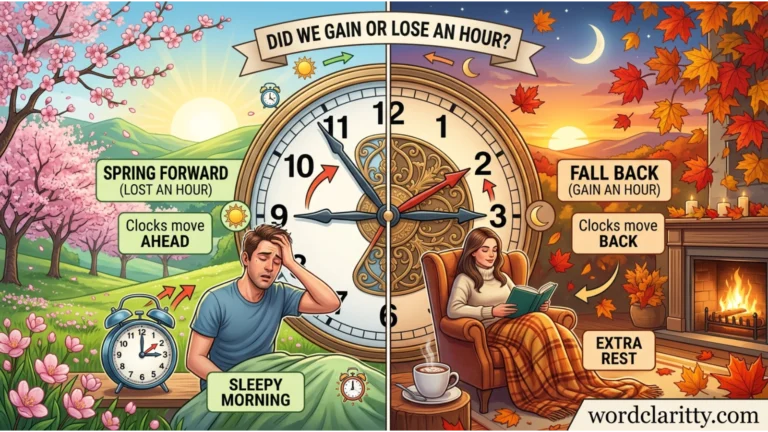
Have you ever wondered whether you should say, “Did we gain an hour?” or “Did we lose an hour?”? These expressions often confuse English learners because both are used when talking about changes in time, especially during Daylight Saving Time (DST) or seasonal clock changes.
The words gain and lose have opposite meanings, but the correct choice depends on what happened to the clock and how much time you actually have available. Understanding this difference can help you speak naturally about time changes, travel, sleep, work schedules, and appointments. In this guide, we will explain gain vs. lose in simple English with clear examples and useful memory tricks.
Why “Gain” and “Lose” Are Confusing
English learners often mix up gain and lose because both words can describe a change in the amount of something. However, they describe changes in opposite directions.
Similar pronunciation
Gain and lose do not sound alike, so they are not homophones. However, learners may confuse them when speaking quickly because both are common, short verbs used in similar sentences.
For example:
- “We gain an hour.”
- “We lose an hour.”
The sentence structures are almost identical, but the meanings are opposite.
Similar spelling
The words are not particularly similar in spelling. Still, because both are short and frequently used verbs, learners may remember the grammar pattern but forget which word expresses an increase and which expresses a decrease.
Context confusion
The biggest problem is context. When clocks change, people sometimes remember only that “the time changes” without remembering whether they get more or less time.
For example, if the clock moves backward from 2:00 to 1:00, you have an additional hour in that part of the day. Therefore, you gain an hour.
If the clock moves forward from 2:00 to 3:00, one hour disappears from the clock schedule. Therefore, you lose an hour.
Common learner mistakes
Common mistakes include:
- Saying “I lost an hour” when the clock moved backward.
- Saying “I gained an hour” when the clock moved forward.
- Confusing the clock time with the actual passage of time.
- Assuming that “earlier on the clock” always means losing time.
- Forgetting that gain means getting more and lose means having less.
Gain vs. Lose Explained Simply
Simple explanation
Gain means to get, receive, or have more of something.
Lose means to no longer have something, or to have less of it.
When talking about a clock change:
- Gain an hour = you get one extra hour.
- Lose an hour = one hour is taken away from your available time.
One-line distinction
You gain an hour when you get extra time; you lose an hour when you have less time available.
Examples
“When the clocks moved back, we gained an hour of sleep.”
This means there was an extra hour available.
“When the clocks moved forward, we lost an hour of sleep.”
This means there was one less hour available.
So, if you are asking “Did we gain or lose an hour?”, the correct answer depends on the direction of the clock change.
Clock moves backward → gain an hour.
Clock moves forward → lose an hour.
Understanding Homophones in English
What Are Homophones?
Homophones are words that have the same pronunciation but different meanings, spellings, or both.
For example:
- to
- too
- two
These words usually sound the same in standard English, but they have different meanings.
Gain and lose are not homophones. They have different sounds and different spellings. Their confusion comes mainly from their opposite meanings and similar grammatical use.
Why Homophones Cause Confusion
Homophones can be especially difficult because listening alone does not always tell you which word a speaker means.
For example:
“I have two books.”
“I went to school.”
The surrounding context helps you understand the intended word.
Although gain and lose are not homophones, context is also important when choosing between them. You need to ask yourself: Did I get more time, or did I have less time?
What Does “Gain” Mean?
Definition and Core Meaning
Gain is a verb and noun. As a verb, it generally means to get, receive, increase, or obtain something beneficial or additional.
In the expression “gain an hour,” it means that you have an additional hour available.
For example:
“We gained an hour when the clocks moved back.”
Here, gained means that the schedule provided an extra hour.
The word can also describe many other types of increase:
- gain experience
- gain knowledge
- gain confidence
- gain weight
- gain time
- gain an advantage
- gain popularity
Origin and Historical Use
Gain comes from older forms of English and French and has long been connected with ideas such as obtaining something, benefiting, or increasing.
Over time, its meaning expanded beyond material possessions. Today, English speakers commonly use gain for increases in knowledge, experience, time, strength, money, and many other things.
Modern Usage and Synonyms
Depending on the context, synonyms for gain include:
- obtain
- get
- receive
- acquire
- increase
- earn
- benefit from
However, these words are not always interchangeable.
For example, we normally say “gain an hour,” not “earn an hour,” when describing a clock change.
Example Sentences
- “We gained an hour when the clocks changed.”
- “She gained valuable experience during her internship.”
- “The team gained confidence after winning the match.”
- “I hope to gain more time by finishing this task early.”
- “He gained weight during the holiday.”
The key idea is that gain involves getting more or obtaining something.
What Does “Lose” Mean?
Definition and Core Meaning
Lose is a verb meaning to no longer have something, to fail to keep something, or to have less of something.
In the expression “lose an hour,” it means that one hour is no longer available in the relevant schedule or period.
For example:
“We lost an hour when the clocks moved forward.”
The speaker means that the clock adjustment reduced the amount of time available in that part of the day.
Origin and Historical Context
Lose comes from Old English and related Germanic forms. Historically, it has been associated with failing to keep, missing, or being deprived of something.
Modern English uses lose in many situations, including possessions, opportunities, games, time, money, and sleep.
Modern Usage and Synonyms
Depending on the context, synonyms or related expressions include:
- misplace
- miss
- forfeit
- waste
- surrender
- be deprived of
Again, these words do not always have exactly the same meaning.
For example, “lose an hour” does not necessarily mean that you wasted an hour. It can simply mean that a clock change resulted in less available time.
Example Sentences
- “We lost an hour when the clocks moved forward.”
- “I lost my keys this morning.”
- “She lost valuable time waiting for the bus.”
- “They lost the game by one point.”
- “I lost an hour of sleep last night.”
The central idea is that lose involves having less, no longer having something, or failing to keep something.
Gain vs. Lose: Key Differences at a Glance
| Word | Part of Speech | Meaning | Example Context |
|---|---|---|---|
| Gain | Verb / Noun | To get, obtain, or increase something | “We gained an hour.” |
| Lose | Verb | To no longer have, miss, or have less of something | “We lost an hour.” |
A quick way to understand the difference is:
Gain = more
Lose = less
This simple relationship works in many everyday situations.
For example:
- Gain weight → have more weight.
- Lose weight → have less weight.
- Gain time → have more available time.
- Lose time → have less available time.
- Gain an hour → get an extra hour.
- Lose an hour → have one hour less.
What happens when clocks change?
If a clock is moved back one hour, you generally describe the change as gaining an hour.
If a clock is moved forward one hour, you generally describe the change as losing an hour.
However, the exact effect on a person’s schedule can depend on the local time-change rules and the situation being discussed.
How to Remember the Difference Between Gain and Lose
Easy memory tricks
The easiest memory trick is:
GAIN = GET MORE
LOSE = HAVE LESS
Think about money:
- If you gain $10, you have $10 more.
- If you lose $10, you have $10 less.
Now apply the same idea to time:
- Gain an hour = one more hour.
- Lose an hour = one less hour.
Association techniques
Try connecting gain with words such as:
- get
- grow
- increase
- extra
Connect lose with:
- less
- miss
- decrease
- disappear
Another useful trick is to remember the clock movement:
Back = gain.
Forward = lose.
When the clock moves backward, you get an extra hour in the schedule. When it moves forward, an hour is skipped on the clock.
One memorable example
Imagine you are sleeping.
If the clock moves from 2:00 a.m. back to 1:00 a.m., you have another 1:00–2:00 period available. You can think:
“The clock went back, so I gained an hour of sleep.”
If the clock moves from 2:00 a.m. to 3:00 a.m., the 2:00–3:00 period is skipped on the clock. You can think:
“The clock went forward, so I lost an hour of sleep.”
Common Mistakes and Confusions
Wrong example 1
✘ “The clocks moved back, so we lost an hour.”
Correct version
✔ “The clocks moved back, so we gained an hour.”
Explanation
When the clock moves backward, an extra hour becomes available in the schedule.
Wrong example 2
✘ “The clocks moved forward, so we gained an hour.”
Correct version
✔ “The clocks moved forward, so we lost an hour.”
Explanation
When the clock moves forward, the schedule skips ahead by an hour.
Wrong example 3
✘ “I gained an hour because my meeting lasted longer.”
Better version
✔ “I lost an hour because my meeting lasted longer.”
Explanation
If a meeting takes more of your available time, you normally describe the result as losing time, especially when the extra time was not planned.
Wrong example 4
✘ “I lose an hour of sleep every night because I go to bed early.”
Better version
✔ “I lose an hour of sleep when I go to bed later.”
Explanation
Going to bed later can reduce the amount of sleep you get if your wake-up time stays the same.
Examples Section: Correct and Incorrect Usage
Example 1
✔ Correct: “We gained an hour when the clocks moved backward.”
✘ Incorrect: “We lost an hour when the clocks moved backward.”
Why? Moving the clock backward creates an additional hour in the schedule.
Example 2
✔ Correct: “We lost an hour when the clocks moved forward.”
✘ Incorrect: “We gained an hour when the clocks moved forward.”
Why? Moving forward skips an hour on the clock.
Example 3
✔ Correct: “I gained an hour of free time because my appointment was canceled.”
✘ Incorrect: “I lost an hour of free time because my appointment was canceled.”
Why? A canceled appointment gives you additional free time.
Example 4
✔ Correct: “I lost an hour waiting for the delayed train.”
✘ Incorrect: “I gained an hour waiting for the delayed train.”
Why? Waiting used up time that could have been spent elsewhere.
Example 5
✔ Correct: “She gained an hour by finishing her work early.”
✘ Incorrect: “She lost an hour by finishing her work early.”
Why? Finishing early gives her more available time.
Example 6
✔ Correct: “I lost an hour of sleep because I stayed up late.”
✘ Incorrect: “I gained an hour of sleep because I stayed up late.”
Why? Staying up late generally reduces the amount of sleep available when the wake-up time remains unchanged.
Self Assessment: Test Your Knowledge
Fill in each blank with gain or lose. Use the correct form when necessary.
- When the clocks move backward, we usually ______ an hour.
- When the clocks move forward, we usually ______ an hour.
- I finished my work early, so I ______ an hour of free time.
- The long delay made us ______ an hour waiting at the station.
Self Assessment Answers
- gain — When clocks move backward, an extra hour becomes available.
- lose — When clocks move forward, an hour is skipped on the clock.
- gained — Finishing early gave the person additional free time.
- lose — Waiting used up an hour of available time.
FAQs:
1. Do we gain or lose an hour when the clocks go back?
You generally gain an hour when the clocks go back. The clock is set to an earlier time, giving you an additional hour in the schedule.
2. Do we gain or lose an hour when the clocks go forward?
You generally lose an hour when the clocks go forward. The clock advances, so one hour is skipped in the local clock schedule.
3. Is it correct to say “I gained an hour”?
Yes. “I gained an hour” is grammatically correct when you mean that you obtained an additional hour of available time.
4. Is “I lost an hour” correct English?
Yes. “I lost an hour” is correct when you mean that an hour of available time was used, missed, or became unavailable.
5. What is the difference between “gain time” and “lose time”?
Gain time means to obtain more available time or create extra time. Lose time means to use, waste, miss, or otherwise have less available time.
6. Is “gain” the opposite of “lose”?
Yes. In many contexts, gain and lose express opposite changes. Gain suggests getting or increasing something, while lose suggests having less, missing, or no longer having something.
7. What is an easy way to remember “gain an hour” and “lose an hour”?
Remember:
Clock goes back → gain an hour.
Clock goes forward → lose an hour.
You can also remember gain = more and lose = less.
Conclusion:
Understanding the difference between gain and lose becomes much easier when you focus on the basic idea behind each word. Gain means to get, receive, obtain, or increase something, while lose means to no longer have something, miss something, or have less of it. Therefore, when talking about an hour, “gain an hour” means that you have an extra hour available, whereas “lose an hour” means that you have one hour less available.
This distinction is especially useful when discussing clock changes. As a simple memory rule, remember “back = gain” and “forward = lose.” If the clock moves backward, you generally gain an hour. If it moves forward, you generally lose an hour. The same logic also works in everyday situations: you can gain time by finishing something early and lose time because of a delay.
Most importantly, do not worry if these expressions seem confusing at first. Think about whether the change gives you more time or less time. Once you connect gain with more and lose with less, the difference becomes much easier to remember and use naturally in everyday English.

Bilal Hassan is a Master’s graduate, content writer, and author at WordClaritty.com. He specializes in creating clear, informative, and reader-friendly content focused on language, word meanings, and educational topics. With a passion for accuracy and simplicity, he helps readers expand their knowledge through engaging and easy-to-understand articles.