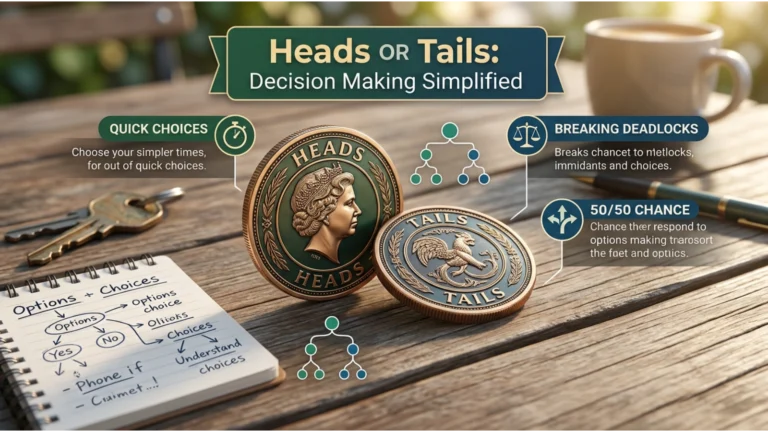
“Heads or tails” is a common English phrase used when people flip a coin to make a random choice. However, English learners sometimes wonder whether heads or tails is the correct word, what each word means, and why both can describe a coin.
The confusion becomes greater because “heads” can refer to more than one person or object, while “tails” may sound like it refers only to animals. In fact, both words are correct, but they describe opposite sides of a coin. Understanding the difference will help you use the phrase naturally in conversations, games, decisions, and everyday English.
Why “Heads” and “Tails” Are Confusing
The words heads and tails are easy to confuse when learners first encounter the expression “heads or tails?” Both words describe sides of a coin, but their everyday meanings are quite different.
Here are some common reasons for confusion:
- Similar context: Both words are normally used together when talking about flipping a coin.
- Different everyday meanings: A “head” can mean the upper part of a person or animal, while a “tail” is the rear part of an animal. On a coin, however, they identify two different sides.
- Context confusion: “Heads” can mean multiple heads, the front side of a coin, or the result of a coin toss.
- Common learner mistakes: Learners may say “head” instead of “heads” when announcing a coin-toss result or use “tails” as though it means any back side of an object.
For example, after a coin is flipped, a person may say, “It’s heads!” or “It’s tails!” The words identify which side of the coin is facing upward.
Heads vs Tails Explained Simply
Simple explanation
Heads is the side of a coin that traditionally shows a person’s head, portrait, or other main figure. Tails is the opposite side of the coin.
One-line distinction
“Heads” means the portrait side of a coin, while “tails” means the opposite side.
Example sentences
- I called heads before Sarah flipped the coin.
- The coin landed on tails, so we chose the other team.
Both heads and tails are correct English words. Neither is “more correct” than the other. The correct choice depends on which side of the coin is facing upward or which side you choose when making a call.
Understanding Opposite Terms in English
The relationship between heads and tails is easier to understand when you know how opposite terms work.
What Are Opposite Terms?
Opposite terms are words or expressions that describe contrasting ideas, positions, directions, or meanings.
For example:
- hot / cold
- up / down
- front / back
- inside / outside
- heads / tails when referring to a coin
A simple example is: “The coin landed on heads rather than tails.”
Why Opposite Terms Cause Confusion
Opposite terms can be confusing when both words appear in the same expression. Learners may know each word separately but still be unsure about how they work together.
For example, someone may understand that a tail is the rear part of an animal but not immediately understand why a coin has a “tails” side.
The answer is historical and visual: coins traditionally have a prominent image or portrait on one side, often associated with a head, while the other side is called the tails side.
What Does “Heads” Mean?
Definition and Core Meaning
Heads is the plural form of head, but it also has a special meaning in coin-tossing.
On a coin, heads refers to the side that traditionally displays the head, portrait, or image of a person. On many coins, this is the side associated with the main national figure or symbol.
When people flip a coin, they can call “heads” or “tails” before the coin lands.
For example:
“Heads, I win; tails, you win.”
Here, heads does not mean several human heads. It identifies one particular side of the coin.
Origin and Historical Use
The use of heads for one side of a coin comes from the practice of placing a ruler’s or important person’s portrait on coins. Historically, coins often displayed the head or bust of a king, queen, emperor, or other important figure.
Over time, English speakers commonly referred to this portrait side as the heads side.
The exact design of coins has changed across countries and historical periods, but the expression heads or tails has remained common.
Modern Usage and Synonyms
Today, heads is frequently used in:
- Coin tossing
- Games
- Sports decisions
- Random choices
- Informal competitions
- Everyday expressions
There is not always a perfect synonym for heads in the coin-tossing sense. Depending on context, you might describe it as:
- The portrait side
- The front side of the coin
- The heads side
However, heads is the normal expression when calling a coin toss.
Example Sentences
- I called heads before the coin was flipped.
- The coin landed on heads.
- Let’s use a coin toss. You choose heads, and I’ll choose tails.
- The referee asked the captain to call heads or tails.
- It came up heads three times in a row.
Notice the expression “came up heads.” This is a natural way to say that the heads side was facing upward after the toss.
What Does “Tails” Mean?
Definition and Core Meaning
Tails is the plural form of tail. In general English, a tail is the rear part of an animal’s body. However, when talking about a coin, tails means the side opposite the heads side.
The tails side traditionally does not show the main portrait or head associated with the other side.
Origin and Historical Context
The term tails developed as the counterpart to heads. If one side displayed a person’s head or portrait, the other side became known as the tails side.
The word does not mean that every coin literally has a picture of an animal’s tail. Instead, tails became the conventional name for the opposite side of a coin.
Therefore, when someone asks:
“Heads or tails?”
they are asking you to choose between the two sides of the coin.
Modern Usage and Synonyms
Tails is commonly used when:
- Calling a coin toss
- Describing the result of a coin flip
- Making a random choice
- Explaining which side of a coin is visible
Common expressions include:
- tails
- the tails side
- it came up tails
There is no exact everyday synonym that replaces tails in the phrase “heads or tails?”
Example Sentences
- I chose tails before the coin was flipped.
- The coin landed on tails.
- It came up tails, so we started the game.
- Do you want heads or tails?
- He called tails during the coin toss.
Heads vs Tails: Key Differences at a Glance
| Word | Part of Speech | Meaning | Example Context |
|---|---|---|---|
| Heads | Noun / coin-toss term | The side of a coin traditionally showing a head, portrait, or main figure | “I choose heads.” |
| Tails | Noun / coin-toss term | The side of a coin opposite the heads side | “The coin landed on tails.” |
The most important point is that both words are correct. They simply refer to different sides of the same coin.
How to Remember the Difference Between Heads and Tails
A few simple memory tricks can make the difference easy to remember.
1. Think of a Person
Imagine a person’s body from front to back:
HEAD → BODY → TAIL
The head is at one end, and the tail is at the other. On a coin, heads and tails similarly represent opposite sides.
2. Remember the Question
The standard expression is:
“Heads or tails?”
The word or tells you that you are choosing between two alternatives.
You do not need to remember which word is “correct.” Instead, remember that heads = one side and tails = the other side.
3. Use the Portrait Trick
Think:
HEADS = face or portrait
If the side showing a portrait is facing upward, it is heads.
The opposite side is tails.
4. Remember a Simple Example
Imagine someone says:
“Heads I win, tails you win.”
This sentence clearly connects each word with one of the two possible results.
Common Mistakes and Confusions
Mistake 1: Saying “head” instead of “heads”
✘ I choose head.
✔ I choose heads.
Explanation: The traditional expression for a coin toss is heads or tails. Even when there is only one coin, heads is normally used.
Mistake 2: Thinking “tails” means an animal’s tail
✘ The coin has a real tail.
✔ The coin landed on tails.
Explanation: In coin-tossing language, tails is the name of one side of the coin. It does not mean the coin physically has a tail.
Mistake 3: Using “heads” for every side of a coin
✘ Both sides are heads.
✔ One side is heads, and the other is tails.
Explanation: In the traditional heads-or-tails expression, the two sides have different names.
Mistake 4: Saying “the tail side” in a coin toss
While “tail side” may be understandable, natural English normally uses “tails.”
✔ It landed on tails.
This is much more natural than:
✘ It landed on the tail side.
Examples Section: Correct and Incorrect Usage
Example 1
✔ Correct: I called heads before the coin was flipped.
✘ Incorrect: I called head before the coin was flipped.
Why? The standard coin-toss term is heads, not head.
Example 2
✔ Correct: The coin landed on tails.
✘ Incorrect: The coin landed on tail.
Why? Tails is the conventional name for that side of the coin.
Example 3
✔ Correct: Do you want heads or tails?
✘ Incorrect: Do you want head or tail?
Why? The established English expression is “heads or tails?”
Example 4
✔ Correct: It came up heads, so our team went first.
✘ Incorrect: It came up head, so our team went first.
Why? The phrase “came up heads” is a common way to describe the result of a coin toss.
Example 5
✔ Correct: She chose tails, and I chose heads.
✘ Incorrect: She chose the tail, and I chose the head.
Why? In this context, heads and tails function as the names of the two coin-toss outcomes.
Self Assessment: Test Your Knowledge
Fill in each blank with heads or tails.
- “I choose ______,” said Ali before the coin was flipped.
- The coin landed on ______, so Maria won the toss.
- “Do you want ______ or tails?”
- The coin came up ______ three times in a row.
Self Assessment Answers
- heads or tails — either can be correct because the speaker can choose either side.
- heads or tails — the answer depends on which side actually landed face up.
- heads
- heads or tails — either is grammatically possible depending on the result.
The key lesson is that heads and tails are both correct words. You use them to identify the two possible sides of a coin.
FAQs:
1. Is it correct to say “heads or tails”?
Yes. “Heads or tails?” is the standard English expression used when asking someone to choose a side of a coin before a toss.
2. Which is correct: heads or tails?
Both are correct. Heads and tails are the names traditionally given to the two sides of a coin.
3. Why is one side of a coin called heads?
It is traditionally called heads because coins have often shown the head, portrait, or bust of a ruler or important person on one side.
4. Why is the other side called tails?
Tails became the conventional name for the side opposite the heads side. It does not mean that the coin literally has an animal tail.
5. Should I say “head” or “heads” when flipping a coin?
Use heads. The natural expression is “heads or tails?” or “I choose heads.”
6. Can I say “the coin came up heads”?
Yes. “The coin came up heads” is a natural expression meaning that the heads side was facing upward after the toss.
7. Is “heads or tails” used only in games?
No. It can be used whenever a coin toss is used to make a random decision, such as deciding who goes first or choosing between two options.
Conclusion:
Understanding heads and tails is simple once you remember that they are the traditional names for the two sides of a coin. Heads refers to the side that traditionally shows a person’s head, portrait, or main figure. Tails refers to the opposite side. So, when someone asks, “Heads or tails?”, both choices are grammatically correct. The answer depends only on which side you choose or which side appears after the coin is flipped.
For English learners, the most useful expressions to remember are “I choose heads,” “I choose tails,” “It landed on heads,” and “It landed on tails.” Also remember that the standard forms are heads and tails, not usually “head” and “tail,” when talking about a coin toss.
A helpful memory trick is to connect heads with a portrait and tails with the opposite side. Once you learn this association, the expression “heads or tails” becomes much easier to understand and use naturally. Keep noticing these expressions in conversations, games, movies, and everyday English. With a little practice, choosing the correct word will become automatic.