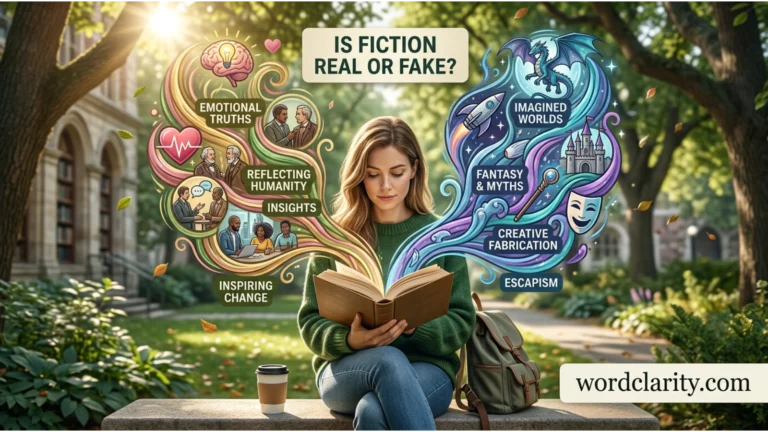
Many English learners ask, “Is fiction real or fake?” The short answer is that writers do not present fiction as factual reality, but calling every fictional story simply “fake” can be misleading. Fiction is a type of writing, storytelling, or entertainment created from imagination.
Understanding this difference is useful when talking about books, movies, stories, news, people, products, and everyday situations. In this guide, we will explain fiction vs. fake in simple English, show common mistakes, and give practical examples so you can use both words correctly and confidently.
Why “Fiction” and “Fake” Are Confusing
The words fiction and fake can seem similar because both can describe something that is not literally true. However, they are used in different situations and have different meanings.
Similar pronunciation
Fiction and fake do not have similar pronunciation. They sound quite different:
- Fiction: /ˈfɪk.ʃən/
- Fake: /feɪk/
So, pronunciation is not the main reason learners confuse these words.
Similar spelling
The spelling is also different. Fiction has seven letters, while fake has four.
However, learners may connect the two words because both can be associated with something imaginary, untrue, or not factual.
Context confusion
This is the biggest source of confusion.
For example:
- A fictional novel is an imaginary story.
- A fake passport is an illegal or false document made to appear genuine.
- A fake identity is an identity that someone falsely presents as genuine.
The key difference is purpose and context.
Common learner mistakes
English learners sometimes say:
“This movie is fake.”
When they mean that the movie is a fictional story.
A more natural sentence is:
“This movie is fiction.”
Or:
“This is a fictional movie.”
Similarly, you would not normally call an invented character a “fake person” because the character was never presented as a real person.
Fiction vs Fake Explained Simply
Simple explanation
Fiction is an invented story, character, event, or situation created through imagination.
One-line distinction
Fiction is created as imagination or storytelling; fake means something is not genuine but may be presented as genuine.
Examples
- The Harry Potter novels are fiction.
- The watch he sold me was fake.
The first sentence describes an imaginative story.
A useful way to think about it is:
Fiction asks you to imagine; fake tries to appear genuine.
Understanding Homophones in English
The difference between fiction and fake is sometimes discussed alongside other confusing English words, but they are not homophones.
What Are Homophones?
Homophones are words that sound the same or almost the same when spoken but have different meanings or spellings.
For example:
- write = to put words on paper
- right = correct or opposite of left
Why Homophones Cause Confusion
Homophones can be especially difficult for English learners because listening alone may not tell you which word a speaker means.
For example:
“I want to write it.”
and
“That answer is right.”
The surrounding context helps identify the correct word.
Fiction and fake are different because they are not homophones. They have different sounds, spellings, grammatical uses, and meanings.
What Does “Fiction” Mean?
Definition and Core Meaning
Fiction is writing, storytelling, or entertainment based on events, characters, or situations that are invented rather than presented as factual.
Fiction can include:
- Novels
- Short stories
- Fairy tales
- Fantasy
- Science fiction
- Mystery stories
- Fictional movies and television shows
- Imaginary characters and events
Importantly, fiction does not mean “worthless” or “false information.” A fictional story can communicate real emotions, ideas, experiences, or lessons even though its characters and events are invented.
For example:
The novel is fiction, but its message about friendship feels very real.
Origin and Historical Use
The word fiction comes from the Latin word fictio, meaning something formed, shaped, or invented. It is related to the Latin verb fingere, meaning “to shape” or “to form.”
Over time, fiction became strongly associated with invented stories and literary works.
Modern Usage and Synonyms
Depending on the context, words related to fiction include:
- Imaginary
- Invented
- Story
- Tale
- Novel
- Fantasy
- Made-up
However, these words are not always exact synonyms.
For example, fiction is a broad category, while fantasy is a particular type of fiction.
Example sentences
- I enjoy reading historical fiction.
- Sherlock Holmes is a fictional character.
- The story is fiction, but it explores a real social problem.
- She writes fiction in her free time.
- The film is based on a work of fiction.
An important point: Fiction does not always mean “completely impossible”
For example:
The movie is historical fiction.
This means the story may use real historical settings or events while adding invented characters, dialogue, or situations.
So, fiction can contain elements of truth without becoming nonfiction.
What Does “Fake” Mean?
Definition and Core Meaning
Fake means not genuine, authentic, or real, especially when something is made or presented to look genuine.
The word can describe objects, information, identities, emotions, documents, accounts, and many other things.
For example:
He discovered that the designer bag was fake.
Origin and Historical Context
The word fake has a long history in English and has been used in different forms and contexts. Its modern everyday meaning is strongly connected with something that is counterfeit, false, artificial, or not genuine.
Today, fake is a very common word in informal English.
You may hear it when people talk about:
- Fake products
- Fake news
- Fake accounts
- Fake documents
- Fake smiles
- Fake identities
- Fake promises
- Fake photographs
Modern Usage and Synonyms
Depending on the situation, synonyms or related words include:
- False
- Counterfeit
- Artificial
- Imitation
- Forged
- Fraudulent
- Insincere
- Unauthentic
These words are not always interchangeable.
For example, a counterfeit product is specifically an unauthorized imitation, while a fake smile may describe an expression that is not sincere.
Example sentences
- The website was selling fake products.
- She realized that the signature was fake.
- That social media account is fake.
- He gave me a fake name.
- The painting was a fake, not an original.
Fiction vs Fake: Key Differences at a Glance
| Word | Part of Speech | Meaning | Example Context |
|---|---|---|---|
| Fiction | Noun | An invented story or imaginative work | “I love reading fiction.” |
| Fictional | Adjective | Invented for a story rather than presented as real | “Sherlock Holmes is a fictional character.” |
| Fake | Adjective, noun, verb | Not genuine; made or presented as genuine when it is not | “The watch is fake.” |
| Fake | Noun | A person or thing that is not genuine | “The painting was a fake.” |
| Fake | Verb | To pretend or imitate something | “He faked a smile.” |
The easiest distinction
If something is created as a story, think fiction.
If something is supposed to be genuine but is not, think fake.
Compare:
The dragon in the novel is fictional.
The dragon is part of an invented story.
The designer bag is fake.
How to Remember the Difference Between Fiction and Fake
Easy memory tricks
Try this simple rule:
Fiction = Story
Fake = Not Genuine
When you see a book, movie, novel, or imaginary character, fiction is often the correct word.
When you see a counterfeit product, false identity, dishonest document, or imitation, fake is often the better word.
Association techniques
Associate fiction with:
- Fiction books
- Fictional characters
- Fiction movies
- Storytelling
- Imagination
Associate fake with:
- Fake money
- Fake products
- Fake accounts
- Fake documents
- Fake names
One memorable example
Remember this sentence:
“The story is fiction, but the fake passport is not.”
The story is intentionally invented for storytelling. The passport is fake because it is made or presented as a genuine document when it is not.
Another useful comparison is:
A fictional character is invented for a story; a fake identity is invented to appear real.
That single contrast can help you remember the difference.
Common Mistakes and Confusions
Mistake 1: Calling every fictional story “fake”
✘ This novel is fake.
✔ This novel is fiction.
Why? A novel can be completely imaginary and still be genuine as a work of fiction. “Fake” suggests that something is pretending to be genuine.
Mistake 2: Calling an imaginary character fake
✘ Superman is a fake person.
✔ Superman is a fictional character.
Mistake 3: Using “fiction” for a counterfeit object
✘ This is a fiction Rolex watch.
✔ This is a fake Rolex watch.
Why? A counterfeit watch is an object that is not genuine. Fake is the appropriate word.
Mistake 4: Confusing fiction with a lie
Fiction and lies are not exactly the same.
A fictional story is normally understood as invented storytelling.
A lie is a false statement made with the intention of deceiving someone.
For example:
The author wrote a fictional story about a detective.
This is fiction.
He lied about where he had been.
This is a lie.
The purpose and context are different.
Examples Section: Correct and Incorrect Usage
Example 1
✔ Correct: The novel is a work of fiction.
✘ Incorrect: The novel is a fake.
Example 2
✔ Correct: The painting is fake.
✘ Incorrect: The painting is fiction.
Explanation: If a painting is presented as an original but is actually a counterfeit, fake is the correct word.
Example 3
✔ Correct: The detective in the story is fictional.
✘ Incorrect: The detective in the story is fake.
Explanation: Fictional tells us that the character was invented for a story.
Example 4
✔ Correct: She discovered that the online account was fake.
✘ Incorrect: She discovered that the online account was fiction.
Explanation: A fake account may pretend to belong to a real person or organization.
Example 5
✔ Correct: The movie is fictional, although it is inspired by real events.
✘ Incorrect: The movie is fake because it did not happen exactly this way.
Explanation: A fictional movie can be inspired by real events while changing characters, dialogue, or situations for storytelling.
Example 6
✔ Correct: The company warned customers about fake products.
✘ Incorrect: The company warned customers about fiction products.
Explanation: Products can be counterfeit or fake.
Self Assessment: Test Your Knowledge
Fill in each blank with fiction, fictional, or fake.
- Sherlock Holmes is a __________ character created by Arthur Conan Doyle.
- I usually read __________ before going to bed.
- The customer discovered that the expensive watch was __________.
- The movie is __________, although some scenes were inspired by real historical events.
Self Assessment Answers
- fictional — Sherlock Holmes is an invented character in literature.
- fiction — Fiction refers to stories that are created or invented.
- fake — The watch is not genuine.
- fictional — The movie is an invented story, even though it uses real historical inspiration.
FAQs:
1. Is fiction real or fake?
Fiction is invented rather than presented as factual reality, but it is not necessarily “fake” in the usual sense. A fictional story is openly created as a story, while something fake may be presented as genuine.
2. Does fiction mean false?
Not exactly. Fiction means an invented or imaginative story. It can contain real facts, real places, realistic situations, or important truths while still being fictional.
3. Is a fictional character fake?
It is better to say that a fictional character is imaginary, invented, or fictional. “Fake” can sound as though the character is pretending to be a real person.
4. What is the difference between fiction and fake?
Fiction usually refers to an invented story or imaginative work.
5. Can a true story be fiction?
A story can be described as fictionalized when real events or people are adapted into an invented story. However, a work marketed as nonfiction is generally expected to present factual information rather than invented events.
6. Is a movie fiction or fake?
A movie can be fiction if it tells an invented story. It is not automatically fake.
7. What is the opposite of fiction?
Conclusion:
Understanding fiction vs. fake becomes much easier when you focus on the purpose behind the words. Fiction refers to an invented story, imaginative work, or character. It is common in novels, movies, television, short stories, and other forms of storytelling. Fake, however, means something that is not genuine, authentic, or real, especially when it is made or presented as though it were genuine. A fake product may imitate a real product, while a fictional character is simply created for a story.
The most useful memory trick is simple: fiction = invented story; fake = not genuine. For example, a dragon in a fantasy novel is fictional, while a counterfeit designer bag is fake. Also remember that fiction is not the same as a lie. A fictional story is normally created for entertainment, creativity, or communication, whereas a lie is a false statement intended to deceive.
Once you understand this difference, you can use fiction, fictional, and fake more naturally in both spoken and written English. Keep practicing with real examples, and these commonly confused words will soon become much easier to remember.