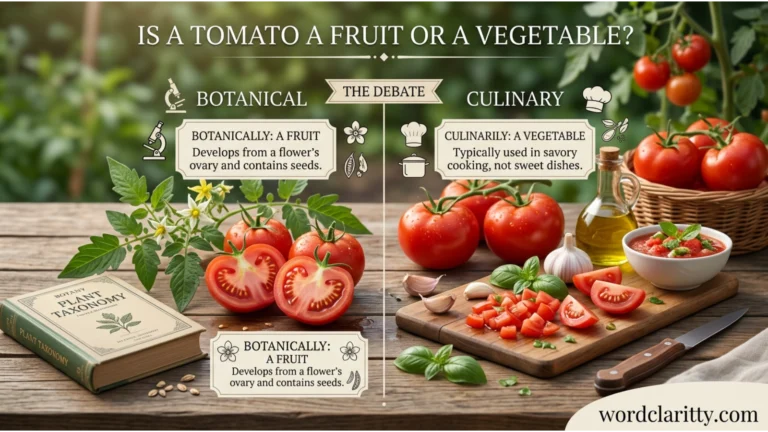
Is a tomato a fruit or a vegetable? This simple question can confuse even confident English learners because the answer changes depending on whether we are talking about botany or everyday cooking. In science, a tomato is a fruit because it develops from the flower of a tomato plant and contains seeds. In the kitchen, however, people usually treat tomatoes as vegetables because they are commonly used in salads, sauces, soups, and savory dishes.
Understanding this difference is useful because English often uses the same word in scientific and everyday contexts. Once you know the basic distinction, it becomes much easier to understand why both “tomato is a fruit” and “tomato is a vegetable” can appear in English.
Why “Fruit” and “Vegetable” Are Confusing
The words fruit and vegetable are not homophones, and they do not have similar pronunciation or spelling. However, they are confusing because the same food can sometimes be described differently depending on the context.
Here are the main reasons learners may become confused:
- Similar context: Both words describe types of plant food.
- Context confusion: Science and everyday cooking use different ways of classifying foods.
- Different definitions: A botanical definition focuses on how a plant part develop.
- Common learner mistakes: Learners may assume that every sweet food is a fruit and every savory food is a vegetable.
- Everyday language: People commonly call tomatoes, cucumbers, peppers, and pumpkins vegetables even though several of them are botanically fruits.
So, the confusion is not mainly about pronunciation or spelling. It comes from two different classification systems.
Fruit vs Vegetable Explained Simply
Simple explanation
A fruit is, in botanical terms, the part of a flowering plant that develops from the flower’s ovary and usually contains seeds.
A vegetable is a culinary term generally used for edible plant parts such as roots, stems, leaves, and sometimes flowers.
One-line distinction
Fruit is mainly a botanical classification, while vegetable is mainly a culinary classification.
Example sentences
- A tomato is botanically a fruit because it develops from a flower and contains seeds.
- We often use tomatoes as vegetables in salads, soups, sauces, and other savory dishes.
Notice that these sentences are not necessarily contradicting each other. They are using different meanings and contexts.
Understanding Homophones in English
What Are Homophones?
Homophones are words that sound the same when spoken but have different meanings, and often different spellings.
For example:
- to — used for direction or purpose
- two — the number 2
- too — meaning “also” or “more than necessary”
Example:
I have two apples too.
“Fruit” and “vegetable” are not homophones. They sound different and have different spellings.
Why Homophones Cause Confusion
Homophones can be difficult for English learners because listening alone may not tell you which word a speaker means.
For example, if someone says, “I have two books,” you cannot know from the sound alone whether they mean two or another word that sounds like it. Context helps you understand the intended meaning.
The fruit-versus-vegetable question is different. Here, the difficulty comes from classification and context, not pronunciation.
What Does “Fruit” Mean?
Definition and Core Meaning
In everyday English, a fruit usually means an edible plant food that is often sweet or juicy, such as an apple, orange, mango, or grape.
In botany, however, the definition is more specific. A fruit is a structure that develops from the ovary of a flowering plant, often after fertilization, and commonly contains seeds.
This scientific definition explains why tomatoes are fruits.
Origin and Historical Use
The word fruit has a long history in English. It comes through Old French from Latin fructus, meaning enjoyment, produce, or something produced.
Over time, “fruit” developed several meanings. It can refer not only to food but also to the result or product of something.
For example:
- The fruit of the tree is ripe.
- Her hard work produced good fruit.
In modern English, the food meaning is especially common.
Modern Usage and Synonyms
Depending on the context, related words include:
- produce
- edible fruit
- crop
- berry, for certain botanical fruits
- citrus, for a particular fruit group
However, these words are not exact synonyms in every situation.
Important points about fruit
- Fruits commonly develop from flowers.
- Many fruits contain seeds.
- Tomatoes are botanically fruits.
- Apples, oranges, grapes, and peaches are fruits.
- Not all fruits are sweet.
Example sentences
- The tomato is a fruit according to botanical classification.
- I bought some fresh fruit for breakfast.
- This plant produces small red fruits.
- Avocados are botanically fruits, although they are usually used in savory foods.
The last example shows why botanical and culinary categories do not always match.
What Does “Vegetable” Mean?
Definition and Core Meaning
Unlike “fruit,” vegetable is not a precise botanical category. In everyday cooking, the word can refer to many different plant parts.
For example:
- Carrots are roots.
- Spinach consists mainly of leaves.
- Celery is mainly a stem.
- Broccoli includes immature flower structures.
Origin and Historical Context
The word vegetable comes from Latin roots connected with growing and living. It entered English with meanings related to plant life before developing its modern food-related meaning.
Today, “vegetable” is primarily used for edible plant foods that are normally prepared as part of savory meals.
Modern Usage and Synonyms
Common related words include:
- produce
- greens
- plant food
- edible plant
- garden produce
These words are not always exact substitutes. For example, “produce” can include both fruits and vegetables.
Important points about vegetables
- Vegetables can come from different parts of a plant.
- “Vegetable” is mainly a culinary term.
- Roots, stems, leaves, and flowers can all be vegetables.
- Some foods called vegetables are botanically fruits.
- Tomatoes are a common example of this overlap.
Example sentences
- She added some vegetables to the rice.
- Leafy green vegetables are popular in many healthy meals.
- Although tomatoes are botanically fruits, cooks often treat them as vegetables.
Fruit vs Vegetable: Key Differences at a Glance
| Word | Part of Speech | Meaning | Example Context |
|---|---|---|---|
| Fruit | Noun | A plant structure that develops from a flower; commonly an edible plant food | “A tomato is a fruit botanically.” |
| Vegetable | Noun | An edible plant part commonly used in savory cooking | “Add some vegetables to the soup.” |
The key difference is that fruit has a clear botanical meaning, while vegetable is mainly a culinary category.
This distinction also explains why there can be overlap.
How to Remember the Difference Between Fruit and Vegetable
Learning a definition is useful, but a simple memory trick can make the difference easier to remember.
Easy memory tricks
Remember this sentence:
Fruit comes from the flower; vegetable comes from the kitchen.
This is not a complete scientific definition, but it is a helpful learning shortcut.
Another useful trick is:
Fruit = botanical role
Vegetable = cooking role
When you see a food such as a tomato, ask:
- How does this part develop on the plant?
- How do people normally use it in cooking?
The first question leads you toward the botanical answer. The second leads you toward the culinary answer.
Association techniques
Think of a tomato plant with a flower. After the flower develops, the tomato grows in its place and contains seeds. This helps you remember that a tomato is botanically a fruit.
This helps you remember why people commonly call it a vegetable.
One memorable example
Tomato = fruit in botany, vegetable in the kitchen.
That single sentence is enough to remember the central idea.
Common Mistakes and Confusions
Mistake 1: “A tomato cannot be a fruit because it is not sweet.”
Why it is confusing: Many people associate fruit with sweetness.
Correct idea: Sweetness is not what makes something a botanical fruit. A tomato develops from a flower and contains seeds, so it is botanically a fruit.
Mistake 2: “Everything used in a salad is a vegetable.”
Why it is confusing: Salads often contain foods commonly called vegetables.
Correct idea: Some salad ingredients are botanically fruits. Tomatoes, cucumbers, and peppers are examples.
Mistake 3: “Fruit and vegetable are scientific opposites.”
Why it is confusing: In everyday conversation, people often treat them as two completely separate groups.
Correct idea: “Fruit” has a botanical definition, but “vegetable” is mainly a culinary category.
Mistake 4: “Tomato is only a fruit.”
This statement can be misleading when discussing ordinary cooking.
A more precise sentence is:
A tomato is botanically a fruit, but it is commonly used as a vegetable in cooking.
Mistake 5: “Fruit always means sweet food.”
In everyday English, fruit often suggests sweet food, but botanical fruits do not have to be sweet.
For example, tomatoes and avocados are botanical fruits but are commonly used in savory dishes.
Examples Section: Correct and Incorrect Usage
Example 1
✔ Correct: A tomato is botanically a fruit.
✘ Incorrect: A tomato is botanically a vegetable.
Explanation: The tomato develops from the flower’s ovary and contains seeds, which makes it a botanical fruit.
Example 2
✔ Correct: We usually use tomatoes like vegetables in cooking.
✘ Incorrect: We use tomatoes like vegetables because they are scientifically vegetables.
Explanation: The first sentence describes culinary use. The second incorrectly presents “vegetable” as the botanical classification.
Example 3
✔ Correct: Tomatoes are commonly used in salads and savory dishes.
✘ Incorrect: Tomatoes cannot be fruits because they are used in savory dishes.
Explanation: How a food tastes or how it is cooked does not determine its botanical classification.
Example 4
✔ Correct: A tomato can be called a fruit in science and a vegetable in everyday cooking.
✘ Incorrect: Calling a tomato a fruit is always wrong because cooks call it a vegetable.
Explanation: Both descriptions can be appropriate when the context is clear.
Example 5
✔ Correct: Cucumbers are botanically fruits, although they are commonly treated as vegetables.
✘ Incorrect: Cucumbers are fruits only when they are sweet.
Explanation: Botanical classification does not depend on whether a food tastes sweet.
Self Assessment: Test Your Knowledge
Fill in each blank with fruit or vegetable.
- Botanically, a tomato is a __________.
- Carrots are commonly called __________ in cooking.
- A tomato is often treated as a __________ in savory dishes.
- The botanical meaning of __________ is connected with a structure that develops from a flower and commonly contains seeds.
Self Assessment Answers
- fruit
- vegetables
- vegetable
- fruit
If you answered all four correctly, you understand the main difference: tomato is a fruit botanically but is commonly treated as a vegetable in cooking.
FAQs:
Is a tomato a fruit or a vegetable?
A tomato is botanically a fruit because it develops from the flower of a tomato plant and contains seeds. In everyday cooking, however, tomatoes are commonly treated as vegetables.
Why is a tomato called a fruit?
This is the botanical definition of a fruit.
Why do people call tomatoes vegetables?
People call tomatoes vegetables because they are usually prepared and eaten in savory dishes. In cooking, the word “vegetable” is used differently from the scientific botanical classification.
Are tomatoes technically fruits?
Yes. Technically, in botanical terms, tomatoes are fruits. The word “technically” here refers to the scientific classification of the plant structure.
Are fruits always sweet?
No. Fruits do not have to be sweet according to their botanical definition.
Are cucumbers and peppers fruits too?
Yes. Botanically, cucumbers and peppers are fruits because they develop from flowers and contain seeds.
Is “tomato is a fruit” grammatically correct?
Yes. “A tomato is a fruit” is grammatically correct.
Conclusion:
The question “Is a tomato a fruit or vegetable?” has a simple answer once you understand the difference between botanical and culinary language. Botanically, a tomato is a fruit because it develops from the flower of a tomato plant and contains seeds. In everyday cooking, however, tomatoes are commonly treated as vegetables because they are usually used in salads, sauces, soups, sandwiches, and other savory dishes. Therefore, the two descriptions can both make sense when they are used in the right context.
For English learners, the most important point is not to think of “fruit” and “vegetable” as perfect scientific opposites. Fruit has a clear botanical meaning, while vegetable is mainly a culinary term. Also remember that these words are not homophones: their confusion comes from context and classification, not pronunciation.
A useful memory sentence is: “Tomato is a fruit in botany and a vegetable in the kitchen.” You can use this sentence to remember why both descriptions appear in English. Once you understand this example, other foods such as cucumbers, peppers, and avocados become easier to understand too. Keep paying attention to context when learning English, and confusing words will become much clearer. With practice, you will not only know the answer—you will also know exactly why it is correct.

Bilal Hassan is a Master’s graduate, content writer, and author at WordClaritty.com. He specializes in creating clear, informative, and reader-friendly content focused on language, word meanings, and educational topics. With a passion for accuracy and simplicity, he helps readers expand their knowledge through engaging and easy-to-understand articles.