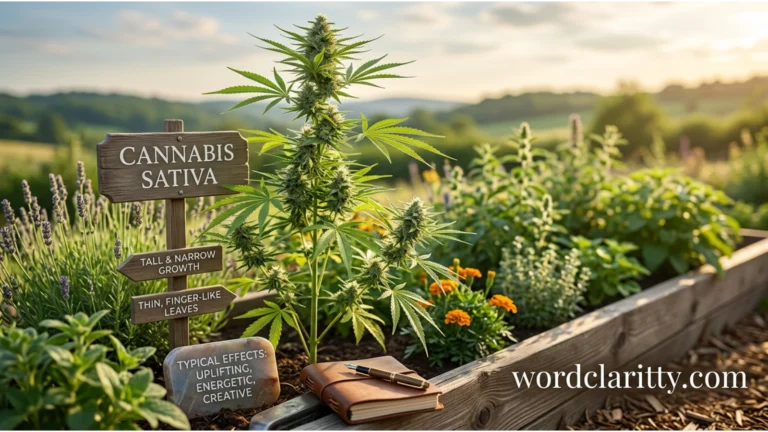
Indica and sativa are two words that often confuse English learners because they appear in similar contexts and are commonly used together. You may see them in discussions about plants, botany, and cannabis, but their meanings are not exactly the same.
Understanding the difference is useful because choosing the wrong word can change the meaning of a sentence. It is also important to know that Indica and sativa are not homophones: they do not sound the same.
Instead, confusion usually comes from their similar spelling, shared subject matter, and different uses in everyday language. This guide explains indica vs. sativa in simple English, with definitions, examples, memory tricks, and common mistakes.
Why “Indica” and “Sativa” Are Confusing
English learners may mix up indica and sativa for several reasons.
Similar pronunciation
The two words have a similar rhythm and are often spoken together: in-di-ca and sa-ti-va. However, they are not pronounced the same and are not homophones.
Their pronunciation can also vary slightly depending on the speaker’s accent and whether the words are being used in English or in a scientific context.
Similar spelling
Both words end in -ica or -iva and are commonly seen in scientific or botanical names. Their Latin-based appearance can make them harder to remember than ordinary English vocabulary.
Context confusion
The biggest source of confusion is context. Both words can describe plant classifications, and both are strongly associated with cannabis terminology.
For example:
- Cannabis indica is a botanical name associated with the indica designation.
- Cannabis sativa is a botanical name associated with the sativa designation.
Because they occur in similar sentences, learners may remember the words but forget which one refers to which term.
Common learner mistakes
Some common mistakes include:
- Treating indica and sativa as interchangeable.
- Assuming they are homophones.
- Using one word when referring to the other.
- Believing that every plant labeled indica or sativa has exactly the same characteristics.
- Confusing botanical terminology with modern commercial or informal cannabis terminology.
The easiest solution is to learn the basic distinction first and then pay attention to context.
Indica vs. Sativa Explained Simply
Simple explanation
Indica and sativa are botanical terms traditionally used in the naming and classification of plants. In modern cannabis discussions, they are commonly used as labels for different types or categories of cannabis.
One-line distinction
Indica traditionally refers to Cannabis indica, while sativa traditionally refers to Cannabis sativa.
A useful point for English learners is that these words are related terms, not words with the same meaning.
Example sentences
- “The plant was identified as Cannabis indica.”
- “The article discusses the history of Cannabis sativa.”
In everyday cannabis language, people may also say:
- “This product is labeled indica.”
- “The product is described as sativa.”
These examples show how the words can function as labels in modern usage.
Understanding Homophones in English
This section is important because indica and sativa are sometimes mistakenly treated as homophones. They are not.
What Are Homophones?
Homophones are words that have the same pronunciation but different meanings, and they may have different spellings.
For example:
- right = correct or a direction
- write = to form words using letters
These words sound alike, but their meanings and spellings are different.
Why Homophones Cause Confusion
Homophones can be difficult because listening alone may not tell you which word a speaker means.
For example:
“Please write the right answer.”
The words write and right sound the same, but their meanings are different.
By contrast, indica and sativa do not sound alike. Their confusion comes from their related meanings and contexts, not from being homophones.
What Does “Indica” Mean?
Definition and Core Meaning
Indica is a term used in botanical classification and is traditionally associated with Cannabis indica. In modern English, especially in cannabis-related conversations, indica is also commonly used as a label for cannabis products or varieties described as indica.
The word is ultimately connected with India, reflecting historical botanical naming.
Origin and Historical Use
The name indica comes from Latin and means roughly “of India” or “from India.” It was used in scientific naming to identify plants associated with India or the Indian region.
In botanical names, indica is not necessarily a complete description of every characteristic of a plant. It is part of a scientific naming tradition.
Over time, cannabis terminology became more complicated. Modern cannabis products are often described using labels such as indica, sativa, and hybrid. These labels are widely understood by consumers, although modern cannabis genetics do not always fit neatly into these traditional categories.
Modern Usage and Synonyms
In modern usage, indica can refer to:
- A botanical designation associated with Cannabis indica.
- A traditional cannabis category or label.
- A description used in cannabis product names.
- A term used in informal discussions about cannabis varieties.
There is not a perfect everyday synonym for indica. Depending on context, related phrases may include indica-type, indica variety, or indica-labeled cannabis.
Example sentences
- “The scientific name includes the word indica.”
- “The product is labeled as an indica variety.”
- “The article compares indica and sativa terminology.”
- “Indica is a common label in modern cannabis discussions.”
It is useful to remember that a label such as indica does not automatically provide a complete scientific description of a plant.
What Does “Sativa” Mean?
Definition and Core Meaning
Sativa is another botanical term traditionally associated with Cannabis sativa. The word comes from Latin and is connected with the idea of something being cultivated or sown.
In modern cannabis language, sativa is commonly used as a label for cannabis products or varieties described as sativa.
Origin and Historical Context
The Latin word sativa relates to cultivation and agricultural use. Similar Latin-based words appear in scientific plant names.
For example, sativa occurs in the scientific names of several cultivated plants. Therefore, the word itself is not exclusive to cannabis.
In cannabis terminology, however, Cannabis sativa is especially well known. Traditional botanical classifications used sativa and indica to distinguish cannabis plants, while modern scientific understanding recognizes that cannabis variation is more complex than a simple two-category system.
Modern Usage and Synonyms
Today, sativa may refer to:
- A botanical designation associated with Cannabis sativa.
- A traditional cannabis category.
- A label used for cannabis products.
- A term used when comparing cannabis varieties or categories.
Possible related phrases include sativa-type, sativa variety, and sativa-labeled cannabis, depending on the context.
Example sentences
- “The plant was historically described as Cannabis sativa.”
- “The label identifies the product as sativa.”
- “Sativa is also found in the scientific names of some cultivated plants.”
As with indica, modern commercial use of the term does not always correspond perfectly to a strict botanical classification.
Indica vs. Sativa: Key Differences at a Glance
| Word | Part of Speech | Meaning | Example Context |
|---|---|---|---|
| Indica | Noun / adjective in modern usage | A botanical term traditionally associated with Cannabis indica | “The product is labeled indica.” |
| Sativa | Noun / adjective in modern usage | A botanical term traditionally associated with Cannabis sativa | “The product is labeled sativa.” |
The key difference
The simplest way to understand the two words is:
Indica = traditionally associated with Cannabis indica.
Sativa = traditionally associated with Cannabis sativa.
However, there is an important scientific-language detail. Modern cannabis genetics and plant characteristics do not always follow a simple indica-versus-sativa division. Therefore, these terms can work as useful everyday labels without being complete scientific descriptions.
How to Remember the Difference Between Indica and Sativa
Remembering two unfamiliar scientific words can be difficult. Try these simple techniques.
Easy memory tricks
1. Learn them as a pair
Instead of memorizing one word alone, remember:
Indica and sativa = two traditional cannabis terms.
Then associate indica with Cannabis indica and sativa with Cannabis sativa.
2. Focus on the endings
The most important distinction is not their first letters but their complete botanical names:
- Cannabis indica
- Cannabis sativa
Reading the full phrases repeatedly can make the difference easier to remember.
Association techniques
Think of sativa as a word connected to cultivation because of its Latin origin.
For indica, remember the historical association with India.
These associations are memory aids, not complete definitions.
One memorable example
Use this sentence:
“Indica and sativa are two different labels, not two spellings of the same word.”
That sentence helps prevent one of the most common learner errors.
Common Mistakes and Confusions
Mistake 1: Saying they are homophones
✘ “Indica and sativa are homophones.”
This is incorrect. They have different pronunciations.
✔ “Indica and sativa are related botanical terms.”
Mistake 2: Treating them as synonyms
✘ “Indica is another word for sativa.”
This is incorrect because the terms traditionally refer to different botanical categories.
✔ “Indica and sativa are different terms used in cannabis classification and labeling.”
Mistake 3: Using the wrong label
✘ “The article says the plant is Cannabis sativa, so it is indica.”
The sentence mixes the two labels.
✔ “The article says the plant is Cannabis sativa, so it is described using the sativa designation.”
Mistake 4: Assuming the words apply only to cannabis
✘ “Sativa is a word that only means cannabis.”
This is too broad. Sativa is a Latin-derived botanical term that appears in the scientific names of other cultivated plants as well.
✔ “Sativa is a botanical term that is especially familiar in cannabis terminology.”
Mistake 5: Assuming labels tell you everything about a plant
✘ “The word indica tells us every important characteristic of the plant.”
A label does not necessarily provide a complete scientific description.
✔ “Indica is a traditional botanical or commercial label, but plant characteristics can be more complex.”
Examples Section: Correct and Incorrect Usage
Example 1
✔ Correct: “The two terms discussed in the article are indica and sativa.”
✘ Incorrect: “The two terms discussed in the article are homophones, indica and sativa.”
Why? They do not have the same pronunciation.
Example 2
✔ Correct: “The label describes the product as sativa.”
✘ Incorrect: “The label describes the product as indica, but the writer uses sativa as if the words were identical.”
Why? The two terms are different labels.
Example 3
✔ Correct: “Cannabis indica and Cannabis sativa are traditional botanical names.”
✘ Incorrect: “Cannabis indica and Cannabis sativa are two different spellings for the same botanical name.”
Why? They are different scientific names.
Example 4
✔ Correct: “The meaning of sativa is easier to understand when you consider its Latin botanical origin.”
✘ Incorrect: “Sativa always means one specific type of cannabis with exactly the same characteristics.”
Why? Modern cannabis terminology is more complicated than a simple two-category system.
Example 5
✔ Correct: “Indica and sativa are often compared in discussions about cannabis.”
✘ Incorrect: “Indica and sativa have exactly the same meaning.”
Why? They are related but distinct terms.
Self Assessment: Test Your Knowledge
Fill in the blank.
- People traditionally associate _________ with Cannabis indica.
- People traditionally associate _________ with Cannabis sativa.
- People often discuss the words _________ and sativa together in cannabis terminology.
- The term _________ derives from a Latin word associated with cultivation and sowing.
Self Assessment Answers
- Indica
- Sativa
- Indica
- Sativa
Quick explanation
If you remember the full botanical names, the answers become easier:
- Cannabis indica → indica
- Cannabis sativa → sativa
The word sativa also has a broader botanical history and is related to the idea of cultivated plants.
FAQs:
1. What is the difference.
Indica is traditionally associated with Cannabis indica, while sativa is traditionally associated with Cannabis sativa. In modern cannabis language, they are commonly used as category or product labels.
2. Are indica and sativa homophones?
No. Indica and sativa are not homophones. They have different pronunciations and different meanings.
3. Is indica the opposite of sativa?
Not exactly. They are commonly presented as contrasting cannabis categories, but they are not simple opposites in the way that hot and cold are. Their botanical history and modern usage are more complicated.
4. Is sativa only used for cannabis?
No. Sativa is a Latin-derived botanical term that appears in scientific plant names beyond cannabis. However, it is especially familiar to many people because of cannabis terminology.
5. How do you remember indica and sativa?
Remember the full names: Cannabis indica and Cannabis sativa. You can also associate indica with its historical connection to India and sativa with cultivation.
6. Indica and sativa as adjectives?
Yes. In modern informal and commercial English, you may see expressions such as Indica variety and sativa product. In scientific writing, the full botanical name and precise classification may be more appropriate.
7. Which is correct:
Both are correct words, but they are not interchangeable.
Conclusion:
Indica traditionally refers to Cannabis Indica, while sativa traditionally refers to Cannabis sativa. People widely use both words when discussing cannabis, and modern English speakers use both terms as labels. However, their modern commercial use does not always represent the full complexity of cannabis botany and genetics.
For English learners, one important point is especially useful: They sound different, so their confusion comes mainly from their similar context and specialized vocabulary. To remember them, learn the complete phrases Cannabis Indica and Cannabis sativa rather than trying to memorize the words separately. You can also connect Indica with its historical association with India and sativa with cultivation. Finally, remember that both words are correct; the important thing is choosing the one that matches the meaning and context. Keep practicing these terms in real sentences, and unfamiliar scientific vocabulary will become much easier to understand.