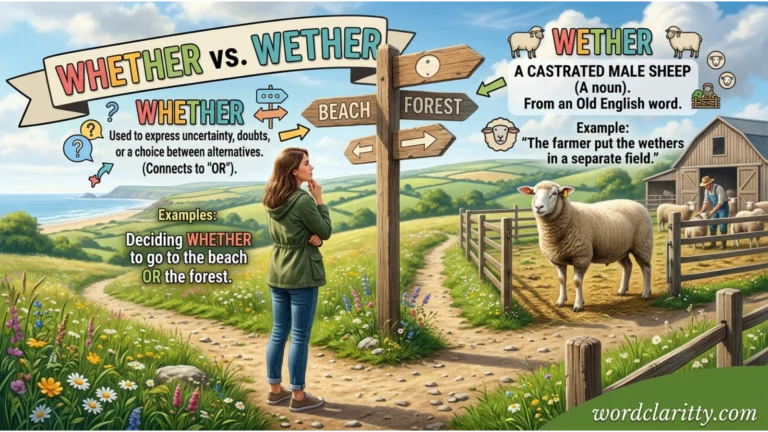
Whether and wether are easy to confuse because they look and sound very similar. However, they have completely different meanings and are used in different situations. For English learners, this small spelling difference can cause mistakes in writing, schoolwork, emails, and everyday communication. The good news is that the difference is simple once you know what each word means.
Whether is a common English word used when talking about choices, alternatives, or possibilities. Wether, on the other hand, is a specialized word used for a castrated male sheep or goat. In this guide, you will learn when to use whether and wether, how to remember the difference, and how to avoid common spelling mistakes.
Why “Whether” and “Wether” Are Confusing
Whether and wether confuse English learners for several simple reasons.
- Similar pronunciation: In many varieties of English, whether and wether are pronounced almost identically, making them difficult to distinguish when heard in conversation.
- Similar spelling: Both words begin with w and contain similar letters. The main visual difference is the extra h in whether.
- Context confusion: Most learners know whether but rarely encounter wether. When they hear the word, they may automatically spell it as the more familiar whether.
- Common learner mistakes: A frequent mistake is using wether when the intended meaning is “if” or “which of two possibilities.” Another mistake is assuming that whether refers to an animal because the two words sound alike.
The key point is that these words belong to completely different areas of vocabulary.
Whether vs Wether Explained Simply
Simple explanation
Whether is used to introduce alternatives, choices, or uncertainty. It often means “if” when discussing two or more possibilities.
Wether is a noun referring to a castrated male sheep or goat, especially a sheep.
One-line distinction
Whether = a choice or possibility; wether = a castrated male sheep or goat.
Example sentences
- I don’t know whether she will come to the party.
- The farmer bought a young wether for the flock.
A useful shortcut is to remember that whether belongs to everyday English, while wether is mainly used in farming, agriculture, and animal-related contexts.
Understanding Homophones in English
What Are Homophones?
Homophones are words that have the same or very similar pronunciation but have different meanings and spellings.
For example:
- right = correct or a direction
- write = to put words on paper or a screen
Similarly, whether and wether are commonly treated as homophones because they are pronounced alike or nearly alike in many accents.
Why Homophones Cause Confusion
Homophones can be especially confusing because spoken English does not show spelling. When you hear:
“I don’t know whether he will come.”
you cannot see whether the speaker means whether or is simply saying a different word with the same sound.
Context usually provides the answer. If the sentence is about a choice or possibility, the correct spelling is whether. If it is about a male sheep or goat, the word is wether.
What Does “Whether” Mean?
Definition and Core Meaning
Whether is a conjunction used to introduce two or more possibilities, alternatives, or uncertain situations.
It commonly means:
- if something is true or not
- which of two possibilities is true
- regardless of which possibility happens
For example:
I don’t know whether he is at home.
This means the speaker does not know if he is at home or not.
Origin and Historical Use
Whether is an old English word. It comes from Old English hwæther, which was related to the idea of “which of two.” Over time, its use developed into the modern conjunction and question-related word we use today.
Its long history explains why whether appears in many established English expressions, including whether or not.
Modern Usage and Synonyms
Today, whether is extremely common in both spoken and written English.
It can be used:
- To express uncertainty
- I don’t know whether they are ready.
- To introduce alternatives
- We need to decide whether to stay or leave.
- To introduce a choice
- Tell me whether you want tea or coffee.
- In the phrase whether or not
- She will attend whether or not you invite her.
- Before to + verb
- He is deciding whether to study abroad.
Depending on the sentence, related expressions may include if, which, regardless of whether, or whether or not. However, these are not always interchangeable in every grammatical structure.
Example Sentences
- I can’t decide whether to buy the blue shirt.
- Do you know whether the store is open?
- She asked whether I needed help.
- We haven’t decided whether to travel by train or plane.
- Whether you agree or disagree, you should listen carefully.
- I don’t know whether or not he received my message.
An Important Grammar Tip
Whether is often followed by or not, but or not is not always necessary.
- I don’t know whether she will come.
- I don’t know whether or not she will come.
Both sentences are grammatically correct.
Also, whether is commonly used before an infinitive:
I don’t know whether to go.
Using wether in this sentence would be incorrect.
What Does “Wether” Mean?
Definition and Core Meaning
Wether is a noun used mainly in agriculture and animal husbandry. It traditionally means a castrated male sheep. The term can also be used for a castrated male goat in some contexts.
This is a specialized word, so you are much less likely to see it in everyday conversation than whether.
Origin and Historical Context
Wether is an old English agricultural term. It comes from Old English weðer, referring to a castrated male sheep. The word has been used for centuries in connection with sheep farming and livestock.
Because modern English speakers do not often discuss livestock in everyday conversation, many learners encounter wether only occasionally.
Modern Usage and Synonyms
Today, wether is primarily found in:
- farming
- sheep production
- livestock discussions
- agricultural writing
- veterinary or animal-related contexts
Depending on the exact context, related terms may include castrated ram or castrated male sheep, although these descriptions are not always exact substitutes in every technical context.
Example Sentences
- The farmer selected a healthy wether for the flock.
- The young wether was separated from the breeding animals.
- The shepherd examined each wether carefully.
- Several wethers were grazing in the field.
A Useful Vocabulary Note
Do not confuse wether with weather.
- Wether = a castrated male sheep or goat.
- Weather = the condition of the atmosphere.
For example:
The weather is cold today.
This has nothing to do with a wether.
Whether vs Wether: Key Differences at a Glance
| Word | Part of Speech | Meaning | Example Context |
|---|---|---|---|
| Whether | Conjunction | Introduces a choice, alternative, or possibility | I don’t know whether he will come. |
| Wether | Noun | A castrated male sheep or goat | The farmer raised a young wether. |
The easiest distinction is therefore:
Whether is about choices and possibilities. Wether is about livestock.
How to Remember the Difference Between Whether and Wether
Remembering the spelling becomes easier when you connect each word with its meaning.
1. Remember the “h” in whether
Think of whether as a word used when you are asking about “which possibility?”
Whether = which possibility
For example:
I don’t know whether to stay.
There are two possibilities: stay or leave.
2. Connect wether with livestock
Wether is the less common word. Associate it with a sheep or goat on a farm.
You can remember:
Wether = wool and livestock
Although this is only a memory association, it makes the unusual spelling easier to recall.
3. Use the “choice test”
When you are unsure, replace the word with “if”.
If if makes sense, you probably need whether.
I don’t know whether she is coming.
Replace it:
I don’t know if she is coming.
The meaning still works, so whether is correct.
One Memorable Example
I don’t know whether the wether will stay in the field.
Here, both words appear together:
- whether = introduces uncertainty
- wether = refers to the animal
This is a useful sentence to remember the difference.
Common Mistakes and Confusions
Mistake 1: Using “wether” for “whether”
Wrong:
I don’t know wether I should go.
Correct:
I don’t know whether I should go.
Why? The sentence expresses uncertainty about a choice. Therefore, whether is required.
Mistake 2: Using “whether” for the animal
Wrong:
The farmer bought a whether.
Correct:
The farmer bought a wether.
Why? The sentence refers to a livestock animal, specifically a castrated male sheep or goat.
Mistake 3: Confusing “wether” with “weather”
Wrong:
The wether is beautiful today.
Correct:
The weather is beautiful today.
Why? Weather refers to atmospheric conditions such as rain, sunshine, wind, and temperature.
Mistake 4: Forgetting “whether” in a choice
Incorrect:
I can’t decide I should stay or leave.
Correct:
I can’t decide whether I should stay or leave.
Why? Whether helps introduce the alternatives.
Examples Section: Correct and Incorrect Usage
Example 1
✔ Correct: I don’t know whether John is available.
✘ Incorrect: I don’t know wether John is available.
Explanation: The sentence expresses uncertainty, so whether is correct.
Example 2
✔ Correct: The shepherd cared for several wethers.
✘ Incorrect: The shepherd cared for several whethers.
Explanation: The sentence is about livestock. The correct plural is wethers.
Example 3
✔ Correct: She is deciding whether to accept the job.
✘ Incorrect: She is deciding wether to accept the job.
Explanation: The sentence describes a decision between possibilities, so use whether.
Example 4
✔ Correct: The young wether was grazing near the barn.
✘ Incorrect: The young whether was grazing near the barn.
Explanation: Here, the word refers to a castrated male sheep or goat, so wether is correct.
Example 5
✔ Correct: We will go whether it rains or not.
✘ Incorrect: We will go wether it rains or not.
Explanation: The phrase whether or not expresses two possibilities.
Self Assessment: Test Your Knowledge
Fill in each blank with whether or wether.
- I can’t decide ______ to take the bus or walk.
- The farmer has three young ______ in the field.
- Do you know ______ the meeting starts at nine?
- She wasn’t sure ______ she should accept the offer.
Tip: Ask yourself whether the sentence is about a choice/possibility or a farm animal.
Self Assessment Answers
- whether — It introduces a choice between taking the bus and walking.
- wethers — The sentence refers to castrated male sheep or goats.
- whether — It introduces uncertainty about the meeting time.
- whether — It introduces a decision or possibility.
FAQs:
1. What is the difference between whether and wether?
Whether introduces alternatives, choices, or uncertainty. Wether is a noun referring to a castrated male sheep or goat.
2. Is whether or wether correct?
Both words are correct English words, but they have different meanings. Use whether for choices and possibilities. Use wether when discussing the specific livestock animal.
3. Is whether a conjunction?
Yes. Whether is commonly used as a conjunction to introduce alternatives or uncertainty.
For example:
I don’t know whether she will come.
4. What does wether mean?
Wether means a castrated male sheep and, in some usage, a castrated male goat. It is mainly an agricultural term.
5. Are whether and wether homophones?
They are commonly pronounced the same or nearly the same in many English accents, so they are generally treated as homophones. Their meanings and spellings, however, are different.
6. Can whether mean “if”?
Yes. In many sentences, whether can express the same basic uncertainty as if.
I don’t know whether he is coming.
This is similar in meaning to:
I don’t know if he is coming.
However, whether is especially useful when presenting alternatives or using structures such as whether to.
7. What is the difference between whether and weather?
Whether relates to choices, alternatives, or uncertainty. Weather refers to atmospheric conditions such as rain, wind, sunshine, and temperature.
For example:
I don’t know whether to go.
The weather is rainy.
Conclusion:
Understanding the difference between whether and wether is much easier once you connect each word with its specific meaning. Whether is the word you will use most often. It introduces choices, alternatives, or uncertainty and can often be understood as “if” in sentences such as “I don’t know whether she is coming.” It also appears in useful structures such as whether or not and whether to. Wether, by contrast, is a specialized noun connected with livestock. It refers to a castrated male sheep and, in some contexts, a castrated male goat. Because it is uncommon in everyday English, learners may accidentally use it when they actually mean whether.
The easiest memory trick is to associate whether with a choice and wether with a farm animal. If the sentence involves deciding, wondering, asking, or considering possibilities, whether is almost certainly the word you need. If the sentence is about sheep or livestock, wether may be correct. Also remember that weather is a completely different word referring to atmospheric conditions. With a little practice and attention to context, these similar-looking words become much easier to distinguish. Keep noticing them in real English, try writing your own examples, and you will soon use whether and wether confidently and correctly.