
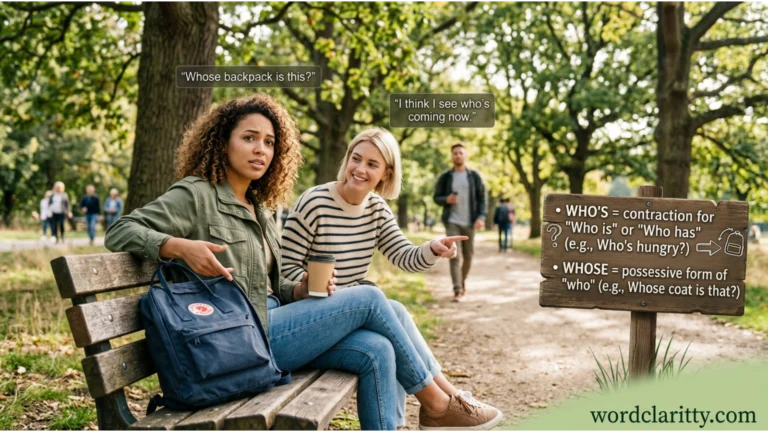
“Who’s” and “whose” are two small English words that cause surprisingly large problems for learners. They sound almost identical when spoken, and their spelling is very similar, but they have completely different grammatical roles. One is a contraction, while the other is used to show possession or ask about ownership.
Because both can appear in questions, sentences such as “Who’s book is this?” are a common mistake. Understanding the difference between who’s and whose matters because choosing the wrong word can change the meaning of a sentence and make your writing look less accurate. The good news is that the difference is simple once you know what each word represents.
Why “Who’s” and “Whose” Are Confusing
English learners often mix up whos and whose because they look and sound so similar. However, their meanings are different.
Similar pronunciation
In most varieties of standard English, whos and whose are pronounced almost exactly the same. When someone says a sentence aloud, it can be difficult to know which word they mean.
For example:
- “Whos coming to the party?”
- “Whose phone is this?”
The pronunciation does not provide much help, so you need to look at the meaning and grammar.
Similar spelling
Both words begin with who, which makes them easy to confuse when writing. The apostrophe in who’s is especially important because it tells us that the word is a contraction.
Context confusion
Both words can appear in questions:
- Whos at the door?
- Whose coat is this?
The first question asks about a person. The second asks about ownership.
Common learner mistakes
A very common mistake is writing who’s when you mean whose:
The correct sentence is:
✔ Whose car is parked outside?
A useful test is to replace who’s with who is or who has. If the sentence does not make sense, you probably need whose.
Who’s vs Whose Explained Simply
Whos is a contraction of who is or who has, while whose shows possession or asks who something belongs to.
One-line distinction
who is / who has; whose = belonging to whom.
Examples:
= “Who is waiting outside?”
Whose:
“Whose jacket is this?”
= “Who does this jacket belong to?”
So, when you can replace the word with who is or who has, use whos. When you are talking about ownership, use whose.
Understanding Homophones in English
What Are Homophones?
Homophones are words that sound the same, or nearly the same, but have different meanings and often different spellings.
For example:
- to — used for direction or an infinitive
- too — also or excessively
- two — the number 2
“Whos” and “whose” are commonly taught alongside homophones because they have the same pronunciation in standard English but different meanings and grammatical functions.
Why Homophones Cause Confusion
Homophones can be especially confusing when listening because you cannot see the spelling.
For example, if someone says:
“Whose bag is this?”
You hear a sound that is almost identical to. You have to understand the context to determine which word is intended.
This is why learning the meaning and grammatical function of each word is more useful than simply memorizing how they sound.
What Does “Who’s” Mean?
Definition and Core Meaning
Who’s is a contraction. It can mean either:
- who is
- who has
The apostrophe shows that letters have been removed from the original phrase.
For example:
Who’s coming with us?
= Who is coming with us?
Or:
whose finished the project?
= Who has finished the project?
The exact meaning depends on the sentence.
Origin and Historical Use
The word who’s developed as a shortened form of who is and who has. Contractions have long been used in English to make speech and writing more natural and concise.
The apostrophe in who’s is important because it marks the missing letters.
Modern Usage and Synonyms
Today, who’s is extremely common in everyday English, especially in conversation and informal writing.
It can be used:
- To ask about someone’s identity
- To describe what someone is doing
- To ask who is responsible for something
- To shorten who has in some sentences
There is no exact synonym, because its meaning depends on whether it means who is or who has.
Example sentences
- Who’s your new teacher.
- Who’s responsible for this report?
- **Who’s been using my laptop?
- Who’s already finished the assignment?
Notice that each example can be expanded:
Who’s your new teacher? → Who is your new teacher?
Who’s been using my laptop? → Who has been using my laptop?
What Does “Whose” Mean?
Definition and Core Meaning
Whose is used to ask about possession or to identify the person something belongs to.
It can mean:
belonging to whom
For example:
Whose phone is ringing?
This means:
Who does the phone belong to?
Whose can also be used in statements, not just questions:
I met a student whose artwork won a prize.
Here, whose connects the student with the artwork that belongs to or is associated with that student.
Origin and Historical Context
Whose has a long history in English and is related to the possessive form of who. Unlike who’s, it is not a contraction and therefore does not use an apostrophe.
This distinction remains important in modern English:
- who’s = who is / who has
- whose = possession
Modern Usage and Synonyms
Whose is used in both everyday and formal English.
Common uses include:
- Asking who owns something
- Identifying a person through something connected to them
- Introducing a relative clause
Examples include:
- Whose keys are these?
- Whose idea was it?
- The woman whose car was damaged called the police.
- I know a writer whose books are very popular.
There is no single direct synonym for whose, but phrases such as “belonging to whom” can express a similar idea.
Example sentences
- Whose shoes are by the door?
- Whose notebook did you borrow?
- Whose responsibility is this?
- She is the teacher whose class I joined.
- The boy whose bicycle was stolen reported it.
Who’s vs Whose: Key Differences at a Glance
| Word | Part of Speech | Meaning | Example Context |
|---|---|---|---|
| Who’s | Contraction | Who is / who has | “Who’s coming to the meeting?” |
| Whose | Possessive determiner/pronoun | Belonging to whom | “Whose bag is on the chair?” |
The most important difference is the apostrophe.
An apostrophe does not make who’s possessive. Instead, it shows that who’s is a shortened form of who is or who has.
Compare:
Who’s calling me?
Whose phone is calling?
In the second, whose asks about ownership.
How to Remember the Difference Between Who’s and Whose
A few simple memory tricks can make this distinction much easier.
1. Use the “who is” test
Whenever you see who’s, replace it with who is.
Who’s at the door?
Who is at the door?
The sentence works, so who’s is correct.
Try:
Who is book is this?
That does not work. Therefore, you need whose.
2. Use the “who has” test
Sometimes who’s means who has.
Who’s taken my pen?
Who has taken my pen?
This makes sense.
3. Think about ownership
If the sentence asks “Who does this belong to?”, use whose.
Whose umbrella is this?
Think:
Who does this umbrella belong to?
4. Remember the apostrophe
Think of the apostrophe in who’s as a signal that letters are missing:
who is → who’s
who has → who’s
By contrast, whose is a complete word and does not need an apostrophe.
One memorable example
Who’s wearing whose jacket?
Here, who’s means who is, while whose asks about ownership. Seeing both words together is an excellent way to remember the difference.
Common Mistakes and Confusions
Mistake 1: Using “who’s” for possession
This is incorrect because the sentence asks who owns the phone.
✔ Whose phone is this?
Mistake 2: Using “whose” when you mean “who is”
✘ Whose coming to the party?
Here, the intended meaning is “Who is coming?”
✔ Who’s coming to the party?
Mistake 3: Thinking the apostrophe means possession
Some learners remember that apostrophes can show possession:
Sarah’s book
They then assume:
Who’s book
must also show possession. However, who’s is different. Its apostrophe represents missing letters.
✔ Sarah’s book = possession
✔ Whose book? = possession
incorrect when asking about ownership
Mistake 4: Confusing “whose” with “who”
Compare:
Who is your manager?
This asks about a person’s identity.
Whose office is this?
This asks who the office belongs to.
Examples Section: Correct and Incorrect Usage
Example 1
✔ Correct: Who’s coming to the meeting?
✘ Incorrect: Whose coming to the meeting?
Why? The sentence does not ask about ownership.
Example 2
✔ Correct: Whose laptop is on the desk?
Why? The question asks who owns the laptop
Why? “Who’s” cannot be used as a possessive form.
Example 3
✔ Correct: Who’s been eating the cookies?
Why? “Who’s” means “who has.”
✘ Incorrect: Whose been eating the cookies?
Why? “Whose” does not mean “who has.”
Example 4
✔ Correct: The student whose project won the prize was excited.
Why? “Whose” connects the student with the project associated with that student.
✘ Incorrect: The student project won the prize was excited.
Why? “Who’s” cannot replace the possessive relative word whose.
Example 5
✔ Correct: I wonder whose coat this is.
Why? The sentence asks who the coat belongs to.
Why?would mean “who is” or “who has,” neither of which fits here.
Self Assessment: Test Your Knowledge
Fill in each blank .
- _______ coming to the office tomorrow?
- _______ keys are these?
- Do you know _______ been using my computer?
- _______ jacket did you leave in the classroom?
Take a moment to answer each question before checking the solutions.
Self Assessment Answers
- Who’s coming to the office tomorrow?
Why: “whose” means “who is.” - Whose keys are these?
Why: The question asks about ownership. - Do you know who’s been using my computer?
Why: “whos” means “who has.” - Whose jacket did you leave in the classroom?
Why: The question asks who the jacket belongs to.
FAQs:
Is “who’s” the same as “whose”?
No. Who’s means who is or who has, while whose is used to show or ask about possession.
Is “who’s” possessive?
No. Who’s is a contraction. Its apostrophe indicates missing letters from who is or who has. Whose is the possessive form.
When should I use “whose”?
Use whose when you want to ask or state who something belongs to.
Example:
Whose pen is this?
When should I use whose.
Use whose when you can replace it with who is or who has.
Examples:
Who’s at home? = Who is at home?
Who has finished?
Is “whose” only used in questions?
No. Whose can also be used in statements and relative clauses.
I met a woman whose son is a doctor.
Can “whose” refer to things?
Yes. In some contexts, whose can refer to things as well as people.
We visited a company whose products are sold worldwide.
What is an easy way to remember “whose”?
Use the replacement test. If who is or who has fits. If the sentence is about ownership or belonging, use whose.
Conclusion:
The difference between who’s and whose is simple once you focus on their jobs in a sentence. Who’s is a contraction of who is or who has. For example, ” means “Who is calling?” and “Who’s finished the work?” can mean “Who has finished the work?” On the other hand, whose is used to show possession or ask who something belongs to. In “Whose bag is this?”, the meaning is “Who does this bag belong to?”
The easiest way to remember the difference is to use the replacement test. If you can replace with who is or has, then it is correct. If the sentence involves ownership, Also remember that the apostrophe does not indicate possession; it indicates that letters have been removed. With regular practice, this small distinction becomes automatic. Pay attention when reading, listen for the context when speaking, and try creating your own examples. English has many confusing word pairs, but learning them one at a time can make your writing clearer and more confident.

