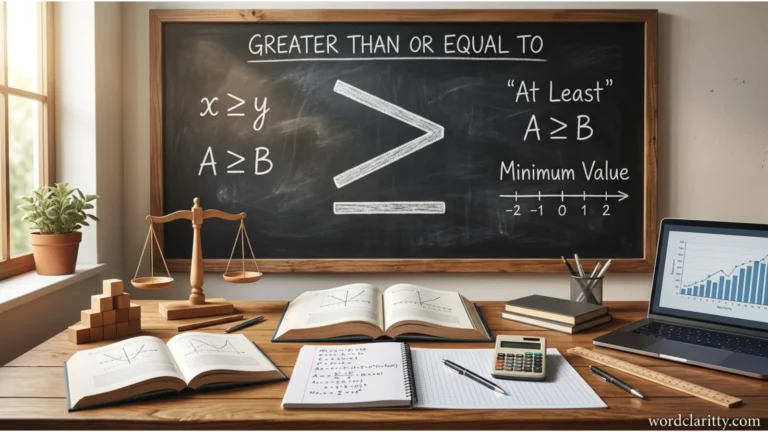
Understanding mathematical symbols is an important part of learning English, especially when reading textbooks, solving equations, or discussing numbers. One symbol that often confuses students is the greater than or equal to sign (≥).
Many learners wonder what it means, how to read it aloud, and when to use it instead of the greater than sign (>) or the less than or equal to sign (≤). Although these symbols look similar, each has a different purpose. Learning how to use the greater than or equal to symbol correctly makes mathematical expressions easier to understand and helps you communicate numerical information clearly in English.
Why the Greater Than and Greater Than or Equal To Signs Are Confusing
The greater than sign (>) and the greater than or equal to sign (≥) are closely related. Both compare two values and indicate that the value on the left is larger or, in the case of ≥, equal to the value on the right. This similarity can make it difficult for beginners to identify when each symbol is appropriate.
Here are the main reasons these mathematical symbols cause confusion.
1. Similar Appearance
Both symbols have a pointed shape that opens toward the larger side of an inequality. The main difference is the additional horizontal line beneath the greater than or equal to sign.
- Greater than (>): Indicates that one value is strictly larger than another.
- Greater than or equal to (≥): Indicates that one value is larger than or exactly equal to another.
For example, 8 > 5 is true, but 5 > 5 is false. In contrast, 5 ≥ 5 is true.
2. Similar Meaning
Both symbols describe numerical relationships involving a value that is larger than another value. However, only ≥ includes equality.
This small difference can change the meaning of a mathematical statement. For instance, if a competition requires participants to score at least 50 points, a score of exactly 50 qualifies. The condition must therefore use ≥ rather than >.
3. Context Confusion
These symbols frequently appear in school assignments, exam questions, statistics, computer programming, and everyday numerical rules.
Consider the following statements:
- A student must score more than 70 marks.
- A student must score at least 70 marks.
The first statement excludes a score of exactly 70, while the second includes it. Understanding the wording helps you select the correct symbol.
4. Common Learner Mistakes
English learners and mathematics beginners sometimes treat the two symbols as interchangeable. Common errors include forgetting that ≥ includes equality, confusing ≥ with ≤, or reading both symbols simply as “greater than.”
To avoid these mistakes, remember that the extra line beneath ≥ means the equality condition is included.
Greater Than (>) vs Greater Than or Equal To (≥) Explained Simply
The difference between these symbols is easy to understand once you focus on whether the two values can be equal.
Greater than (>) means that one number is larger than another number. Greater than or equal to (≥) means that one number is larger than or exactly equal to another number.
In simple terms:
- Use > when equality is not allowed.
- Use ≥ when equality is allowed.
Example Sentences
- Greater than: The temperature is greater than 20°C (temperature > 20°C). This means the temperature must be above 20°C, not exactly 20°C.
- Greater than or equal to: The minimum age is 18 years (age ≥ 18). This means a person who is exactly 18 years old also meets the requirement.
Quick Comparison
| Expression | How to Read It | Meaning |
|---|---|---|
| 9 > 4 | Nine is greater than four. | True |
| 4 > 4 | Four is greater than four. | False |
| 9 ≥ 4 | Nine is greater than or equal to four. | True |
| 4 ≥ 4 | Four is greater than or equal to four. | True |
The most important point is that ≥ includes the possibility of equality, whereas > does not.
Understanding Mathematical Symbols in English
Mathematical symbols help people communicate relationships between numbers without writing long explanations. They are especially useful when describing quantities, comparing measurements, and expressing rules.
What Are Mathematical Comparison Symbols?
Mathematical comparison symbols show how two values relate to each other.
For example, the symbols >, <, ≥, and ≤ describe whether a value is larger, smaller, or equal to another value.
Consider these examples:
- 10 > 6 means ten is greater than six.
- 3 < 8 means three is less than eight.
- 7 ≥ 7 means seven is greater than or equal to seven.
- 4 ≤ 9 means four is less than or equal to nine.
Each symbol has a specific meaning. Choosing the correct one makes a mathematical statement accurate.
Why Do These Symbols Cause Confusion?
The symbols can look similar, especially when students are learning them for the first time. The difference may depend on a single additional line, but that line changes which values satisfy the statement.
For example, x > 5 excludes 5, while x ≥ 5 includes 5.
The word “or equal to” is particularly important because it tells readers that the boundary value is acceptable. Recognizing this phrase helps learners understand mathematical instructions and translate English statements into inequalities.
What Does the Greater Than Sign (>) Mean?
Definition and Core Meaning
The greater than sign (>) is a mathematical symbol used to show that the value on the left is larger than the value on the right.
For example:
12 > 7
This expression is read as “twelve is greater than seven.” It means 12 has a higher numerical value than 7.
The greater than symbol does not allow the two values to be equal. Therefore, 6 > 6 is false because both numbers have the same value.
Origin and Historical Use
The greater than and less than symbols became widely known through the work of English mathematician Thomas Harriot. His mathematical notation was published in the 1631 book Artis Analyticae Praxis, after his death.
These symbols offered a shorter way to express numerical comparisons. Over time, they became standard notation in mathematics and are now used internationally in textbooks, scientific writing, and technical communication.
Modern Usage and Synonyms
The greater than sign is commonly used in:
- Mathematics: To compare numbers and quantities.
- Education: To explain numerical relationships in schoolwork and examinations.
- Statistics: To describe values above a particular threshold.
- Programming: To compare variables and values in conditional statements.
- Everyday communication: To express requirements that exceed a stated amount.
Common English expressions associated with > include “more than,” “above,” and “greater than.” However, the most appropriate wording depends on the context.
For example, “more than 100 people attended” normally means the attendance exceeded 100, not exactly 100.
Example Sentences
- The number 15 is greater than 10: 15 > 10.
- A temperature of 30°C is greater than 25°C: 30 > 25.
- The company earned more than $5,000: earnings > $5,000.
- The value of x must be greater than 3: x > 3.
- Eight is not greater than eight: 8 > 8 is false.
Remember that the greater than sign describes a strict inequality. Equality is not included.
What Does the Greater Than or Equal To Sign (≥) Mean?
Definition and Core Meaning
The greater than or equal to sign (≥) indicates that the value on the left is either larger than the value on the right or exactly equal to it.
For example:
10 ≥ 10
This expression is read as “ten is greater than or equal to ten.” It is true because the two values are equal.
Similarly, 12 ≥ 10 is true because 12 is greater than 10.
However, 8 ≥ 10 is false because 8 is neither greater than nor equal to 10.
Origin and Historical Context
The greater than or equal to symbol developed from the established greater than notation, with an additional line representing equality. This combination allows mathematicians to express two conditions in one symbol.
The notation is now widely used in algebra, calculus, statistics, economics, computer science, and many other fields.
It is especially helpful when describing minimum requirements, acceptable ranges, and mathematical boundaries.
Modern Usage and Synonyms
The greater than or equal to sign is used whenever a value must meet or exceed a particular threshold.
Common applications include:
- Age requirements: A participant must be at least 18 years old.
- Examination results: A student needs a score of 50 or higher.
- Financial conditions: An account must contain at least $100.
- Statistics: A variable must have a value of 10 or greater.
- Programming: A condition checks whether one value is greater than or equal to another.
Common English expressions for ≥ include “at least,” “no less than,” “equal to or greater than,” and “greater than or equal to.”
These expressions can communicate the same mathematical condition, although the best wording depends on the sentence.
Example Sentences
- Students must score at least 60 marks to pass: score ≥ 60.
- A person must be 18 or older to meet the age requirement: age ≥ 18.
- The number 20 is greater than or equal to 15: 20 ≥ 15.
- The number 7 is greater than or equal to 7: 7 ≥ 7.
- The value of x must be at least 4: x ≥ 4.
Notice that the last two examples allow equality. That is the defining feature of the greater than or equal to symbol.
Greater Than vs Greater Than or Equal To: Key Differences at a Glance
The following table summarizes the main differences between these two mathematical symbols.
| Word | Part of Speech | Meaning | Example Context |
|---|---|---|---|
| Greater than (>) | Mathematical comparison symbol | The left value is strictly larger than the right value. | x > 5 means x must be larger than 5. |
| Greater than or equal to (≥) | Mathematical comparison symbol | The left value is larger than or equal to the right value. | x ≥ 5 means x can be 5 or any larger value. |
Additional Differences
| Feature | Greater Than (>) | Greater Than or Equal To (≥) |
|---|---|---|
| Equality allowed? | No | Yes |
| Includes the boundary value? | No | Yes |
| Common phrase | More than | At least |
| Example | Age > 18 | Age ≥ 18 |
| Is 18 acceptable? | No | Yes |
These examples assume age is being treated as a numerical value and the stated boundary is 18.
The easiest way to distinguish the symbols is to check whether the condition accepts the exact number on the right side. If it does, use ≥. If it requires a strictly larger number, use >.
How to Remember the Difference Between Greater Than and Greater Than or Equal To
Remembering the difference becomes easier when you connect the symbols to familiar words and examples.
1. Look for the Extra Line
The greater than sign (>) has no horizontal line beneath it. The greater than or equal to sign (≥) has an extra line.
Think of the extra line as a reminder that equality is included.
- > means greater only.
- ≥ means greater or equal.
2. Associate ≥ With “At Least”
The phrase “at least” is a useful memory trick for ≥.
For example, if a teacher says that students need at least 40 marks to pass, a score of exactly 40 is acceptable.
Therefore:
Score ≥ 40
By contrast, if the instruction says students must score more than 40 marks, the correct expression is:
Score > 40
A score of exactly 40 would not satisfy that second condition.
3. Use a Number Line
Imagine a number line with 5 as the boundary.
For x > 5, the allowed values lie to the right of 5, but 5 itself is excluded.
For x ≥ 5, the allowed values also lie to the right of 5, but 5 itself is included.
When graphing these inequalities, a hollow circle usually represents an excluded boundary, while a filled circle represents an included boundary.
4. Remember One Memorable Example
Imagine a cinema that allows entry to people aged 18 or older.
The condition is age ≥ 18 because an 18-year-old qualifies.
If the cinema instead required visitors to be older than 18, the condition would be age > 18, excluding those who are exactly 18.
Connecting symbols to everyday rules makes their meanings easier to remember.
Common Mistakes and Confusions
Students sometimes choose the wrong comparison symbol because they overlook the exact meaning of the words in a question.
Here are common errors and their correct versions.
Mistake 1: Using > When Equality Is Allowed
Wrong: A person must be at least 21 years old: age > 21.
Correct: A person must be at least 21 years old: age ≥ 21.
Explanation: “At least 21” includes 21 itself. The greater than symbol would exclude the boundary value.
Mistake 2: Using ≥ When Equality Is Not Allowed
Wrong: The result must be greater than 80: result ≥ 80.
Correct: The result must be greater than 80: result > 80.
Explanation: “Greater than 80” means the result must exceed 80. A result of exactly 80 does not qualify.
Mistake 3: Confusing ≥ With ≤
Wrong: x ≥ 10 means x is less than or equal to 10.
Correct: x ≥ 10 means x is greater than or equal to 10.
Explanation: The direction of the symbol matters. The symbol ≤ means less than or equal to.
Mistake 4: Reading ≥ as Only “Greater Than”
Wrong: The expression 6 ≥ 6 is false because six is not greater than six.
Correct: The expression 6 ≥ 6 is true.
Explanation: The symbol includes equality. The two values do not need to be different for the expression to be true.
Mistake 5: Forgetting the Meaning of “More Than”
Wrong: “More than 100” means 100 or more.
Correct: “More than 100” means a value strictly greater than 100.
Explanation: In ordinary numerical usage, “100 or more” means ≥ 100, whereas “more than 100” means > 100.
Examples Section: Correct and Incorrect Usage
The following examples show how to apply the greater than and greater than or equal to symbols in everyday situations.
Example 1: Comparing Two Numbers
✔ Correct: 14 > 9 means 14 is greater than 9.
✘ Incorrect: 9 > 14 means 9 is greater than 14.
Explanation: Nine is smaller than fourteen, so the second statement is false.
Example 2: A Minimum Exam Score
✔ Correct: A student needs at least 50 marks: score ≥ 50.
✘ Incorrect: A student needs at least 50 marks: score > 50.
Explanation: A score of exactly 50 meets the minimum requirement, so equality must be included.
Example 3: A Strict Age Requirement
✔ Correct: The condition says an applicant must be older than 25: age > 25.
✘ Incorrect: The condition says an applicant must be older than 25: age ≥ 25.
Explanation: A person who is exactly 25 does not meet a requirement to be older than 25.
Example 4: Equality Between Values
✔ Correct: 8 ≥ 8 is true.
✘ Incorrect: 8 > 8 is true.
Explanation: Eight is equal to itself, but it is not greater than itself. Therefore, only the first statement is true.
Example 5: A Minimum Purchase Amount
✔ Correct: Customers must spend at least $30: purchase ≥ $30.
✘ Incorrect: Customers must spend at least $30: purchase > $30.
Explanation: Spending exactly $30 satisfies an “at least $30” requirement.
Example 6: A Temperature Above a Threshold
✔ Correct: The temperature is strictly above 15°C: temperature > 15°C.
✘ Incorrect: A temperature of exactly 15°C is above 15°C.
Explanation: A temperature equal to 15°C is not above 15°C. It meets an inclusive threshold of 15°C, but not a strict one.
Self-Assessment: Test Your Knowledge
Test your understanding by completing the following four sentences. Choose either > or ≥ for each blank.
- The number 12 is greater than 7: 12 ___ 7.
- A student must score at least 40 marks to pass: score ___ 40.
- The number 9 is equal to 9, so 9 ___ 9 is true.
- A person must be older than 16 years: age ___ 16.
Try answering all four questions before checking the solutions below.
Self-Assessment Answers
- > — 12 > 7 because 12 is strictly greater than 7.
- ≥ — A score of 40 meets the minimum requirement, so equality is allowed.
- ≥ — 9 ≥ 9 is true because the two values are equal.
- > — “Older than 16” excludes a person who is exactly 16.
If you answered all four correctly, you understand the central difference between these mathematical symbols. If you made a mistake, revisit the examples and pay special attention to phrases such as “at least,” “equal to,” and “greater than.”
FAQs:
1. What Does the Greater Than or Equal To Sign (≥) Mean?
The greater than or equal to sign (≥) means that one value is either larger than or equal to another value. For example, 10 ≥ 10 is true because the two numbers are equal.
2. What Is the Difference Between > and ≥?
The greater than sign (>) requires the first value to be strictly larger than the second. The greater than or equal to sign (≥) allows the values to be equal as well as allowing the first value to be larger.
3. How Do You Read the ≥ Symbol in English?
Read ≥ as “greater than or equal to.” For example, x ≥ 5 is read as “x is greater than or equal to five.”
4. Does Greater Than or Equal To Include the Number Itself?
Yes. The ≥ symbol includes the number on the right side of the expression. For example, x ≥ 10 includes 10, 11, 12, and other values greater than 10.
5. What Is Another Word for Greater Than or Equal To?
Common alternatives include “at least,” “no less than,” and “equal to or greater than.” For example, “at least 20” can be written as x ≥ 20.
6. Is 5 ≥ 5 True or False?
It is true. The two numbers are equal, and the ≥ symbol explicitly allows equality.
7. How Can I Remember the Greater Than or Equal To Symbol?
Conclusion:
The simplest way to remember this distinction is to focus on the extra line beneath ≥. It represents the equality condition and reminds you that the boundary value is included. You can also connect ≥ with everyday phrases such as “at least,” “no less than,” and “equal to or greater than.” In contrast, phrases such as “more than,” “above,” and “strictly greater than” generally indicate > when used for numerical comparisons.
These symbols are useful in school examinations, algebra, statistics, financial calculations, programming, and everyday situations involving minimum requirements. For example, a score of at least 60 can be written as score ≥ 60, while a score greater than 60 is written as score > 60. The difference determines whether a score of exactly 60 meets the condition.
To improve your understanding, practise translating short English statements into mathematical inequalities and checking whether the boundary value is allowed. With regular practice, these symbols will become easier to recognize and use correctly. Keep learning, ask questions when something is unclear, and remember that even small improvements in mathematical vocabulary can make a big difference in your confidence and accuracy.