English learners often come across words that sound alike but have completely different meanings. One pair that frequently causes confusion is Quaff vs Coif. At first glance, these words may seem interchangeable because they share a similar pronunciation and an unusual spelling pattern. However, they refer to entirely different things.
Understanding the difference between quaff and coif can help you avoid embarrassing mistakes in both writing and conversation.
If you’re reading literature, improving your vocabulary, or preparing for exams, learning how to use these words correctly will make your English more accurate and natural.
Table of Contents
- Introduction
- Why “Quaff” and “Coif” Are Confusing
- Quaff vs Coif Explained Simply
- Understanding Homophones in English
- What Are Homophones?
- Why Homophones Cause Confusion
- What Does “Quaff” Mean?
- What Does “Coif” Mean?
- Quaff vs Coif: Key Differences at a Glance
- How to Remember the Difference Between Quaff and Coif
- Common Mistakes and Confusions
- Examples Section: Correct and Incorrect Usage
- Self Assessment: Test Your Knowledge
- Self Assessment Answers
- FAQs About “Quaff and Coif”
- Final Conclusion: Using “Quaff” and “Coif” Correctly
Why “Quaff” and “Coif” Are Confusing
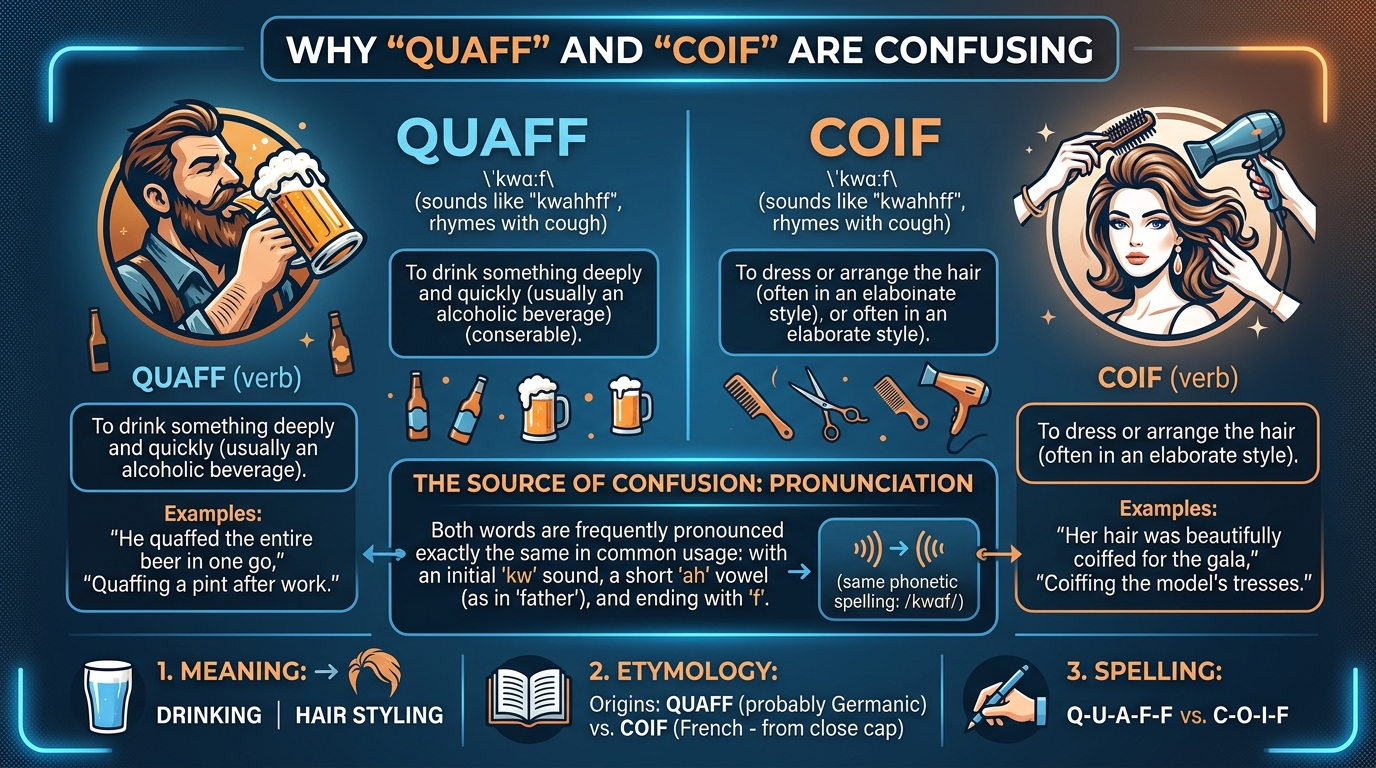
Many English learners mix up quaff and coif because of several factors.
Similar Pronunciation
Both words are often pronounced similarly in some accents, especially when spoken quickly. This can make it difficult for learners to distinguish them by sound alone.
Similar Spelling
Although the spellings are not identical, both words are short, uncommon, and contain unusual vowel combinations. This visual similarity can lead to confusion.
Context Confusion
Since neither word appears in everyday conversation very often, many learners do not have enough exposure to understand when each one should be used.
Common Learner Mistakes
People sometimes use coif when talking about drinking or use quaff when referring to hairstyles. These mistakes happen because learners remember the sound but forget the meaning.
Quaff vs Coif Explained Simply
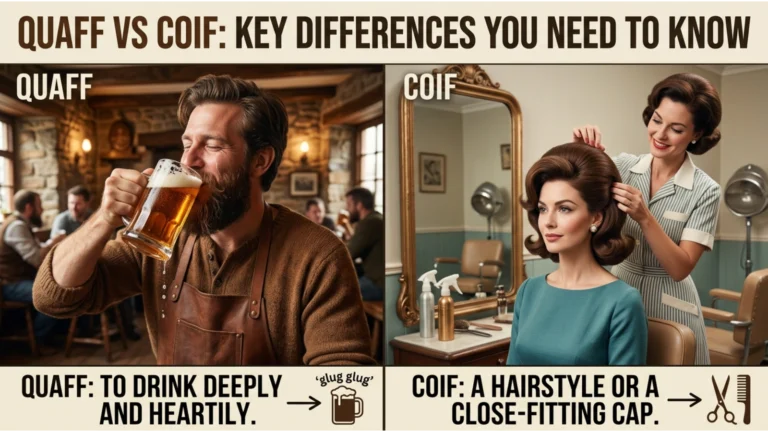
Quaff means to drink a beverage heartily or in large amounts, while coif refers to a hairstyle or the act of arranging hair.
One-Line Distinction
Quaff is about drinking; coif is about hair.
Example Sentences
- He quaffed a glass of cold lemonade after the game.
- The stylist carefully coifed her hair before the wedding.
Another pair of examples:
- The travelers quaffed water after their long hike.
- She wore a beautifully coifed hairstyle to the event.
Understanding Homophones in English
What Are Homophones?
Homophones are words that sound the same or very similar but have different meanings and spellings.
Example:
- Flower = a plant
- Flour = a powder used in baking
Why Homophones Cause Confusion
Homophones can be confusing because listeners hear the same sound but must rely on context to understand the intended meaning.
For example:
- “I need flour for the cake.”
- “The flower looks beautiful.”
The pronunciation is nearly identical, but the meanings are completely different.
What Does “Quaff” Mean?
Definition and Core Meaning
Quaff is a verb that means to drink something enthusiastically, deeply, or in large gulps.
The word is often used when describing the enjoyment of a drink, especially in literary or descriptive writing.
Origin and Historical Use
The word quaff dates back to Middle English and has been used for centuries to describe hearty drinking. It often appeared in poems, stories, and historical texts involving feasts and celebrations.
Modern Usage and Synonyms
Today, quaff is less common in everyday speech but still appears in books, articles, and creative writing.
Synonyms include:
- Drink
- Gulp
- Swallow
- Sip (depending on context)
- Consume
Key Points About Quaff
- Usually used as a verb.
- Relates to drinking liquids.
- Often suggests enjoyment or enthusiasm.
- Common in literary and descriptive writing.
Example Sentences
- The athletes quaffed bottles of water after the race.
- He quaffed a mug of hot chocolate on a cold evening.
- Guests quaffed sparkling drinks during the celebration.
- They sat around the fire and quaffed cider.
What Does “Coif” Mean?
Definition and Core Meaning
Coif can be a noun or a verb.
As a noun, it refers to a hairstyle or a close-fitting cap worn in earlier centuries.
As a verb, it means to arrange, style, or dress someone’s hair.
Origin and Historical Context
The word comes from Old French and originally referred to a hood or close-fitting cap. Over time, it became associated with hairstyles and hair arrangement.
Historically, coifs were worn by men, women, and certain professional groups.
Modern Usage and Synonyms
In modern English, coif is mostly associated with hairstyles, beauty, and fashion.
Synonyms include:
- Style
- Arrange
- Groom
- Shape
- Dress (hair)
Key Points About Coif
- Can function as a noun or a verb.
- Connected with hair and hairstyling.
- Common in fashion and beauty contexts.
- Sometimes refers to a specific hairstyle.
Example Sentences
- The stylist coifed her hair for the ceremony.
- His neatly coifed hair impressed everyone.
- The actress appeared with a perfectly coifed look.
- She spent an hour coifing her hair before the party.

Quaff vs Coif: Key Differences at a Glance
| Word | Part of Speech | Meaning | Example Context |
|---|---|---|---|
| Quaff | Verb | To drink heartily or enthusiastically | He quaffed a glass of juice. |
| Coif | Noun, Verb | A hairstyle or to arrange hair | She coifed her hair before dinner. |
How to Remember the Difference Between Quaff and Coif
Learning memory tricks can make these words easier to remember.
Easy Memory Tricks
Quaff = Drink
Think of the letter “A” in quaff as standing for Ale, a type of drink.
Coif = Hair
Think of the letter “OI” in coif as resembling a stylist’s creative choice for hair fashion.
Association Techniques
- Quaff → Café → Drink
- Coif → Comb → Hair
One Memorable Example
Imagine a person entering a salon.
First, they get their hair coifed.
Then, they go to a café and quaff a cold drink.
Hair first, drink second.
Common Mistakes and Confusions
Many learners accidentally swap these words.
Wrong Example
“He quaffed his hair before the interview.”
Correct Version
“He coifed his hair before the interview.”
Explanation
Hair is styled, not drunk. Therefore, coifed is correct.
Wrong Example
“She coifed a glass of lemonade.”
Correct Version
“She quaffed a glass of lemonade.”
Explanation
Lemonade is a beverage, so quaffed is the correct choice.
Examples Section: Correct and Incorrect Usage
Example 1
✔ Correct: He quaffed a refreshing drink after exercising.
✘ Incorrect: He coifed a refreshing drink after exercising.
Example 2
✔ Correct: The stylist coifed the model’s hair.
✘ Incorrect: The stylist quaffed the model’s hair.
Example 3
✔ Correct: Guests quaffed fruit punch at the party.
✘ Incorrect: Guests coifed fruit punch at the party.
Example 4
✔ Correct: She arrived with a beautifully coifed hairstyle.
✘ Incorrect: She arrived with a beautifully quaffed hairstyle.
Example 5
✔ Correct: The travelers quaffed water during their journey.
✘ Incorrect: The travelers coifed water during their journey.
Example 6
✔ Correct: The actor’s carefully coifed hair matched his elegant suit.
✘ Incorrect: The actor’s carefully quaffed hair matched his elegant suit.
Self Assessment: Test Your Knowledge
Fill in the blanks with quaff or coif.
1.
The hairstylist will ______ her hair before the photo shoot.
2.
After the marathon, the runners ______ several bottles of water.
3.
His perfectly ______ hairstyle attracted attention.
4.
The guests gathered to ______ sparkling drinks during the celebration.
Self Assessment Answers
- coif
- quaffed
- coifed
- quaff
FAQs About “Quaff and Coif”
1. Are quaff and coif homophones?
They are often pronounced similarly in some accents, which is why they can be confused, but they have completely different meanings.
2. What does quaff mean in English?
Quaff means to drink a liquid enthusiastically or in large gulps.
3. What does coif mean?
Coif refers to a hairstyle or the act of styling and arranging hair.
4. Is quaff commonly used today?
It is less common in everyday conversation but still appears in literature, journalism, and descriptive writing.
5. Can coif be both a noun and a verb?
Yes. It can refer to a hairstyle (noun) or the act of styling hair (verb).
6. How can I remember the difference?
Remember: quaff = drink, coif = hair. Think of ale for quaff and a comb for coif.
7. Which word should I use when talking about beverages?
Use quaff whenever you are describing drinking a beverage.
Final Conclusion: Using “Quaff” and “Coif” Correctly
Understanding the difference between quaff and coif is much easier once you connect each word with its main idea. Quaff relates to drinking, especially drinking enthusiastically or in large gulps. Whether someone is enjoying water after a workout or celebrating with a special beverage, quaff is the word associated with consuming drinks. Coif, on the other hand, relates to hair. It can describe a hairstyle itself or the act of arranging and styling hair for a polished appearance.
Although these words may sound similar and occasionally confuse English learners, their meanings belong to completely different categories. One deals with beverages, while the other deals with personal appearance. A simple memory trick can help: quaff belongs at the table, coif belongs at the salon. This easy association makes it much harder to mix them up.
In real-world English, you are more likely to encounter coif in beauty, fashion, and hairstyle discussions, while quaff appears in literature, storytelling, and descriptive writing about drinks. By practicing with example sentences and reviewing the comparison table, you can confidently choose the correct word every time. Keep learning, keep reading, and remember that mastering small word differences like these is an important step toward becoming a stronger and more fluent English speaker.