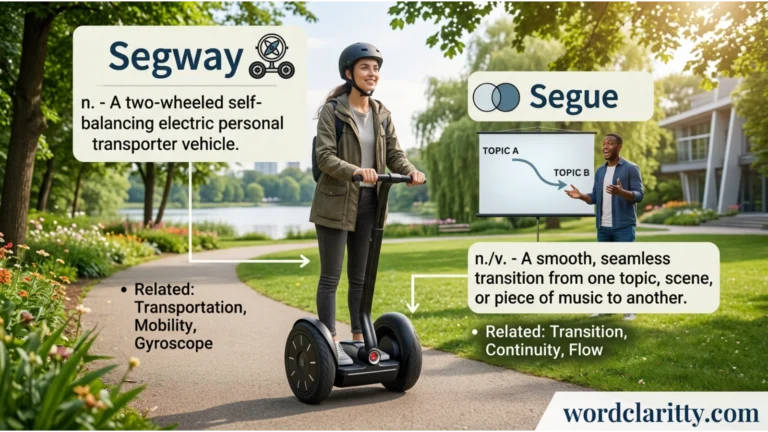
Segway or Segue is a common source of confusion for English learners because the two words sound almost identical but have completely different meanings. Many people mistakenly use segway when they actually mean segue, especially in writing. Understanding the difference is important because using the correct word improves clarity and makes your communication more professional. Segway is a brand name associated with a two-wheeled personal transportation device, while segue refers to a smooth transition from one topic, idea, or section to another. In this guide, we will break down the meanings, usage, and examples of both words so you can confidently choose the right one. By the end, the Segway or Segue confusion will be much easier to understand and avoid.
Table of Contents
- Why “Segway” and “Segue” Are Confusing
- Segway vs Segue Explained Simply
- Understanding Homophones in English
- What Does “Segway” Mean?
- What Does “Segue” Mean?
- Segway vs Segue: Key Differences at a Glance
- How to Remember the Difference Between Segway and Segue
- Common Mistakes and Confusions
- Examples Section: Correct and Incorrect Usage
- Self Assessment: Test Your Knowledge
- Self Assessment Answers
- FAQs About “Segway and Segue”
- Final Conclusion: Using “Segway” and “Segue” Correctly
Why “Segway” and “Segue” Are Confusing
The confusion between segway and segue is extremely common, especially among English learners and native speakers who hear the words more often than they see them written.
Similar Pronunciation
Both words are pronounced as:
/ˈseɡ.weɪ/ (SEG-way)
Since they sound identical, many people assume they are simply different spellings of the same word.
Similar Spelling
Although the spellings are not identical, they look somewhat similar:
- Segway
- Segue
The first four letters are the same, making it easy to mix them up.
Context Confusion
People often hear phrases like:
- “Let’s segue into the next topic.”
- “We need a smooth segue between sections.”
Because the pronunciation sounds like “segway,” many writers incorrectly spell the word as segway.
Common Learner Mistakes
Some common errors include:
- Writing segway when referring to a transition.
- Assuming segue is a typo.
- Not realizing that Segway is actually a brand name.
Segway vs Segue Explained Simply
Segue means a smooth transition from one topic, idea, or section to another, while Segway is a personal transportation device brand.
One-Line Distinction
Segue = transition.
Segway = scooter-like vehicle.
Example Sentences
- The speaker used a clever segue to move into the next topic.
- Tourists explored the city on Segway vehicles.
Another pair of examples:
- She smoothly segued from one point to another.
- He learned how to ride a Segway during his vacation.
Understanding Homophones in English
What Are Homophones?
Homophones are words that sound the same but have different meanings and spellings.
Example:
- Flower = a plant
- Flour = a baking ingredient
Even though they sound alike, they mean different things.
Why Homophones Cause Confusion
Homophones can be difficult because listeners cannot tell which spelling is intended from pronunciation alone.
For example:
- “I need a smooth segue.”
- “I rode a Segway.”
Both sound nearly identical when spoken, but the meanings are completely different.
What Does “Segway” Mean?
Definition and Core Meaning
Segway is a trademarked brand name for a self-balancing, two-wheeled electric transportation device.
People stand on the platform and control movement by shifting their weight.
Origin and Historical Use
The Segway vehicle was introduced in 2001 and became famous for its innovative design.
The name “Segway” was chosen to suggest a smooth movement from one place to another.
Modern Usage and Synonyms
Today, the word is primarily associated with the vehicle itself.
Key Points
- Refers to a transportation device
- Usually capitalized as Segway
- Functions as a proper noun
- Common in tourism and personal transportation
Related Terms
- Electric scooter
- Personal transporter
- Mobility device
Example Sentences
- We rented a Segway for our city tour.
- She quickly learned how to ride a Segway.
- The company introduced a new Segway model.
- Many tourists enjoy Segway sightseeing tours.
What Does “Segue” Mean?
Definition and Core Meaning
Segue means a smooth transition from one thing to another without interruption.
It can be used as both a noun and a verb.
Origin and Historical Context
The word comes from Italian, where segue means “it follows.”
It originally appeared in music to indicate a seamless transition between sections.
Over time, the word expanded into everyday English.
Modern Usage and Synonyms
Today, segue is commonly used in:
- Public speaking
- Writing
- Broadcasting
- Teaching
- Presentations
Synonyms
- Transition
- Connection
- Bridge
- Shift
- Progression
Key Points
- Refers to a smooth change between topics
- Can be a noun or verb
- Common in formal and professional communication
- Often used in presentations and speeches
Example Sentences
- The presenter used a smooth segue into the next section.
- Let me segue into another important point.
- The movie provided a natural segue between scenes.
- She seamlessly segued from one subject to another.
Segway vs Segue: Key Differences at a Glance
| Word | Part of Speech | Meaning | Example Context |
|---|---|---|---|
| Segway | Proper noun | A self-balancing transportation device | We toured the city on a Segway. |
| Segue | Noun, Verb | A smooth transition between ideas or sections | The speaker used a segue into the next topic. |
How to Remember the Difference Between Segway and Segue
Learning a simple memory trick can help you avoid mistakes.
Easy Memory Tricks
Trick 1: Think About Motion
Segway has the word way in it.
A Segway helps you travel along a way or path.
Trick 2: Think About Essays
Segue is often used in writing and speaking.
If you’re moving from one idea to another, you need a segue.
Association Techniques
- Segway = vehicle
- Segue = transition
One Memorable Example
Imagine giving a speech while riding a Segway.
- The vehicle is the Segway.
- The smooth movement between your ideas is the segue.
Common Mistakes and Confusions
Wrong Example
❌ The speaker used a great segway into the next topic.
Correct Version
✔ The speaker used a great segue into the next topic.
Explanation: The sentence refers to a transition, not a vehicle.
Wrong Example
❌ We rented a segue during our vacation.
Correct Version
✔ We rented a Segway during our vacation.
Explanation: The sentence refers to transportation.
Wrong Example
❌ Can you segway into the next chapter?
Correct Version
✔ Can you segue into the next chapter?
Explanation: The verb form is segue.
Examples Section: Correct and Incorrect Usage
Example 1
✔ Correct: The teacher used a smooth segue between lessons.
✘ Incorrect: The teacher used a smooth segway between lessons.
Example 2
✔ Correct: We explored downtown on a Segway.
✘ Incorrect: We explored downtown on a segue.
Example 3
✔ Correct: The host expertly segued into the next segment.
✘ Incorrect: The host expertly segwayed into the next segment.
Example 4
✔ Correct: That paragraph needs a better segue.
✘ Incorrect: That paragraph needs a better Segway.
Example 5
✔ Correct: The tourists stopped their Segway tour for lunch.
✘ Incorrect: The tourists stopped their segue tour for lunch.
Example 6
✔ Correct: She used humor as a segue to discuss a serious topic.
✘ Incorrect: She used humor as a Segway to discuss a serious topic.
Self Assessment: Test Your Knowledge
Fill in the blanks with Segway or segue.
1.
The presenter used a smooth ______ into the final section.
2.
We rented a ______ while visiting the historic district.
3.
Can you ______ into your next argument more naturally?
4.
The documentary created a perfect ______ between scenes.
Self Assessment Answers
1.
segue
2.
Segway
3.
segue
4.
segue
FAQs About “Segway and Segue”
1. Is it segue or segway when talking about a transition?
The correct word is segue when referring to a smooth transition between ideas or topics.
2. Why do people spell segue as segway?
Because both words are pronounced the same way, many people write the more familiar spelling they hear.
3. Is Segway a real word?
Yes. Segway is a trademarked brand name for a self-balancing electric vehicle.
4. Can segue be used as a verb?
Yes. For example: “She smoothly segued into the next topic.”
5. Is segue formal or informal?
It can be used in both formal and informal settings, especially in presentations, writing, and conversation.
6. How do you pronounce segue?
It is pronounced SEG-way.
7. Which word should I use in an essay?
Use segue when discussing transitions between paragraphs, ideas, or sections.
Final Conclusion: Using “Segway” and “Segue” Correctly
Understanding the difference between segway and segue is easier once you know that they serve completely different purposes. A Segway is a well-known self-balancing transportation device, while a segue is a smooth transition from one idea, topic, scene, or section to another. Although the words sound exactly alike, their meanings are unrelated, which is why they frequently confuse English learners and even experienced writers.
In everyday communication, you are much more likely to encounter segue when writing essays, giving presentations, teaching lessons, or having conversations that move naturally from one subject to another. On the other hand, Segway appears when discussing transportation, tourism, or personal mobility devices. Remember the simple memory tip: Segway helps you travel on a way, while segue helps your ideas travel smoothly from one place to another.
The next time you hear the pronunciation “SEG-way,” pause and think about the context. Are you talking about a vehicle or a transition? That one question will usually lead you to the correct spelling. As you continue learning English, paying attention to commonly confused words like these will strengthen your vocabulary, improve your writing accuracy, and boost your confidence. Keep practicing, and soon choosing between Segway and segue will feel completely natural.