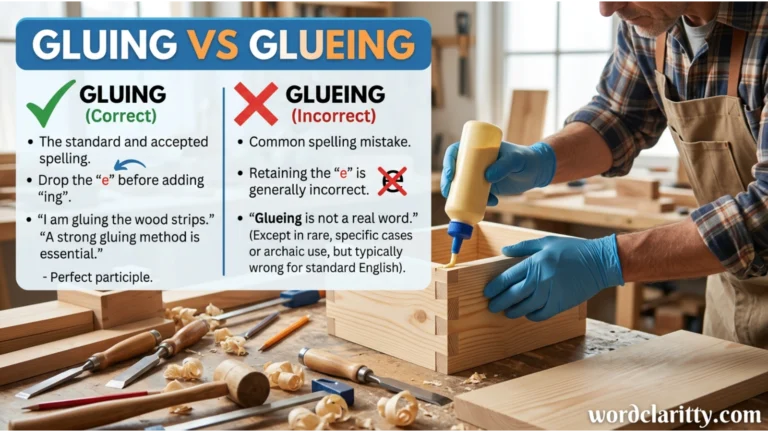
Gluing vs Glueing is a common spelling question that often confuses English learners and even native speakers. Both words appear to describe the act of joining materials together with glue, but many people wonder which spelling is actually correct.
Understanding the difference between gluing vs glueing is important because using the right form can improve your writing accuracy and help you follow standard English conventions. The confusion comes from spelling rules that apply when adding the suffix “-ing” to verbs ending in “e.” In this guide, we’ll explain which spelling is preferred, why it is considered correct, and when you might still come across the alternative form. By the end, you’ll know exactly which version to use with confidence.
Table of Contents
- Why “Gluing” and “Glueing” Are Confusing
- Gluing vs Glueing Explained Simply
- Understanding Homophones in English
- What Are Homophones?
- Why Homophones Cause Confusion
- What Does “Gluing” Mean?
- What Does “Glueing” Mean?
- Gluing vs Glueing: Key Differences at a Glance
- How to Remember the Difference Between Gluing and Glueing
- Common Mistakes and Confusions
- Examples Section: Correct and Incorrect Usage
- Self Assessment: Test Your Knowledge
- Self Assessment Answers
- FAQs About “Gluing and Glueing”
- Final Conclusion: Using “Gluing” and “Glueing” Correctly
Why “Gluing” and “Glueing” Are Confusing
Many learners struggle with gluing and glueing because the two words look very similar and are pronounced the same way.
Similar Pronunciation
Both spellings are pronounced as:
/ˈɡluːɪŋ/
Since there is no pronunciation difference, people often assume both forms are equally correct.
Similar Spelling
The only difference is the extra letter e in glueing. Because the base word is glue, many writers think the e should remain when adding -ing.
Context Confusion
Whether you write gluing paper together or glueing paper together, the meaning remains the same. This makes it difficult for learners to recognize the preferred spelling.
Common Learner Mistakes
Learners often:
- Keep the silent e from the base word.
- Assume all verbs keep their original spelling before adding -ing.
- Use glueing because it appears more logical.
In modern English, however, one spelling is generally preferred.
Gluing vs Glueing Explained Simply
Gluing is the standard and widely accepted spelling in modern English, while glueing is an alternative spelling that is much less common and often considered nonstandard in many style guides.
One-Line Distinction
Gluing is the preferred modern spelling; glueing is a rare alternative form.
Simple Explanation
When adding -ing to many verbs ending in a silent e, English usually drops the e.
For example:
- make → making
- bake → baking
- use → using
- glue → gluing
Example Sentences
- She is gluing the pieces of cardboard together.
- The children spent the afternoon gluing decorations onto the poster.
Understanding Homophones in English
What Are Homophones?
Homophones are words that sound the same but may have different spellings or meanings.
Example:
- sea
- see
Both words sound identical but have different meanings.
Why Homophones Cause Confusion
English learners often rely on pronunciation when spelling words. Since gluing and glueing sound exactly alike, writers may not realize that one spelling is preferred over the other.
For example:
- Correct: She is gluing the model together.
- Less common: She is glueing the model together.
Because they sound the same, confusion is common.
What Does “Gluing” Mean?
Definition and Core Meaning
Gluing is the present participle and gerund form of the verb glue.
It means:
- Joining objects together using glue.
- Attaching materials with an adhesive.
- Fixing or sticking items together.
Origin and Historical Use
The word glue comes from older European language roots referring to sticky substances used for bonding materials together.
As English spelling conventions developed, the standard form became gluing, following the common rule of dropping the silent e before adding -ing.
Modern Usage and Synonyms
Today, gluing is used in:
- Schools
- Craft projects
- Construction
- Manufacturing
- DIY activities
Synonyms
- Attaching
- Bonding
- Joining
- Sticking
- Fastening
Example Sentences
- The teacher was gluing artwork onto the classroom wall.
- He spent an hour gluing broken pieces of the vase together.
- We are gluing labels onto the boxes.
- The child enjoys gluing pictures into a scrapbook.
Key Points
- Standard modern spelling
- Widely accepted worldwide
- Used in formal and informal writing
- Recommended by most dictionaries and style guides
What Does “Glueing” Mean?
Definition and Core Meaning
Glueing has the same meaning as gluing.
It refers to:
- Joining materials with glue.
- Attaching items using an adhesive.
Origin and Historical Context
Historically, some writers retained the final e from the base word glue before adding -ing.
As spelling conventions became more standardized, gluing emerged as the preferred form.
Modern Usage and Synonyms
Today, glueing is:
- Rarely used
- Considered an alternative spelling
- Less common in modern publications
Synonyms
- Bonding
- Attaching
- Joining
- Sticking
- Fastening
Example Sentences
Although uncommon, examples include:
- She was glueing photographs into an album.
- They spent the afternoon glueing decorations onto the display board.
Key Points
- Same meaning as gluing
- Less common spelling
- Often replaced by gluing in modern English
- May occasionally appear in older texts or personal writing
Gluing vs Glueing: Key Differences at a Glance
| Word | Part of Speech | Meaning | Example Context |
|---|---|---|---|
| Gluing | Present participle / Gerund | Attaching something with glue | She is gluing paper onto the board. |
| Glueing | Present participle / Gerund | Same meaning as gluing | He was glueing pieces together. |
| Usage Status | Spelling Preference | Standard modern form | Preferred in most writing |
| Usage Status | Alternative Form | Less common spelling | Rarely used today |
How to Remember the Difference Between Gluing and Glueing
Learning a simple memory trick can help you avoid mistakes.
Easy Memory Tricks
Think of these examples:
- make → making
- use → using
- bake → baking
- glue → gluing
Notice how the silent e disappears.
Association Technique
Remember this phrase:
“Drop the silent e before adding ing.”
This rule works for many English verbs.
Memorable Example
Imagine a teacher saying:
“We’re gluing posters today.”
This is the spelling you will see in textbooks, dictionaries, and professional writing.
Whenever you hesitate, choose gluing.
Common Mistakes and Confusions
Many learners incorrectly keep the final e when adding -ing.
Wrong Example
❌ She is glueing the broken toy.
Correct Version
✔ She is gluing the broken toy.
Explanation
Modern English generally removes the silent e before adding -ing.
Wrong Example
❌ We spent the afternoon glueing decorations.
Correct Version
✔ We spent the afternoon gluing decorations.
Explanation
Although glueing may occasionally appear, gluing is the standard form.
Wrong Example
❌ The students were glueing pictures into notebooks.
Correct Version
✔ The students were gluing pictures into notebooks.
Explanation
Most dictionaries list gluing as the preferred spelling.
Examples Section: Correct and Incorrect Usage
Example 1
✔ Correct: She is gluing the craft sticks together.
✘ Incorrect: She is glueing the craft sticks together.
Example 2
✔ Correct: We spent the evening gluing photographs into an album.
✘ Incorrect: We spent the evening glueing photographs into an album.
Example 3
✔ Correct: The workers are gluing panels onto the surface.
✘ Incorrect: The workers are glueing panels onto the surface.
Example 4
✔ Correct: The child enjoys gluing colorful shapes onto paper.
✘ Incorrect: The child enjoys glueing colorful shapes onto paper.
Example 5
✔ Correct: He is gluing the broken model airplane.
✘ Incorrect: He is glueing the broken model airplane.
Self Assessment: Test Your Knowledge
Fill in the blanks with gluing or glueing.
1.
The students are ______ pictures into their scrapbooks.
2.
Modern dictionaries generally prefer the spelling ______.
3.
She spent the afternoon ______ decorations onto the poster board.
4.
The standard spelling used in most professional writing is ______.
Self Assessment Answers
1.
gluing
2.
gluing
3.
gluing
4.
gluing
FAQs About “Gluing and Glueing”
1. Is gluing or glueing correct?
Gluing is the preferred and standard spelling in modern English.
2. Why is gluing spelled without the letter e?
English spelling rules often drop a silent e before adding -ing.
3. Is glueing a real word?
Yes. It exists as an alternative spelling, but it is much less common today.
4. Which spelling do dictionaries recommend?
Most modern dictionaries recommend gluing.
5. Is glueing wrong?
It is not completely wrong, but it is generally considered less common and not the preferred form.
6. Which spelling should English learners use?
English learners should use gluing because it is widely accepted and recognized.
7. Does gluing have a different meaning from glueing?
No. Both words have the same meaning. The difference is mainly spelling preference.
Final Conclusion: Using “Gluing” and “Glueing” Correctly
Understanding the difference between gluing and glueing is easier than it first appears. Both spellings refer to the act of joining or attaching things with glue, and they carry the same meaning. However, in modern English, gluing is the standard and preferred spelling. It follows the common English rule of dropping a silent e before adding the suffix -ing, just as we do with words like making, using, and baking.
Although you may occasionally encounter glueing in older texts, personal writing, or less formal contexts, it is far less common today. For academic work, professional communication, business writing, and everyday English, gluing is the safer and more widely accepted choice.
A simple way to remember the difference is to think of the rule: “Drop the silent e before adding ing.” This memory trick works for many English verbs and can help you avoid spelling mistakes in the future.
The more you read and write English, the more natural these spelling patterns will become. Don’t worry if you have been using glueing—many learners make the same mistake. Keep practicing, pay attention to common spelling rules, and you’ll build stronger writing skills with confidence.