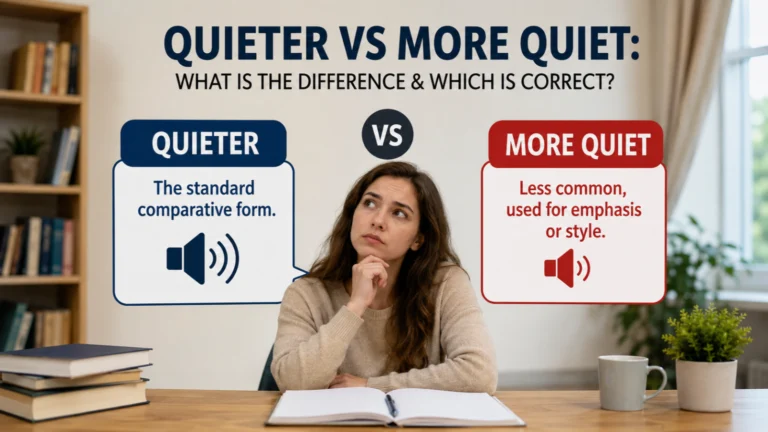
Quieter vs more quiet is a grammar question that often confuses English learners. Both expressions seem to have the same meaning, and you may hear native speakers use each one in different situations. So, which form is actually correct? The good news is that both can be correct, but one is much more common in everyday English. Understanding when to use quieter and when more quiet is acceptable will help you speak and write more naturally. In this guide, you’ll learn the difference in simple language, discover practical examples, avoid common mistakes, and build confidence in using comparative adjectives correctly.
Table of Contents
- Introduction
- Why “Quieter” and “More Quiet” Are Confusing
- Quieter vs More Quiet Explained Simply
- Understanding Homophones in English
- What Are Homophones?
- Why Homophones Cause Confusion
- What Does “Quieter” Mean?
- What Does “More Quiet” Mean?
- Quieter vs More Quiet: Key Differences at a Glance
- How to Remember the Difference Between Quieter and More Quiet
- Common Mistakes and Confusions
- Examples Section: Correct and Incorrect Usage
- Self Assessment: Test Your Knowledge
- Self Assessment Answers
- FAQs About “Quieter and More Quiet”
- Final Conclusion: Using “Quieter” and “More Quiet” Correctly
Why “Quieter” and “More Quiet” Are Confusing
Many English learners wonder whether they should say quieter or more quiet. Since both describe something with less noise than another thing, they appear interchangeable.
Here are the main reasons for the confusion:
Similar Pronunciation
Both expressions contain the word quiet, so they sound nearly identical except for the added comparative ending.
Similar Spelling
The only difference is that quieter adds -er, while more quiet uses the word more before quiet.
Context Confusion
Many adjectives become comparative by adding -er, while others use more. Learners often struggle to know which rule applies.
Common Learner Mistakes
People frequently assume that every adjective can freely use either form. In reality, English has preferred patterns based on the length and structure of adjectives.
Quieter vs More Quiet Explained Simply
The simplest explanation is:
“Quieter” means less noisy compared with something else, while “more quiet” also means less noisy but is less common and usually used for emphasis or style.
One-Line Distinction
Quieter is the standard comparative form, while more quiet is an alternative that is grammatically acceptable but used less often.
Examples
- The library is quieter than the cafeteria.
- After midnight, the streets became quieter.
- This corner feels more quiet than the entrance.
- The countryside seemed more quiet after the rain.
Although both are correct, quieter sounds more natural in everyday English.
Understanding Homophones in English
What Are Homophones?
Homophones are words that sound the same but have different meanings or spellings.
Example:
- Sea and see
They sound alike but have different meanings.
Why Homophones Cause Confusion
Homophones can make writing difficult because you hear the same sound but must choose the correct spelling.
Example:
- I want to see the ocean.
- The sea is calm today.
Note: Quieter and more quiet are not homophones. They simply express the same comparative meaning in different grammatical forms.
What Does “Quieter” Mean?
Definition and Core Meaning
Quieter is the comparative form of quiet. It means less noisy, more peaceful, or making less sound than another person, place, or thing.
Origin and Historical Use
The adjective quiet comes from Latin through Old French and has been used in English for centuries. Following the normal English rule for short adjectives, -er was added to form the comparative quieter.
Modern Usage and Synonyms
Today, quieter is the preferred comparative form in both spoken and written English.
Synonyms
- Less noisy
- More peaceful
- More silent
- More calm
- Softer
Example Sentences
- The classroom became quieter after the teacher arrived.
- This engine is quieter than the old one.
- My new apartment is much quieter at night.
- Please speak quieter during the meeting.
What Does “More Quiet” Mean?
Definition and Core Meaning
More quiet has the same basic meaning as quieter. It compares two things by saying one has less noise or disturbance.
Origin and Historical Context
English sometimes forms comparatives with more, especially for longer adjectives. Although quiet usually takes -er, writers and speakers occasionally choose more quiet for emphasis, rhythm, or style.
Modern Usage and Synonyms
While grammatically acceptable, more quiet is less common than quieter.
Synonyms
- Less noisy
- More peaceful
- More silent
- More restful
Example Sentences
- The garden feels more quiet in the early morning.
- This neighborhood is more quiet than downtown.
- She preferred a more quiet place to study.
- The hotel became more quiet after most guests left.
Quieter vs More Quiet: Key Differences at a Glance
| Word | Part of Speech | Meaning | Example Context |
|---|---|---|---|
| Quieter | Comparative adjective | Less noisy than something else | The office is quieter today. |
| More Quiet | Comparative adjective phrase | Less noisy than something else; less common | The beach was more quiet after sunset. |
Quick Summary
- Both are grammatically correct.
- Quieter is the preferred and more natural choice.
- More quiet is sometimes used for emphasis or stylistic reasons.
How to Remember the Difference Between Quieter and More Quiet
Learning this difference is easy if you remember one simple rule.
Easy Memory Tricks
- Short adjectives usually add -er.
- Quiet is a short adjective.
- Therefore, quieter is usually the best choice.
Association Technique
Think:
Quiet → Quieter
Just like:
- Small → Smaller
- Fast → Faster
- Bright → Brighter
Memorable Example
Imagine a librarian saying:
“Please be quieter.”
You would almost never hear:
“Please be more quiet.”
That makes quieter easier to remember as the natural everyday form.
Common Mistakes and Confusions
Here are mistakes English learners often make.
Wrong
The classroom is more quieter today.
Correct
The classroom is quieter today.
Explanation: Never use more together with -er.
Wrong
This park is most quieter than the other one.
Correct
This park is quieter than the other one.
Explanation: Comparative adjectives compare two things.
Wrong
My new phone is more quieter.
Correct
My new phone is quieter.
Explanation: Do not double the comparative.
Wrong
She speaks more quieter now.
Correct
She speaks quieter now.
Examples Section: Correct and Incorrect Usage
Example 1
✔ Correct: This room is quieter than the hallway.
✘ Incorrect: This room is more quieter than the hallway.
Example 2
✔ Correct: We wanted a more quiet location for our meeting.
✘ Incorrect: We wanted a more quieter location.
Example 3
✔ Correct: The baby became quieter after falling asleep.
✘ Incorrect: The baby became more quieter after falling asleep.
Example 4
✔ Correct: The countryside is quieter than the city.
✘ Incorrect: The countryside is more quieter than the city.
Self Assessment: Test Your Knowledge
Fill in the blanks with quieter or more quiet.
1.
The library is __________ than the cafeteria.
2.
She wanted a __________ place to read.
3.
The children became __________ after the movie started.
4.
This neighborhood feels __________ than downtown.
Self Assessment Answers
- quieter
- more quiet (or quieter, though quieter is more common)
- quieter
- quieter (preferred)
FAQs About “Quieter and More Quiet”
Is “quieter” grammatically correct?
Yes. Quieter is the standard comparative form of quiet and is the preferred choice in modern English.
Can I say “more quiet”?
Yes. It is grammatically acceptable, but it is less common than quieter.
Which form sounds more natural?
In everyday conversation and writing, quieter sounds more natural.
Why do some writers use “more quiet”?
Some writers use more quiet for emphasis, rhythm, or stylistic reasons, especially in formal or literary writing.
Can I say “more quieter”?
No. More quieter is incorrect because it uses two comparative forms together.
Is “quieter” used in formal writing?
Yes. Quieter is appropriate in both formal and informal English.
What’s the easiest rule to remember?
If the adjective is short like quiet, use -er. So quieter is usually the best choice.
Final Conclusion: Using “Quieter” and “More Quiet” Correctly
Understanding the difference between quieter vs more quiet is much easier once you know how English comparatives work. Both expressions describe something that has less noise than another thing, and both are grammatically acceptable. However, quieter is the standard comparative form and the one you will hear and read most often. It follows the common English pattern of adding -er to short adjectives, making it the natural choice in everyday speech, academic writing, and professional communication. More quiet carries the same meaning but is less common and is generally reserved for emphasis, stylistic preference, or specific writing contexts.
A simple way to remember the difference is to think about other short adjectives such as fast, small, and bright. Just as we say faster, smaller, and brighter, we also usually say quieter. Most importantly, never combine the two forms by saying more quieter, because that is grammatically incorrect. By practicing with real-life examples and paying attention to how native speakers use comparative adjectives, you’ll quickly develop a natural feel for choosing the right form. Every grammar topic you master makes your English clearer and more confident, so keep reading, practicing, and asking questions. Small improvements like this add up and help you communicate with accuracy and ease.