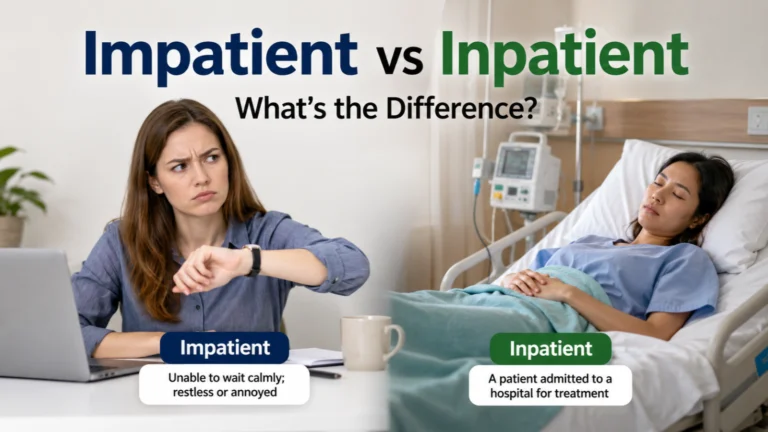
English learners often confuse impatient and inpatient because the two words look very similar. In fast reading or casual conversation, it is easy to mistake one for the other. However, these words have completely different meanings and are used in very different situations. Impatient describes a person’s feelings, while inpatient refers to someone receiving treatment in a hospital. Knowing the difference helps you communicate clearly and avoid embarrassing mistakes in writing and speaking. In this guide, you’ll learn the meanings, origins, examples, memory tricks, and practical tips that make it easy to remember when to use impatient and inpatient correctly.
Why “Impatient” and “Inpatient” Are Confusing
Many English learners mix up impatient and inpatient for several reasons.
Similar Pronunciation
The words sound somewhat alike, especially in fast speech. Since only one letter separates them, learners may hear them incorrectly.
Similar Spelling
Both words contain the letters patient, making them appear nearly identical at first glance. The only difference is the extra “in” at the beginning of inpatient.
Context Confusion
The word patient itself has two meanings:
- A person receiving medical treatment.
- A person who remains calm without getting upset.
This makes the related words even more confusing.
Common Learner Mistakes
Some learners accidentally write:
- The impatient stayed in the hospital overnight.
- She became inpatient while waiting.
Both sentences use the wrong word because the meanings are completely different.
Impatient vs Inpatient Explained Simply
Impatient means someone is unable to wait calmly, while inpatient means a person admitted to a hospital for medical treatment.
One-Line Distinction
Impatient describes a feeling; inpatient describes a hospital patient.
Examples
Impatient
- Sarah became impatient after waiting for an hour.
- The children grew impatient before dinner.
Inpatient
- The doctor admitted him as an inpatient.
- She remained an inpatient for three days after surgery.
Understanding Homophones in English
What Are Homophones?
Homophones are words that sound the same or nearly the same but have different meanings and sometimes different spellings.
Example:
- there
- their
Although they sound alike, they have different meanings.
Why Homophones Cause Confusion
English contains many words that are pronounced similarly. Learners often rely on pronunciation instead of spelling or context.
For example:
- their house
- there is my bag
Likewise, impatient and inpatient may sound similar, but context tells you which one is correct.
What Does “Impatient” Mean?
Definition and Core Meaning
Impatient is an adjective describing someone who becomes annoyed, restless, or frustrated because they must wait or because something is happening too slowly.
Origin and Historical Use
The word comes from the Latin impatiens, meaning unable to endure or unable to tolerate. It entered English centuries ago and has long been used to describe a person’s emotions or attitude.
Modern Usage and Synonyms
Common synonyms include:
- Restless
- Eager
- Irritated
- Frustrated
- Anxious
- Agitated
Key Points
- Describes emotions.
- Usually refers to waiting.
- Functions as an adjective.
- Often appears before nouns or after linking verbs.
Example Sentences
- The audience became impatient when the show started late.
- My brother is impatient with slow internet.
- Please don’t be impatient.
- The customers looked impatient.
What Does “Inpatient” Mean?
Definition and Core Meaning
Inpatient is a noun or adjective referring to someone who stays in a hospital or medical facility while receiving treatment.
Origin and Historical Context
The term developed from combining in and patient to distinguish people admitted to hospitals from outpatients, who receive treatment without staying overnight.
Hospitals have used this distinction for many decades.
Modern Usage and Synonyms
Related words include:
- Hospital patient
- Admitted patient
- Resident patient
Key Points
- Used mainly in healthcare.
- Refers to hospital admission.
- Can be a noun or adjective.
- Opposite of outpatient.
Example Sentences
- The inpatient received excellent care.
- She became an inpatient after the accident.
- Inpatient treatment lasted one week.
- The hospital expanded its inpatient services.
Impatient vs Inpatient: Key Differences at a Glance
| Word | Part of Speech | Meaning | Example Context |
|---|---|---|---|
| Impatient | Adjective | Unable to wait calmly | The children became impatient. |
| Inpatient | Noun, Adjective | A person admitted to a hospital | The inpatient stayed overnight. |
How to Remember the Difference Between Impatient and Inpatient
Here are a few easy memory tricks.
Easy Memory Tricks
- Impatient = I am waiting.
- Waiting often makes people impatient.
- Inpatient = In the hospital.
- Think of the word in as staying inside the hospital.
Association Techniques
Imagine two pictures:
- Someone tapping their foot while waiting = impatient
- Someone lying in a hospital bed = inpatient
Visual associations help your memory.
One Memorable Example
An impatient person wants to leave quickly. An inpatient cannot leave the hospital yet.
Common Mistakes and Confusions
Wrong
She became inpatient while standing in line.
Correct
She became impatient while standing in line.
Explanation: She was waiting, not staying in a hospital.
Wrong
The doctor examined an impatient after surgery.
Correct
The doctor examined an inpatient after surgery.
Explanation: The sentence refers to a hospital patient.
Wrong
I felt inpatient because the bus was late.
Correct
I felt impatient because the bus was late.
Explanation: Being frustrated while waiting requires impatient.
Examples Section: Correct and Incorrect Usage
Example 1
✔ Correct: I became impatient after waiting two hours.
✘ Incorrect: I became inpatient after waiting two hours.
Example 2
✔ Correct: The hospital admitted him as an inpatient.
✘ Incorrect: The hospital admitted him as an impatient.
Example 3
✔ Correct: Our teacher told us not to be impatient.
✘ Incorrect: Our teacher told us not to be inpatient.
Example 4
✔ Correct: She received inpatient care after surgery.
✘ Incorrect: She received impatient care after surgery.
Self Assessment: Test Your Knowledge
Fill in the blanks with impatient or inpatient.
- The nurse checked on every ________ twice a day.
- We became ________ because the train was delayed.
- After surgery, he remained an ________ for five days.
- Don’t become ________; your turn is coming soon.
Self Assessment Answers
- inpatient
- impatient
- inpatient
- impatient
FAQs About “Impatient and Inpatient”
1. Is impatient the opposite of patient?
Yes. Impatient means unable to wait calmly, while patient means calm and willing to wait.
2. What is an inpatient?
An inpatient is a person admitted to a hospital or medical center for treatment.
3. Can inpatient be an adjective?
Yes. For example:
She received inpatient treatment.
4. Is impatient always negative?
Usually, yes. It suggests frustration, irritation, or restlessness while waiting.
5. What is the opposite of inpatient?
The opposite is outpatient, a person who receives medical treatment without staying in the hospital.
6. Why do people confuse impatient and inpatient?
Because the words look and sound similar, and both contain the word patient.
7. Which word should I use when talking about waiting?
Use impatient whenever you are describing someone’s feelings about waiting.
Final Conclusion: Using “Impatient” and “Inpatient” Correctly
Understanding the difference between impatient and inpatient is much easier once you focus on what each word describes. Impatient is about emotions. It refers to someone who feels restless, annoyed, or unable to wait calmly. Whether you’re waiting in traffic, standing in a long queue, or expecting important news, feeling frustrated by the delay means you are impatient. Inpatient, on the other hand, belongs to the world of healthcare. It describes a person who has been admitted to a hospital or another medical facility for treatment and stays there overnight or longer. Although the words look alike and may sound similar, their meanings are entirely different.
A simple memory trick can help you every time. Think of impatient as being irritated while waiting, and remember that inpatient begins with “in,” reminding you that the person is in the hospital. Reading, writing, and speaking with these words in context will quickly make the distinction feel natural. As you continue learning English, don’t be discouraged by confusing word pairs. Every new comparison strengthens your vocabulary and builds confidence. Keep practicing with real-life examples, pay attention to context, and before long you’ll use impatient and inpatient correctly without even thinking about it.