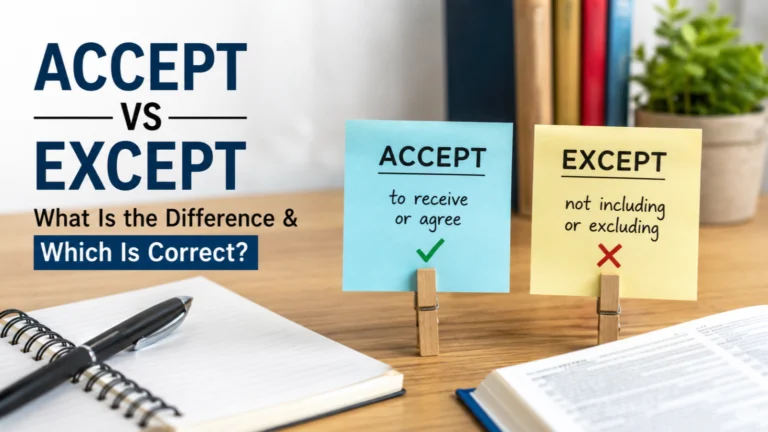
Accept vs Except is one of the most commonly confused word pairs in English because the two words sound similar but have completely different meanings. Many learners mistakenly use one in place of the other, which can change the meaning of a sentence and create confusion in both writing and conversation. Understanding the difference between these words will help you communicate more accurately and confidently in everyday situations, academic writing, and professional communication. In this guide, you’ll discover the meanings, grammar, pronunciation, examples, and simple tips to remember when to use each word correctly. By the end, Accept vs Except will no longer be confusing, and you’ll be able to choose the right word with confidence whenever you write or speak. Accept vs Except is easier to master than you might think.
Why “Accept” and “Except” Are Confusing
Many people accidentally mix up accept and except because they share similar sounds and nearly identical spelling. However, they serve completely different purposes in English grammar.
Similar Pronunciation
Both words are pronounced almost the same in everyday conversation. Native speakers often pronounce them so similarly that learners may not notice the difference.
Similar Spelling
The words differ by only one letter:
- Accept
- Except
Since they look nearly identical, typing or writing the wrong one is a common mistake.
Context Confusion
Both words frequently appear in formal writing, conversations, emails, and academic English. Learners sometimes choose the wrong word because they focus on pronunciation instead of meaning.
Common Learner Mistakes
Some common mistakes include:
- Writing except when meaning “receive.”
- Using accept when meaning “not including.”
- Confusing them during exams and writing assignments.
- Misunderstanding sentences because of incorrect word choice.
Accept vs Except Explained Simply
Accept means to receive, agree to, or say yes to something, while except means not including or leaving something out.
One-Line Distinction
Accept means “to receive.” Except means “excluding.”
Examples
Accept
- I happily accept your invitation.
- She decided to accept the job offer.
Except
- Everyone came except Ali.
- The shop is open every day except Sunday.
Understanding Homophones in English
What Are Homophones?
Homophones are words that sound the same or almost the same but have different meanings and spellings.
Example:
- Right
- Write
Although they sound alike, they have different meanings.
Why Homophones Cause Confusion
English learners often rely on pronunciation when speaking or writing. Because accept and except sound very similar, people sometimes choose the wrong spelling.
For example:
- Incorrect: I except your apology.
- Correct: I accept your apology.
Understanding the meaning instead of relying only on pronunciation helps prevent these mistakes.
What Does “Accept” Mean?
Definition and Core Meaning
Accept is a verb.
It means:
- To receive something willingly.
- To agree with something.
- To approve or admit something as true.
- To say yes to an offer or invitation.
Origin and Historical Use
The word accept comes from the Latin word acceptare, meaning “to receive willingly.” It entered English through Old French and has been used for centuries to describe receiving, approving, or agreeing.
Modern Usage and Synonyms
Today, accept is commonly used in daily conversations, workplaces, schools, and formal writing.
Common synonyms include:
- Receive
- Agree
- Approve
- Admit
- Welcome
- Take
Key Points
- It is always a verb.
- It involves receiving or agreeing.
- It often follows offers, invitations, gifts, apologies, or responsibilities.
Example Sentences
- I accept your invitation.
- She accepted the award with gratitude.
- They accepted responsibility for the mistake.
- Will you accept this gift?
What Does “Except” Mean?
Definition and Core Meaning
Except is usually a preposition.
It means:
- Not including.
- Leaving out.
- Excluding someone or something.
Sometimes it also functions as a conjunction.
Origin and Historical Context
The word except comes from the Latin exceptus, meaning “taken out.” Its meaning has remained almost unchanged throughout history.
Modern Usage and Synonyms
Today, except is used whenever something is excluded from a group.
Common synonyms include:
- Excluding
- Other than
- Apart from
- Leaving out
- But
Key Points
- Usually functions as a preposition.
- Shows exclusion.
- Often follows words like everyone, everything, all, or every.
Example Sentences
- Everyone came except Sara.
- The museum is open every day except Monday.
- I like all vegetables except spinach.
- Nobody knew the answer except the teacher.
Accept vs Except: Key Differences at a Glance
| Word | Part of Speech | Meaning | Example Context |
|---|---|---|---|
| Accept | Verb | To receive, agree, or approve | I accept your apology. |
| Except | Usually a preposition (sometimes conjunction) | Not including; excluding | Everyone came except John. |
How to Remember the Difference Between Accept and Except
Learning a few simple memory tricks can help you remember these words forever.
Easy Memory Tricks
- Accept = A = Agree
- Accept = A = Acquire or Receive
- Except = EX = Exclude
- Think of the EX in Except as meaning Exit or Excluded.
Association Techniques
Imagine someone handing you a gift.
If you take it, you accept it.
Now imagine a classroom where everyone is present except one student.
The missing student is excluded.
One Memorable Example
Accept the invitation.
Everyone came except Tom.
One sentence is about receiving.
The other is about leaving someone out.
Common Mistakes and Confusions
Wrong
❌ I except your offer.
Correct
✅ I accept your offer.
Explanation: You receive an offer, so use accept.
Wrong
❌ Everyone arrived accept Jack.
Correct
✅ Everyone arrived except Jack.
Explanation: Jack is excluded.
Wrong
❌ She excepted the scholarship happily.
Correct
✅ She accepted the scholarship happily.
Explanation: Scholarships are received, not excluded.
Wrong
❌ All students accept Ahmed passed the exam.
Correct
✅ All students except Ahmed passed the exam.
Explanation: Ahmed is the exception.
Examples Section: Correct and Incorrect Usage
Example 1
✔ Correct: I gladly accept your invitation.
✘ Incorrect: I gladly except your invitation.
Example 2
✔ Correct: Everyone attended the meeting except Ali.
✘ Incorrect: Everyone attended the meeting accept Ali.
Example 3
✔ Correct: She decided to accept the new job.
✘ Incorrect: She decided to except the new job.
Example 4
✔ Correct: Every shop is open except this one.
✘ Incorrect: Every shop is open accept this one.
Self Assessment: Test Your Knowledge
Fill in the blanks with accept or except.
1.
I will gladly ________ your invitation.
2.
Everyone finished the assignment ________ Ahmed.
3.
She refused to ________ the award.
4.
The restaurant opens every day ________ Tuesday.
Self Assessment Answers
- accept
- except
- accept
- except
Accept vs Except: FAQs About “Accept and Except”
1. What is the main difference between accept and except?
Accept means to receive or agree, while except means excluding or leaving something out.
2. Is accept a verb?
Yes. Accept is a verb because it describes an action.
3. Is except a preposition?
Usually, yes. It commonly acts as a preposition meaning “excluding.”
4. Can accept and except be used interchangeably?
No. Their meanings are completely different, so they should never replace each other.
5. Which word is used with invitations?
Use accept.
Example: I accept your invitation.
6. Which word means “not including”?
The correct word is except.
Example: Everyone passed except Sam.
7. How can I remember the difference?
Remember:
- Accept = Agree
- Except = Exclude
The first letters provide an easy reminder.
Final Conclusion: Using “Accept” and “Except” Correctly
Understanding the difference between accept and except is an important step toward improving your English vocabulary and writing skills. Although these two words look and sound very similar, their meanings are entirely different. Accept is a verb that means to receive, agree to, or approve something. You use it when taking an offer, accepting an apology, or agreeing to an invitation. Except, on the other hand, usually functions as a preposition that means “not including” or “excluding.” It helps identify someone or something left out of a group or situation.
A simple way to remember them is this: Accept starts with “A” for Agree or Acquire, while Except starts with “EX” for Exclude. This small memory trick can help you choose the correct word quickly, whether you’re speaking, writing, or taking an English exam. Reading examples, practicing regularly, and paying attention to context will strengthen your understanding over time.
Don’t be discouraged if you occasionally mix them up—many native speakers make the same mistake. With consistent practice and careful reading, using accept and except correctly will soon become second nature. Every new word you master brings you one step closer to speaking and writing English with greater confidence, accuracy, and clarity.