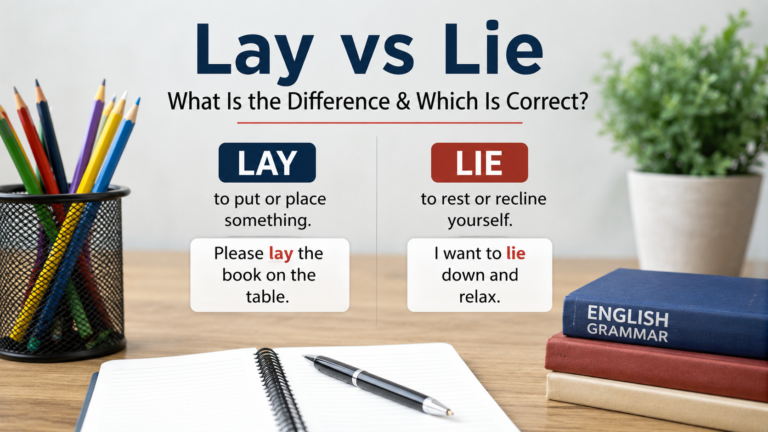
Lay vs Lie is one of the most confusing grammar topics for English learners because the two verbs look and sound similar but have different meanings and uses. Many people accidentally say, “I’m going to lay down,” when they actually mean “I’m going to lie down.” Understanding the difference can make your speaking and writing more accurate, natural, and professional. The key distinction is that lay vs lie depends on whether the verb needs an object. Lay means to put or place something somewhere, while lie means to recline or rest by yourself. Once you learn this simple rule and see a few examples, choosing the correct word becomes much easier. This guide explains the differences with clear definitions, grammar tips, and everyday examples.
Table of Contents
- Introduction
- Why “Lay” and “Lie” Are Confusing
- Lay vs Lie Explained Simply
- Understanding Homophones in English
- What Are Homophones?
- Why Homophones Cause Confusion
- What Does “Lay” Mean?
- What Does “Lie” Mean?
- Lay vs Lie: Key Differences at a Glance
- How to Remember the Difference Between Lay and Lie
- Common Mistakes and Confusions
- Examples Section: Correct and Incorrect Usage
- Self Assessment: Test Your Knowledge
- Self Assessment Answers
- FAQs About “Lay and Lie”
- Final Conclusion: Using “Lay” and “Lie” Correctly
Why “Lay” and “Lie” Are Confusing
The words lay and lie are among the most confusing verbs in English. There are several reasons why learners often mix them up.
Similar pronunciation
Both words have short, simple sounds and are easy to confuse during conversations.
Similar spelling
The words differ by only one letter, making them easy to mistake while reading or writing.
Context confusion
Both words describe positions or placement. However, one involves putting something down, while the other describes resting yourself.
Common learner mistakes
Many learners say:
- “I’m going to lay down.”
- “The book is lying on the table, so I will lie it there.”
These sentences sound natural to many people but are grammatically incorrect in standard English.
The biggest reason for confusion is that the past tense of “lie” is “lay.” This makes the two verbs overlap in different tenses.
Lay vs Lie Explained Simply
The easiest way to understand these verbs is to remember one important rule.
Lay means to put or place something somewhere, while lie means to rest or recline yourself.
One-line distinction
Lay requires an object. Lie does not.
Examples
Lay
- Please lay the keys on the table.
- She lays the baby in the crib every night.
Lie
- I want to lie on the sofa after work.
- The cat likes to lie in the sunshine.
Understanding Homophones in English
What Are Homophones?
Homophones are words that sound the same or nearly the same but have different meanings and sometimes different spellings.
Example:
- Their
- There
They sound alike but have different meanings.
Why Homophones Cause Confusion
English learners often rely on pronunciation. When two words sound similar, they may choose the wrong one.
For example:
- I want to lie down.
- Please lay your phone on the desk.
Because both words relate to position, many learners accidentally switch them.
What Does “Lay” Mean?
Definition and Core Meaning
Lay means to put, place, or set something down.
Someone performs the action on another object.
Important rule
If you can ask “Lay what?”, the sentence probably needs lay.
Origin and Historical Use
The verb lay comes from the Old English word lecgan, meaning to place or put down. It has been used for centuries in English to describe placing objects in a specific location.
Modern Usage and Synonyms
Today, lay commonly appears in daily conversation, literature, business writing, and instructions.
Synonyms
- Put
- Place
- Set
- Position
- Arrange
Examples
- Please lay your notebook on the desk.
- They carefully laid the bricks.
- She lays fresh flowers on the grave every week.
- We will lay the blankets on the floor.
What Does “Lie” Mean?
Definition and Core Meaning
Lie means to rest, recline, or be in a flat position.
The subject performs the action itself.
No object is needed.
Origin and Historical Context
The verb lie comes from the Old English word licgan, meaning to recline or remain resting. It has long been used to describe people, animals, or objects that are resting naturally.
Modern Usage and Synonyms
Today, lie is commonly used when talking about resting, sleeping, relaxing, or being located somewhere.
Synonyms
- Rest
- Recline
- Stretch out
- Relax
- Be positioned
Examples
- I want to lie down for a while.
- The dog is lying beside the fireplace.
- The mountains lie beyond the river.
- She lay on the beach all afternoon yesterday.
Lay vs Lie: Key Differences at a Glance
| Word | Part of Speech | Meaning | Example Context |
|---|---|---|---|
| Lay | Verb | To put or place something | Lay the book on the shelf. |
| Lie | Verb | To rest or recline | Lie on the bed and relax. |
How to Remember the Difference Between Lay and Lie
Fortunately, there are easy ways to remember these confusing verbs.
Easy memory tricks
- Lay = Place
- Lie = Recline
Notice that lay involves moving something.
Association technique
Remember this sentence:
You lay something down, but you lie down yourself.
Memorable example
- I lay my backpack on the chair.
- Then I lie on the couch.
If another object receives the action, use lay.
If the subject is resting, use lie.
Common Mistakes and Confusions
Here are mistakes many learners make.
Wrong
I am going to lay down for a nap.
Correct
I am going to lie down for a nap.
Explanation:
You are resting yourself.
Wrong
Please lie your jacket here.
Correct
Please lay your jacket here.
Explanation:
The jacket is the object being placed.
Wrong
The dog laid on the rug all day.
Correct
The dog lay on the rug all day.
Explanation:
The dog was resting.
Wrong
She layed the dishes on the table.
Correct
She laid the dishes on the table.
Explanation:
The past tense of lay is laid, not layed.
Examples Section: Correct and Incorrect Usage
Example 1
✔ Correct: Please lay the papers on my desk.
✘ Incorrect: Please lie the papers on my desk.
Example 2
✔ Correct: I want to lie down after dinner.
✘ Incorrect: I want to lay down after dinner.
Example 3
✔ Correct: She laid the baby gently in the crib.
✘ Incorrect: She lay the baby gently in the crib.
Example 4
✔ Correct: The cat is lying under the tree.
✘ Incorrect: The cat is laying under the tree.
Example 5
✔ Correct: We laid the picnic blanket on the grass.
✘ Incorrect: We lay the picnic blanket on the grass.
Example 6
✔ Correct: The books lie on the top shelf.
✘ Incorrect: The books lay on the top shelf. (Present tense)
Self Assessment: Test Your Knowledge
Fill in the blanks with lay or lie.
- Please ______ your phone on the table.
- I need to ______ down because I’m tired.
- The children ______ their backpacks by the door every morning.
- The cat likes to ______ near the fireplace.
Self Assessment Answers
- lay
- lie
- lay
- lie
FAQs About “Lay and Lie”
1. What is the main difference between lay and lie?
Lay means to put something somewhere, while lie means to rest or recline.
2. Does “lay” always need an object?
Yes. Lay is a transitive verb, so it normally requires an object.
3. Can “lie” be used without an object?
Yes. Lie is an intransitive verb and does not take a direct object.
4. Why is the past tense so confusing?
Because the past tense of lie is lay, while the past tense of lay is laid.
5. Is “I’m going to lay down” correct?
In standard English, I’m going to lie down is the correct form when you mean to rest.
6. What is an easy trick to remember the difference?
Remember:
Lay = Place something.
Lie = Rest yourself.
7. Do native English speakers confuse these words?
Yes. Many native speakers use them incorrectly in casual conversation, but formal writing follows the standard grammar rules.
Final Conclusion: Using “Lay” and “Lie” Correctly
Understanding the difference between lay and lie can make your English clearer, more accurate, and more natural. Although these two verbs often confuse learners because of their similar spelling, pronunciation, and unusual verb forms, the basic rule is straightforward. Use lay when you are putting or placing something somewhere, and use lie when a person, animal, or thing rests or reclines without acting on another object. A helpful way to remember this is: “You lay something down, but you lie down yourself.” Keep in mind that the past tense forms add another challenge—lay becomes laid, while lie becomes lay—so practicing them regularly is worthwhile.