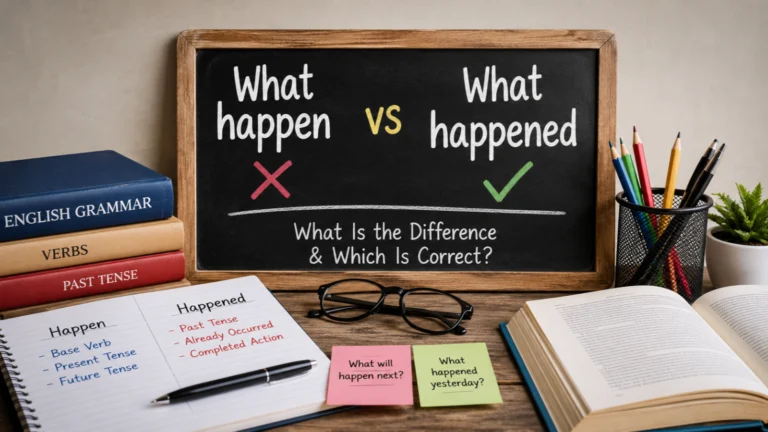
Many English learners wonder whether they should say “what happen” or “what happened.” At first glance, the two phrases look almost identical, which makes the confusion understandable. However, only one of them is grammatically correct in most everyday situations. Knowing when to use each form will help you sound more natural, improve your speaking skills, and avoid common grammar mistakes. In this guide, you’ll learn the difference in simple English, see plenty of examples, discover easy memory tricks, and test your understanding with a short quiz. By the end, you’ll confidently know which expression to use in different situations.
Why “What Happen” and “What Happened” Are Confusing
Many learners accidentally mix up these expressions because they appear very similar.
Similar Pronunciation
When native speakers talk quickly, happen and happened may sound alike, especially because the -ed ending is often pronounced softly.
Similar Spelling
The only visible difference is the addition of -ed, making it easy to overlook while writing.
Context Confusion
Learners often know that happen is the base verb and assume it can follow what directly. In reality, English grammar usually requires a helping verb or the past-tense form.
Common Learner Mistakes
Common incorrect sentences include:
- What happen yesterday?
- What happen to your phone?
- I don’t know what happen.
The correct versions are:
- What happened yesterday?
- What happened to your phone?
- I don’t know what happened.
What Happen vs What Happened Explained Simply
1- “What happen” is usually not grammatically correct by itself.
2- “What happened” is the correct phrase when asking about something that already took place.
One-line distinction
“What happened” describes a past event, while “what happen” is generally incomplete unless used with another helping verb.
Examples
- What happened after the meeting?
- Nobody knows what happened last night.
When using the base verb happen, you need a helping verb.
Examples:
- What will happen next?
- What does happen during winter?
Understanding Homophones in English
What Are Homophones?
Homophones are words that sound the same but have different meanings or spellings.
Example:
- there
- their
Although happen and happened are not homophones, learners often confuse them because they sound similar in fast speech.
Why Homophones Cause Confusion
English contains many words that sound alike. Learners sometimes rely on pronunciation instead of grammar.
Example:
- They’re coming tomorrow.
- Their house is beautiful.
The words sound almost identical but have different meanings.
Similarly, happen and happened require attention to grammar rather than pronunciation.
What Does “What Happen” Mean?
Definition and Core Meaning
Strictly speaking, “what happen” is not a complete or standard English question.
The word happen means:
to take place or occur.
However, the base verb happen normally requires a helping verb.
Examples:
- What will happen tomorrow?
- What does happen during an eclipse?
Using what happen? alone is considered grammatically incorrect in standard English.
Origin and Historical Use
The verb happen comes from Middle English and originally meant “to occur by chance.” Over time, it became one of the most common English verbs for describing events.
Modern Usage and Synonyms
Synonyms include:
- occur
- take place
- come about
- arise
Example Sentences
- We don’t know what will happen next.
- Strange things happen every winter.
- Accidents sometimes happen unexpectedly.
What Does “What Happened” Mean?
Definition and Core Meaning
“What happened” is a complete and correct English question.
It asks about something that has already occurred.
Examples:
- What happened yesterday?
- What happened to your car?
Origin and Historical Context
Happened is the simple past tense of happen. English uses the past tense to describe completed actions or events.
Modern Usage and Synonyms
Possible alternatives include:
- What occurred?
- What took place?
- What went on?
Example Sentences
- What happened after lunch?
- Can you explain what happened?
- Nobody knows what happened inside the building.
- I heard something happened at school.
What Happen vs What Happened: Key Differences at a Glance
| Word | Part of Speech | Meaning | Example Context |
|---|---|---|---|
| happen | Base verb | To occur or take place | What will happen tomorrow? |
| happened | Past tense verb | Occurred in the past | What happened yesterday? |
How to Remember the Difference Between What Happen and What Happened
Learning the difference is easy once you know one simple rule.
Easy Memory Tricks
- -ed = already finished
- If you’re talking about yesterday, last week, or earlier today, choose happened.
- If you’re using will, does, did, or another helping verb, use the base verb happen.
Association Technique
Think of -ed as a sign that the action has already ended.
Finished event → happened
Future event → will happen
Memorable Example
Yesterday:
✔ What happened?
Tomorrow:
✔ What will happen?
Common Mistakes and Confusions
Wrong
What happen yesterday?
Correct
What happened yesterday?
Explanation: Yesterday refers to the past.
Wrong
I don’t know what happen.
Correct
I don’t know what happened.
Explanation: The event has already occurred.
Wrong
What happened tomorrow?
Correct
What will happen tomorrow?
Explanation: Tomorrow refers to the future.
Wrong
What happen next?
Correct
What will happen next?
Explanation: Future events need will + happen.
Examples Section: Correct and Incorrect Usage
Example 1
✔ Correct: What happened after the game?
✘ Incorrect: What happen after the game?
Example 2
✔ Correct: Nobody knows what happened.
✘ Incorrect: Nobody knows what happen.
Example 3
✔ Correct: What will happen if it rains?
✘ Incorrect: What will happened if it rains?
Example 4
✔ Correct: Strange things happen here every winter.
✘ Incorrect: Strange things happened here every winter. (if describing a regular habit)
Example 5
✔ Correct: What does happen during a solar eclipse?
✘ Incorrect: What happened during every solar eclipse? (when referring to a general scientific process)
Self Assessment: Test Your Knowledge
Fill in the blanks.
1.
What __________ yesterday?
2.
Nobody knows what __________.
3.
What will __________ tomorrow?
4.
Accidents sometimes __________ unexpectedly.
Self Assessment Answers
- happened
- happened
- happen
- happen
FAQs About “What Happen” and “What Happened”
Is “What happen?” grammatically correct?
No. In standard English, “What happened?” is correct unless another helping verb is used.
Why do people say “What happen?”
Many English learners translate directly from their native language or forget to use the past tense.
Can I say “What will happened?”
No. After will, always use the base verb.
Correct:
What will happen?
Is “What happened?” always about the past?
Yes. It asks about an event that has already taken place.
What tense is “happened”?
It is the simple past tense of the verb happen.
Can “happen” be used without “will” or “does”?
Yes. It can be used as a normal verb.
Example:
- Accidents happen.
- Good things happen every day.
How can I remember the difference?
Remember:
- Past event = happened
- Helping verb + happen = correct
Final Conclusion: Using “What Happen” and “What Happened” Correctly
Understanding the difference between “what happen” and “what happened” is an important step toward speaking and writing accurate English. Although these expressions look very similar, they are not interchangeable. “What happened?” is the correct question when asking about something that has already taken place, making it one of the most common phrases in everyday English.
On the other hand, “what happen” by itself is not considered correct grammar. The base verb happen should only be used with a helping verb, such as will, does, can, or did, depending on the sentence. A simple memory trick can help: if the event is finished, choose happened; if another verb like will or does comes before it, use happen. Reading, listening, and practicing with real-life examples will make this rule feel natural over time. Don’t be discouraged if you make mistakes—every English learner experiences similar challenges. The more you notice these patterns in conversations, books, and media, the easier they become to remember. Keep practicing, review the examples in this guide whenever needed, and you’ll soon use happen and happened with confidence in both speaking and writing.