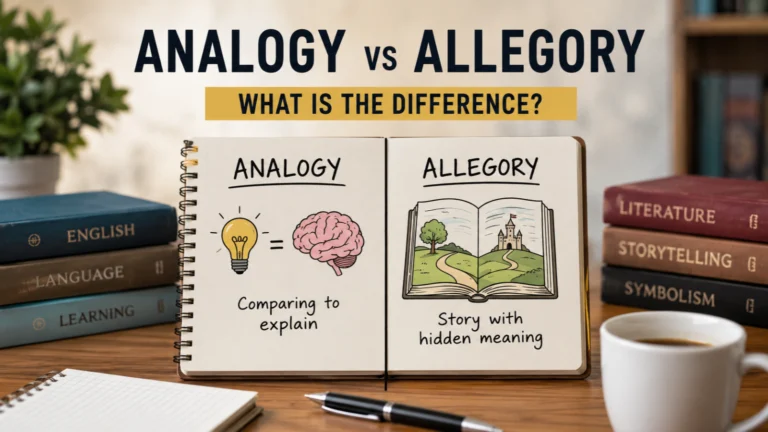
Analogy vs Allegory can be confusing because both are literary devices used to explain ideas and add depth to writing. However, they serve different purposes and are not interchangeable. An analogy compares two different things to make a concept easier to understand, while an allegory tells a complete story in which characters, events, and settings symbolize deeper meanings or moral lessons. Knowing the distinction helps students, writers, and readers interpret texts more accurately and communicate more effectively. In this guide, you’ll learn the key differences, practical examples, and when to use each device in your writing. By the end, Analogy vs Allegory will be much easier to understand, helping you avoid common mistakes and improve your language skills. Mastering Analogy vs Allegory will also make your reading and writing more confident and precise.
Why “Analogy” and “Allegory” Are Confusing
Many learners mistakenly think analogy and allegory have the same meaning because both are used to explain ideas in creative ways.
Here are the main reasons people mix them up:
Similar Pronunciation
Both words begin with “al-“ and have a similar rhythm when spoken, making them easy to confuse.
Similar Spelling
The spellings share several letters, although the endings are different.
- Analogy
- Allegory
Because they look alike, learners sometimes remember the wrong one.
Context Confusion
Both terms often appear in literature, education, philosophy, and writing classes. Since both involve meaning beyond the obvious, people may think they are interchangeable.
Common Learner Mistakes
- Calling a comparison an allegory.
- Referring to a symbolic story as an analogy.
- Assuming every metaphor is an allegory.
- Using “analogy” whenever symbolism appears.
Analogy vs Allegory Explained Simply
Analogy means comparing two things to explain an idea, while allegory means telling a symbolic story that represents a deeper message.
One-line Distinction
An analogy explains. An allegory symbolizes.
Examples
Analogy
“The human brain is like a computer because both process information.”
“The teacher used an analogy about a bridge to explain teamwork.”
Allegory
“Animal Farm” is an allegory about political power.
“The short story is an allegory of hope overcoming fear.”
Understanding Homophones in English
What Are Homophones?
Homophones are words that sound the same but have different meanings and often different spellings.
Example:
- Sea
- See
Although they sound alike, they mean different things.
Why Homophones Cause Confusion
English contains many words with similar sounds, making it easy for learners to choose the wrong one.
For example:
- Their
- There
- They’re
Interestingly, analogy and allegory are not homophones because they do not have identical pronunciation. However, their similar appearance and literary usage still cause confusion.
What Does “Analogy” Mean?
Definition and Core Meaning
An analogy is a comparison between two different things to explain an idea or make it easier to understand.
Its purpose is to clarify, teach, or illustrate.
Origin and Historical Use
The word comes from the Greek word analogia, meaning proportion or correspondence.
Ancient philosophers such as Aristotle frequently used analogies to explain complex ideas.
Modern Usage and Synonyms
Today, analogies are common in:
- Education
- Science
- Business
- Everyday conversation
- Public speaking
Synonyms
- Comparison
- Parallel
- Similarity
- Correspondence
- Illustration
Example Sentences
- Learning a language is like building a house one brick at a time. This is an analogy.
- The coach used an analogy about climbing mountains to motivate the team.
- Electricity flowing through wires is often explained using the analogy of water flowing through pipes.
What Does “Allegory” Mean?
Definition and Core Meaning
An allegory is a story, poem, or artwork in which people, places, and events represent deeper ideas, moral lessons, or political messages.
Everything in the story has both a literal meaning and a symbolic meaning.
Origin and Historical Context
The word comes from the Greek allegoria, meaning speaking differently or speaking in symbols.
Allegories have been used for centuries in religion, literature, and philosophy.
Modern Usage and Synonyms
Today, allegories appear in:
- Novels
- Children’s stories
- Films
- Religious writings
- Political literature
Synonyms
- Symbolic story
- Parable
- Extended metaphor
- Moral tale
- Symbolic narrative
Example Sentences
- The Pilgrim’s Progress is a famous allegory of the Christian journey.
- Many readers see The Chronicles of Narnia as an allegory containing religious symbolism.
- The movie works as an allegory about freedom and oppression.
Analogy vs Allegory: Key Differences at a Glance
| Word | Part of Speech | Meaning | Example Context |
|---|---|---|---|
| Analogy | Noun | A comparison used to explain something | “The teacher used an analogy about sports.” |
| Allegory | Noun | A symbolic story with a hidden meaning | “Animal Farm is an allegory about politics.” |
How to Remember the Difference Between Analogy and Allegory
Here are some easy tricks.
Easy Memory Tricks
- Analogy = Analysis + Explanation
- Think of explaining one idea by comparing it to another.
- Allegory = A Long Story
- Both allegory and story remind you that it is a complete narrative.
Association Techniques
Imagine a teacher using an analogy during class.
Now imagine an author writing an entire symbolic novel.
The first explains.
The second tells.
Memorable Example
“A teacher gives an analogy.
A novelist writes an allegory.”
This sentence is easy to remember.
Common Mistakes and Confusions
Wrong
“The teacher told an allegory about how the heart works.”
Correct
“The teacher used an analogy about a pump to explain how the heart works.”
Explanation: The teacher is comparing ideas, not telling a symbolic story.
Wrong
“Animal Farm is an analogy.”
Correct
“Animal Farm is an allegory.”
Explanation: The novel represents political events through symbolism.
Wrong
“His comparison was an allegory.”
Correct
“His comparison was an analogy.”
Explanation: A simple comparison is an analogy.
Examples Section: Correct and Incorrect Usage
✔ Correct:
“The scientist used an analogy to explain gravity.”
✘ Incorrect:
“The scientist used an allegory to explain gravity.”
✔ Correct:
“The novel is an allegory about justice.”
✘ Incorrect:
“The novel is an analogy about justice.”
✔ Correct:
“The coach’s analogy helped everyone understand teamwork.”
✘ Incorrect:
“The coach’s allegory helped everyone understand teamwork.”
✔ Correct:
“The children’s story is an allegory about kindness.”
✘ Incorrect:
“The children’s story is an analogy about kindness.”
Self Assessment: Test Your Knowledge
Fill in the blanks.
1.
The teacher used an ________ to explain photosynthesis.
2.
Animal Farm is an ________ about political power.
3.
A comparison that explains an idea is called an ________.
4.
A symbolic story with a hidden meaning is called an ________.
Self Assessment Answers
- analogy
- allegory
- analogy
- allegory
FAQs About “Analogy and Allegory”
1. What is the main difference between analogy and allegory?
An analogy is a comparison used to explain something, while an allegory is a symbolic story with a deeper meaning.
2. Is an allegory a type of analogy?
No. Although both involve meaning and comparison, an allegory is a complete narrative, whereas an analogy is simply an explanatory comparison.
3. Can one sentence be an allegory?
Usually not. Allegories are generally extended stories or narratives rather than single sentences.
4. Are analogy and metaphor the same?
No. A metaphor directly states that one thing is another, while an analogy explains similarities in greater detail to help understanding.
5. Is Animal Farm an analogy or an allegory?
It is an allegory because the characters and events symbolically represent historical people and political ideas.
6. Why do English learners confuse these words?
Their similar spelling, similar pronunciation, and frequent appearance in literature make them easy to mix up.
7. How can I remember which word to use?
Remember this simple rule: analogy explains; allegory symbolizes.
Final Conclusion: Using “Analogy” and “Allegory” Correctly
Understanding the difference between analogy and allegory will make your English clearer and more accurate. Although these words look and sound somewhat alike, they serve different purposes. An analogy is a comparison that helps explain an idea by relating it to something more familiar. Teachers, scientists, speakers, and writers use analogies every day to simplify complex topics. An allegory, on the other hand, is a complete story with a symbolic meaning beneath the surface. Authors use allegories to express moral lessons, political ideas, religious beliefs, or social criticism through characters and events that represent something deeper.
A simple way to remember the difference is this: an analogy explains, while an allegory tells a symbolic story. If you’re comparing two ideas to help someone understand, choose analogy. If you’re discussing a novel, poem, film, or narrative that carries hidden meanings throughout, choose allegory. Practicing with real examples, reading widely, and testing yourself with exercises like those in this guide will help these meanings become second nature. As your vocabulary grows, you’ll find it easier to recognize these literary terms and use them confidently in both writing and conversation. Keep learning, stay curious, and remember that every new word you master strengthens your English communication skills.