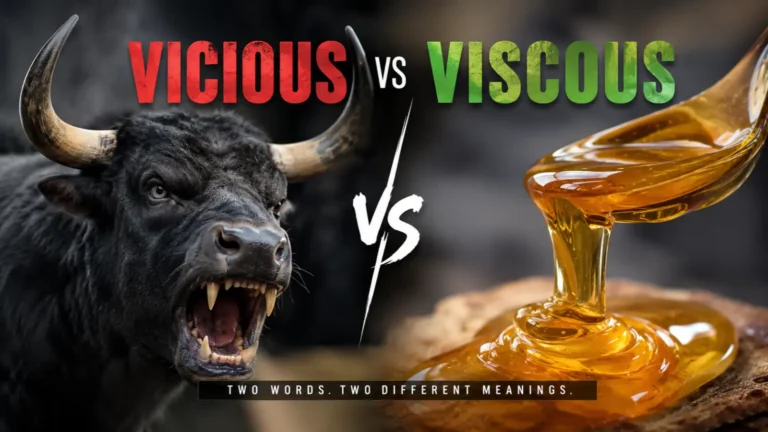
Vicious vs Viscous is a common word pair that confuses many English learners because the two words look and sound somewhat similar, yet they have completely different meanings. Understanding Vicious vs Viscous can help you avoid embarrassing mistakes in writing and conversation. Vicious describes someone or something that is cruel, violent, or intentionally harmful, while viscous refers to a thick, sticky liquid that flows slowly, such as honey or motor oil. Mixing these words up can change the meaning of an entire sentence. In this guide, you’ll learn the definitions, pronunciation, examples, key differences, and simple memory tips to master Vicious vs Viscous and use each word correctly with confidence.
Why “Vicious” and “Viscous” Are Confusing
Many English learners accidentally mix up vicious and viscous because they share a similar spelling and pronunciation. Despite their resemblance, they belong to completely different categories of meaning.
Here are the main reasons people confuse them:
Similar Pronunciation
Both words begin with “vis-“ and have nearly the same rhythm when spoken, making them easy to mishear.
Similar Spelling
Only one letter changes the word:
- Vicious
- Viscous
Because they look alike, writers often type the wrong one by mistake.
Context Confusion
Someone unfamiliar with these words may assume they have related meanings simply because they look similar. In reality, they describe entirely different ideas.
Common Learner Mistakes
Learners often write:
- “The oil is vicious.”
- “He is a viscous criminal.”
Both sentences are incorrect because the words have been swapped.
Vicious vs Viscous Explained Simply
Simply put:
Vicious means cruel, violent, or intentionally harmful, while viscous means thick and sticky, especially when talking about liquids.
One-Line Distinction
Vicious describes behavior or actions; viscous describes the consistency of a liquid.
Examples
- The dog became vicious when threatened.
- Honey is viscous and pours slowly.
Understanding Homophones in English
Although vicious and viscous are not true homophones, they are commonly confused because they sound similar.
What Are Homophones?
Homophones are words that sound the same but have different meanings and spellings.
Example:
- Sea
- See
These words sound identical but have different meanings.
Why Homophones Cause Confusion
When people hear similar-sounding words, they may spell them incorrectly.
Example:
Someone might hear “their” but write “there.”
Similarly, learners sometimes confuse vicious and viscous because their pronunciation is somewhat alike.
What Does “Vicious” Mean?
Definition and Core Meaning
Vicious is an adjective that describes someone or something that is deliberately cruel, violent, aggressive, or morally bad.
It often refers to harmful behavior, dangerous animals, severe criticism, or destructive cycles.
Origin and Historical Use
The word vicious comes from the Latin word vitiosus, meaning faulty, corrupt, or full of vice. It entered English during the Middle Ages and gradually became associated with cruelty and violence.
Modern Usage and Synonyms
Today, vicious commonly describes:
- Cruel people
- Violent animals
- Harsh attacks
- Destructive habits
- Dangerous situations
Synonyms
- Cruel
- Brutal
- Savage
- Fierce
- Violent
- Ruthless
- Malicious
Example Sentences
- The vicious dog chased the stranger.
- She faced a vicious online attack.
- The country experienced a vicious storm.
- He escaped a vicious cycle of poverty.
What Does “Viscous” Mean?
Definition and Core Meaning
Viscous is an adjective used to describe liquids that are thick, sticky, and slow to flow.
The thicker the liquid, the more viscous it is.
Origin and Historical Context
The word viscous comes from the Latin word viscum, meaning birdlime, a sticky substance once used to trap birds.
Its scientific meaning later expanded to describe the thickness or resistance of liquids.
Modern Usage and Synonyms
You will often hear viscous in:
- Science
- Chemistry
- Cooking
- Engineering
- Medicine
Synonyms
- Thick
- Sticky
- Glue-like
- Syrupy
- Dense
- Gooey
Example Sentences
- Honey is highly viscous.
- Engine oil becomes less viscous when heated.
- The syrup was too viscous to pour quickly.
- Lava is an extremely viscous liquid.
Vicious vs Viscous: Key Differences at a Glance
| Word | Part of Speech | Meaning | Example Context |
|---|---|---|---|
| Vicious | Adjective | Cruel, violent, harmful | A vicious attack |
| Viscous | Adjective | Thick and slow-flowing | Viscous motor oil |
How to Remember the Difference Between Vicious and Viscous
Here are some easy memory tricks.
Memory Trick 1
Vicious = Violence
Both begin with “Vi” and relate to harmful actions.
Memory Trick 2
Viscous = Sticky Substance
Think of viscous syrup or viscous honey.
Association Technique
Imagine:
- A vicious wolf attacking prey.
- A viscous jar of honey pouring slowly.
One is dangerous.
One is sticky.
Memorable Example
The vicious bear avoided the viscous mud.
The bear is dangerous.
The mud is thick.
Common Mistakes and Confusions
Wrong
The honey is vicious.
Correct
The honey is viscous.
Explanation: Honey is thick, not cruel.
Wrong
The criminal was viscous.
Correct
The criminal was vicious.
Explanation: Criminals can be cruel, not sticky.
Wrong
The engine uses vicious oil.
Correct
The engine uses viscous oil.
Explanation: Oil has viscosity.
Wrong
The viscous dog attacked everyone.
Correct
The vicious dog attacked everyone.
Explanation: Dogs can be aggressive, not thick.
Examples Section: Correct and Incorrect Usage
Example 1
✔ Correct: The boxer suffered a vicious punch.
✘ Incorrect: The boxer suffered a viscous punch.
Example 2
✔ Correct: Molasses is extremely viscous.
✘ Incorrect: Molasses is extremely vicious.
Example 3
✔ Correct: The newspaper published a vicious criticism.
✘ Incorrect: The newspaper published a viscous criticism.
Example 4
✔ Correct: The paint became more viscous in cold weather.
✘ Incorrect: The paint became more vicious in cold weather.
Self Assessment: Test Your Knowledge
Fill in the blanks with vicious or viscous.
- The snake made a ______ attack.
- Maple syrup is very ______.
- The article received ______ criticism online.
- Cold engine oil becomes more ______.
Self Assessment Answers
- vicious
- viscous
- vicious
- viscous
FAQs About “Vicious and Viscous”
1. Are vicious and viscous the same word?
No. They have different meanings even though they look similar.
2. Does vicious mean thick?
No. Vicious means cruel, violent, or harmful.
3. Does viscous describe people?
Usually no. Viscous describes liquids or substances, not people.
4. Is honey viscous?
Yes. Honey is naturally thick and flows slowly, making it highly viscous.
5. Can an animal be viscous?
Not in normal English. Animals can be vicious, but not viscous.
6. Which word is used in science?
Viscous is commonly used in science, engineering, physics, chemistry, and medicine to describe the thickness and flow of liquids.
7. How can I remember the difference quickly?
Remember this simple rule:
- Vicious = Violence
- Viscous = Viscosity (thickness)
Final Conclusion: Using “Vicious” and “Viscous” Correctly
Understanding the difference between vicious and viscous is easier once you connect each word to its core meaning. Vicious describes someone or something that is cruel, violent, aggressive, or intentionally harmful. It is commonly used when talking about dangerous animals, harsh criticism, destructive behavior, or severe attacks. Viscous, on the other hand, refers to the physical property of a liquid that is thick, sticky, and slow to flow. You’ll often see it in scientific discussions, cooking recipes, engineering, or descriptions of substances like honey, syrup, oil, paint, or lava.
A simple way to remember them is through association. Think of vicious as being related to violence or harmful behavior, and think of viscous as being connected to viscosity, the scientific term for a liquid’s thickness. This small memory trick can help you choose the correct word whenever you write or speak.
The more examples you read and practice, the more natural the distinction will become. Pay attention to context: if you’re describing behavior, actions, or attitudes, vicious is probably the right choice. If you’re talking about liquids or materials, viscous is the word you need. With regular practice and careful observation, you’ll avoid this common mistake and communicate more clearly and confidently in English.

Bilal Hassan is a Master’s graduate, content writer, and author at WordClaritty.com. He specializes in creating clear, informative, and reader-friendly content focused on language, word meanings, and educational topics. With a passion for accuracy and simplicity, he helps readers expand their knowledge through engaging and easy-to-understand articles.