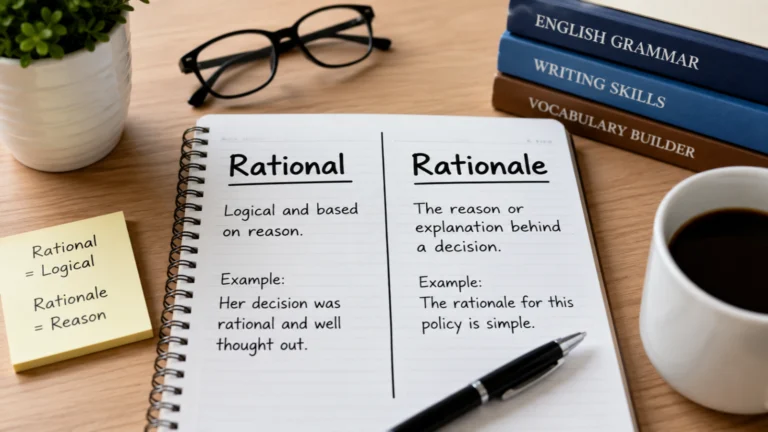
Rational vs Rationale is a common English language topic that often confuses students, professionals, and everyday writers because the two words look similar but have very different meanings. Understanding Rational vs Rationale can help you choose the correct word in academic writing, business communication, and daily conversations. While rational describes someone or something that is logical and based on reason, rationale refers to the explanation or reasoning behind a decision, action, or belief. Learning this distinction will improve your vocabulary, reduce writing mistakes, and make your communication clearer and more professional. In this guide, you’ll discover the meanings, differences, examples, and practical tips that make Rational vs Rationale easy to understand and remember.
Why “Rational” and “Rationale” Are Confusing
English learners often confuse rational and rationale because they are closely related in spelling and pronunciation.
Similar Pronunciation
Both words begin with ration-, making them sound alike when spoken quickly.
Similar Spelling
Only the ending differs:
- Rational
- Rationale
This small spelling difference can easily be overlooked.
Context Confusion
Both words relate to reason or logic, so learners sometimes assume they are interchangeable.
For example:
- “She made a rational decision.” ✔
- “She explained the rationale behind the decision.” ✔
Although both involve reasoning, they serve different grammatical roles.
Common Learner Mistakes
People often:
- Use rationale when describing a logical person.
- Use rational when talking about an explanation.
- Confuse adjective and noun forms.
Rational vs Rationale Explained Simply
Rational means based on logic or reason, while rationale means the reason or explanation behind something.
One-Line Distinction
Rational = logical.
Rationale = explanation.
Examples
Rational
- She made a rational choice.
- Try to remain rational during the discussion.
Rationale
- The teacher explained the rationale behind the new rule.
- We understand the rationale for changing the schedule.
Understanding Homophones in English
Although rational and rationale are not true homophones, they are often mistaken because they sound similar.
What Are Homophones?
Homophones are words that sound the same but have different meanings and spellings.
Example:
- Sea
- See
These words sound identical but have different meanings.
Why Homophones Cause Confusion
When learners hear words without seeing them written, similar sounds can lead to mistakes.
Example:
Someone might hear rational and incorrectly write rationale, even though they have different meanings.
What Does “Rational” Mean?
Definition and Core Meaning
Rational is an adjective.
It describes someone or something that is based on logic, reason, or careful thinking rather than emotions.
Origin and Historical Use
The word comes from the Latin rationalis, meaning “reasonable” or “having reason.” It has been used in English since the 14th century.
Modern Usage and Synonyms
Common synonyms include:
- Logical
- Reasonable
- Sensible
- Practical
- Sound
- Intelligent
Key Points
- Adjective
- Describes thinking or decisions
- Based on facts and logic
- Opposite of emotional or irrational
Example Sentences
- She made a rational decision after considering all the facts.
- A rational investor avoids unnecessary risks.
- It is important to stay rational during emergencies.
- His explanation sounded rational and convincing.
What Does “Rationale” Mean?
Definition and Core Meaning
Rationale is a noun.
It refers to the reason, justification, or explanation for an action, decision, belief, or plan.
Origin and Historical Context
The word entered English through French from Medieval Latin. It originally referred to a statement explaining the reasoning behind something.
Modern Usage and Synonyms
Common synonyms include:
- Explanation
- Reason
- Justification
- Basis
- Logic
- Motivation
Key Points
- Noun
- Means explanation or reasoning
- Often used in academic and professional writing
- Explains why something is done
Example Sentences
- The manager explained the rationale behind the new policy.
- Please include the rationale for your proposal.
- The report outlines the rationale for the budget increase.
- Understanding the rationale helps everyone accept the decision.
Rational vs Rationale: Key Differences at a Glance
| Word | Part of Speech | Meaning | Example Context |
|---|---|---|---|
| Rational | Adjective | Logical and reasonable | She gave a rational answer. |
| Rationale | Noun | The explanation or reason behind something | The rationale for the change was clear. |
How to Remember the Difference Between Rational and Rationale
Learning a simple memory trick can help you avoid mistakes.
Easy Memory Tricks
- Rational = Logical
- Rationale = Reason
Notice that rationale ends in -ale, which you can associate with an explanation or account.
Association Techniques
Imagine this situation:
- First, you make a rational decision.
- Then, you explain your rationale.
The decision comes first.
The explanation comes afterward.
Memorable Example
A rational doctor chooses the best treatment.
The doctor’s rationale explains why that treatment was chosen.
Common Mistakes and Confusions
Wrong
She gave a rational for changing the plan.
Correct
She gave a rationale for changing the plan.
Explanation: An explanation requires the noun rationale.
Wrong
The manager remained rationale during the crisis.
Correct
The manager remained rational during the crisis.
Explanation: We need an adjective describing the manager.
Wrong
The report explains the rational behind the decision.
Correct
The report explains the rationale behind the decision.
Wrong
His thinking was rationale.
Correct
His thinking was rational.
Examples Section: Correct and Incorrect Usage
Example 1
✔ Correct: The scientist gave a rational explanation based on evidence.
✘ Incorrect: The scientist gave a rationale explanation based on evidence.
Example 2
✔ Correct: The proposal included a detailed rationale.
✘ Incorrect: The proposal included a detailed rational.
Example 3
✔ Correct: She stayed rational during the emergency.
✘ Incorrect: She stayed rationale during the emergency.
Example 4
✔ Correct: The committee discussed the rationale for the new policy.
✘ Incorrect: The committee discussed the rational for the new policy.
Self Assessment: Test Your Knowledge
Fill in the blanks.
- The teacher explained the ________ behind the grading system.
- It is important to stay ________ when making financial decisions.
- Every research project should include its ________.
- His calm and ________ thinking solved the problem.
Self Assessment Answers
- rationale
- rational
- rationale
- rational
FAQs About Rational and Rationale
1. What is the main difference between rational and rationale?
Rational is an adjective meaning logical or reasonable. Rationale is a noun meaning the explanation or reason behind something.
2. Is rationale the noun form of rational?
Not exactly. Both words come from the same root related to reason, but rationale is an independent noun meaning explanation, while rational is an adjective.
3. Can I use rational instead of rationale?
No. They are different parts of speech and are not interchangeable.
4. Which word is used in business writing?
Both are common.
- Rational describes logical decisions.
- Rationale explains why those decisions were made.
5. Is rationale a formal word?
Yes. It is commonly used in education, research, business, government, and professional documents.
6. What is the opposite of rational?
The opposite is irrational, which means not based on reason or logic.
7. How can I remember the difference?
Remember this simple phrase:
Rational people make decisions. Rationale explains decisions.
Final Conclusion: Using “Rational” and “Rationale” Correctly
Understanding the difference between rational and rationale is an important step toward improving your English vocabulary and writing skills. Although these two words share a similar root and are connected by the idea of reason, they perform different jobs in a sentence. Rational is an adjective that describes logical thinking, sensible behavior, or decisions based on facts instead of emotions. Rationale, on the other hand, is a noun that refers to the explanation, justification, or reasoning behind an action or decision. A simple way to remember this is: a rational person makes a choice, and their rationale explains why they made it.
This memory trick works well in everyday conversations, academic assignments, workplace communication, and professional reports. Whenever you write or speak, pause for a moment and ask yourself whether you are describing a logical quality or providing an explanation. That simple question will help you choose the correct word with confidence. The more you read, write, and practice using these terms in real-life examples, the more natural they will become. Keep learning, stay curious, and remember that mastering small differences like rational versus rationale is a big step toward speaking and writing clear, accurate, and confident English.