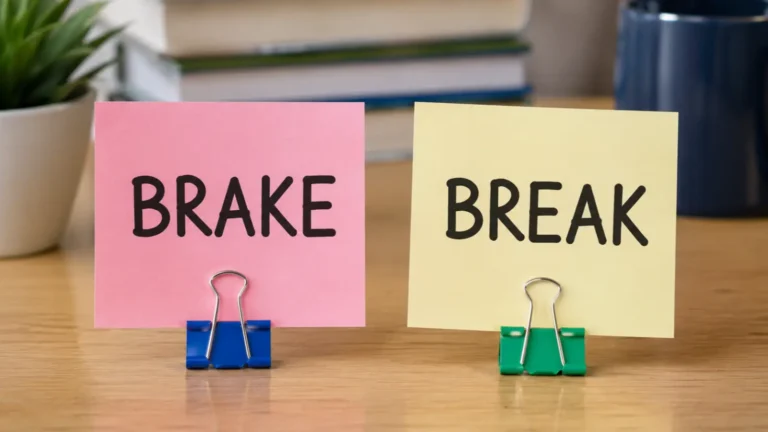
Brake vs Break is a common word pair that confuses many English learners because the two words sound exactly the same but have completely different meanings. Understanding the difference between Brake vs Break is important for clear writing, accurate speaking, and avoiding embarrassing mistakes in everyday communication. While brake usually refers to slowing or stopping a vehicle, break has several meanings, including separating something into pieces, taking a rest, or interrupting an activity. Since both words appear frequently in conversations, emails, exams, and professional writing, knowing when to use each one correctly is essential. In this guide, you’ll learn the meanings, differences, examples, grammar tips, and memory tricks that make Brake vs Break easy to understand and remember.
Why “Brake” and “Break” Are Confusing
The words brake and break often confuse English learners because they are homophones, meaning they are pronounced the same but have different spellings and meanings.
Here are the main reasons people mix them up:
- Similar pronunciation: Both words are pronounced as /breɪk/.
- Similar spelling: Only one letter differs, making them easy to mistype.
- Context confusion: Both words appear in everyday conversations, especially in travel, sports, work, and daily life.
- Common learner mistakes: Writers often spell brake as break when discussing cars or write break incorrectly when referring to stopping a vehicle.
Understanding the context is the easiest way to choose the correct word.
Brake vs Break Explained Simply
Brake means to slow down or stop movement, while break means to separate into pieces, damage something, or take a pause.
One-line distinction
Brake stops movement, while break means to damage, separate, or pause.
Examples
Brake
- Always use the brake before turning sharply.
- She pressed the brake to avoid hitting the cyclist.
Break
- Be careful not to break the glass.
- Let’s take a break after finishing this chapter.
Understanding Homophones in English
What Are Homophones?
Homophones are words that sound the same but have different meanings and spellings.
Example:
- Brake (to stop a vehicle)
- Break (to damage or pause)
Although they sound identical, their meanings are completely different.
Why Homophones Cause Confusion
People often learn spoken English before written English. Since homophones sound alike, many learners spell them incorrectly.
For example:
- “Press the break pedal.” ✘
- “Press the brake pedal.” ✔
Reading and writing regularly helps reduce these mistakes.
What Does “Brake” Mean?
Definition and Core Meaning
The word brake refers to a device or action used to slow down or stop movement, especially in vehicles.
It can be used as both a noun and a verb.
Origin and Historical Use
The word brake comes from older English words meaning to restrain or slow down. As transportation developed, the word became closely associated with the systems used to stop bicycles, trains, motorcycles, and cars.
Modern Usage and Synonyms
Common meanings include:
- To stop a vehicle
- To reduce speed
- A stopping mechanism
Synonyms
- Stop
- Slow
- Decelerate
- Halt
- Restrain
Example Sentences
- She gently applied the brake before the traffic light.
- Always check your brakes before a long journey.
- The cyclist used the rear brake on the steep hill.
- He braked suddenly when a deer crossed the road.
What Does “Break” Mean?
Definition and Core Meaning
The word break has several meanings. It commonly means to separate into pieces, damage something, interrupt something, or take a rest.
It can be both a verb and a noun.
Origin and Historical Context
The word break comes from Old English and has been used for centuries to describe something splitting apart or stopping temporarily.
Over time, its meanings expanded to include pauses, opportunities, interruptions, and even records being surpassed.
Modern Usage and Synonyms
Common meanings include:
- Damage something
- Separate into pieces
- Pause from work
- Interrupt
- Escape
Synonyms
- Smash
- Crack
- Split
- Pause
- Rest
- Interrupt
Example Sentences
- Don’t break your phone.
- We need a short break before the meeting.
- The children accidentally broke the vase.
- She took a coffee break after lunch.
Brake vs Break: Key Differences at a Glance
| Word | Part of Speech | Meaning | Example Context |
|---|---|---|---|
| Brake | Noun, Verb | To slow or stop movement | Press the brake before the turn. |
| Break | Noun, Verb | To damage, separate, pause, or interrupt | Don’t break the window. |
How to Remember the Difference Between Brake and Break
Learning a simple memory trick can help you avoid mistakes.
Easy Memory Tricks
- Brake has an A, just like Automobile.
- Brake is connected with cars, bikes, and vehicles.
- Break contains the word idea of something breaking apart.
Association Techniques
Think:
- Brake = Stop the car
- Break = Crack or pause
Memorable Example
Use the brake so you don’t break the car.
This sentence contains both words correctly and is easy to remember.
Common Mistakes and Confusions
Wrong
❌ I hit the break when the light turned red.
Correct
✔ I hit the brake when the light turned red.
Explanation: A vehicle uses a brake, not a break.
Wrong
❌ Please don’t brake the plate.
Correct
✔ Please don’t break the plate.
Explanation: Plates can break, not brake.
Wrong
❌ We took a five-minute brake.
Correct
✔ We took a five-minute break.
Explanation: A pause is called a break.
Wrong
❌ The driver forgot to break before the curve.
Correct
✔ The driver forgot to brake before the curve.
Explanation: Slowing a vehicle requires the verb brake.
Examples Section: Correct and Incorrect Usage
Example 1
✔ Correct: The driver pressed the brake immediately.
✘ Incorrect: The driver pressed the break immediately.
Example 2
✔ Correct: Be careful not to break the mirror.
✘ Incorrect: Be careful not to brake the mirror.
Example 3
✔ Correct: We stopped for a lunch break.
✘ Incorrect: We stopped for a lunch brake.
Example 4
✔ Correct: Always test your brakes before driving.
✘ Incorrect: Always test your breaks before driving.
Self Assessment: Test Your Knowledge
Fill in the blanks with brake or break.
- Please press the ______ before turning.
- Don’t ______ the glass.
- We took a short coffee ______.
- The cyclist used the front ______ to stop safely.
Self Assessment Answers
- brake
- break
- break
- brake
FAQs About “Brake” and “Break”
1. Are brake and break pronounced the same?
Yes. They are homophones and are pronounced exactly the same.
2. Is it “press the brake” or “press the break”?
The correct phrase is press the brake because a brake stops a vehicle.
3. Can brake be used as a verb?
Yes. For example:
The driver braked quickly.
4. Can break be both a noun and a verb?
Yes.
Verb:
- Don’t break the toy.
Noun:
- Let’s take a break.
5. Which word is used for taking a rest?
Use break when referring to a pause or rest.
Example:
- We had a short break after class.
6. Which word is related to vehicles?
Brake is related to stopping or slowing vehicles.
7. How can I remember the difference quickly?
Remember:
- Brake = Automobile
- Break = Damage or Pause
Final Conclusion: Using “Brake” and “Break” Correctly
Understanding the difference between brake and break is easier once you focus on their meanings rather than their pronunciation. Although these words sound identical, they serve very different purposes in English. Brake refers to slowing down or stopping movement, especially when driving a vehicle. Break, on the other hand, means to damage something, divide it into pieces, interrupt an activity, or take a period of rest. Paying attention to the context will usually make the correct choice obvious.
A helpful way to remember them is the simple association: brake goes with automobiles, while break goes with breaking or taking a break. You can also recall the sentence, “Use the brake so you don’t break the car,” which reinforces both meanings in a memorable way.
As you continue learning English, don’t worry if you occasionally confuse these homophones. Even native speakers sometimes make spelling mistakes when typing quickly. The key is to read regularly, practice writing complete sentences, and review examples whenever you encounter confusing word pairs. With consistent practice, choosing between brake and break will become second nature, helping you write more accurately, speak with confidence, and communicate clearly in both everyday conversations and professional situations.

Bilal Hassan is a Master’s graduate, content writer, and author at WordClaritty.com. He specializes in creating clear, informative, and reader-friendly content focused on language, word meanings, and educational topics. With a passion for accuracy and simplicity, he helps readers expand their knowledge through engaging and easy-to-understand articles.