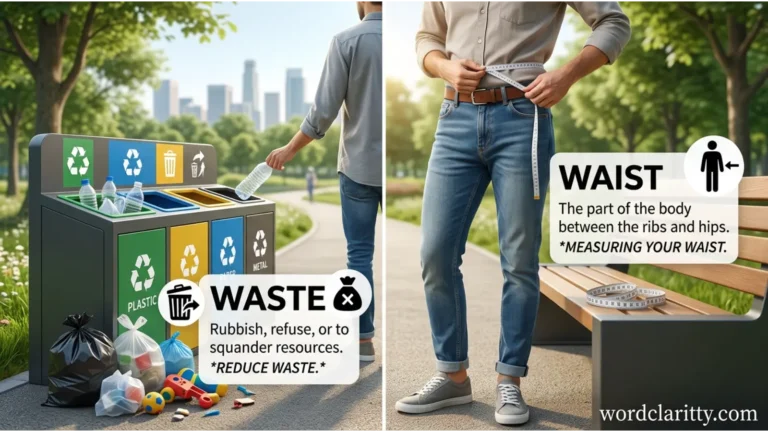
Waste vs Waist is a common source of confusion for English learners because the two words sound exactly alike but have completely different meanings. Understanding the difference between them can improve both your writing and speaking skills while helping you avoid embarrassing mistakes. Waste vs Waist is an example of a pair of homophones—words that share the same pronunciation but differ in spelling and meaning. Waste usually refers to something that is unused, thrown away, or used carelessly, while waist is the part of the body between the ribs and hips. In this guide, you’ll learn the definitions, pronunciation, examples, and simple memory tricks to remember the correct word every time. By the end, Waste vs Waist will no longer be confusing.
Why “Waste” and “Waist” Are Confusing
Many English learners confuse waste and waist because they are homophones, meaning they sound exactly alike but have different meanings and spellings.
Similar Pronunciation
Both words are pronounced as /weɪst/, making them identical in speech.
For example:
- “Don’t waste your time.”
- “She tied a belt around her waist.”
Even though they sound the same, they refer to completely different things.
Similar Spelling
The words differ by only one letter:
- Waste
- Waist
Because they look so similar, writers often type the wrong one by mistake.
Context Confusion
Learners sometimes focus on pronunciation instead of meaning.
For example:
- ❌ My waste hurts.
- ✔ My waist hurts.
Common Learner Mistakes
People often confuse these words when talking about:
- Clothing
- Health
- Recycling
- Time management
- Food
- Exercise
Understanding the context makes choosing the correct word much easier.
Waste vs Waist Explained Simply
Here’s the easiest way to remember them:
Waste means using something carelessly or unwanted material, while waist is the middle part of your body between your ribs and hips.
One-Line Distinction
Waste is about loss or unnecessary use; waist is a body part.
Example Sentences
Waste
- Don’t waste your money on things you don’t need.
- Food waste is a serious environmental problem.
Waist
- The dress fits perfectly around her waist.
- He measured his waist before buying new jeans.
Understanding Homophones in English
What Are Homophones?
Homophones are words that sound the same but have different spellings and meanings.
Example:
- Flower
- Flour
Although they sound identical, they mean different things.
Why Homophones Cause Confusion
English has many homophones because pronunciation has changed over time while spelling often remained the same.
For example:
- Their
- There
- They’re
The same happens with waste and waist, making careful reading and understanding of context essential.
What Does “Waste” Mean?
Definition and Core Meaning
Waste means:
- To use something carelessly or unnecessarily.
- Material that is no longer useful.
- A loss of time, money, energy, or resources.
It can be used as both a noun and a verb.
Origin and Historical Use
The word waste comes from Old French and Latin roots meaning empty, desolate, or ruined. Over time, it developed meanings related to unnecessary loss and discarded materials.
Modern Usage and Synonyms
Common synonyms include:
- Squander
- Misuse
- Throw away
- Loss
- Garbage
- Rubbish
- Refuse
Common Uses
- Waste time
- Waste money
- Waste energy
- Food waste
- Plastic waste
- Industrial waste
Example Sentences
- Don’t waste your opportunities.
- We should recycle household waste.
- She wasted an entire afternoon watching television.
- Water waste should be reduced.
What Does “Waist” Mean?
Definition and Core Meaning
Waist refers to the narrow middle section of the human body between the ribs and the hips.
It is always a noun.
Origin and Historical Context
The word comes from Middle English and has referred to the body’s middle section for hundreds of years. It later became common in tailoring and fashion.
Modern Usage and Synonyms
Related words include:
- Midsection
- Midriff
- Torso (general)
- Belt line
Common Uses
- Waist size
- Waist measurement
- Waist belt
- High-waisted pants
- Slim waist
Example Sentences
- She wrapped a scarf around her waist.
- His waist measured thirty-four inches.
- The belt fits comfortably around my waist.
- Exercise can strengthen your waist muscles.
Waste vs Waist: Key Differences at a Glance
| Word | Part of Speech | Meaning | Example Context |
|---|---|---|---|
| Waste | Noun, Verb | Loss, unnecessary use, unwanted material | Don’t waste water. |
| Waist | Noun | Middle part of the human body | The belt fits my waist. |
How to Remember the Difference Between Waste and Waist
Learning a simple memory trick can prevent future mistakes.
Easy Memory Tricks
Remember the Letter “I”
Waist contains the letter I.
Think:
I have a waist.
Think About Health
If you’re measuring your body, you need waist, not waste.
Think About Throwing Things Away
If you’re talking about garbage, losing time, or using resources poorly, use waste.
Association Technique
- Waste → Trash
- Waist → Belt
If a belt can go around it, it’s your waist.
Memorable Example
Don’t waste money buying pants without measuring your waist first.
This sentence uses both words correctly.
Common Mistakes and Confusions
Mistake 1
❌ I hurt my waste yesterday.
✔ I hurt my waist yesterday.
Explanation: You’re talking about a body part.
Mistake 2
❌ Don’t waist your food.
✔ Don’t waste your food.
Explanation: You’re talking about unnecessary use.
Mistake 3
❌ Her waste measurement is 28 inches.
✔ Her waist measurement is 28 inches.
Explanation: Clothing sizes refer to the waist.
Mistake 4
❌ We should reduce waist in our kitchen.
✔ We should reduce waste in our kitchen.
Explanation: Kitchen waste means discarded food or materials.
Examples Section: Correct and Incorrect Usage
Example 1
✔ Correct: Don’t waste electricity.
✘ Incorrect: Don’t waist electricity.
Example 2
✔ Correct: She tied the jacket around her waist.
✘ Incorrect: She tied the jacket around her waste.
Example 3
✔ Correct: Food waste should be recycled whenever possible.
✘ Incorrect: Food waist should be recycled whenever possible.
Example 4
✔ Correct: He has a 32-inch waist.
✘ Incorrect: He has a 32-inch waste.
Example 5
✔ Correct: It would be a waste of time to ignore the instructions.
✘ Incorrect: It would be a waist of time to ignore the instructions.
Self Assessment: Test Your Knowledge
Fill in the blanks with waste or waist.
- She measured her ______ before ordering new clothes.
- Don’t ______ your chance to learn English.
- The belt fits comfortably around my ______.
- We should reduce plastic ______ to protect the environment.
Self Assessment Answers
- Waist
- Waste
- Waist
- Waste
FAQs About “Waste” and “Waist”
1. Are waste and waist pronounced the same?
Yes. They are homophones and share the same pronunciation.
2. What does waste mean?
Waste refers to unnecessary use, loss, or unwanted material.
3. What does waist mean?
Waist is the middle part of your body between your ribs and hips.
4. Is “waist of time” correct?
No. The correct expression is waste of time.
5. Can waste be both a noun and a verb?
Yes. You can say:
- Don’t waste food. (verb)
- Food waste is increasing. (noun)
6. Is waist ever used as a verb?
No. Waist is only used as a noun.
7. How can I remember the difference quickly?
Think of a belt for waist and trash or loss for waste. This simple association makes it easier to choose the correct word.
Final Conclusion: Using “Waste” and “Waist” Correctly
Understanding the difference between waste and waist is easier than it first appears. Although these two words are pronounced exactly the same, they belong to entirely different contexts. Waste refers to using something carelessly, losing valuable resources, or unwanted materials such as garbage or food scraps. It can function as both a noun and a verb in everyday English. Waist, on the other hand, is always a noun and refers to the middle part of the human body where a belt is usually worn. Keeping this distinction in mind will help you avoid one of the most common spelling mistakes among English learners.
A practical way to remember them is through simple associations: think “waste equals trash or loss” and “waist equals belt or body.” Whenever you’re talking about time, money, energy, water, or recycling, waste is almost certainly the correct choice. If you’re discussing clothing sizes, exercise, fashion, or body measurements, you need waist instead. Reading regularly, practicing with example sentences, and paying attention to context will make these words feel natural over time. Every small grammar improvement strengthens your overall English skills, so don’t be discouraged by occasional mistakes. Keep practicing, review these memory tips whenever needed, and you’ll soon use waste and waist correctly with confidence in both speaking and writing.

Bilal Hassan is a Master’s graduate, content writer, and author at WordClaritty.com. He specializes in creating clear, informative, and reader-friendly content focused on language, word meanings, and educational topics. With a passion for accuracy and simplicity, he helps readers expand their knowledge through engaging and easy-to-understand articles.