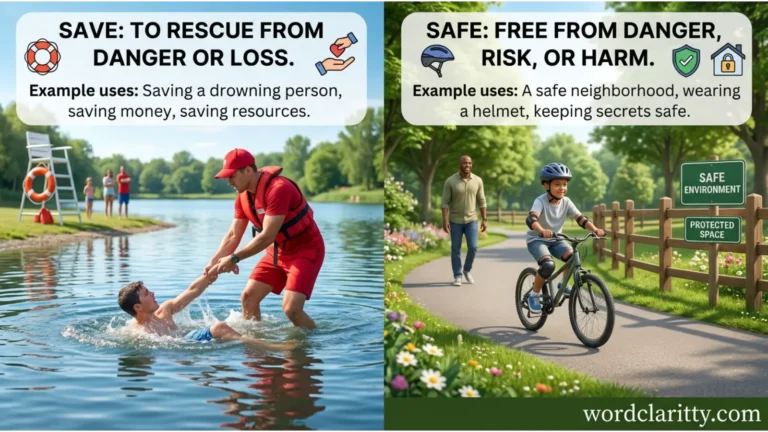
Save vs Safe is a common source of confusion for English learners because the two words look similar and are often used in related situations. Save vs Safe becomes easier to understand when you know that save is usually a verb, while safe is mainly an adjective. For example, you save money, but your money is safe in the bank. Many learners accidentally write “safe” when they mean “save,” which can change the meaning of a sentence completely. Understanding Save vs Safe is important for writing emails, school assignments, and everyday messages correctly. In this guide, you will learn the meaning, grammar, pronunciation, and correct usage of both words with simple examples and practical tips.
Why “Save” and “Safe” Are Confusing
Many English learners accidentally mix up save and safe because they share similar features.
Similar Pronunciation
The words are pronounced almost the same. The only major difference is the final sound.
- Save ends with a /v/ sound.
- Safe ends with an /f/ sound.
These sounds can be difficult for learners because they are produced in nearly the same place in the mouth.
Similar Spelling
The two words differ by only one letter.
- Save
- Safe
Since only the last letter changes, learners often type or write the wrong word.
Context Confusion
Both words are commonly used when talking about protection.
For example:
- Save someone’s life.
- Keep someone safe.
Because both involve preventing harm, people sometimes think they can be used interchangeably.
Common Learner Mistakes
Some common mistakes include:
- ❌ I want to safe my document.
- ❌ Please save while crossing the road.
These sentences use the wrong word because save is usually an action, while safe describes a condition.
Save vs Safe Explained Simply
The easiest way to remember the difference is this:
Save means to protect, rescue, store, or keep something for later, while safe means protected, secure, or free from danger.
One-Line Distinction
Save is usually a verb, while safe is usually an adjective.
Examples
Save
- Please save your homework before closing the computer.
- Firefighters saved the family from the burning house.
Safe
- The children are safe inside the building.
- Keep your passport in a safe place.
Understanding Homophones in English
What Are Homophones?
Homophones are words that sound the same or nearly the same but have different meanings and often different spellings.
Example:
- Their
- There
Although they sound alike, they are used differently.
Why Homophones Cause Confusion
English contains many words that sound similar. Learners often rely on pronunciation instead of meaning.
For example:
- Save your file.
- Your file is safe.
The words sound similar but cannot replace each other.
What Does “Save” Mean?
Definition and Core Meaning
Save is mainly a verb. It means to rescue, protect, store, or keep something for future use.
Depending on the context, save may mean:
- Rescue from danger
- Store information
- Keep money
- Prevent waste
- Preserve something
Origin and Historical Use
The word save comes from the Latin salvare, meaning “to make safe” or “to rescue.” It entered English through Old French and has been used for centuries to describe protection and preservation.
Modern Usage and Synonyms
Today, save appears in many everyday situations.
Synonyms include:
- Rescue
- Protect
- Preserve
- Store
- Keep
- Spare
Examples
- Save your work before turning off the computer.
- We are saving money for a vacation.
- The doctor saved the patient’s life.
- Recycling helps save natural resources.
What Does “Safe” Mean?
Definition and Core Meaning
Safe is usually an adjective. It describes someone or something that is protected from danger, injury, or harm.
It may also describe a secure location or condition.
Origin and Historical Context
The word safe comes from the Latin salvus, meaning “healthy, unharmed, or secure.” It entered English through French and has long been associated with security and protection.
Modern Usage and Synonyms
Today, safe is used in conversations about health, travel, security, and everyday life.
Synonyms include:
- Secure
- Protected
- Harmless
- Shielded
- Risk-free
- Unharmed
Examples
- Your belongings are safe here.
- Drive safely so everyone stays safe.
- The baby is safe with her parents.
- Always keep medicines in a safe place.
Save vs Safe: Key Differences at a Glance
| Word | Part of Speech | Meaning | Example Context |
|---|---|---|---|
| Save | Verb | To rescue, store, preserve, or keep | Save your file before closing the program. |
| Safe | Adjective | Protected from danger or secure | The children are safe at home. |
How to Remember the Difference Between Save and Safe
Here are a few simple memory tricks.
Easy Memory Tricks
- Save = Action
- Safe = State
If someone is doing something, use save.
If someone or something is protected, use safe.
Association Techniques
Think about your computer.
- You save a document.
- The saved document is safe on your computer.
One Memorable Example
You save money to keep your future safe.
This sentence uses both words correctly and shows their different meanings.
Common Mistakes and Confusions
Wrong Example
❌ Please safe your homework.
Correct Version
✔ Please save your homework.
Explanation: Saving is an action.
Wrong Example
❌ The children were save after the storm.
Correct Version
✔ The children were safe after the storm.
Explanation: Safe describes their condition.
Wrong Example
❌ Keep your password save.
Correct Version
✔ Keep your password safe.
Explanation: Safe describes security.
Wrong Example
❌ She is trying to safe enough money.
Correct Version
✔ She is trying to save enough money.
Explanation: Save means to keep money for later.
Examples Section: Correct and Incorrect Usage
Example 1
✔ Correct: Save your progress before exiting the game.
✘ Incorrect: Safe your progress before exiting the game.
Example 2
✔ Correct: We arrived home safe and sound.
✘ Incorrect: We arrived home save and sound.
Example 3
✔ Correct: The lifeguard saved the swimmer.
✘ Incorrect: The lifeguard safed the swimmer.
Example 4
✔ Correct: Your information is safe with us.
✘ Incorrect: Your information is save with us.
Example 5
✔ Correct: Saving electricity helps the environment.
✘ Incorrect: Safing electricity helps the environment.
Self Assessment: Test Your Knowledge
Fill in the blanks with save or safe.
- Please ______ your work before shutting down the computer.
- The hikers were finally ______ after the rescue team arrived.
- We are trying to ______ enough money to buy a new car.
- Keep your passport in a ______ place while traveling.
Self Assessment Answers
- save
- safe
- save
- safe
FAQs About “Save” and “Safe”
1. Is it “save” or “safe” a document?
Use save because storing a document is an action.
2. Can “safe” be used as a verb?
No. Safe is generally an adjective. The verb is save.
3. Why do save and safe sound so similar?
They share almost the same pronunciation, differing mainly in the final consonant sound.
4. Is “save” always a verb?
Mostly, yes. However, save can occasionally appear as a noun in sports, such as “The goalkeeper made a great save.”
5. What does “safe” describe?
It describes a person, place, object, or situation that is protected from danger.
6. How can I remember the difference easily?
Remember: Save = Do something. Safe = Protected condition.
7. Can both words appear in one sentence?
Yes.
Example:
Save your passwords in a safe location.
Final Conclusion: Using “Save” and “Safe” Correctly
Understanding the difference between save and safe is easier once you remember the role each word plays. Save is usually a verb that means to rescue, protect, store, preserve, or keep something for the future. You save a file on your computer, save money for an important goal, or save someone from danger. Safe, on the other hand, is usually an adjective that describes someone or something as protected, secure, or free from harm. A child can be safe at home, your valuables can be kept in a safe place, and careful driving helps everyone stay safe.
A simple memory trick is to think of save as an action and safe as a condition. You perform the action of saving so that people, belongings, or information remain safe. As you continue learning English, pay attention to how these words appear in books, conversations, news articles, and everyday situations. The more you read and practice, the more natural the difference will become. Keep reviewing examples, complete practice exercises, and use both words in your own sentences. With regular practice, choosing between save and safe will soon become automatic, helping you communicate more clearly and confidently in both spoken and written English.

Bilal Hassan is a Master’s graduate, content writer, and author at WordClaritty.com. He specializes in creating clear, informative, and reader-friendly content focused on language, word meanings, and educational topics. With a passion for accuracy and simplicity, he helps readers expand their knowledge through engaging and easy-to-understand articles.