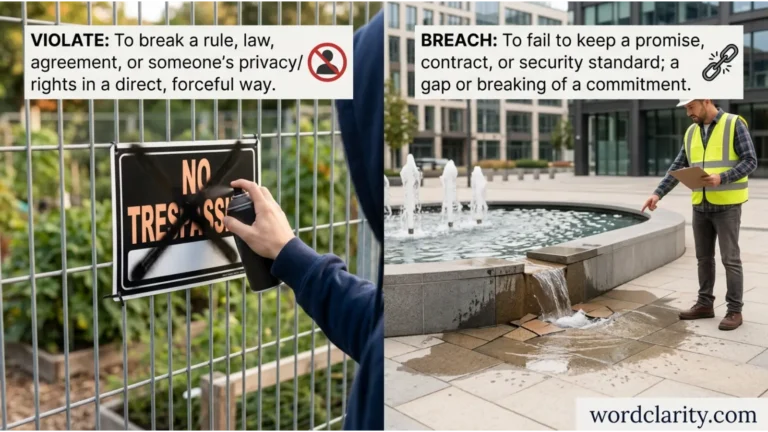
Violate vs Breach is a common grammar topic that confuses many English learners because both words can describe breaking a rule, law, agreement, or obligation. However, they are not always interchangeable, and using the wrong one can make your writing sound unnatural or inaccurate. Understanding the difference between these two terms will help you communicate more clearly in academic, professional, and everyday English. In this guide, you’ll learn the meanings, correct usage, key differences, and practical examples that make each word easy to remember. By the end, Violate vs Breach will no longer be confusing, and you’ll know exactly which word fits different contexts. Mastering Violate vs Breach is an important step toward writing and speaking English with greater confidence.
Why “Violate” and “Breach” Are Confusing
Many English learners mix up violate and breach because they often appear in similar situations. Both words can describe failing to follow rules, laws, contracts, or promises. However, they focus on slightly different ideas.
Similar Pronunciation
Although violate and breach do not sound alike, learners often encounter them in similar legal or formal conversations, making them easy to confuse.
Similar Spelling
These words are not spelled similarly. The confusion comes from their meanings rather than their spelling.
Context Confusion
Both words commonly appear with:
- Laws
- Rules
- Contracts
- Privacy
- Trust
- Agreements
For example:
- Violate the law
- Breach a contract
Since both involve breaking something important, learners sometimes choose the wrong word.
Common Learner Mistakes
Many learners write:
- ❌ He breached the law.
- ❌ They violated the contract.
While the second sentence may sometimes be acceptable, native speakers usually prefer breach a contract and violate a law because these combinations sound more natural.
Violate vs Breach Explained Simply
The easiest way to understand these words is to remember what each one usually refers to.
Violate means breaking a rule, law, right, or principle, while breach means breaking an agreement, contract, trust, or security barrier.
One-Line Distinction
Violate focuses on breaking rules or rights, whereas breach focuses on breaking agreements, duties, or security.
Examples
Violate
- She violated the school rules.
- The company violated environmental laws.
Breach
- The supplier breached the contract.
- Hackers caused a security breach.
Understanding Homophones in English
What Are Homophones?
Homophones are words that sound the same but have different meanings and spellings.
Example:
- Pair
- Pear
Although they sound identical, they have different meanings.
Violate and breach are not homophones. However, learners often confuse them because they share similar meanings in certain contexts.
Why Homophones Cause Confusion
Homophones can make English difficult because listeners hear the same sound but must understand the meaning from context.
Example:
“I bought a pear.”
“I bought a pair of shoes.”
Although violate and breach are not homophones, context confusion works in a similar way because both can describe breaking something important
What Does “Violate” Mean?
Definition and Core Meaning
Violate means to break or fail to obey a law, rule, right, promise, or principle.
It often suggests doing something that is morally, legally, or officially wrong.
Origin and Historical Use
The word violate comes from the Latin word violare, meaning to treat with violence, dishonor, or disrespect.
Over time, its meaning expanded to include breaking laws, rules, or personal rights.
Modern Usage and Synonyms
Common synonyms include:
- Break
- Disobey
- Ignore
- Infringe
- Contravene
- Disrespect
Common Uses
- Violate a law
- Violate a rule
- Violate someone’s rights
- Violate company policy
- Violate international law
Example Sentences
- Drivers who speed violate traffic laws.
- The company violated workers’ rights.
- Students should never violate school regulations.
- Publishing private information may violate someone’s privacy.
What Does “Breach” Mean?
Definition and Core Meaning
Breach means to break an agreement, contract, trust, duty, or security system.
It often refers to failing to fulfill an obligation or allowing unauthorized access.
Origin and Historical Context
The word breach comes from Old English and originally meant a break, gap, or opening.
Its meaning later expanded to include broken agreements and failures to meet responsibilities.
Modern Usage and Synonyms
Common synonyms include:
- Break
- Violation
- Default
- Failure
- Infringement
- Contravention
Common Uses
- Breach of contract
- Security breach
- Data breach
- Breach of trust
- Breach of confidentiality
Example Sentences
- The employee committed a breach of confidentiality.
- Hackers caused a major data breach.
- The company breached the contract.
- His actions were a breach of trust.
Violate vs Breach: Key Differences at a Glance
| Word | Part of Speech | Meaning | Example Context |
|---|---|---|---|
| Violate | Verb | Break a law, rule, right, or principle | Violate traffic laws |
| Breach | Noun / Verb | Break a contract, agreement, trust, or security | Breach of contract |
How to Remember the Difference Between Violate and Breach
Here are a few easy tricks.
Memory Trick 1
Think:
Violate = Rules and Rights
Examples:
- Violate the law
- Violate human rights
- Violate regulations
Memory Trick 2
Think:
Breach = Business and Barriers
Examples:
- Breach a contract
- Security breach
- Data breach
- Breach of trust
Association Technique
Imagine a police officer.
If someone breaks a law, they violate it.
Now imagine two companies signing a contract.
If one company fails to follow it, they breach the agreement.
Memorable Example
- A driver violates traffic laws.
- A company breaches a business contract.
Common Mistakes and Confusions
Mistake 1
❌ He breached the traffic law.
✔ He violated the traffic law.
Explanation: Laws are usually violated, not breached.
Mistake 2
❌ They violated the business contract.
✔ They breached the business contract.
Explanation: Contracts are most commonly breached.
Mistake 3
❌ The hackers violated the database.
✔ The hackers caused a data breach.
Explanation: Security incidents are usually described as breaches.
Mistake 4
❌ She breached my privacy.
✔ She violated my privacy.
Explanation: Privacy is commonly violated.
Examples Section: Correct and Incorrect Usage
Example 1
✔ Correct: The company breached the contract.
✘ Incorrect: The company violated the contract.
Example 2
✔ Correct: He violated the school rules.
✘ Incorrect: He breached the school rules.
Example 3
✔ Correct: The hackers caused a security breach.
✘ Incorrect: The hackers caused a security violation.
Example 4
✔ Correct: The government must not violate human rights.
✘ Incorrect: The government must not breach human rights.
Example 5
✔ Correct: She committed a breach of trust.
✘ Incorrect: She committed a violation of trust.
Example 6
✔ Correct: They violated the company’s safety policy.
✘ Incorrect: They breached the company’s safety policy.
Self Assessment: Test Your Knowledge
Choose the correct word.
1.
The employee ________ the confidentiality agreement.
2.
You should never ________ traffic laws.
3.
Hackers caused a serious data ________.
4.
The government must not ________ human rights.
Self Assessment Answers
- breached
- violate
- breach
- violate
FAQs About “Violate” and “Breach”
1. Are violate and breach synonyms?
They are similar but not identical. Violate usually refers to breaking laws, rules, or rights, while breach commonly refers to breaking agreements, contracts, trust, or security.
2. Is it “breach of contract” or “violation of contract”?
Breach of contract is the standard and most common legal expression.
3. Can I say “violate a contract”?
Yes. It is grammatically correct in some contexts, but breach a contract is far more natural and widely used, especially in legal and business English.
4. Which word is used with privacy?
Native speakers almost always say violate someone’s privacy.
5. What is a data breach?
A data breach happens when confidential or private information is accessed, shared, or stolen without permission.
6. Which word is more common in legal English?
Both appear frequently. Violate is common for laws and rights, while breach is preferred for contracts, duties, confidentiality, and security.
7. How can I remember the difference?
Remember this simple rule:
- Violate = laws, rules, rights
- Breach = contracts, trust, security
Final Conclusion: Using “Violate” and “Breach” Correctly
Understanding the difference between violate and breach is an important step toward mastering natural English. Although both words describe breaking something, they are used in different contexts. Violate is the better choice when talking about laws, rules, regulations, policies, rights, or moral principles. It emphasizes failing to obey or respect an established standard. Breach, on the other hand, is most commonly used for agreements, contracts, trust, confidentiality, and security. It highlights the failure to fulfill an obligation or the creation of a gap in protection or commitment.
A helpful way to remember the distinction is to think of violate as being connected to rules and rights, while breach is linked to business agreements, trust, and security. This simple association can help you choose the correct word quickly in everyday conversations, academic writing, and professional communication.
As you continue learning English, pay attention to common word partnerships such as violate the law, violate human rights, breach a contract, and data breach. Reading authentic English texts and practicing these expressions in your own sentences will make them feel natural over time. With regular practice and careful observation, you’ll soon use both words accurately and confidently, making your English clearer, more professional, and more fluent.