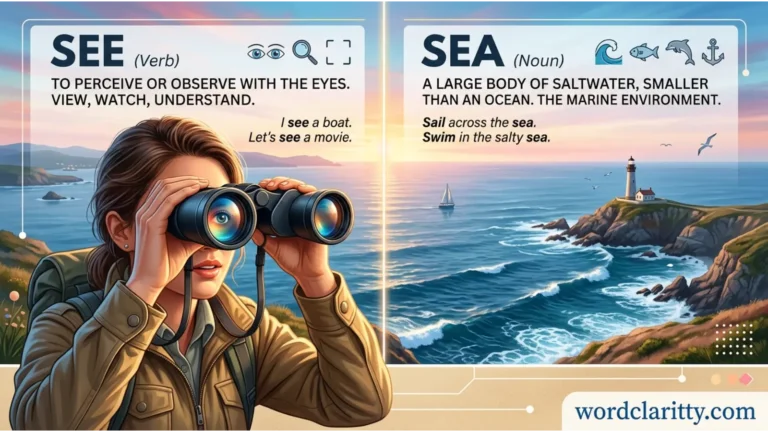
See vs Sea is a common source of confusion for English learners because the two words sound exactly the same but have completely different meanings. These words are known as homophones, making them easy to mix up in both writing and conversation. Understanding See vs Sea is important because using the wrong word can change the meaning of a sentence and create unnecessary mistakes. While see refers to using your eyes or noticing something, sea describes a large body of salt water connected to an ocean. Learning the difference is simple once you understand their meanings, spelling, and usage. In this guide, See vs Sea will be explained with clear definitions, easy examples, and practical tips to help you use each word correctly with confidence.
Why “See” and “Sea” Are Confusing
Many English learners mix up see and sea because they are homophones—words that sound the same but have different meanings and spellings.
Here are the main reasons for the confusion:
Similar Pronunciation
Both see and sea are pronounced as /siː/.
When speaking, there is no difference in their pronunciation, so listeners understand the correct word from the context.
Similar Spelling
These words differ by only one letter:
- See
- Sea
Because their spellings are similar, learners sometimes type the wrong one.
Context Confusion
If someone says,
“Let’s go to the sea.”
A learner may accidentally write,
“Let’s go to the see.”
The sentence sounds correct but becomes grammatically incorrect.
Common Learner Mistakes
Many learners:
- Use sea instead of see when talking about vision.
- Use see instead of sea when talking about oceans.
- Depend only on pronunciation instead of understanding meaning.
See vs Sea Explained Simply
The easiest way to understand the difference is this:
See means to use your eyes or understand something, while sea means a large body of salt water.
One-Line Distinction
See relates to vision, while sea refers to water.
Examples
See
- I can see the mountains from my window.
- Did you see the movie yesterday?
Sea
- The children played beside the sea.
- Ships sailed across the sea.
Understanding Homophones in English
What Are Homophones?
Homophones are words that sound the same but have different meanings and spellings.
Example:
- flower
- flour
Although they sound identical, they mean completely different things.
Why Homophones Cause Confusion
English contains many homophones because pronunciation has changed over time while spellings remained different.
For example:
- I can see the stars.
- We walked beside the sea.
The pronunciation is the same, but the meanings depend entirely on the sentence.
What Does “See” Mean?
Definition and Core Meaning
See is mainly a verb.
It means:
- to notice with your eyes
- to watch
- to understand
- to meet someone
- to experience something
Origin and Historical Use
The word see comes from Old English seon, meaning “to perceive with the eyes.” It has been used for over a thousand years and remains one of the most common English verbs.
Modern Usage and Synonyms
Depending on context, synonyms include:
- observe
- notice
- watch
- view
- look at
- understand
- recognize
Common Uses
- Seeing with your eyes
- Watching television
- Meeting someone
- Understanding an idea
- Visiting a place
Example Sentences
- I see a bird in the tree.
- Can you see the difference?
- I’ll see my doctor tomorrow.
- Now I see what you mean.
What Does “Sea” Mean?
Definition and Core Meaning
Sea is a noun.
It refers to a large area of salt water, usually connected to an ocean.
Sometimes it also describes a very large number or area of something.
Example:
- a sea of flowers
- a sea of faces
Origin and Historical Context
The word sea comes from Old English sæ, which referred to large bodies of water. It has been part of English for centuries.
Modern Usage and Synonyms
Possible synonyms include:
- ocean (in some contexts)
- waters
- marine waters
- coastal waters
Common Uses
- Beaches
- Oceans
- Geography
- Travel
- Marine life
- Figurative expressions
Example Sentences
- The sea was calm today.
- Fishermen returned from the sea.
- We enjoyed our vacation by the sea.
- The ship disappeared into the sea.
See vs Sea: Key Differences at a Glance
| Word | Part of Speech | Meaning | Example Context |
|---|---|---|---|
| See | Verb | To look, notice, understand, meet | I can see the rainbow. |
| Sea | Noun | A large body of salt water | The boat crossed the sea. |
How to Remember the Difference Between See and Sea
Remembering these words becomes much easier with simple associations.
Easy Memory Tricks
- See has two e’s, like two eyes.
- Sea contains the letter A, reminding you of the Atlantic Ocean.
Association Techniques
Think:
- See = Eyes
- Sea = Water
Whenever you think about looking, choose see.
Whenever you think about beaches or oceans, choose sea.
Memorable Example
“I see the sea from my hotel window.”
The first word means looking.
The second word means the ocean.
Common Mistakes and Confusions
Wrong
❌ I can sea your house.
Correct
✅ I can see your house.
Explanation: The sentence talks about vision, so see is correct.
Wrong
❌ We swam in the see.
Correct
✅ We swam in the sea.
Explanation: Swimming happens in water, so sea is correct.
Wrong
❌ Did you sea my message?
Correct
✅ Did you see my message?
Explanation: Here, see means notice or read.
Wrong
❌ The see was rough today.
Correct
✅ The sea was rough today.
Explanation: The sentence refers to the ocean.
Examples Section: Correct and Incorrect Usage
Example 1
✔ Correct: I can see the moon tonight.
✘ Incorrect: I can sea the moon tonight.
Example 2
✔ Correct: The fishermen sailed across the sea.
✘ Incorrect: The fishermen sailed across the see.
Example 3
✔ Correct: Let’s see what happens next.
✘ Incorrect: Let’s sea what happens next.
Example 4
✔ Correct: We spent the weekend by the sea.
✘ Incorrect: We spent the weekend by the see.
Example 5
✔ Correct: I hope to see you soon.
✘ Incorrect: I hope to sea you soon.
Example 6
✔ Correct: Dolphins live in the sea.
✘ Incorrect: Dolphins live in the see.
Self Assessment: Test Your Knowledge
Fill in the blanks with see or sea.
- We walked beside the ________ during sunset.
- Can you ________ my new glasses?
- The sailors crossed the ________ safely.
- I hope to ________ you again next week.
Self Assessment Answers
- sea
- see
- sea
- see
FAQs About “See and Sea”
1. Are see and sea pronounced the same?
Yes. They are perfect homophones and have the same pronunciation.
2. Is see a verb?
Yes. It is mainly used as a verb meaning to look, notice, understand, or meet.
3. Is sea a noun?
Yes. It refers to a large body of salt water connected to an ocean.
4. Can see mean “understand”?
Yes. For example:
“I see your point.”
Here, it means “I understand.”
5. Can sea be used figuratively?
Yes. Expressions like a sea of people or a sea of lights describe a very large amount of something.
6. How can I remember the difference quickly?
Think:
- See = Eyes
- Sea = Ocean
This simple trick works in nearly every situation.
7. Which word is correct in “I can ___ the beach”?
The correct word is see, because the sentence is about using your eyes.
Final Conclusion: Using “See” and “Sea” Correctly
Understanding the difference between see and sea is easier than it first appears. Even though these two words sound exactly alike, they serve completely different purposes in English. See is a verb that relates to vision, noticing, understanding, or meeting someone, while sea is a noun that refers to a large body of salt water or, in some expressions, a vast amount of something. The key to choosing the correct word is to focus on the meaning of your sentence rather than its pronunciation. If you’re talking about looking with your eyes or understanding an idea, see is the right choice.
If you’re describing oceans, beaches, ships, or marine life, sea is the correct word. Simple memory tricks can also help—think of the two e’s in see as two eyes, and remember that sea contains the letter A, which can remind you of the Atlantic Ocean. The more you read, write, and practice these words in real sentences, the more natural they will become. Don’t worry if you occasionally confuse them; even experienced learners make mistakes with homophones. With regular practice and attention to context, you’ll soon use see and sea accurately and confidently in everyday English. Keep learning, keep practicing, and you’ll continue building stronger English skills one word at a time.