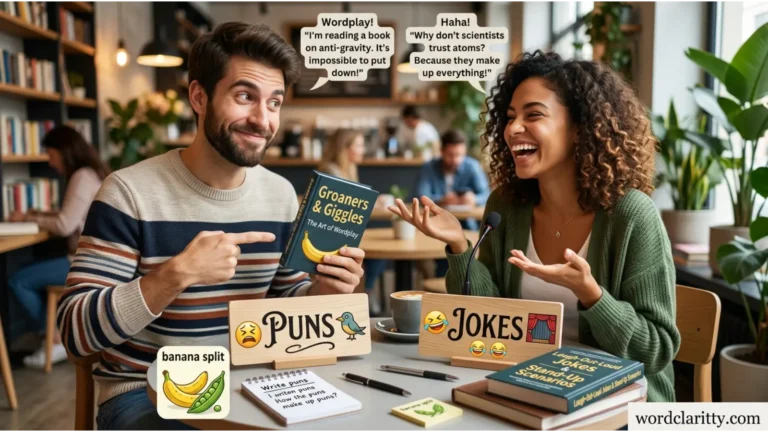
Many English learners wonder about puns vs jokes because both are meant to make people laugh. However, they are not the same thing. A pun is a specific type of wordplay, while a joke is a broader form of humor that can be told in many different ways. Since people often use these words in similar conversations, it is easy to confuse them. Learning the difference will help you understand English humor better, improve your vocabulary, and use the correct word in speaking and writing. In this guide, you’ll discover what each word means, how they differ, and when to use each one correctly.
Why “Puns” and “Jokes” Are Confusing
Many learners think puns and jokes mean exactly the same thing because both are used to make people laugh. Although they belong to the same category of humor, they work differently.
Similar Pronunciation
The words pun and joke do not sound alike, so pronunciation is not the main reason for confusion.
Similar Spelling
These words are spelled very differently. Their spelling usually does not cause mistakes.
Context Confusion
The confusion comes from how people use them in everyday conversation. Someone might say, “That was a funny joke,” even when the humor was actually a pun.
For example:
- “I love dad jokes.”
- “That sentence was full of puns.”
Both involve humor, but they are different types of comedy.
Common Learner Mistakes
English learners often:
- Call every funny sentence a joke.
- Think every joke is a pun.
- Use “pun” when referring to a funny story.
- Miss the wordplay that makes something a pun.
Understanding the purpose of each word helps avoid these mistakes.
Puns vs Jokes Explained Simply
A pun is a joke that uses words with multiple meanings or similar sounds.
A joke is anything intended to make people laugh, whether through storytelling, surprise, exaggeration, or wordplay.
One-Line Distinction
A pun is a type of joke, while not every joke is a pun.
Simple Explanation
Pun means using clever wordplay to create humor, while joke means any humorous statement, story, or action intended to amuse people.
Example Sentences
- The comedian told a clever pun about a broken pencil.
- Everyone laughed at the funny joke during dinner.
Understanding Homophones in English
What Are Homophones?
Homophones are words that sound the same but have different meanings and often different spellings.
Example:
- Sea
- See
They sound identical but have different meanings.
Why Homophones Cause Confusion
Because homophones sound alike, listeners may misunderstand which word is intended without context.
Example:
“I can see the sea.”
Although pun and joke are not homophones, learning about homophones helps English learners understand why many English words are commonly confused.
What Does “Pun” Mean?
Definition and Core Meaning
A pun is a humorous use of language that plays with words having multiple meanings or similar sounds.
Puns often require the listener to think about the different meanings of a word before understanding the humor.
Origin and Historical Use
The word pun has been used in English since the 1600s. Writers such as William Shakespeare frequently used puns in plays to entertain audiences through clever language.
Puns vs Jokes: Modern Usage and Synonyms
Today, puns appear in:
- Comedy
- Advertising
- Movies
- Greeting cards
- Social media
- Headlines
Synonyms
- Wordplay
- Play on words
- Language joke
- Double meaning
Example Sentences
- The teacher made a science pun.
- His pizza pun made everyone laugh.
- That advertisement uses a clever pun.
- Shakespeare loved writing puns.
What Does “Joke” Mean?
Definition and Core Meaning
A joke is anything said or done to make people laugh.
Jokes may involve funny stories, unexpected endings, exaggeration, irony, or even puns.
Origin and Historical Context
The word joke entered English in the late 1600s and gradually became associated with humorous stories and amusing remarks.
Modern Usage and Synonyms
Today, jokes appear in:
- Stand-up comedy
- Television
- Books
- Conversations
- Internet memes
- Social media
Synonyms
- Funny story
- Gag
- Wisecrack
- Quip
- Humorous remark
Example Sentences
- She told a funny joke at lunch.
- The comedian’s jokes made the audience laugh.
- That’s my favorite joke.
- His opening joke was hilarious.
Puns vs Jokes: Key Differences at a Glance
| Word | Part of Speech | Meaning | Example Context |
|---|---|---|---|
| Pun | Noun | A humorous play on words | “That bakery sign uses a clever pun.” |
| Joke | Noun | Anything intended to make people laugh | “He told a joke during the meeting.” |
How to Remember the Difference Between Puns and Jokes
Learning the difference becomes much easier with simple memory tricks.
Easy Memory Tricks
- Think of pun = play on words.
- Think of joke = any funny thing.
Association Technique
Imagine a toolbox.
- A joke is the whole toolbox.
- A pun is just one tool inside it.
Every pun is a joke, but many jokes do not use wordplay.
Memorable Example
“I used a pun about a calendar because its days are numbered.”
This sentence is a joke because it is funny—but specifically, it is a pun because it depends on the double meaning of “numbered.”
Common Mistakes and Confusions
Wrong Example
❌ That funny story was a pun.
✅ That funny story was a joke.
Explanation: A story without wordplay is simply a joke.
Wrong Example
❌ Every joke is a pun.
✅ Some jokes are puns.
Explanation: Only jokes based on wordplay are puns.
Wrong Example
❌ The comedian told twenty puns, but none used wordplay.
✅ The comedian told twenty jokes.
Explanation: If they don’t involve wordplay, they are jokes rather than puns.
Wrong Example
❌ The advertisement told a joke using two meanings of one word.
✅ The advertisement used a pun.
Explanation: Double meanings create puns.
Examples Section: Correct and Incorrect Usage
Example 1
✔ Correct: The restaurant’s slogan is a clever pun.
✘ Incorrect: The restaurant’s slogan is a clever joke.
Example 2
✔ Correct: My grandfather tells funny jokes every weekend.
✘ Incorrect: My grandfather tells funny puns every weekend.
Example 3
✔ Correct: That newspaper headline contains a pun.
✘ Incorrect: That newspaper headline contains a joke.
Example 4
✔ Correct: The comedian ended the show with a hilarious joke.
✘ Incorrect: The comedian ended the show with a hilarious pun, even though there was no wordplay.
Self Assessment: Test Your Knowledge
1.
The newspaper headline used clever ______ to make readers smile.
2.
My uncle always tells funny ______ during family dinners.
3.
A ______ usually depends on wordplay.
4.
Not every ______ is a pun.
Self Assessment Answers
- puns
- jokes
- pun
- joke
FAQs About “Puns and Jokes”
1. Is a pun the same as a joke?
No. A pun is a specific type of joke that relies on wordplay.
2. Can every joke be called a pun?
No. Most jokes do not use wordplay, so they are simply jokes.
3. Why are puns popular?
People enjoy puns because they are clever and make listeners think about multiple meanings of words.
4. Are dad jokes usually puns?
Many dad jokes include puns, but not all of them do.
5. Are puns good for learning English?
Yes. They help learners understand multiple meanings, pronunciation, and vocabulary.
6. Where are puns commonly used?
Puns are common in advertisements, books, movies, newspapers, social media, and everyday conversations.
7. How can I identify a pun?
Ask yourself whether the humor depends on a word having two meanings or on words that sound alike. If it does, it is likely a pun.
Final Conclusion: Using “Puns” and “Jokes” Correctly
Understanding the difference between puns vs jokes can make your English more accurate and your appreciation of humor much deeper. Although both are designed to make people laugh, they are not interchangeable. A joke is the broader category that includes funny stories, witty remarks, observations, and many other forms of humor. A pun, on the other hand, is a special kind of joke that depends on clever wordplay, double meanings, or similar-sounding words. Remember the simple rule: every pun is a joke, but not every joke is a pun. Keeping this distinction in mind will help you choose the right word in conversations, writing, and even while enjoying English books, movies, or comedy shows.
Whenever you hear a humorous sentence, look for wordplay. If the humor comes from the language itself, it is probably a pun. If it is simply funny without relying on multiple meanings or similar sounds, it is a joke. The more examples you read and hear, the easier it becomes to recognize the difference naturally. Continue practicing with real-life conversations, articles, and entertainment, and you’ll soon feel confident using both terms correctly. Mastering small vocabulary differences like these is an excellent step toward speaking and writing English with greater precision and confidence.

Bilal Hassan is a Master’s graduate, content writer, and author at WordClaritty.com. He specializes in creating clear, informative, and reader-friendly content focused on language, word meanings, and educational topics. With a passion for accuracy and simplicity, he helps readers expand their knowledge through engaging and easy-to-understand articles.