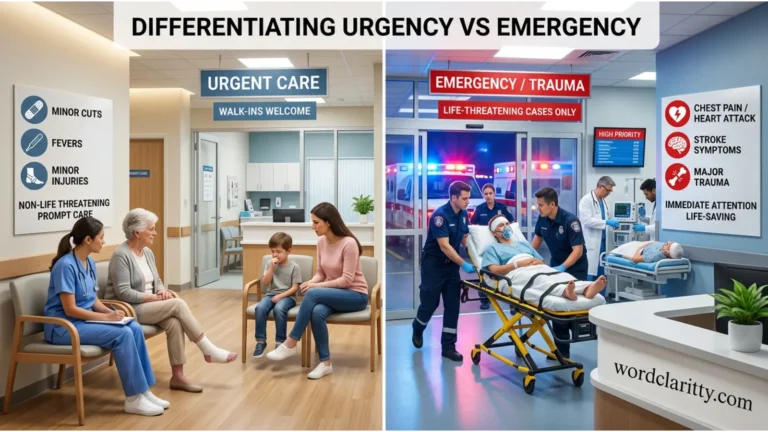
Urgency vs emergency is a common point of confusion for English learners because both words describe situations that need attention. However, they are not interchangeable. Knowing the difference helps you communicate more clearly in everyday conversations, at work, in healthcare, and during real-life situations. An urgent task may need to be completed soon, while an emergency requires immediate action to prevent serious harm or danger. Understanding when to use each word improves your vocabulary and helps you avoid misunderstandings. In this guide, you’ll learn the meanings, differences, examples, memory tips, and common mistakes related to urgency vs emergency in simple, easy-to-understand English.
Why “Urgency” and “Emergency” Are Confusing
Many English learners mix up urgency and emergency because both words involve situations that need attention. Despite their similarities, they describe different levels of importance.
Similar Pronunciation
Both words contain similar sounds and end with the suffix “-ency,” making them sound somewhat alike when spoken quickly.
Similar Spelling
The words share several letters and have nearly identical endings. This visual similarity often causes learners to confuse them while reading or writing.
Context Confusion
Both words appear in workplaces, hospitals, schools, and daily conversations. Because both suggest something important, people often assume they mean exactly the same thing.
Common Learner Mistakes
- Using emergency for tasks that are simply important.
- Calling every urgent email an emergency.
- Thinking urgent and emergency are perfect synonyms.
- Confusing priority with danger.
Remember, every emergency is urgent, but not every urgent situation is an emergency.
Urgency vs Emergency Explained Simply
Urgency means something needs attention soon, while emergency means immediate action is necessary because there is serious danger or risk.
One-Line Distinction
Urgency means “important soon”; emergency means “act immediately to prevent harm.”
Example Sentences
- The report has a sense of urgency because the deadline is tomorrow.
- The fire alarm created an emergency, and everyone evacuated the building immediately.
Another pair of examples:
- She answered the urgent emails before lunch.
- The ambulance arrived quickly because it was a medical emergency.
Understanding Homophones in English
Although urgency and emergency are not homophones, learners often confuse similar-sounding words, so it’s useful to understand what homophones are.
What Are Homophones?
Homophones are words that sound the same but have different meanings and spellings.
Example:
- Flower – a plant
- Flour – powder used for baking
Why Homophones Cause Confusion
English contains many words that sound alike but mean different things. Learners sometimes choose the wrong word because they focus on pronunciation instead of meaning.
Example:
“I need to buy flour.”
Some learners may mistakenly write:
“I need to buy flower.”
Although urgency and emergency are not homophones, they are frequently confused because they are related in meaning and have similar spellings.
What Does “Urgency” Mean?
Definition and Core Meaning
Urgency is the need to deal with something quickly because delaying it may cause problems or inconvenience. It does not necessarily involve immediate danger.
Origin and Historical Use
The word urgency comes from the Latin word urgere, meaning to press or drive forward. It entered English centuries ago to describe situations requiring prompt attention.
Modern Usage and Synonyms
Today, urgency is commonly used in business, education, healthcare, customer service, and daily life.
Synonyms
- Importance
- Priority
- Pressing need
- Immediacy
- Promptness
Key Points
- Requires prompt attention.
- Usually involves deadlines.
- Does not always involve danger.
- Common in workplaces and schools.
Example Sentences
- There is a sense of urgency before the project deadline.
- Please respond with urgency to avoid delays.
- The teacher stressed the urgency of submitting assignments on time.
- We handled the customer’s request with urgency.
What Does “Emergency” Mean?
Definition and Core Meaning
An emergency is a serious, unexpected situation that requires immediate action because lives, health, property, or safety may be at risk.
Origin and Historical Context
The word emergency comes from the Latin verb emergere, meaning to arise or come forth unexpectedly. Over time, it became associated with sudden dangerous situations requiring immediate response.
Modern Usage and Synonyms
Emergency is commonly used in healthcare, law enforcement, public safety, disaster management, and transportation.
Synonyms
- Crisis
- Disaster
- Critical situation
- Life-threatening event
- Catastrophe
Key Points
- Requires immediate action.
- Usually involves danger.
- Often unexpected.
- May require emergency services.
Example Sentences
- Call emergency services immediately.
- The hospital treated several emergency patients.
- A chemical leak created an emergency.
- The pilot declared an emergency before landing.
Urgency vs Emergency: Key Differences at a Glance
| Word | Part of Speech | Meaning | Example Context |
|---|---|---|---|
| Urgency | Noun | Need for quick attention | Finishing a report before the deadline |
| Emergency | Noun | Dangerous situation requiring immediate action | Calling an ambulance after an accident |
How to Remember the Difference Between Urgency and Emergency
Here are some simple tricks to remember the difference.
Easy Memory Tricks
- Urgency = Important Soon
- Emergency = Immediate Danger
Association Techniques
Imagine two clocks.
- Urgency shows time running out before a deadline.
- Emergency shows flashing red lights and sirens.
Deadlines suggest urgency.
Ambulances suggest emergency.
One Memorable Example
“If I don’t finish my homework tonight, that’s urgency.”
“If the house is on fire, that’s an emergency.”
Common Mistakes and Confusions
Wrong Example
✘ This email is an emergency because my boss wants it today.
✔ This email is urgent because my boss wants it today.
Explanation: Missing a deadline is important but usually not dangerous.
Wrong Example
✘ Please treat this emergency before Friday.
✔ Please treat this urgent request before Friday.
Explanation: If it can wait until Friday, it is generally not an emergency.
Wrong Example
✘ The broken leg wasn’t urgent.
✔ The broken leg was a medical emergency.
Explanation: Serious injuries often require immediate treatment.
Wrong Example
✘ We had an urgency at the hospital after the explosion.
✔ We had an emergency at the hospital after the explosion.
Explanation: Explosions create emergencies, not merely urgent situations.
Examples Section: Correct and Incorrect Usage
Example 1
✔ Correct: The manager emphasized the urgency of finishing the report today.
✘ Incorrect: The manager emphasized the emergency of finishing the report today.
Example 2
✔ Correct: Dial the emergency number if someone is unconscious.
✘ Incorrect: Dial the urgency number if someone is unconscious.
Example 3
✔ Correct: There is urgency in responding to customer complaints.
✘ Incorrect: There is emergency in responding to customer complaints.
Example 4
✔ Correct: The earthquake created a national emergency.
✘ Incorrect: The earthquake created a national urgency.
Self Assessment: Test Your Knowledge
Fill in the blanks with urgency or emergency.
- The doctor declared a medical ________ after the accident.
- The team worked with great ________ to finish the project before the deadline.
- Please call emergency services only during an ________.
- There is a sense of ________ because the application closes tonight.
Self Assessment Answers
- emergency
- urgency
- emergency
- urgency
FAQs About “Urgency and Emergency”
1. What is the main difference between urgency and emergency?
Urgency means something should be done soon, while an emergency requires immediate action because of danger or serious risk.
2. Can an urgent situation become an emergency?
Yes. If an urgent issue is ignored, it may develop into an emergency.
3. Is every emergency urgent?
Yes. Every emergency requires urgent attention.
4. Is every urgent task an emergency?
No. Many urgent tasks involve deadlines but do not involve danger.
5. Which word is used in hospitals?
Hospitals use both. Emergency refers to life-threatening conditions, while urgency may describe cases needing prompt but not immediate treatment.
6. Can I use urgency and emergency interchangeably?
No. They have related meanings but describe different levels of seriousness.
7. Which word is more serious?
Emergency is more serious because it usually involves immediate risk to people or property.
Final Conclusion: Using “Urgency” and “Emergency” Correctly
Understanding urgency vs emergency is an important step toward becoming a more confident English speaker and writer. Although these words both describe situations that require attention, they are not interchangeable. Urgency refers to something that should be handled quickly to avoid delays or problems, such as meeting a deadline, replying to an important email, or completing a project on time. Emergency, on the other hand, describes a sudden and serious situation that requires immediate action because lives, health, safety, or property may be at risk. Remember the simple rule: urgent means important soon, while emergency means immediate danger.
This memory trick can help you choose the correct word in everyday conversations, professional communication, healthcare settings, and emergency situations. Reading authentic English, paying attention to context, and practicing with real-life examples will make the distinction even clearer over time. The more you use these words correctly, the more natural your English will sound. Keep practicing, review the examples in this guide whenever needed, and don’t be discouraged by occasional mistakes. Every new word you master brings you one step closer to speaking and writing English with greater accuracy, confidence, and clarity.

Bilal Hassan is a Master’s graduate, content writer, and author at WordClaritty.com. He specializes in creating clear, informative, and reader-friendly content focused on language, word meanings, and educational topics. With a passion for accuracy and simplicity, he helps readers expand their knowledge through engaging and easy-to-understand articles.