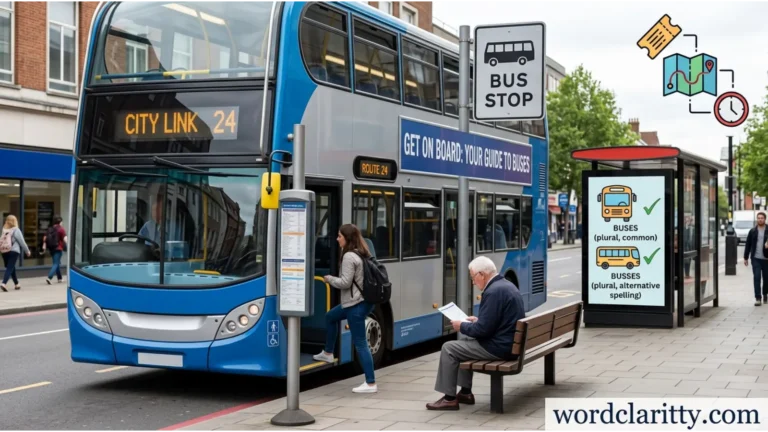
If you’ve ever wondered whether you should write busses or buses, you’re not alone. Many English learners—and even native speakers—find these two spellings confusing because they look almost identical. However, they don’t always mean the same thing. In most situations, buses is the correct plural form of bus, while busses is a less common word with a completely different meaning in traditional English. Knowing the difference helps you write more accurately, avoid embarrassing mistakes, and improve your grammar skills. This guide explains everything in simple language with examples, memory tips, and practice questions.
Why “Busses” and “Buses” Are Confusing
The words busses and buses confuse many English learners because they are extremely similar in spelling and pronunciation.
Here are the main reasons for the confusion:
Similar Pronunciation
Both words are pronounced almost exactly the same in everyday English. Since they sound alike, people often assume they are simply different spellings of the same word.
Similar Spelling
The only visible difference is an extra “s” in busses, making it easy to mistype or misspell.
Context Confusion
When discussing public transportation, people sometimes mistakenly write busses instead of buses, even though buses is the standard plural.
Common Learner Mistakes
English learners often:
- Add an extra s because many English words double consonants.
- Believe both spellings are equally acceptable.
- Don’t realize that busses has another meaning unrelated to vehicles.
Busses vs Buses Explained Simply
Buses means more than one bus (the vehicle), while busses is traditionally the third-person singular or plural form of the verb buss, meaning to kiss.
One-Line Distinction
Buses refers to vehicles, whereas busses refers to kisses in older or literary English.
Example Sentences
- The city buses arrive every fifteen minutes.
- The grandmother busses each child on the forehead before bedtime.
Understanding Homophones in English
What Are Homophones?
Homophones are words that sound the same but have different meanings, spellings, or both.
Example:
- Sea and see
Although busses and buses are not perfect homophones in every accent, they are pronounced so similarly that many people confuse them.
Why Homophones Cause Confusion
When people hear words rather than see them written, they may choose the wrong spelling.
For example:
- “The school buses are late.”
Someone unfamiliar with the spelling may incorrectly write:
- “The school busses are late.”
What Does “Busses” Mean?
Definition and Core Meaning
Busses is the plural or third-person singular form of the verb buss, which means to kiss, especially in an affectionate or old-fashioned way.
Although correct, this word is uncommon in modern everyday English.
Origin and Historical Use
The word buss dates back several centuries and comes from older European languages referring to a kiss or affectionate greeting.
It appeared frequently in older literature, poetry, and classic novels.
Modern Usage and Synonyms
Today, buss is rarely used outside literary or historical writing.
Synonyms
- Kiss
- Peck
- Embrace (depending on context)
- Smoch (informal, not an exact synonym)
Key Points
- Means to kiss
- Rare in modern English
- Mostly found in literature
- Not the plural of the vehicle bus
Example Sentences
- She busses her baby every morning.
- The actor busses the heroine at the end of the play.
- In the novel, the mother lovingly busses her child.
What Does “Buses” Mean?
Definition and Core Meaning
Buses is the standard plural form of the noun bus, which refers to a large road vehicle used to transport passengers.
It can also be the third-person singular form of the verb bus, meaning to transport by bus or to clear tables in a restaurant.
Origin and Historical Context
The word bus comes from omnibus, a Latin word meaning for all. Over time, omnibus was shortened to bus, and buses became the accepted plural form.
Modern Usage and Synonyms
The word buses is common worldwide.
Synonyms
- Coaches (for some long-distance vehicles)
- Public transport
- Transit vehicles
- School buses
Key Points
- Standard plural of bus
- Used in transportation
- Common in everyday English
- Accepted in all major English dictionaries
Example Sentences
- The school buses leave at 3:30 p.m.
- Electric buses reduce pollution.
- Several buses were delayed because of heavy traffic.
- The company buses employees to the office every morning.
Busses vs Buses: Key Differences at a Glance
| Word | Part of Speech | Meaning | Example Context |
|---|---|---|---|
| Buses | Noun (plural), Verb | More than one bus; transports by bus | The buses arrived on time. |
| Busses | Verb | Kisses affectionately | She busses her grandson goodbye. |
How to Remember the Difference Between Busses and Buses
Here are a few easy tricks to remember the correct spelling.
Memory Trick 1
If you’re talking about transportation, always think:
Bus → Buses
Memory Trick 2
Remember this sentence:
People ride buses, but grandparents buss children goodbye.
Association Technique
Think of the extra “s” in busses as standing for smooch.
- Buses = vehicles
- Busses = kisses
Memorable Example
“The yellow buses took students to school, while Grandma busses each child before they leave.”
Common Mistakes and Confusions
Wrong
❌ There were five busses waiting outside.
Correct
✔ There were five buses waiting outside.
Explanation:
You are referring to vehicles, so buses is correct.
Wrong
❌ Grandma buses the baby every night.
Correct
✔ Grandma busses the baby every night.
Explanation:
Here the meaning is to kiss, so busses is the correct verb.
Wrong
❌ The city operates hundreds of busses.
Correct
✔ The city operates hundreds of buses.
Wrong
❌ Students waited for the school busses.
Correct
✔ Students waited for the school buses.
Examples Section: Correct and Incorrect Usage
Example 1
✔ Correct: The city added twenty new buses.
✘ Incorrect: The city added twenty new busses.
Example 2
✔ Correct: The mother busses her little daughter before school.
✘ Incorrect: The mother buses her little daughter before school.
Example 3
✔ Correct: School buses must follow safety regulations.
✘ Incorrect: School busses must follow safety regulations.
Example 4
✔ Correct: The old story says the prince busses the princess.
✘ Incorrect: The old story says the prince buses the princess.
Self Assessment: Test Your Knowledge
Fill in the blanks with buses or busses.
- The city purchased ten new ________ this year.
- Grandma always ________ the children before they leave.
- The school ________ arrive at eight every morning.
- In the novel, the hero lovingly ________ his wife.
Self Assessment Answers
- buses
- busses
- buses
- busses
FAQs About “Busses and Buses”
1. Which spelling is correct: buses or busses?
Buses is the correct plural of bus. Busses is a different word related to kissing.
2. Is “busses” ever correct?
Yes. It is correct as the verb form of buss, meaning to kiss, although it is uncommon today.
3. Why do people write “busses” instead of “buses”?
Many people assume adding an extra s follows English spelling patterns, or they simply don’t know that busses has a separate meaning.
4. Do dictionaries accept both spellings?
Yes. Major dictionaries recognize buses as the plural of bus and busses as a form of the verb buss.
5. Which spelling should I use in everyday writing?
Almost always, you should use buses because most people are talking about public transportation or school vehicles.
6. Is “buss” still commonly used?
No. It is considered old-fashioned or literary and appears far less often than kiss in modern English.
7. Can “bus” also be used as a verb?
Yes. As a verb, bus means to transport people by bus or, in restaurant settings, to clear tables. Its third-person singular form is buses.
Final Conclusion: Using “Busses” and “Buses” Correctly
Understanding the difference between busses and buses is easier once you know that they usually refer to completely different things. Buses is the standard and widely accepted plural of bus, the vehicle that carries passengers. It is also used as a verb meaning to transport people by bus or clear tables in certain contexts. Busses, on the other hand, comes from the older verb buss, which means to kiss affectionately. While this spelling is still correct, it is uncommon in modern English and is mostly found in literature, historical writing, or poetic language.
Whenever you’re writing about school transportation, city transit, or public transport, the correct choice is almost always buses. Reserve busses only for the rare situations where you’re describing someone giving a kiss. A simple memory trick can help: people ride buses, but family members may buss loved ones goodbye. Paying attention to context is the easiest way to choose the right spelling.
As you continue learning English, you’ll come across many word pairs that look or sound alike. Taking the time to understand these small differences will make your writing clearer, more accurate, and more professional. Keep practicing with real examples, read regularly, and don’t be afraid to check unfamiliar words. Every new distinction you learn brings you one step closer to confident and natural English.