Have you ever wondered whether to say “an hour” or “a hour”? This is a common grammar question among English learners because the word “hour” begins with the letter H. Normally, we use “a” before words that start with consonants and “an” before words that start with vowels. However, English pronunciation makes this rule a little more interesting.
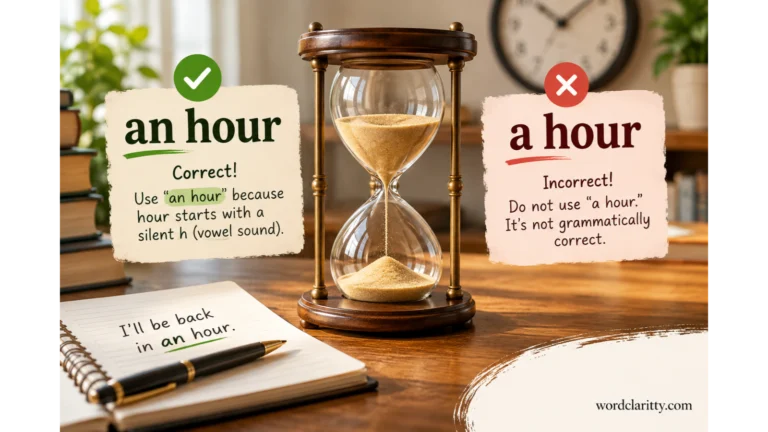
The correct expression is “an hour” because the H in “hour” is silent, and the word begins with a vowel sound. Understanding this simple rule will help you avoid common grammar mistakes, improve your pronunciation, and write more confidently in everyday English.
Why “An Hour” or “A Hour” Are Confusing
The expressions “an hour” and “a hour” confuse many English learners because English spelling and pronunciation do not always follow the same patterns.
At first glance, “a hour” might seem correct because “hour” begins with H, which is a consonant letter. However, the important factor is the sound at the beginning of the word, not its first written letter.
Let’s examine the main reasons for this confusion.
1. Similar Pronunciation
Both expressions refer to the same intended period of time, but they are not equally correct in standard English.
The word “hour” is pronounced approximately like “our.” The letter H is silent.
Therefore, the correct phrase is pronounced:
An hour: /ən ˈaʊər/ (approximately “un OW-er”).
In natural speech, the word “an” connects smoothly with the vowel sound at the beginning of “hour.”
Using “a” instead of “an” does not follow the normal article rule for this pronunciation.
2. Similar Spelling
The difference between the two expressions is only one letter:
- An hour: Uses the article “an.”
- A hour: Uses the article “a.”
Both expressions contain the same noun, “hour.” However, changing the article makes one expression grammatically correct and the other incorrect in standard English.
This small difference is especially important in academic writing, professional communication, and English language examinations.
3. Context Confusion
English learners often memorize the simplified rule that “a” comes before consonants and “an” comes before vowels.
However, this explanation can be misleading when it focuses on letters rather than sounds.
Compare these examples:
- A house
- A hotel
- An hour
- An honest person
All four nouns begin with the letter H, but only “hour” and “honest” begin with vowel sounds in standard pronunciation.
Therefore, the correct article depends on how the word is pronounced.
4. Common Learner Mistakes
Some common mistakes include:
- Writing “a hour” because the word begins with H.
- Assuming every word beginning with H requires “a.”
- Forgetting that some English letters are silent.
- Choosing articles based only on spelling.
- Confusing the pronunciation of “hour” with words such as “house” and “horse.”
The easiest way to avoid these mistakes is to listen to the first sound of the word before choosing “a” or “an.”
An Hour or A Hour Explained Simply
The difference between “an hour” and “a hour” is simple: “An hour” is grammatically correct, while “a hour” is incorrect in standard English.
The word “hour” begins with a vowel sound because its H is silent. Therefore, we use the indefinite article “an.”
Simple Explanation
An hour: The correct expression referring to a period of 60 minutes.
A hour: An incorrect combination of the article “a” and the noun “hour.”
The intended meaning is the same, but the grammar is different.
One-Line Distinction
Use “an hour,” not “a hour,” because “hour” starts with a vowel sound, even though it begins with the consonant letter H.
Two Example Sentences
Example 1:
“I will finish my homework in an hour.”
This sentence means that the speaker expects to finish the homework within approximately 60 minutes.
Example 2:
“She waited for an hour before the train arrived.”
Here, “an hour” describes a waiting period lasting 60 minutes.
In both examples, “an” is the correct article because of the pronunciation of “hour.”
The Basic A vs An Grammar Rule
Use a before a consonant sound:
- A book
- A car
- A house
- A university
Use an before a vowel sound:
- An apple
- An orange
- An hour
- An umbrella
Notice that “university” begins with a vowel letter but a consonant sound, while “hour” begins with a consonant letter but a vowel sound.
This shows why pronunciation matters more than spelling.
Understanding Homophones in English
English contains many words that sound alike but have different spellings and meanings. These words are called homophones.
Understanding homophones can help learners recognize why English pronunciation sometimes differs from spelling.
What Are Homophones?
Homophones are words that have the same pronunciation but different meanings and often different spellings.
For example, “hour” and “our” are homophones in standard English pronunciation.
- Hour: A period of 60 minutes.
- Our: A possessive determiner showing that something belongs to or is associated with us.
Consider these sentences:
- “The meeting lasted an hour.”
- “Our meeting starts at nine.”
Although “hour” and “our” sound the same, they have completely different grammatical functions.
Other common English homophones include:
- Here and hear
- Right and write
- Sea and see
- One and won
- Their and there
Learning these examples can improve both spelling and pronunciation.
Why Homophones Cause Confusion
Homophones cause confusion because English spelling does not always clearly indicate pronunciation.
For example, the word “hour” contains a silent H, while the word “house” has a pronounced H.
Compare:
- “I need an hour.”
- “I need a house.”
The difference comes from the initial sounds of the nouns.
Strictly speaking, “an hour” and “a hour” are not homophones in the usual grammatical sense. They are alternative article choices before the same noun, and only one follows the standard rule.
However, learning about homophones and silent letters helps explain why “hour” behaves differently from many other words beginning with H.
What Does “An Hour” Mean?
Definition and Core Meaning
“An hour” means a period of 60 minutes. It is the grammatically correct expression used when referring to one hour as a unit of time.
The noun “hour” describes a standard measurement of time.
One hour equals:
- 60 minutes
- 3,600 seconds
- One twenty-fourth of a day
- Two periods of 30 minutes
For example:
“I studied English for an hour.”
This means the speaker spent 60 minutes studying English.
The phrase can also be used when talking about approximate time.
For example:
“I will be ready in about an hour.”
Here, the speaker expects to be ready after approximately 60 minutes.
Origin and Historical Use
The English word “hour” comes through Old French from Latin hora, which referred to an hour or a period of time. The Latin word was borrowed from Greek hōra, which could refer to a season, period, or time.
Over centuries, the pronunciation of “hour” developed in English, and the initial H became silent in standard modern pronunciation.
Because the word begins with a vowel sound, English speakers use the article “an” before it.
The modern expression “an hour” follows the established English rule that indefinite articles depend on pronunciation rather than spelling.
Modern Usage and Synonyms
“An hour” is used in everyday English when discussing time, schedules, appointments, travel, work, study, and other activities.
Common contexts include:
- Duration: “The lesson lasted an hour.”
- Waiting: “We waited for an hour.”
- Travel: “The journey takes an hour.”
- Study: “I practise English for an hour daily.”
- Future plans: “I will call you in an hour.”
- Work: “The meeting will begin in an hour.”
Depending on the context, similar expressions include:
- Sixty minutes
- One hour
- A sixty-minute period
- Approximately sixty minutes
- A full hour
These expressions may differ slightly in emphasis, but they all relate to the same basic unit of time.
Example Sentences
- “I usually exercise for an hour every morning.”
- “The movie starts in an hour.”
- “She spent an hour preparing dinner.”
- “We waited for an hour at the airport.”
- “He completed the assignment in less than an hour.”
- “The doctor will be available in about an hour.”
Each example correctly uses “an” because “hour” begins with a vowel sound.
What Does “A Hour” Mean?
Definition and Core Meaning
“A hour” is not a grammatically correct expression in standard English.
It is a common article error made when writers focus on the first letter of “hour” instead of its pronunciation.
Although readers can usually understand that “a hour” is intended to mean 60 minutes, the correct expression is always “an hour” in standard English.
For example:
Incorrect: “I need a hour to finish the report.”
Correct: “I need an hour to finish the report.”
The meaning remains understandable, but the second sentence follows the correct grammar rule.
Origin and Historical Context
The confusion surrounding “a hour” comes from the way English indefinite articles are taught.
Many learners first hear a simplified rule:
- Use “a” before consonants.
- Use “an” before vowels.
However, the more accurate rule is based on sounds, not written letters.
Because H is a consonant letter, some learners incorrectly assume that every word beginning with H must use “a.”
Historically, the English articles “a” and “an” developed from an older form related to the number one. Over time, English developed the modern pattern in which “an” appears before vowel sounds and “a” before consonant sounds.
The phrase “a hour” does not follow that pattern because the H in “hour” is silent.
Modern Usage and Synonyms
In modern standard English, “a hour” should be replaced with “an hour.”
You may occasionally encounter the incorrect form in informal writing, online comments, or texts written by English learners.
However, it is not recommended for:
- Academic essays
- Professional emails
- Business reports
- English language examinations
- Educational articles
- Formal communication
If you want to avoid repeating “an hour,” you can use alternatives such as “sixty minutes” or “one hour.”
Example Sentences
Here are common examples of the incorrect expression and their corrected versions.
Incorrect: “The class will start in a hour.”
Correct: “The class will start in an hour.”
Incorrect: “I spent a hour cleaning my room.”
Correct: “I spent an hour cleaning my room.”
Incorrect: “We will arrive in a hour.”
Correct: “We will arrive in an hour.”
Incorrect: “She waited a hour for the bus.”
Correct: “She waited an hour for the bus.”
In every example, replacing “a” with “an” makes the sentence grammatically correct.
An Hour vs A Hour: Key Differences at a Glance
The following comparison table explains the difference between the two expressions.
| Word | Part of Speech | Meaning | Example Context |
|---|---|---|---|
| An hour | Indefinite article + noun | A period of 60 minutes; grammatically correct | “I will return in an hour.” |
| A hour | Indefinite article + noun, incorrectly combined | Intended to mean 60 minutes, but grammatically incorrect | “I will return in a hour.” (Incorrect) |
Which One Is Correct?
The correct expression is “an hour.”
The H in “hour” is silent, so the word begins with a vowel sound.
Compare these examples:
- An hour — correct
- A hour — incorrect
- An honest person — correct
- A house — correct
- An honour — correct
- A hotel — correct
The important rule is to choose the article based on the first sound of the following word.
How to Remember the Difference Between An Hour and A Hour
Learning the difference becomes easier when you connect the grammar rule with pronunciation.
1. Remember That H Is Silent in “Hour”
The simplest memory trick is:
Silent H + vowel sound = An
Because “hour” sounds like “our,” it begins with a vowel sound.
Therefore:
- An hour — correct
- A hour — incorrect
Whenever you see the word “hour,” remember that its H is not pronounced.
2. Think About the Sound, Not the Letter
Before choosing “a” or “an,” say the following word aloud.
If it begins with a vowel sound, use “an.”
If it begins with a consonant sound, use “a.”
For example:
- An apple
- An egg
- An hour
- A banana
- A house
- A university
This technique works for many confusing article choices in English.
3. Associate “Hour” with “Our”
The words “hour” and “our” are pronounced alike in standard English.
Think of this sentence:
“Our meeting starts in an hour.”
Both “our” and “hour” begin with a vowel sound.
This association can help you remember why “an” is the correct article.
4. One Memorable Example
Imagine you have an English examination tomorrow.
You tell your friend:
“I need an hour to revise my notes.”
Remember the sentence as:
“An hour of practice makes my English better.”
Repeating this simple sentence can help the correct article become natural.
Common Mistakes and Confusions
English learners often make article mistakes because they rely too heavily on spelling.
Here are some common errors and explanations.
Mistake 1: Using “A” Before “Hour”
✘ Incorrect: “I waited a hour for the train.”
✔ Correct: “I waited an hour for the train.”
Explanation: The H in “hour” is silent, so the word begins with a vowel sound.
Mistake 2: Using “An” Before Every H Word
✘ Incorrect: “She bought an house.”
✔ Correct: “She bought a house.”
Explanation: Unlike “hour,” the word “house” begins with a pronounced H sound, which is a consonant sound.
Mistake 3: Confusing “Hour” and “Our”
✘ Incorrect: “The journey took an our.”
✔ Correct: “The journey took an hour.”
Explanation: “Hour” refers to time, while “our” shows possession or association.
Mistake 4: Choosing Articles Based on Spelling
✘ Incorrect: “He studies at an university.”
✔ Correct: “He studies at a university.”
Explanation: Although “university” begins with the vowel letter U, it starts with a /j/ sound, like the beginning of “yes.” Therefore, it takes “a.”
Mistake 5: Using “A” Before “Honest”
✘ Incorrect: “He is a honest man.”
✔ Correct: “He is an honest man.”
Explanation: The H in “honest” is silent, so the word begins with a vowel sound.
Examples Section: Correct and Incorrect Usage
These examples demonstrate how to use “an hour” correctly in different situations.
Example 1: Talking About Study Time
✔ Correct: “I studied English for an hour.”
✘ Incorrect: “I studied English for a hour.”
Why? The word “hour” begins with a vowel sound, so “an” is required.
Example 2: Describing Travel Time
✔ Correct: “It takes an hour to reach the airport.”
✘ Incorrect: “It takes a hour to reach the airport.”
Why? The H in “hour” is silent.
Example 3: Discussing Appointments
✔ Correct: “My appointment is in an hour.”
✘ Incorrect: “My appointment is in a hour.”
Why? The correct indefinite article before “hour” is “an.”
Example 4: Talking About Work
✔ Correct: “She spent an hour preparing the presentation.”
✘ Incorrect: “She spent a hour preparing the presentation.”
Why? The article must match the initial sound of the noun.
Example 5: Describing Waiting Time
✔ Correct: “We waited for an hour before the bus arrived.”
✘ Incorrect: “We waited for a hour before the bus arrived.”
Why? “Hour” begins with the vowel sound /aʊ/.
Example 6: Making Future Plans
✔ Correct: “I will call you in an hour.”
✘ Incorrect: “I will call you in a hour.”
Why? The correct phrase is “an hour,” regardless of the sentence’s tense.
Self Assessment: Test Your Knowledge
Choose the correct article to complete each sentence.
Question 1: I will finish my homework in ___ hour.
a) a
b) an
Question 2: She lives in ___ house near the park.
a) a
b) an
Question 3: He is ___ honest person who always tells the truth.
a) a
b) an
Question 4: We waited for ___ hour before the meeting started.
a) a
b) an
Self Assessment Answers
Answer 1: b) an
“I will finish my homework in an hour.”
The H in “hour” is silent, so “an” is correct.
Answer 2: a) a
“She lives in a house near the park.”
The H in “house” is pronounced, so the word begins with a consonant sound.
Answer 3: b) an
“He is an honest person who always tells the truth.”
The H in “honest” is silent, so “an” is required.
Answer 4: b) an
“We waited for an hour before the meeting started.”
The word “hour” begins with a vowel sound, so “an” is the correct article.
Check Your Score
- 4 correct: Excellent! You understand the article rule.
- 3 correct: Very good. Review the example you missed.
- 1–2 correct: Keep practising words with silent letters.
- 0 correct: Start with the basic rule: choose “a” or “an” according to pronunciation, not spelling.
FAQs:
1. Is It “An Hour” or “A Hour”?
“An hour” is correct in standard English. The H in “hour” is silent, so the word begins with a vowel sound and requires the article “an.”
2. Why Do We Say “An Hour” Instead of “A Hour”?
We say “an hour” because English uses “an” before vowel sounds. Since “hour” begins with the /aʊ/ sound, “an” is the correct article.
3. Is the H Silent in “Hour”?
Yes. In standard English pronunciation, the H in “hour” is silent. The word is pronounced like “our.”
4. Is “A Hour” Grammatically Correct?
No. “A hour” is incorrect in standard English. The correct expression is “an hour,” meaning a period of 60 minutes.
5. Is It “An Hour” or “A Hour” in American English?
“An hour” is correct in both American and British English. The standard pronunciation of “hour” begins with a vowel sound in both varieties.
6. Why Do We Say “A House” but “An Hour”?
We say “a house” because “house” begins with a pronounced H sound. We say “an hour” because the H is silent and the word begins with a vowel sound.
7. Is It “An Hour and a Half” or “A Hour and a Half”?
The correct expression is “an hour and a half.” For example, “The journey took an hour and a half.” This means the journey lasted 90 minutes.
Conclusion:
Understanding the difference between “an hour” and “a hour” is an important step toward improving your English grammar and pronunciation. Although the word “hour” begins with the consonant letter H, its pronunciation starts with a vowel sound because the H is silent. Therefore, “an hour” is the correct expression, while “a hour” is grammatically incorrect in standard English. This rule applies whether you are talking about studying, travelling, working, waiting, or planning an activity that takes 60 minutes.
The easiest way to remember the difference is to focus on pronunciation rather than spelling. English uses “an” before vowel sounds and “a” before consonant sounds. For example, we say “an hour” and “an honest person” because their H letters are silent. However, we say “a house” and “a hotel” because their H sounds are pronounced. Another helpful memory trick is to remember that “hour” sounds like “our,” making the correct article easier to recognize.
You can strengthen your understanding by practising sentences such as “I will return in an hour” and “She studied for an hour.” Reading these sentences aloud will help you become familiar with the natural pronunciation.
As you continue learning English, remember that small grammar rules can make a big difference in how clearly and confidently you communicate. Keep practising, pay attention to word sounds, and use every new example as an opportunity to improve. With consistent practice, choosing between “a” and “an” will become easier and more natural.

Bilal Hassan is a Master’s graduate, content writer, and author at WordClaritty.com. He specializes in creating clear, informative, and reader-friendly content focused on language, word meanings, and educational topics. With a passion for accuracy and simplicity, he helps readers expand their knowledge through engaging and easy-to-understand articles.