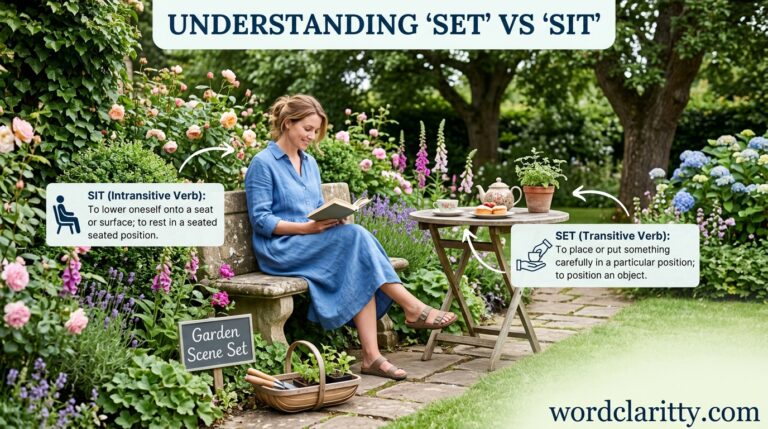
Set or sit are two commonly confused English words because both can relate to a person or object being in a particular position. However, they do not mean the same thing, and using the wrong word can change the meaning of a sentence. Set usually means to put, place, or arrange something somewhere, while sit usually means to rest your body in a seated position. The confusion becomes greater because both words can be used as verbs and have several different forms and meanings. Learning the difference between set and sit will help you speak and write more accurately. Once you understand their basic patterns, choosing the correct word becomes much easier.
Why “Set” and “Sit” Are Confusing
English learners often mix up set and sit because the two words are short, familiar, and connected with position or placement. Their meanings can sometimes appear related, especially when talking about chairs, tables, objects, or people.
Here are the main reasons for the confusion:
- Similar pronunciation: The words are not homophones, but their short vowel sounds can be difficult for some learners to distinguish.
- Similar spelling: Both are three-letter words beginning with s, which can make them easy to confuse when writing quickly.
- Context confusion: Both words can appear in sentences about position. For example, a person can sit on a chair, while someone can set a book on the chair.
- Common learner mistakes: Learners sometimes use set when they mean sit, especially in informal speech.
The easiest way to separate them is to remember that sit describes where a person or animal takes a seated position, while set usually describes putting or placing something somewhere.
Set vs Sit Explained Simply
i- Set and sit have different basic meanings.
Set means to put, place, or arrange something, while sit means to rest in a seated position.
ii- Set
Set is commonly used when someone places or arranges an object.
- Please set the glass on the table.
- She set the books beside the computer.
Sit
Sit is commonly used when a person or animal takes a seated position.
- Please sit on the chair.
- The children sit quietly in the classroom.
One-line distinction
Set = place something. Sit = take a seated position.
This simple distinction works in many everyday situations.
Understanding Homophones in English
What Are Homophones?
Homophones are words that sound the same but have different meanings and spellings.
For example:
- right = correct or opposite of left
- write = to form words with letters
The pronunciation is the same, but the meanings and spellings are different.
Why Homophones Cause Confusion
Homophones can be difficult because listeners cannot always know which word is intended from pronunciation alone. Context helps determine the correct meaning.
For example:
Please write your name on the form.
Here, write means to put letters or words on paper.
It is important to note that set and sit are not true homophones. Their pronunciation is different. They are often confused because they are short, similar-looking words and can occur in related contexts.
What Does “Set” Mean?
Definition and Core Meaning
The verb set has many meanings, but one of its most common meanings is to put, place, or position something somewhere.
For example:
She set the keys on the desk.
Here, set means that she placed the keys on the desk.
Unlike many English verbs, set has the same basic form in the present, past, and past participle:
- Present: set
- Past: set
- Past participle: set
For example:
- I set the alarm every night.
- Yesterday, I set the alarm at 10 p.m.
- I have set the alarm already.
Origin and Historical Use
The word set is very old. It comes from Old English and has developed many meanings over centuries. Historically, it has been associated with placing, putting, fixing, arranging, or establishing something.
Today, set remains one of the most versatile verbs in English. It can describe physical placement as well as abstract actions.
Modern Usage and Synonyms
Depending on the context, synonyms for set can include:
- place
- put
- position
- arrange
- establish
- fix
- prepare
However, these words are not always interchangeable.
For example, we naturally say:
Set the table for dinner.
But we do not normally replace set with every synonym in that expression.
Common Uses of “Set”
- Place something: Set the cup on the counter.
- Arrange something: She set the chairs in a circle.
- Establish something: The teacher set a deadline.
- Adjust something: He set the clock correctly.
- Prepare something: They set the table for dinner.
- Cause something to begin: The event is set to begin at noon.
Example Sentences
- Please set your bag near the door.
- Maria set the plates on the table.
- He set the alarm before going to bed.
- The manager set a new deadline.
- They set the chairs in rows.
What Does “Sit” Mean?
Definition and Core Meaning
The verb sit means to rest your body in a seated position, usually with your weight supported by a chair, bench, floor, or another surface.
For example:
Please sit in this chair.
Here, sit describes the action or position of a person.
Origin and Historical Context
Sit is also an ancient English word. It comes from Old English and has remained connected with the idea of being in a seated position throughout its history.
Unlike set, the verb sit changes form in the past tense:
- Present: sit
- Past: sat
- Past participle: sat
Examples:
- I sit here every morning.
- Yesterday, I sat here.
- I have sat here for an hour.
This difference is especially important for English learners.
Modern Usage and Synonyms
Depending on context, words related to sit include:
- rest
- perch
- remain seated
- settle
However, sit is the normal everyday word for taking or being in a seated position.
Common Uses of “Sit”
- Take a seated position: Please sit down.
- Remain seated: She sat quietly during the meeting.
- Be located in a particular place: The house sits on a hill.
- Attend as a member or participant: He sits on the committee.
- Care for children or pets: She babysits on weekends.
Example Sentences
- Please sit beside me.
- The students sat quietly during the lesson.
- I usually sit near the window.
- The cat likes to sit on the sofa.
- We have sat here for almost an hour.
Set vs Sit: Key Differences at a Glance
| Word | Part of Speech | Meaning | Example Context |
|---|---|---|---|
| Set | Verb | To put, place, arrange, or establish something | Set the book on the desk. |
| Sit | Verb | To take or remain in a seated position | Sit on the chair. |
A useful grammar point is that set normally takes an object when it means “place.”
She set the phone on the table.
By contrast, sit does not normally take a direct object when it means “be seated.”
She sat on the chair.
The object chair comes after the preposition on, rather than directly after sat.
How to Remember the Difference Between Set and Sit
Learning a simple memory trick can make these words much easier.
Memory Trick 1: Set = Something
Think:
Set = Something gets placed.
If you are putting an object somewhere, set may be the correct word.
- Set the phone down.
- Set the plate on the table.
- Set the books on the shelf.
Memory Trick 2: Sit = Self
Think:
Sit = Self takes a seat.
If a person or animal is taking a seated position, use sit.
- Sit on the sofa.
- Sit beside me.
- Sit in your chair.
Memory Trick 3: Set Something, Sit Yourself
This is one of the easiest patterns to remember:
You set something. You sit yourself down.
For example:
I set my laptop on the desk and sit in my chair.
One Memorable Example
Imagine entering a classroom.
First, you set your bag on the desk.
Then, you sit on the chair.
That single situation clearly shows the difference.
Common Mistakes and Confusions
Mistake 1
✘ Please set down on the chair.
✔ Please sit down on the chair.
Explanation: The person is taking a seated position, so sit is needed.
Mistake 2
✘ Sit the book on the table.
✔ Set the book on the table.
Explanation: The book is being placed somewhere, so use set.
Mistake 3
✘ Yesterday, I set in the front row.
✔ Yesterday, I sat in the front row.
Explanation: The past tense of sit is sat, not set.
Mistake 4
✘ I have set here for two hours.
✔ I have sat here for two hours.
Explanation: When describing remaining in a seated position, use the past participle sat.
Mistake 5
✘ She sat the plates on the table.
✔ She set the plates on the table.
Explanation: Plates are objects being placed, so set is correct.
Examples Section: Correct and Incorrect Usage
Here are several examples to make the difference clearer.
Example 1
✔ Correct: Please sit down and listen carefully.
✘ Incorrect: Please set down and listen carefully.
Why? A person is taking a seated position.
Example 2
✔ Correct: Please set the keys on the table.
✘ Incorrect: Please sit the keys on the table.
Why? The keys are being placed somewhere.
Example 3
✔ Correct: She sat near the window yesterday.
✘ Incorrect: She set near the window yesterday.
Why? The past tense of sit is sat.
Example 4
✔ Correct: He set the alarm for 7 a.m.
✘ Incorrect: He sat the alarm for 7 a.m.
Why? The alarm is being adjusted or programmed, so set is correct.
Example 5
✔ Correct: The dog likes to sit beside the door.
✘ Incorrect: The dog likes to set beside the door.
Why? The dog is in a seated position.
Example 6
✔ Correct: She set the dishes on the counter.
✘ Incorrect: She sat the dishes on the counter.
Why? The dishes are objects being placed.
Self Assessment: Test Your Knowledge
Fill in each blank with the correct form of set or sit.
- Please ______ on the sofa and relax.
- She ______ the glass on the kitchen counter.
- Yesterday, we ______ in the front row.
- He ______ the alarm before going to bed.
Self Assessment Answers
- sit — You take a seated position on the sofa.
- set — The glass is being placed somewhere.
- sat — Sat is the past tense of sit.
- set — You set or adjust an alarm.
FAQs About “Set and Sit”
1. What is the difference between set and sit?
Set usually means to put, place, arrange, or adjust something. Sit means to take or remain in a seated position.
2. Is it correct to say “sit the book on the table”?
No, not in standard English when you mean “place the book.” The natural sentence is:
Set the book on the table.
3. Is “sit” the past tense of “set”?
No. The past tense of sit is sat.
- Present: sit
- Past: sat
- Past participle: sat
The verb set generally remains set in its present, past, and past participle forms.
4. Should I say “sit down” or “set down”?
When telling a person to take a seated position, say sit down.
Please sit down.
However, set down can mean to place something down or to write something down.
Please set down the box carefully.
5. Are set and sit homophones?
No. Set and sit are not homophones because they do not have the same pronunciation. They are commonly confused because they are short, similar-looking words and sometimes appear in related contexts.
6. What is the past tense of sit?
The past tense of sit is sat.
I sit here every day.
Yesterday, I sat here.
7. What is an easy way to remember set vs sit?
Remember:
Set something; sit yourself.
If you are placing an object, think set. If you are taking a seat, think sit.
Final Conclusion: Using “Set” and “Sit” Correctly
Understanding set or sit becomes much easier when you focus on their basic actions. Set generally means to put, place, arrange, adjust, or establish something. Sit, on the other hand, means to take or remain in a seated position. For example, you can set a book on a desk, but you sit on a chair. Remember that set commonly keeps the same form in the present and past, while sit changes to sat in the past and remains sat as its past participle.
The most useful memory trick is simple: set something, sit yourself. If an object is being placed somewhere, choose set. If a person or animal is taking a seated position, choose sit. Also remember that set and sit are not homophones, even though English learners sometimes confuse their sounds and spelling.
With regular practice, these two short words will become much easier to distinguish. Pay attention to the action in each sentence rather than trying to memorize every possible meaning at once. When you ask yourself, “Am I placing something, or am I taking a seat?” the correct word will usually become clear. Keep practicing with everyday sentences, and your confidence in using set and sit will steadily improve.