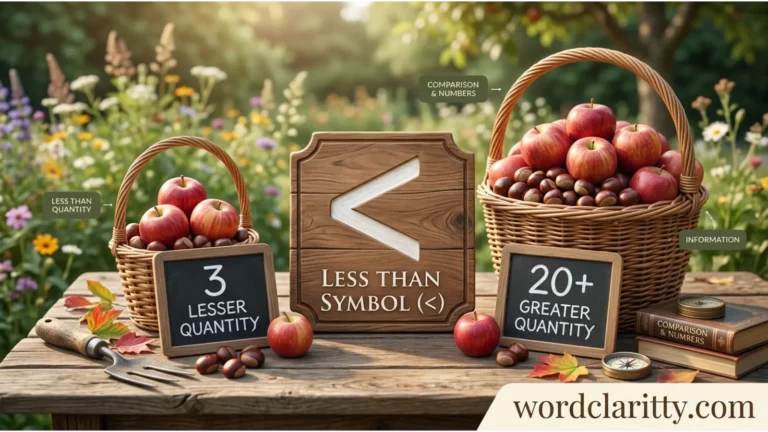
Less then or less than is a common confusion among English learners because then and than look and sound very similar. However, these two words have completely different meanings and grammatical functions. Less than is the correct expression when you want to compare an amount, number, size, degree, or quantity. Less then is usually incorrect when used as a comparison because then refers to time, sequence, or what happens next. Understanding the difference between less then and less than can help you avoid a frequent spelling and grammar mistake in emails, school assignments, professional writing, and everyday communication. This guide explains the difference in simple English with clear examples and easy memory tricks.
Why “Less Then” and “Less Than” Are Confusing
The words then and than are among the most frequently confused words in English. Adding less before them makes the confusion even more common.
Here are the main reasons people mix them up:
Similar Pronunciation
Then and than are pronounced very similarly in many varieties of English. Although they are not exact homophones for every speaker, their pronunciation is close enough to cause mistakes, especially when someone is learning English primarily through conversation.
For example:
- Less than five minutes
- Then we went home
When spoken quickly, learners may have difficulty identifying which word is being used.
Similar Spelling
The words differ by only one letter:
- then → e
- than → a
Because the difference is so small, it is easy to type the wrong word.
Context Confusion
The biggest problem is that then and than have different grammatical jobs.
Than is commonly used for comparisons:
This bag costs less than that one.
Then usually relates to time or sequence:
We finished dinner, then we watched a movie.
Therefore, you need to look at the meaning of the whole sentence rather than relying only on pronunciation.
Common Learner Mistakes
A common mistake is writing:
✘ The box weighs less then 10 kilograms.
The correct version is:
✔ The box weighs less than 10 kilograms.
Here, a comparison is being made between the weight of the box and 10 kilograms, so than is required.
Less Then vs Less Than Explained Simply
The easiest way to understand less then vs less than is to focus on the words comparison and sequence.
“Less than” means a quantity or amount is smaller than another quantity or amount, while “then” refers to a time, sequence, or next action.
One-Line Distinction
Use “less than” for comparison; use “then” for time or sequence.
Examples
Less than:
The journey takes less than two hours.
This compares the journey’s duration with two hours.
Then:
We finished our work, then we went home.
Here, then shows what happened next.
So, if you are asking whether the correct phrase is less then or less than when making a comparison, the answer is less than.
Understanding Homophones in English
English contains many words that sound alike or almost alike but have different meanings and spellings. These words can create problems for learners because spoken English does not always make the spelling obvious.
What Are Homophones?
Homophones are words that have the same pronunciation but different meanings and spellings.
For example:
- right = correct
- write = to form words using letters
Consider:
Please write the right answer.
The words right and write sound the same but have different meanings.
Then and than are often grouped with commonly confused sound-alike words, although their pronunciation can differ slightly depending on the speaker or accent.
Why Homophones Cause Confusion
When you hear a word but do not see it written, it can be difficult to know which spelling is correct.
For example, if someone says:
“The price is less than $20.”
A learner who is unsure about than might incorrectly write:
✘ The price is less then $20.
The meaning tells us that than is correct because the sentence compares the price with $20.
What Does “Less Then” Mean?
Definition and Core Meaning
“Less then” is not normally a correct fixed phrase for making a comparison.
The problem is that less and then perform different grammatical functions. Less indicates a smaller amount or degree, while then generally indicates time, sequence, or a consequence.
For example:
✘ There are less then 20 students in the class.
The intended meaning is a comparison, so than must be used:
✔ There are less than 20 students in the class.
However, the individual words less and then can appear in the same sentence when they serve separate purposes.
For example:
We need less work now, then we can take a break.
Here, less describes a smaller amount of work, while then introduces the next action. This construction is different from the incorrect comparison phrase less then.
Origin and Historical Use
Then is an old English word that has traditionally been connected with time and sequence. It developed from older Germanic forms and has been used for centuries to indicate what happened at a particular time or what happened next.
Modern Usage and Synonyms
Today, then is commonly used to mean:
- at that time
- next
- afterward
- in that case
Examples:
I was younger then.
First, read the instructions; then answer the questions.
If you are ready, then we can begin.
Example Sentences
We finished the meeting and then left the office.
I was living in Lahore then.
First wash the vegetables, then cut them.
Notice that none of these examples uses then to make a comparison.
What Does “Less Than” Mean?
Definition and Core Meaning
Less than is a comparison phrase used when one amount, number, degree, size, duration, or quantity is smaller than another.
Examples include:
The bag weighs less than 5 kilograms.
She is less than 18 years old.
The movie lasted less than two hours.
In each sentence, less than introduces the thing being compared.
Origin and Historical Context
Than has a long history in English and is associated with comparison. Its modern role developed from older forms that were used to introduce the second part of a comparison.
Today, than is especially common after comparative words such as:
- less
- more
- greater
- smaller
- faster
- slower
- better
- worse
- older
- younger
Modern Usage and Synonyms
Less than can communicate ideas such as:
- a smaller quantity
- a lower number
- a shorter period
- a lower degree
- an amount below a particular limit
For example:
The repair took less than an hour.
This phone costs less than $300.
There were less than 50 people at the event.
In mathematics, the symbol < is also used to represent “less than.”
For example:
4 < 10
This means “four is less than ten.”
Example Sentences
The shop is less than one kilometer away.
I need less than ten minutes to finish.
The temperature dropped to less than 5°C.
This solution requires less than three steps.
Less Then vs Less Than: Key Differences at a Glance
| Word | Part of Speech | Meaning | Example Context |
|---|---|---|---|
| Less then | Incorrect comparison phrase; then can be an adverb separately | Not used to express comparison | ✘ Less then 10 people |
| Less than | Comparative phrase | A smaller amount, number, degree, or quantity | ✔ Less than 10 people |
| Then | Adverb | At that time, next, afterward, or in that case | We ate, then we left. |
| Than | Conjunction/preposition in comparisons | Introduces the second part of a comparison | She is younger than me. |
The key point is simple: when “less” is followed by a comparison, use “than,” not “then.”
How to Remember the Difference Between Less Then and Less Than
Learning a simple memory trick can make this distinction much easier.
Memory Trick 1: Than = Comparison
Remember:
THAN = Comparison
If you are comparing two things, amounts, numbers, or degrees, choose than.
less than 10
more than 20
faster than before
Memory Trick 2: Then = Time
Remember:
THEN = Time or Next
If the word relates to something happening afterward or at a particular time, use then.
We ate dinner, then we left.
I lived there then.
Association Technique
Look at the letter A in than.
Think:
A = Amount
When you compare an amount, than is usually the word you need.
For example:
less than $50
less than five minutes
less than 100 people
One Memorable Example
Remember this sentence:
It costs less than $20, then we can buy it.
The first word is than because it compares the price with $20.
The second word is then because it describes what happens next.
This single sentence shows the difference clearly.
Common Mistakes and Confusions
Mistake 1
✘ The package weighs less then 2 kg.
✔ The package weighs less than 2 kg.
Explanation: The sentence compares the package’s weight with 2 kg, so than is correct.
Mistake 2
✘ It took less then an hour.
✔ It took less than an hour.
Explanation: The duration is being compared with one hour.
Mistake 3
✘ There were less then 30 students.
✔ There were less than 30 students.
Explanation: The sentence indicates a number below 30, so than is needed.
Mistake 4
✔ Finish your homework, then go outside.
This is correct because then indicates the next action.
Mistake 5
✔ I had less work then than I do now.
This sentence may look confusing, but it is grammatically possible. The first then refers to an earlier time, while the second than introduces a comparison.
This example shows why understanding the function of each word is more useful than simply memorizing the spelling.
Examples Section: Correct and Incorrect Usage
Example 1
✔ Correct: The test took less than one hour.
✘ Incorrect: The test took less then one hour.
Why? The sentence compares the test duration with one hour.
Example 2
✔ Correct: We had less than five dollars left.
✘ Incorrect: We had less then five dollars left.
Why? The amount is below five dollars, so use than.
Example 3
✔ Correct: First finish the assignment, then submit it.
✘ Incorrect: First finish the assignment, than submit it.
Why? The sentence describes a sequence of actions, so then is correct.
Example 4
✔ Correct: This road is less than three kilometers long.
✘ Incorrect: This road is less then three kilometers long.
Why? The length is being compared with three kilometers.
Example 5
✔ Correct: I was much younger then.
✘ Incorrect: I was much younger than.
Why? Here, then means “at that time.” There is no comparison being introduced.
Example 6
✔ Correct: She earns less than her brother.
✘ Incorrect: She earns less then her brother.
Why? Her earnings are being compared with her brother’s earnings.
Self Assessment: Test Your Knowledge
Fill in each blank with then or than.
- The journey took less _____ three hours.
- We finished dinner and _____ watched television.
- There are fewer _____ 20 seats available.
- I was younger _____, but I remember the event clearly.
Self Assessment Answers
- than — The sentence compares the journey’s duration with three hours.
- then — It describes the next action.
- than — The sentence compares the number of seats with 20.
- then — It refers to an earlier time.
A useful rule to remember is:
Comparison → than
Time or sequence → then
FAQs About “Less Then and Less Than”
Is “less then” correct?
Usually, no. If you are making a comparison, the correct phrase is less than. For example, “The box weighs less than 10 kg.”
Which is correct: less then or less than?
Less than is correct when you mean a smaller amount, number, degree, or quantity.
What does “less than” mean?
Less than means that something has a smaller amount, number, size, degree, or value than something else.
When should I use “then”?
Use then when referring to time, sequence, or a result. For example: “We finished our work, then we went home.”
Is “than” only used after “less”?
No. Than is used with many comparative expressions, including more than, better than, faster than, and older than.
Is “less than 10” grammatically correct?
Yes. Less than 10 means an amount or number below 10. For example: “The class has less than 10 students.”
How can I easily remember less than vs less then?
Remember THAN = comparison and THEN = time or next. If you are comparing something, choose than.
Final Conclusion: Using “Less Then” and “Less Than” Correctly
Understanding less then or less than becomes much easier once you separate the functions of then and than. Less than is the correct expression when you compare an amount, number, measurement, duration, degree, or value with something else. For example, “The task took less than an hour” compares the task’s duration with one hour. In contrast, then is generally used for time or sequence, as in “We finished the task, then we went home.” Therefore, less then is not the correct spelling when you mean a smaller amount or quantity.
A simple memory rule can prevent most mistakes: THAN = comparison, while THEN = time or next. Whenever you see less, more, greater, or another comparative expression, check whether you are making a comparison. If you are, than is likely the word you need. With regular practice and attention to context, this small but common English mistake becomes easy to avoid. Keep reading, writing, and checking your sentences, and you will naturally become more confident using less than and then correctly.

Bilal Hassan is a Master’s graduate, content writer, and author at WordClaritty.com. He specializes in creating clear, informative, and reader-friendly content focused on language, word meanings, and educational topics. With a passion for accuracy and simplicity, he helps readers expand their knowledge through engaging and easy-to-understand articles.