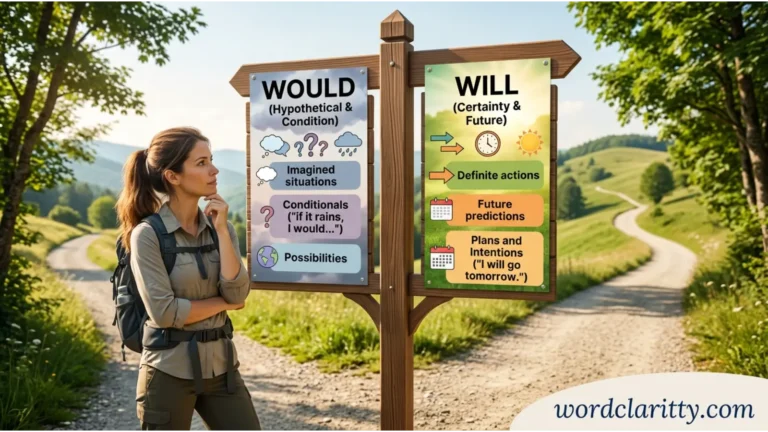
Would vs will can be confusing because both words are modal verbs connected with the future, intentions, requests, and possibilities. However, they are not interchangeable in every sentence. Will is commonly used for future actions, decisions, promises, and predictions, while would often expresses a conditional situation, a polite request, a past habit, or a future viewed from the past. Understanding this difference can make your English clearer and more natural. Whether you are writing an email, speaking with someone, or preparing for an English test, knowing when to use would and will helps you communicate your meaning accurately and confidently.
Why “Would” and “Will” Are Confusing
English learners often mix up would and will because both are modal verbs and can refer to actions that have not happened yet. The difference becomes especially difficult when talking about future plans, possibilities, promises, or polite requests.
Here are some common reasons for the confusion:
- Similar pronunciation: They are not pronounced the same, but both are short, unstressed words that can sound less distinct in fast speech.
- Similar spelling: Both words are short modal verbs and are closely related grammatically.
- Context confusion: Both can appear when discussing future events, intentions, predictions, and requests.
- Common learner mistakes: Learners may use would when they simply mean future will, or use will when a conditional form requires would.
For example:
I will help you tomorrow.
This is a straightforward future intention.
I would help you if I had enough time.
This describes a conditional situation. The speaker is willing to help, but the condition affects whether the action can happen.
Would vs Will Explained Simply
Simple Explanation
Will is generally used for the future, decisions, promises, willingness, and predictions.
Would is generally used for conditional situations, polite requests, past habits, and reported or future-in-the-past situations.
One-Line Distinction
Will usually describes what is expected, intended, or decided to happen, while would often describes what could happen under a condition or what was expected from a past point of view.
Examples
She will call you tonight.
This means the speaker expects or intends the call to happen.
She would call you if she had your number.
This means the call depends on a condition.
A useful shortcut is:
Will = future or definite intention
Would = condition, politeness, or past perspective
Understanding Homophones in English
What Are Homophones?
Homophones are words that sound the same but have different meanings and usually different spellings.
For example:
- right = correct or a direction
- write = to put words on paper
Both words are pronounced the same, but their meanings and spellings are different.
Why Homophones Cause Confusion
Homophones can be difficult because you cannot always identify the correct word from pronunciation alone.
For example:
Please write your name.
A listener understands the correct word from the context.
However, would and will are not homophones. They have different pronunciations and different grammatical functions. They are sometimes confused because they are related modal verbs, not because they sound exactly alike.
This distinction is important for learners who are studying confusing English words.
What Does “Would” Mean?
Definition and Core Meaning
Would is a modal auxiliary verb. It is commonly used to talk about hypothetical or conditional situations, polite requests, preferences, past habits, and events that were expected from a past point of view.
In many conditional sentences, would describes the result of a situation.
For example:
I would travel more if I had more money.
The speaker is imagining a situation rather than stating a definite future plan.
Origin and Historical Use
Would developed from the Old English verb willan, which expressed ideas such as wishing, wanting, or being willing. Over time, its forms became associated with the past form of will.
Today, would has several functions beyond simply being the past form of will. It can express hypothetical situations, politeness, repeated actions in the past, and future events viewed from an earlier time.
Modern Usage and Synonyms
Depending on the context, would can communicate ideas related to:
- hypothetically
- conditionally
- politely
- preference
- willingness
- repeated past action
- future from a past perspective
Some related expressions include:
- might
- could
- used to
- was willing to
- was expected to
These are not always exact synonyms, so the context matters.
Example Sentences
I would buy that laptop if it were cheaper.
Would you please close the door?
When we were children, we would play outside every evening.
She said she would arrive before noon.
I would rather stay at home tonight.
Notice that would does not always mean the same thing. Its meaning depends heavily on the sentence.
What Does “Will” Mean?
Definition and Core Meaning
Will is a modal auxiliary verb commonly used to talk about the future. It can express future actions, predictions, promises, decisions, willingness, and certainty about something expected to happen.
For example:
I will finish the work tomorrow.
The speaker is making a statement about a future action.
Origin and Historical Context
Like would, will comes from the Old English verb willan, which originally carried meanings connected with wanting, wishing, or being willing. Over centuries, its use developed into an important way of expressing future time and intention in English.
Modern English uses will for much more than simple future statements. It can also show willingness or make a prediction.
Modern Usage and Synonyms
Will is commonly used for:
- future actions
- predictions
- promises
- offers
- spontaneous decisions
- willingness
- strong expectations
Depending on the context, related expressions may include:
- be going to
- intend to
- plan to
- expect to
- be likely to
Again, these expressions are not always interchangeable with will.
Example Sentences
I will call you after dinner.
It will rain later.
Don’t worry. I will help you.
We will visit Lahore next week.
She will probably pass the exam.
In each example, will connects the statement with a future action, prediction, intention, or willingness.
Would vs Will: Key Differences at a Glance
| Word | Part of Speech | Meaning | Example Context |
|---|---|---|---|
| Would | Modal auxiliary verb | Conditional, hypothetical, polite, habitual past, or future from a past viewpoint | “I would go if I had time.” |
| Will | Modal auxiliary verb | Future action, prediction, promise, decision, or willingness | “I will go tomorrow.” |
Compare Them Directly
If I have enough money, I will buy the phone.
This describes a possible future action.
If I had enough money, I would buy the phone.
This describes a hypothetical situation.
Another useful comparison is:
She said, “I will help.”
Reported later:
She said she would help.
Here, would represents the future as seen from a past point of view.
How to Remember the Difference Between Would and Will
Learning a simple memory trick can make the difference much easier.
Memory Trick 1: Think “Future” for Will
When you are talking directly about something that is expected or planned for the future, think will.
I will see you tomorrow.
Memory Trick 2: Think “Condition” for Would
When an action depends on an imagined condition, think would.
I would see you if I were in town.
Memory Trick 3: Think “Polite” for Would
For polite requests, would often sounds softer than will.
Would you help me with this?
Compare it with:
Will you help me with this?
Both can be correct, but the first is often more polite or formal.
Memory Trick 4: Look for “If”
When you see a sentence with an if clause describing a hypothetical situation, would is often used in the result clause.
If I were rich, I would travel around the world.
One Memorable Example
Remember this pair:
I will buy a car when I get a job.
I would buy a car if I got a better job.
The first expresses a future plan connected with a real possibility. The second presents a hypothetical condition.
Common Mistakes and Confusions
Mistake 1: Using “Would” for Every Future Sentence
Wrong:
I would go to school tomorrow.
This is usually incorrect if you simply mean that you plan or expect to go.
Correct:
I will go to school tomorrow.
Why?
Use will for a straightforward future statement. Use would when there is another reason, such as a condition or a past viewpoint.
Mistake 2: Using “Will” in a Hypothetical Result
Wrong:
If I had more free time, I will learn Spanish.
Correct:
If I had more free time, I would learn Spanish.
Why?
The sentence describes an imagined condition, so would is normally used in the result clause.
Mistake 3: Confusing Polite Requests
Both forms can be used, but they can have different tones.
Will you pass me the salt?
Would you pass me the salt?
The second sentence is generally more polite or less direct.
Mistake 4: Forgetting the Past Perspective
Wrong:
He said he will come later.
This can sometimes be acceptable if the future is still being presented from the speaker’s current perspective, but in traditional reported speech, would is normally expected.
Better:
He said he would come later.
Mistake 5: Using “Would” Without Understanding the Condition
Unclear:
I would visit my friend tomorrow.
If you mean a definite plan, will is usually better.
Clear:
I will visit my friend tomorrow.
Or, if there is a condition:
I would visit my friend tomorrow if I were free.
The condition explains why would is appropriate.
Examples Section: Correct and Incorrect Usage
Example 1: Future Plan
✔ Correct: I will finish my homework tonight.
✘ Incorrect: I would finish my homework tonight.
Explanation: The first sentence simply states a future intention. There is no condition or special past perspective requiring would.
Example 2: Hypothetical Situation
✔ Correct: I would help you if I had enough time.
✘ Incorrect: I will help you if I had enough time.
Explanation: The sentence presents an imagined condition, so would is the natural choice in the result clause.
Example 3: Polite Request
✔ Correct: Would you open the window, please?
✘ Incorrect: Would you opening the window, please?
Explanation: After would, use the base form of the verb: open, not opening.
Example 4: Reported Speech
✔ Correct: Sara said she would call me later.
✘ Incorrect: Sara said she would called me later.
Explanation: A modal verb such as would is followed by the base form of the main verb: would call, not would called.
Example 5: Promise
✔ Correct: I will never forget your kindness.
✘ Incorrect: I would never forget your kindness.
Explanation: Will works naturally when making a direct promise about the future.
Self Assessment: Test Your Knowledge
Fill in each blank with would or will.
- I ______ call you tomorrow after work.
- If I had more money, I ______ buy a new computer.
- ______ you like some tea?
- He said that he ______ help us with the project.
Self Assessment Answers
- will — This is a straightforward future action.
- would — The sentence describes a hypothetical condition.
- Would — This is a polite offer or question.
- would — The statement reports something that was future from a past point of view.
FAQs About “Would and Will”
1. What is the main difference between would and will?
Will is commonly used for future actions, predictions, promises, decisions, and willingness. Would is commonly used for hypothetical or conditional situations, polite requests, past habits, and future actions viewed from the past.
2. Is “would” the past tense of “will”?
Historically and grammatically, would is closely related to the past form of will. However, modern English uses would for several purposes that are not simply past-time meanings, including hypothetical situations and polite requests.
3. Should I use would or will after “if”?
It depends on the type of condition. For a real or possible future condition, will may appear in the main clause:
If it rains, we will stay home.
For a hypothetical or unlikely condition:
If I had more time, I would travel.
4. Is “Would you help me?” correct?
Yes. Would you help me? is grammatically correct and is commonly used as a polite request. It can sound softer and less direct than Will you help me?
5. Can would and will be used in the same sentence?
Yes. They can appear together when they perform different grammatical functions.
If you help me today, I will help you tomorrow.
I would help you, but I am busy.
The correct choice depends on the meaning of each part of the sentence.
6. Which is correct: “I will” or “I would”?
Both can be correct. Use I will for a future intention, decision, promise, or prediction. Use I would for a hypothetical situation, polite expression, preference, or similar context.
7. Is “would” more polite than “will”?
Often, yes. Would is frequently used to make requests and offers sound more polite or less direct:
Would you please wait here?
However, will is not automatically rude. The choice also depends on tone and context.
Final Conclusion: Using “Would” and “Will” Correctly
Understanding would vs will becomes much easier when you focus on the meaning behind the sentence rather than trying to memorize every rule. Will is commonly used for future actions, predictions, promises, decisions, offers, and willingness. For example, “I will call you tomorrow” describes a future intention. Would, on the other hand, is often used for hypothetical or conditional situations, polite requests, preferences, past habits, and future events viewed from a past perspective. For example, “I would call you if I had your number” describes a condition.
A simple way to remember the difference is to connect will with a straightforward future and would with a condition or imagined situation. Also remember that would can make requests sound more polite, as in “Would you help me?” When you see an if clause, check whether the sentence describes a real possibility or an imagined condition. That can often guide your choice. Finally, remember that would and will are not homophones; they are related modal verbs with different uses. With regular practice and attention to context, choosing between them will become natural. Keep practicing with real sentences, and your English will become clearer and more confident.