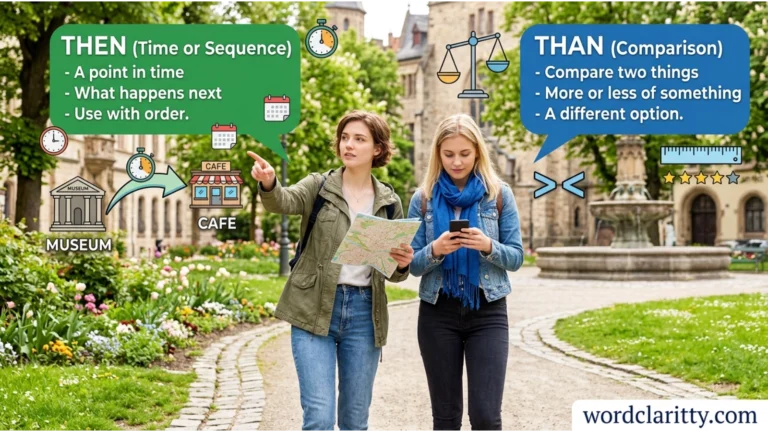
Then or than are two small English words that often cause big confusion. They sound very similar in everyday speech, and even experienced learners sometimes use one when they mean the other. However, then and than have different meanings and grammatical functions.
Understanding the difference is important because using the wrong word can change the meaning of a sentence or make your writing look less polished. The good news is that the rule is simple once you connect each word with its main purpose. In this guide, you will learn when to use then and than, see clear examples, and easy memory tricks.
Why “Then or Than” Are Confusing
English learners often mix up then and than because the two words are very close in spelling and pronunciation.
Here are the main reasons for the confusion:
- Similar pronunciation: In many accents, then and than sound extremely similar, especially when spoken quickly.
- Similar spelling: Both words begin with th and contain only four letters.
- Context confusion: Both words frequently appear in everyday sentences, so learners may choose the word that “looks right” rather than considering its meaning.
- Common learner mistakes: People often write then when making a comparison or than when talking about time or sequence.
For example:
I am taller than my brother.
Here, than introduces a comparison.
But:
We ate dinner and then watched a movie.
Here, then shows what happened next.
The key is to focus on the job the word in the sentence.
Then or Than Explained Simply
The simplest way to understand the difference is:
“Then” is mainly connected with time, sequence, or a result, while “than” is used when comparing people, things,or ideas.
One-Line Distinction
Then = time, order, or result.
Than = comparison.
Examples
Then:
Finish your homework, then you can play video games.
The word then tells us what happens next.
Than:
Sarah is taller than her sister.
The word than compares Sarah with her sister.
So, remember:
Then tells you when or what comes next; than compares.
Understanding Homophones in English
What Are Homophones?
Homophones are words that sound the same or very similar but have different meanings, spellings, or grammatical functions.
For example:
I write in my notebook every day.
Please right the mistake.
Write and right have the same pronunciation in standard English, but they have different meanings and spellings.
It is worth noting that then and than are not perfect homophones for every English speaker. Their pronunciation can differ slightly depending on accent. Nevertheless, their similar sound makes them easy to confuse, particularly in spoken English.
Why Homophones Cause Confusion
When learners hear a word before seeing it written, they may know the meaning but not remember the correct spelling.
For example, if someone says:
“This book is better than that one.”
A learner might later write:
“This book is better then that one.”
The meaning is understandable, but than is required because the sentence makes a comparison.
This is why learning both meaning and spelling is important.
What Does “Then” Mean?
Definition and Core Meaning
Then is commonly used as an adverb. It can refer to a particular time, show the next step in a sequence, or indicate a result.
Its meaning depends on the context.
1. Then for Time
Then can refer to a time in the past or a time already or mentioned.
I lived in London then.
Here, then refers to a particular period in the past.
Another example:
Things were different then.
2. Then for Sequence
Then can mean next or after that.
First, wash the vegetables. Then, cut them into small pieces.
The actions happen in a particular order.
Another example:
She finished her work and then went home.
3. Then for a Result
Then can also mean something like in that case or therefore, especially in conditional situations.
If you are tired, then take a break.
The second part follows from the condition in the first part.
Origin and Historical Use
Then is an old English word. It comes from earlier forms of English related to the idea of at that time or at that moment. Over centuries, its uses expanded, allowing it to describe time, sequence, and logical results.
Modern Usage and Related Words
Depending on the sentence, words or phrases related to then include:
- next
- afterward
- after that
- at that time
- in that case
- subsequently
However, these are not always exact replacements.
Example Sentences
- I was living in Karachi then.
- First, read the instructions, then answer the questions.
- We had lunch and then went shopping.
- If you don’t want coffee, then or choose tea.
- Then what happened?
A useful test is to ask:
Does the sentence talk about time, order, or a result?
If yes, then may be the correct choice.
What Does “Than” Mean?
Definition and Core Meaning
Than is mainly a conjunction or preposition used to introduce the second part of a comparison.
It connects two people, objects, actions, qualities, amounts, or ideas.
For example:
My car is faster than yours.
The sentence compares two cars.
Than in Comparisons
You commonly see than after comparative words such as:
- better
- bigger
- smaller
- faster
- slower
- older
- younger
- easier
- harder
- more
- less
- fewer
Examples:
This test is easier than the last one.
Ali runs faster than I do.
I have more books than my brother.
Origin and Historical Context
Than also has a long history in English. It developed from older forms associated with comparison and contrast. Its main modern function remains the same: introducing the thing or person against which something is compared.
Modern Usage and Related Words
There is no single word that can always replace than. Depending on the sentence, a comparison may be expressed using phrases such as:
- compared with
- compared to
- in contrast with
- rather than
For example:
This phone is cheaper than or that one.
You could also say:
This phone is cheaper compared with that one.
The construction changes, so than remains the natural choice in many comparative sentences.
Example Sentences
- My new laptop is lighter than my old one.
- She is more confident than before.
- This road is longer than the other road.
- I would rather walk than wait.
- There were fewer students than we expected.
A useful test is:
Is the sentence comparing two things?
If yes, than is usually the word you need.
Then vs Than: Key Differences at a Glance
| Word | Part of Speech | Meaning | Example Context |
|---|---|---|---|
| Then | Adverb | At that time; next; after that; in that case | “We had dinner, then watched a film.” |
| Than | Conjunction/Preposition | Used to introduce the second part of a comparison | “The blue car is faster than the red car.” |
Quick Rule
Use “then” when you are talking about time, order, or a result.
Use “than” when you are comparing things.
Compare these two sentences:
I was younger then.
This talks about time.
I was younger than my sister.
This makes a comparison.
That small difference is the key to using these words correctly.
How to Remember the Difference Between Then and Than
Learning a simple memory trick can make the difference much easier to remember.
Memory Trick 1: “Then” Has “E”
Think of then = E = events.
When events happen one after another, use then:
First we eat, then we leave.
You can also connect then with time.
Memory Trick 2: “Than” Has “A”
Think of than = A = comparison.
The letter A can remind you of against, because a comparison places one thing against another.
My house is bigger than yours.
Memory Trick 3: Ask a Question
When you are unsure, ask yourself:
Is this about “when/next”?
→ Use then.
Is this about “which is more, less, better, bigger, etc.”?
→ Use than.
One Memorable Example
First I studied, then I took the test.
The test was harder than I expected.
The first sentence uses then for sequence. The second uses than for comparison.
Common Mistakes and Confusions
Mistake 1: Using “Then” in a Comparison
✘ Wrong:
My car is faster then yours.
✔ Correct:
My car is faster than yours.
Why? The sentence compares two cars, so you need than.
Mistake 2: Using “Than” for Sequence
✘ Wrong:
First, mix the ingredients, than put the mixture in the oven.
✔ Correct:
First, mix the ingredients, then put the mixture in the oven.
Why? The sentence describes what happens next, so use then.
Mistake 3: Confusing “Then” With “At That Time”
✘ Wrong:
I lived there than.
✔ Correct:
I lived there then.
Why? The word refers to a particular time, not a comparison.
Mistake 4: Confusing “Rather Than”
✔ Correct:
I would stay home rather than go outside.
Here, than is part of the expression rather than, which presents a choice or preference.
Examples Section: Correct and Incorrect Usage
Example 1
✔ Correct:
Emma is older than Jack.
✘ Incorrect:
Emma is older then Jack.
Explanation: The sentence compares Emma’s age with Jack’s age.
Example 2
✔ Correct:
We finished dinner and then cleaned the kitchen.
✘ Incorrect:
We finished dinner and than cleaned the kitchen.
Explanation: Then means the cleaning happened afterward.
Example 3
✔ Correct:
This exercise is easier than the previous one.
✘ Incorrect:
This exercise is easier then the previous one.
Explanation: Than introduces the second part of the comparison.
Example 4
✔ Correct:
First, save the document. Then close the program.
✘ Incorrect:
First, save the document. Than close the program.
Explanation: Then shows the order of two actions.
Example 5
✔ Correct:
If you finish early, then you can leave.
✘ Incorrect:
If you finish early, than you can leave.
Explanation: Here, then introduces the result of the condition.
Example 6
✔ Correct:
She has more experience than I do.
✘ Incorrect:
She has more experience then or then.
Explanation: The sentence compares two levels of experience.
Self Assessment: Test Your Knowledge
Fill in each blank.
- My sister is taller ______ me.
- First, complete the form, ______ submit it.
- This restaurant is cheaper ______ the one we visited yesterday.
- I lived in that city ______, but I moved away several years ago.
Take a moment to choose your answers before checking the section below.
Self Assessment Answers
- than — The sentence compares height.
- then — The word shows the next action.
- than — The sentence compares prices.
- then — The word refers to a time in the past.
Quick Score Guide
- 4/4: Excellent! You understand the basic difference.
- 3/4: Good work. Review the memory tricks once more.
- 2/4: Practice identifying comparison and sequence.
- 0–1/4: Go back to the simple rule: then = time/order; than = comparison.
FAQs:
1. What is the difference between then and than?
Then is generally used for time, sequence, or a result. Than is used to make comparisons.
We ate then left.
She is taller than me.
2. Is it “better then” or “better than”?
The correct expression is “better than.”
This version is better than the old one.
Because the sentence compares two things, use than.
3. Is it “first then” or “first than”?
The correct phrase is “first, then.”
First, read the question. Then, choose an answer.
Then shows the next step.
4. Is then a preposition?
Then is most commonly used as an adverb. It can express time, sequence, or a result.
For example:
I was younger then.
5. Is than only used after comparative adjectives?
No. Than can be used in comparisons involving adjectives, adverbs, quantities, nouns, and other structures.
She has more books than I do.
He runs faster than his brother.
6. How can I remember then vs than?
Use this simple rule:
Then = time or next.
Than = comparison.
You can also remember than by connecting it with words such as better, bigger, faster, more, and less.
7. Are then and than homophones?
They are very similar in pronunciation, and in some accents they may sound almost identical. However, they are not perfect homophones for all speakers. Their different meanings and spellings make them easy to distinguish in writing once you know the rule.
Conclusion:
The difference between then and than is simple once you focus on meaning rather than sound. Then is mainly connected with time, sequence, or a result. You use it when describing what happened at a particular time or what happens next: “We finished dinner, then we watched a movie.” Than, on the other hand, is used for comparisons: “This movie is better than the last one.” Remembering this basic distinction can prevent many common English grammar and spelling mistakes.
A useful memory trick is to connect then with time and next, while connecting than with comparison. Whenever you are unsure, stop and ask what the sentence is doing. Is it telling you when something happened or what happens next? Choose then. Is it comparing two people, things, amounts, or ideas? Choose than. With a little practice, the difference will become automatic. Keep noticing these words in books, conversations, emails, and everyday writing. The more you see them in context, the more naturally you will use them. Keep practicing, and you will soon know exactly when to use then and than.

Bilal Hassan is a Master’s graduate, content writer, and author at WordClaritty.com. He specializes in creating clear, informative, and reader-friendly content focused on language, word meanings, and educational topics. With a passion for accuracy and simplicity, he helps readers expand their knowledge through engaging and easy-to-understand articles.