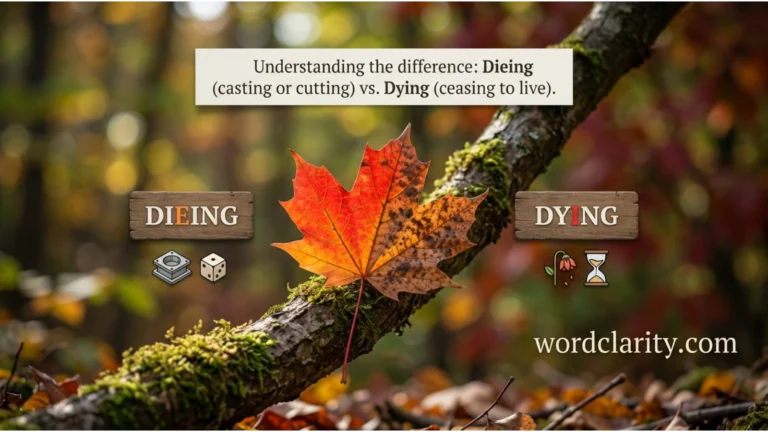
“Dieing” and “dying” look almost identical, so it is easy to wonder which spelling is correct. For most English learners, the confusion comes from a common spelling rule: when a verb ending in -ie changes to its -ing form, the ending usually changes to -ying. As a result, the correct form of die is dying, not dieing.
Understanding this small difference can help you avoid spelling mistakes in essays, emails, messages, and everyday English. In this guide, you will learn what dieing and dying mean, why they are confused, how to remember the correct spelling, and when to use each form.
Why “Dieing” and “Dying” Are Confusing
English spelling can be confusing because words do not always change in the way learners expect. Dieing and dying are a good example.
Here are the main reasons people mix them up:
- Similar pronunciation: In ordinary English, dieing and dying would be read very similarly, which makes the spelling difficult to identify from speech alone.
- Similar spelling: Both forms begin with the same letters, d-i, and both appear to be based on the verb die.
- Context confusion: Learners may apply a general rule such as simply adding -ing to a verb. This would seem to produce dieing, but English has a special spelling change here.
- Common learner mistakes: People sometimes write dieing because they correctly know the base word is die and assume that adding -ing means keeping the original spelling.
The key point is that die + ing does not become dieing in standard modern English. It becomes dying.
This spelling pattern is similar to lie → lying and tie → tying.
Dieing vs Dying Explained Simply
Simple explanation
Dying is the correct spelling when die means to stop living, or when it is used in related figurative expressions.
Dieing is generally considered an incorrect spelling of the present participle or gerund of die in standard modern English.
One-line distinction
Dying is the standard and correct form of die + -ing; dieing is normally a spelling mistake.
Examples
- The plant is dying because it has not received enough water.
- The patient was dying after a long illness.
Compare the forms:
- die → dying
- lie → lying
- tie → tying
The spelling changes from -ie to -y before -ing.
So, if you mean “in the process of dying,” always write dying.
Understanding Homophones in English
What Are Homophones?
Homophones are words that sound the same but have different meanings, and they may have different spellings.
For example:
- to — used with a verb or to indicate direction
- too — also or excessively
- two — the number 2
Example:
I want to buy two books, too.
Although dieing and dying can cause pronunciation-related confusion, they are not a typical pair of homophones. The main problem between them is spelling rather than a difference in meaning or pronunciation.
Why Homophones Cause Confusion
When two words sound alike, learners cannot rely on pronunciation to determine the spelling.
For example, someone may hear “right” and write write, even though the context requires right.
With dieing and dying, however, the important lesson is different: dying is the standard spelling of the -ing form of die. The confusion usually happens because learners expect the original ie to remain unchanged.
What Does “Dieing” Mean?
Definition and Core Meaning
In standard modern English, dieing is generally not the correct spelling of the -ing form of die.
If you want to say that a person, animal, plant, organization, or other thing is in the process of dying, use dying.
For example:
- Incorrect: The flowers are dieing.
- Correct: The flowers are dying.
It is important to distinguish dieing from dyeing. The word dyeing is a real and commonly used English word. It comes from dye, meaning to change the color of something.
For example:
She is dyeing her hair brown.
Therefore:
- die → dying = becoming dead or ceasing to live
- dye → dyeing = changing the color of something
Origin and Historical Use
The verb die has a very old history in English and is related to older Germanic words associated with death. Over time, English spelling developed conventions for forming the -ing form of verbs.
The modern spelling dying follows the established pattern for verbs ending in -ie. The final ie changes to y before -ing.
Although unusual or historical spellings may appear in older texts or specialized references, learners writing modern standard English should use dying when referring to the verb die.
Modern Usage and Synonyms
Today, dieing should generally be avoided in standard English.
Related words and expressions include:
- dying
- death
- deceased
- passing away
- near death
- fatal
- life-threatening
Remember that these words are not always interchangeable. For example, deceased normally describes someone who has already died, while dying describes the process or condition of approaching death.
Example Sentences
Incorrect:
The old tree is dieing.
Correct:
The old tree is dying.
Many plants are dying because of the extreme heat.
The animal appeared to be dying.
What Does “Dying” Mean?
Definition and Core Meaning
Dying is the present participle and gerund form of the verb die.
The basic meaning is stopping or ceasing to live.
It can also have several figurative meanings. For instance, someone can be dying of laughter, meaning they are laughing extremely hard, without actually being close to death.
Similarly, dying for something can mean wanting it very strongly.
Origin and Historical Context
The word dying comes from the verb die, which has roots in Old English and other Germanic languages. The spelling reflects the modern English rule for verbs ending in -ie.
Compare:
- die → dying
- lie → lying
- tie → tying
This is why simply adding -ing to the written form of die does not produce the standard spelling dieing.
Modern Usage and Synonyms
Dying is extremely common in modern English and can be used literally or figuratively.
Common related expressions include:
- dying of thirst — extremely thirsty
- dying of hunger — extremely hungry
- dying of laughter — laughing very hard
- dying to know — wanting to know very much
- dying for a break — strongly wanting a break
- a dying tradition — a tradition that is gradually disappearing
Example Sentences
The leaves are dying because of the lack of water.
The injured bird was dying when the rescue team found it.
I’m dying to know what happened.
The old tradition is slowly dying out.
These examples show that dying can describe literal death as well as figurative situations.
Dieing vs Dying: Key Differences at a Glance
| Word | Part of Speech | Meaning | Example Context |
|---|---|---|---|
| dieing | Generally incorrect spelling | Normally intended to mean the -ing form of “die” | Avoid in standard modern English |
| dying | Present participle / gerund | In the process of dying; also used figuratively | “The plant is dying.” |
| dyeing | Present participle / gerund | Changing the color of something | “She is dyeing her clothes.” |
The most important distinction is simple: die becomes dying.
If you are talking about death, use dying. If you are talking about changing color, use dyeing.
How to Remember the Difference Between Dieing and Dying
Here are some easy ways to remember the correct spelling.
1. Remember “IE” Changes to “Y”
When die takes -ing, the ie changes to y:
die → dying
Think of the pattern:
- lie → lying
- tie → tying
- die → dying
2. Remember the Three-Word Pattern
A useful memory trick is:
Die, lie, tie → dying, lying, tying.
All three verbs ending in -ie change to -y before -ing.
3. Do Not Confuse “Dying” With “Dyeing”
This is one of the most useful associations.
- dying = related to die
- dyeing = related to dye
For example:
The plant is dying.
But:
She is dyeing the fabric.
The extra e in dyeing belongs to dye, not die.
One Memorable Example
Think:
A flower is dying, but a shirt is dyeing.
The flower is losing its life. The shirt is getting a new color.
That simple contrast can help you remember the spelling.
Common Mistakes and Confusions
Mistake 1: Adding -ing Directly to “die”
Wrong:
The dog is dieing.
Correct:
The dog is dying.
Explanation: The ie in die changes to y before -ing.
Mistake 2: Confusing “dying” and “dyeing”
Wrong:
She is dying her hair red.
Correct:
She is dyeing her hair red.
Explanation: Here, the verb is dye, not die. Therefore, the correct form is dyeing.
Mistake 3: Assuming “dieing” Is an Alternative Spelling
Wrong assumption:
“Dieing” and “dying” are two standard spellings of the same word.
Correct understanding:
Dying is the standard spelling when it comes from die.
Mistake 4: Using “dyeing” for death
Wrong:
The old tree is dyeing.
Correct:
The old tree is dying.
Explanation: A tree can die, but it cannot dye itself. Dyeing refers to changing color.
Examples Section: Correct and Incorrect Usage
Example 1
✔ Correct: The flowers are dying because they need water.
✘ Incorrect: The flowers are dieing because they need water.
Why? The verb is die, so its -ing form is dying.
Example 2
✔ Correct: She is dyeing her dress blue.
✘ Incorrect: She is dying her dress blue.
Why? The action involves changing the color of the dress, so the verb is dye.
Example 3
✔ Correct: I was dying to hear the news.
✘ Incorrect: I was dieing to hear the news.
Why? “Dying to” is a common idiom meaning that someone wants something very much.
Example 4
✔ Correct: The leaves are dying in the winter.
✘ Incorrect: The leaves are dyeing in the winter.
Why? The leaves are losing their life or vitality, so dying is correct.
Example 5
✔ Correct: They are dyeing the fabric with natural colors.
✘ Incorrect: They are dieing the fabric with natural colors.
Why? The verb is dye, meaning to give something a different color.
Self Assessment: Test Your Knowledge
Fill in each blank with dying, dieing, or dyeing.
- The grass is ______ because there has been no rain.
- She is ______ the white shirt green.
- I am ______ to find out the answer.
- The old plant looks as though it is ______.
Self Assessment Answers
- dying — The grass is dying because there has been no rain.
- dyeing — She is dyeing the white shirt green.
- dying — “Dying to” means wanting something very strongly.
- dying — The plant is in the process of losing its life.
Remember: die → dying, while dye → dyeing.
FAQs:
Is “dieing” a correct English word?
In standard modern English, dieing is generally not the correct spelling when you mean the -ing form of die. Use dying instead.
Is it “dying” or “dieing”?
The correct spelling is dying when the word comes from die.
The plant is dying.
Why does “die” become “dying”?
English changes the final -ie to -y before adding -ing. Therefore:
die + ing → dying
The same pattern appears in lie → lying and tie → tying.
What is the difference between “dying” and “dyeing”?
Dying comes from die and refers to death or, in figurative expressions, an intense desire or gradual disappearance.
Dyeing comes from dye and means changing the color of something.
The plant is dying.
She is dyeing the fabric.
Is “dying” only used for people?
No. Dying can describe people, animals, plants, and other living things. It can also be used figuratively.
For example:
The tree is dying.
The tradition is dying out.
Is “dying to” grammatically correct?
Yes. Dying to + verb is a common informal expression meaning that someone wants to do something very much.
I am dying to see the new movie.
It does not necessarily refer to literal death.
How can I easily remember “dying” instead of “dieing”?
Remember the spelling pattern:
die → dying
You can also remember lie → lying and tie → tying. When these verbs ending in -ie take -ing, the ie changes to y.
Conclusion:
The difference between dieing and dying is mainly a matter of correct English spelling. When you use the verb die in its -ing form, the standard spelling is dying, not dieing. This applies whether you are talking about literal death, such as “The plant is dying,” or a figurative expression, such as “I am dying to know the answer.”
It is also important not to confuse dying with dyeing. Dyeing comes from dye and means changing the color of something. For example, “She is dyeing her hair.” A useful memory trick is to group die, lie, and tie together: die → dying, lie → lying, tie → tying. In each case, the final -ie changes to y before -ing.
So, whenever you are unsure, ask yourself which base verb you mean. If it is die, write dying. If it is dye, write dyeing. With a little practice, this spelling difference becomes easy to recognize. Keep noticing these patterns as you read and write English, and confusing words will become much easier to use correctly.

Bilal Hassan is a Master’s graduate, content writer, and author at WordClaritty.com. He specializes in creating clear, informative, and reader-friendly content focused on language, word meanings, and educational topics. With a passion for accuracy and simplicity, he helps readers expand their knowledge through engaging and easy-to-understand articles.