
Introduction
Desert and dessert are two English words that look almost identical, but they have completely different meanings. This small spelling difference can cause big confusion, especially for English learners and anyone writing quickly. One word refers to a dry, often sandy region, while the other refers to a sweet course eaten after a meal.
The words also have different pronunciations, which makes them easier to distinguish when spoken correctly. Learning the difference between desert and dessert is useful because both words appear frequently in everyday English. In this guide, you will learn their meanings, pronunciation, origins, common mistakes, memory tricks, and correct usage.
Why “Desert” and “Dessert” Are Confusing
English learners often confuse desert and dessert because the words contain almost the same letters. The main difference is the extra s in dessert, but that single letter changes the meaning completely.
Similar pronunciation
The two words can sound similar, but they are not always pronounced in exactly the same way.
- Desert meaning a dry region is pronounced DEZ-ert.
- Dessert meaning a sweet food is pronounced dih-ZURT.
There is another use of desert as a verb, as in to desert someone. This verb is pronounced like dessert: dih-ZURT.
Similar spelling
The spelling is another major source of confusion:
- desert → one s
- dessert → two s letters
Because the words are visually similar, it is easy to type or write the wrong one.
Context confusion
Context usually tells you which word is correct.
If you are talking about sand, dry land, heat, or geography, you probably need desert.
The Sahara is a huge desert.
If you are talking about cake, ice cream, fruit, or a sweet course after dinner, you need dessert.
We had chocolate cake for dessert.
Common learner mistakes
Some common mistakes include:
- Writing desert when talking about a sweet dish.
- Writing dessert when talking about a dry region.
- Forgetting that dessert has two s letters.
- Pronouncing desert and dessert as if they were exactly the same.
- Confusing the noun desert with the verb desert.
Desert or Dessert Explained Simply
Desert and dessert have different meanings, even though their spellings are very similar.
One-line distinction
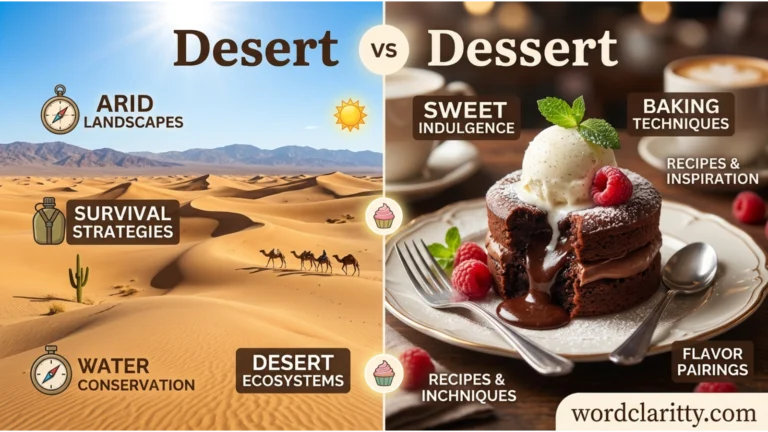
Desert = dry land; dessert = sweet food.
Examples
- The camel crossed the desert.
- She ordered ice cream for dessert.
A useful spelling clue is the extra s in dessert. Think of dessert as something you want to have seconds of: deSSert.
Understanding Homophones in English
English contains many words that sound alike or nearly alike but have different meanings and spellings. Understanding these word pairs can improve both writing and speaking skills.
What Are Homophones?
Homophones are words that have the same pronunciation but different meanings and often different spellings.
For example:
- flower — a plant bloom
- flour — a powder used in cooking
The flower is beautiful.
We need flour to make the cake.
Strictly speaking, desert and dessert are not homophones in all their uses. The geographical noun desert and the food dessert have different pronunciations. However, the verb desert has the same pronunciation as dessert, which is why learners may find this word family particularly confusing.
Why Homophones Cause Confusion
When two words sound the same, listeners cannot always identify the spelling from pronunciation alone.
For example:
The soldier decided to desert his post.
Here, desert is a verb meaning to abandon. It sounds like dessert, but the meaning and spelling are different.
This is why learning words in context is important.
What Does “Desert” Mean?
Definition and Core Meaning
As a noun, desert means a large area of land that receives very little rainfall. Deserts can be hot or cold, and they are not necessarily covered entirely by sand.
Examples include the Sahara Desert, the Gobi Desert, and the Atacama Desert.
Simple definition desert is a very dry region with little rainfall.
The word can also be used as a verb.
To desert means to leave someone or something behind, especially when you have a responsibility or duty to stay.
Origin and Historical Use
The noun desert comes through Old French from Latin dēsertum, referring to an abandoned or deserted place. Over time, the word became associated with uninhabited or barren areas.
The verb desert has a related historical connection to the idea of leaving or abandoning something.
This history helps explain why English uses the same spelling for two related but distinct forms: a desert can be thought of historically as an abandoned or uninhabited place, while to desert something means to leave it.
Modern Usage and Synonyms
Today, desert is commonly used in geography, travel, environmental science, and everyday conversation.
Depending on the context, related words include:
- arid region
- dry land
- wasteland
- barren region
- wilderness
However, these words are not always exact synonyms. For example, a wilderness can be a forest or mountain area and does not have to be dry.
Example Sentences
- The Sahara Desert covers a vast area of North Africa.
- Many plants in the desert can survive with very little water.
- The travelers carried extra water across the desert.
- The soldier was accused of deserting his unit.
- Do not desert your responsibilities when things become difficult.
Notice the difference between the noun and verb:
The desert is extremely dry.
They decided to desert their position.
What Does “Dessert” Mean?
Definition and Core Meaning
Dessert is a sweet food or dish usually served at the end of a meal.
Common desserts include:
- cake
- ice cream
- pudding
- pie
- cheesecake
- fruit tart
- cookies
Simple definition:
Dessert is a sweet food commonly eaten after a meal.
Origin and Historical Context
The word dessert comes from French desservir, meaning roughly “to clear the table.” It developed into the name for the final course served after the main meal.
This history connects the word with the traditional order of a meal: after the main dishes were finished and the table was cleared, a final sweet course could be served.
Modern Usage and Synonyms
Today, dessert is widely used in restaurants, homes, recipes, menus, and casual conversation.
There are several related expressions, although they are not perfect synonyms:
- sweet
- sweet course
- after-dinner treat
- pudding
In British English, pudding can commonly refer to the dessert course, while in American English, pudding usually refers to a particular type of soft, sweet food.
Example Sentences
- We had chocolate cake for dessert.
- What would you like for dessert?
- The restaurant serves three different desserts.
- She made a delicious apple pie for dessert.
- I usually skip dessert after a large meal.
Remember: if you can eat it after dinner, you probably mean dessert.
Desert vs Dessert: Key Differences at a Glance
| Word | Part of Speech | Meaning | Example Context |
|---|---|---|---|
| desert | Noun | A very dry region of land | The camel lives in the desert. |
| desert | Verb | To leave or abandon | He decided to desert his post. |
| dessert | Noun | A sweet food served after a meal | We had ice cream for dessert. |
The most important distinction for English learners is:
desert = dry land
dessert = sweet food
There is also a pronunciation difference between the geographical noun desert and dessert.
- DEZ-ert → dry region
- dih-ZURT → sweet food
- dih-ZURT → abandon or leave
How to Remember the Difference Between Desert and Dessert
The easiest way to remember these words is to focus on the two S’s in dessert.
Memory trick 1: Dessert has “seconds”
Think:
Dessert has two S’s because you want seconds.
deSSert = seconds
This is one of the most popular and useful spelling tricks for remembering the difference.
Memory trick 2: Desert is dry
The word desert has only one s.
One S = sand.
Both sand and desert begin with the idea of a dry environment.
Memory trick 3: Think about what you can eat
If you are choosing between cake and ice cream, the answer is dessert.
“I want dessert after dinner.”
If you are talking about the Sahara, the answer is desert.
“The Sahara is a desert.”
One memorable example
A camel crosses the desert, and a traveler eats dessert afterward.
This sentence puts both words together, making their meanings easier to remember.
Common Mistakes and Confusions
Mistake 1
✘ We ate ice cream for desert.
This is incorrect because ice cream is a sweet food.
✔ We ate ice cream for dessert.
Explanation: A sweet course after a meal is dessert, with two s letters.
Mistake 2
✘ The Sahara is a dessert.
This is incorrect because the Sahara is a dry geographical region.
✔ The Sahara is a desert.
Explanation: A dry region is a desert, with one s.
Mistake 3
✘ The camel walked across the dessert.
✔ The camel walked across the desert.
Explanation: A camel may cross a desert. It does not normally cross a plate of cake or ice cream.
Mistake 4
✘ The restaurant served three deserts.
✔ The restaurant served three desserts.
Explanation: When talking about sweet dishes, use desserts with two s letters.
Mistake 5: Confusing the verb
✘ The soldier desserted his post.
✔ The soldier deserted his post.
Explanation: The verb meaning “to abandon” is spelled desert, although it is pronounced like dessert.
Examples Section: Correct and Incorrect Usage
Example 1
✔ Correct: We ordered chocolate cake for dessert.
✘ Incorrect: We ordered chocolate cake for desert.
Why? Chocolate cake is a sweet dish, so dessert is correct.
Example 2
✔ Correct: The explorers traveled through the desert.
✘ Incorrect: The explorers traveled through the dessert.
Why? The sentence refers to a dry geographical region.
Example 3
✔ Correct: She made fruit salad for dessert.
✘ Incorrect: She made fruit salad for desert.
Why? Fruit salad is being served as a sweet course.
Example 4
✔ Correct: Few plants can survive in such a dry desert.
✘ Incorrect: Few plants can survive in such a dry dessert.
Why? The sentence describes a dry environment, so desert is needed.
Example 5
✔ Correct: The army accused him of deserting his post.
✘ Incorrect: The army accused him of desserting his post.
Why? The verb desert means to abandon or leave.
Example 6
✔ Correct: What is your favorite dessert?
✘ Incorrect: What is your favorite desert?
Why? The question asks about a sweet food, not a geographical region.
Self Assessment: Test Your Knowledge
Fill in each blank with desert, dessert, or the correct form of desert.
- We had chocolate pudding for ______ after dinner.
- The travelers needed plenty of water while crossing the ______.
- What is your favorite ______: cake or ice cream?
- The soldier was punished for choosing to ______ his post.
Self Assessment Answers
- dessert — Chocolate pudding is a sweet food eaten after a meal.
- desert — A desert is a very dry region.
- dessert — Cake and ice cream are examples of desserts.
- desert — As a verb, desert means to abandon or leave.
Quick Score Guide
- 4/4: Excellent! You clearly understand the difference.
- 3/4: Very good. Review the spelling trick once more.
- 2/4: Keep practicing the words in sentences.
- 0–1/4: Review the basic rule: desert = dry land; dessert = sweet food.
FAQs:
1. What is the difference between desert and dessert?
Desert usually means a dry area of land, while dessert means a sweet food served after a meal.
2. Is dessert spelled with one or two S’s?
Dessert is spelled with two S’s: d-e-s-s-e-r-t.
3. How do you remember desert vs dessert?
A useful trick is “dessert has two S’s because you want seconds.” Remember: desert = dry land and dessert = sweet food.
4. Is desert and dessert pronounced the same?
Not always. The geographical noun desert is pronounced DEZ-ert, while dessert is pronounced dih-ZURT. The verb desert, meaning “to abandon,” is pronounced like dessert.
5. Is the Sahara a desert or a dessert?
The Sahara is a desert because it is a very large, extremely dry region in North Africa.
6. Is cake a desert or dessert?
Cake can be a dessert when it is served as a sweet course after a meal.
7. What does desert mean as a verb?
As a verb, desert means to leave or abandon someone, something, or a responsibility. For example: “He deserted his post.”
Conclusion:
Understanding the difference between desert and dessert is simple once you connect each word with its meaning. Desert, with one s, usually refers to a dry region of land, such as the Sahara or Gobi. It can also be a verb meaning to leave or abandon someone or something. Dessert, with two s letters, is a sweet food normally served at the end of a meal, such as cake, ice cream, or pie. The easiest spelling trick is to remember that dessert has two S’s because you may want seconds.
You can also associate the single s in desert with sand and dry landscapes. Pay attention to context, too: if you are discussing geography, think desert; if you are talking about food, think dessert. With a little practice, these commonly confused words become much easier to recognize and spell correctly. Keep using them in your own sentences, and soon the difference will feel natural.

