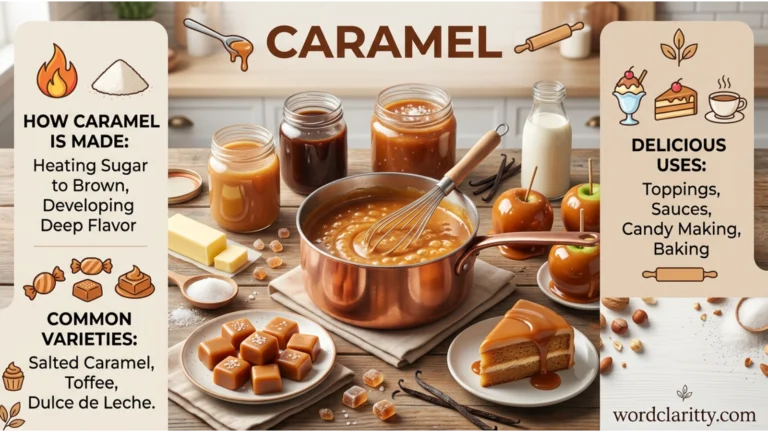
If you have ever wondered whether the correct word is Carmel or caramel, you are not alone. These two words look and sound similar, so even English learners sometimes use them interchangeably. However, they do not have the same meaning. Caramel is the word you usually need when talking about a sweet food, candy, sauce, or flavor.
Carmel, on the other hand, is most commonly used as a proper name, especially in place names and religious references. Understanding the difference can help you avoid spelling mistakes, choose the right word in writing, and understand why some people pronounce caramel in different ways. Let’s make the distinction simple and easy to remember.
Why “Carmel” and “Caramel” Are Confusing
Carmel and caramel are easy to mix up because they are visually and phonetically similar. The extra a in caramel can be easy to forget, especially when someone hears the word rather than sees it written.
Similar pronunciation
The biggest source of confusion is pronunciation. Caramel has more than one accepted pronunciation in English.
Some speakers pronounce it with three syllables:
CAR-a-mel
Others commonly pronounce it with two:
CAR-mel
The two-syllable pronunciation can sound very similar to Carmel. As a result, learners may hear caramel and assume it is spelled carmel.
Similar spelling
The spelling is also confusing:
- Carmel — 6 letters
- Caramel — 7 letters
The difference is only one letter, but that letter changes the word.
Context confusion
The words belong to different contexts.
Caramel is normally associated with:
- Candy
- Desserts
- Sauces
- Sugar
- Flavor
- Cooking
Carmel is usually a proper noun, appearing in names of places, people, organizations, or religious references.
Common learner mistakes
A common mistake is writing:
“I love carmel ice cream.”
The correct spelling for the sweet flavor is:
“I love caramel ice cream.”
Another mistake is assuming that carmel is simply a shorter spelling of caramel. It is not.
Carmel vs Caramel Explained Simply
The simplest way to understand the difference is to look at what each word refers to.
Caramel is a sweet substance or flavor made by heating sugar.
Carmel is generally a proper name and is especially familiar in names such as Mount Carmel and Carmel-by-the-Sea.
One-line distinction
Caramel is a sweet food or flavor, while Carmel is usually a proper name.
Example sentences
- The cake was covered with warm caramel sauce.
- They visited Carmel during their vacation.
So, if you are talking about something sweet, caramel is almost certainly the word you need.
Understanding Homophones in English
Pronunciation is an important reason why English spelling can be difficult. English contains many words that sound the same or almost the same but have different spellings and meanings.
What Are Homophones?
Homophones are words that have the same pronunciation but different meanings and often different spellings.
For example:
- right — correct or opposite of left
- write — to put words on paper or a screen
Consider:
“You are right.”
and
“Please write your name.”
The words sound alike, but their meanings and spellings are different.
Why Homophones Cause Confusion
When you learn English mainly through conversation, you may know how a word sounds before you know how it is spelled.
For example, someone might say “caramel” using the two-syllable pronunciation. A learner could hear something close to “carmel” and spell it incorrectly.
Technically, carmel and caramel are not universally exact homophones because pronunciations vary. The confusion is mainly caused by the common two-syllable pronunciation of caramel.
What Does “Caramel” Mean?
Definition and Core Meaning
Caramel is a sweet substance produced by heating sugar until it changes color and develops a distinctive flavor.
It can be used as:
- A noun: “I bought some caramel.”
- An adjective-like modifier: “She ordered a caramel latte.”
- A description of color: “The walls have a caramel shade.”
Caramel is widely used in cooking and food products. It can be soft, hard, liquid, chewy, or used as a flavoring.
Origin and Historical Use
The word caramel entered English through European languages and ultimately traces back to a Latin term associated with sugar cane. Over time, the word developed into the modern English term for sugar that has been heated and transformed.
The process of making caramel is known as caramelization. During this process, heat causes sugar to undergo chemical changes that produce its familiar brown color and rich flavor.
Modern Usage and Synonyms
In modern English, caramel commonly appears in food-related expressions such as:
- Caramel sauce
- Caramel candy
- Caramel apple
- Caramel popcorn
- Caramel pudding
- Caramel latte
- Salted caramel
- Caramel flavor
There are not many exact synonyms for caramel, because it names a specific substance. Depending on context, related expressions may include burnt sugar, caramelized sugar, or caramel sauce, although these are not always interchangeable.
Example sentences
- She added caramel sauce to the ice cream.
- This coffee has a strong caramel flavor.
- He bought a box of caramel candies.
- The onions developed a rich, caramel-like color after cooking.
Notice that caramel is the correct spelling whenever you mean the sweet substance, flavor, or related color.
What Does “Carmel” Mean?
Definition and Core Meaning
Carmel is usually a proper noun, meaning it is used as a name rather than as the general name of a food or substance.
One well-known use is Mount Carmel, a mountain range and geographic region in present-day Israel. The name also appears in various place names, including Carmel-by-the-Sea, a city in California.
Origin and Historical Context
The name Carmel has ancient roots. It comes from a Hebrew name commonly understood as relating to a garden, orchard, or fruitful land.
The biblical Mount Carmel is an important historical and religious location. Because of this history, Carmel has also been used in names of churches, schools, communities, and institutions.
Modern Usage and Synonyms
Because Carmel is normally a name, it does not have ordinary synonyms in the same way that a common noun does.
You may see it in:
- Mount Carmel
- Carmel-by-the-Sea
- Carmel, Indiana
- Personal names
- Religious institutions
- Names of organizations and schools
Example sentences
- Mount Carmel is mentioned in the Bible.
- They spent the weekend in Carmel-by-the-Sea.
- The school is named Our Lady of Mount Carmel.
- Carmel is also used as a personal name.
The key point is that Carmel does not normally mean a sweet food.
Carmel vs Caramel: Key Differences at a Glance
| Word | Part of Speech | Meaning | Example Context |
|---|---|---|---|
| Caramel | Noun / modifier | A sweet substance, flavor, candy, sauce, or related color | “I ordered a caramel latte.” |
| Carmel | Proper noun | A name used for places, people, and religious or organizational references | “They visited Carmel-by-the-Sea.” |
Which spelling is correct?
Both Carmel and caramel are correct English words, but they are correct in different situations.
If you mean the sweet substance or flavor, use:
caramel
If you mean a place, person, organization, or another proper name called Carmel, use:
Carmel
Therefore, it is not accurate to say that one spelling is always right and the other is always wrong. The correct choice depends on the meaning.
How to Remember the Difference Between Carmel and Caramel
A few simple memory tricks can make this distinction much easier.
1. Remember the extra “a”
Think:
Caramel = A sweet treat
The word caramel contains an extra a after the first “car.”
You can connect the extra a with apple:
caramel apple
Both words contain an a, which can help you remember the spelling.
2. Associate “Carmel” with names
When you see Carmel, think of a name.
For example:
Mount Carmel
Carmel-by-the-Sea
This makes it easier to separate the geographic or personal name from the dessert-related word.
3. Use the “sweet” test
Ask yourself:
Am I talking about something sweet?
If the answer is yes, choose caramel.
caramel candy
caramel sauce
caramel ice cream
If you are talking about a location or name, Carmel may be correct.
One memorable example
I ate a caramel apple in Carmel.
This sentence contains both words and shows the difference clearly:
- caramel apple = a sweet food
- Carmel = a place name
Common Mistakes and Confusions
Mistake 1: Using “carmel” for the flavor
Wrong:
I love carmel popcorn.
Correct:
I love caramel popcorn.
Explanation: The popcorn contains a sweet coating, so caramel is the correct word.
Mistake 2: Assuming “caramel” is always pronounced with three syllables
English pronunciation varies by region and speaker.
Caramel may be pronounced with two or three syllables. Both pronunciations are commonly heard.
Therefore, do not use pronunciation alone to decide the spelling.
Mistake 3: Changing a proper name
If a place or organization is officially named Carmel, you should keep that spelling.
Correct:
We visited Carmel-by-the-Sea.
It would be incorrect to change the place’s name to Caramel-by-the-Sea simply because the words sound similar.
Mistake 4: Treating the words as interchangeable
Wrong:
The restaurant served carmel sauce.
Correct:
The restaurant served caramel sauce.
The fact that caramel can sometimes sound like carmel does not make the spellings interchangeable.
Examples Section: Correct and Incorrect Usage
Here are several examples to make the difference clearer.
✔ Correct: She poured caramel sauce over the pancakes.
✘ Incorrect: She poured carmel sauce over the pancakes.
Why? The sentence refers to a sweet sauce, so caramel is required.
✔ Correct: They traveled to Carmel-by-the-Sea last summer.
✘ Incorrect: They traveled to Caramel-by-the-Sea last summer.
Why? Carmel-by-the-Sea is a proper place name.
✔ Correct: I bought a caramel apple at the fair.
✘ Incorrect: I bought a carmel apple at the fair.
Why? A caramel apple is a food made with caramel.
✔ Correct: Mount Carmel has a long religious and historical significance.
✘ Incorrect: Mount Caramel has a long religious and historical significance.
Why? The geographic name is Mount Carmel.
✔ Correct: The dessert has a rich caramel flavor.
✘ Incorrect: The dessert has a rich carmel flavor.
Why? Caramel describes the flavor.
Self Assessment: Test Your Knowledge
Fill in each blank with Carmel or caramel.
- She drizzled ______ sauce over the cheesecake.
- They planned a trip to ______-by-the-Sea.
- I bought a ______ apple at the market.
- ______ is a name associated with several places and religious references.
Self Assessment Answers
- caramel — It refers to a sweet sauce.
- Carmel — Carmel-by-the-Sea is a place name.
- caramel — A caramel apple is a sweet food.
- Carmel — Here, it refers to a proper name.
FAQs:
Is “carmel” a correct spelling?
Yes. Carmel is a correct English word when it is used as a proper name, such as in Mount Carmel or Carmel-by-the-Sea. It is not normally the spelling for the sweet substance.
Is “caramel” or “carmel” correct for candy?
Caramel is correct. For example, you can say caramel candy, caramel sauce, or caramel-filled chocolate.
Why do some people pronounce caramel like “carmel”?
In many varieties of English, caramel is pronounced with two syllables, which can make it sound very similar to Carmel. Other speakers pronounce it with three syllables. Pronunciation varies by region and individual speaker.
Is caramel a flavor?
Yes. Caramel can refer to the substance itself and is also widely used to describe a flavor in foods and drinks.
What is the difference between Carmel and caramel?
Caramel refers to a sweet substance, flavor, candy, sauce, or related color. Carmel is generally a proper name used for places, people, and religious or organizational names.
How do you spell caramel correctly?
The standard spelling for the sweet food or flavor is:
C-A-R-A-M-E-L
Remember the extra a: caramel.
Is “Carmel” ever used as a name?
Yes. Carmel can be a place name and a personal name. It also occurs in religious and institutional names, especially those connected with Mount Carmel.
Conclusion:
The difference between Carmel and caramel is small in spelling but important in meaning. Caramel is the word you need when you are talking about a sweet substance made by heating sugar, or about foods and drinks that have that flavor. You will see it in expressions such as caramel sauce, caramel candy, caramel apple, and caramel latte. Carmel, by contrast, is generally a proper name. It can refer to places such as Mount Carmel or Carmel-by-the-Sea, as well as people, organizations, and religious institutions.
The main reason these words cause confusion is pronunciation. In some varieties of English, caramel is pronounced with two syllables, making it sound very similar to Carmel. However, similar pronunciation does not mean identical spelling or meaning. When in doubt, use the simple “sweet test”: if you are talking about a dessert, candy, sauce, or flavor, spell it caramel. If you are referring to a name or place, Carmel may be the correct choice. Keep practicing these examples, and this common English spelling confusion will soon become much easier to handle.