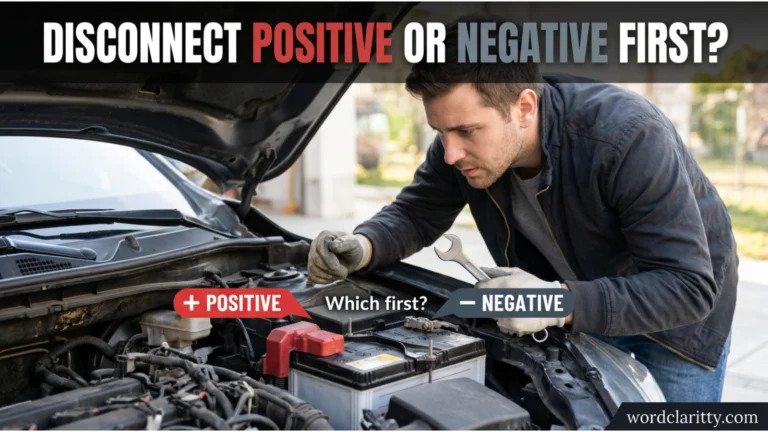
Should you disconnect the positive or negative battery terminal first? This is a common question among car owners, beginner mechanics, and English learners trying to understand automotive instructions. Although the words “positive” and “negative” may seem like simple opposites, they have specific meanings when discussing car batteries and electrical safety.
Removing the wrong terminal first can increase the risk of sparks, short circuits, and injuries. Understanding the correct order helps you follow vehicle maintenance instructions safely and confidently. In this guide, you will learn what positive and negative terminals mean, why the order matters, common mistakes to avoid, and how to remember the correct procedure.
Why “Disconnect Positive First” and “Disconnect Negative First” Are Confusing
Many people feel uncertain about which battery terminal to disconnect first because both terminals look similar and are essential parts of a vehicle’s electrical system.
The confusion becomes greater when instructions use technical terms without explaining their meaning.
1. Similar Pronunciation
The words “positive” and “negative” are not homophones. They have different pronunciations:
- Positive: /ˈpɒzətɪv/ in British English.
- Negative: /ˈneɡətɪv/.
However, both words have three syllables and end with a similar “-tive” sound.
For beginner English learners, this shared ending may make the words seem related in a way that causes confusion.
In electrical discussions, however, they identify opposite polarities.
2. Similar Spelling
Both words end in “-tive,” but their beginnings and meanings differ.
- Positive: Associated with the plus sign (+).
- Negative: Associated with the minus sign (−).
The plus and minus symbols are important because they help identify the correct battery terminals.
3. Context Confusion
In everyday English, “positive” often means good or optimistic, while “negative” can mean bad or unfavourable.
In electrical systems, however, these words refer to electrical polarity rather than good or bad qualities.
For example:
“The negative battery terminal should normally be disconnected first.”
Here, “negative” refers to the terminal marked with a minus sign, not something harmful or undesirable.
4. Common Learner Mistakes
Common misunderstandings include:
- Assuming that the positive terminal should always be disconnected first because it supplies electrical power.
- Believing that the negative terminal is unimportant.
- Confusing battery disconnection with battery reconnection.
- Thinking that positive and negative describe safety rather than polarity.
- Forgetting that different battery systems may require different procedures.
For most conventional negative-ground cars with a standard 12-volt battery, the usual rule is to disconnect the negative terminal first.
Disconnect Positive vs Negative First Explained Simply
For most conventional negative-ground vehicles, disconnect the negative (−) battery terminal first and the positive (+) terminal second.
When reconnecting the battery, the usual order is reversed: positive first, negative last.
Simple Explanation
Disconnect positive first: Removing the cable attached to the battery’s positive (+) terminal before removing the negative cable.
Disconnect negative first: Removing the cable attached to the battery’s negative (−) terminal before removing the positive cable.
In most modern conventional cars, the negative terminal is connected to the vehicle’s metal body or chassis.
Removing this connection first reduces the risk of accidentally creating a short circuit between the positive terminal and grounded metal while using a tool.
One-Line Distinction
Negative first when disconnecting; positive first when reconnecting—for most standard negative-ground car batteries.
Two Example Sentences
Example 1:
“Before replacing the battery in a conventional negative-ground car, disconnect the negative terminal first.”
This describes the usual recommended procedure.
Example 2:
“Disconnecting the positive terminal first can create a short-circuit risk if a metal tool touches the vehicle’s grounded body.”
This explains why the removal order matters.
These instructions are not universal. Always check the vehicle manufacturer’s guidance, particularly for hybrid vehicles, electric vehicles, older positive-ground systems, and vehicles with special battery management equipment.
Understanding Homophones in English
Understanding English vocabulary can make automotive instructions easier to follow, especially when technical words are unfamiliar.
What Are Homophones?
Homophones are words that sound the same but have different meanings and often different spellings.
For example, “brake” and “break” are homophones.
- Brake: A device used to slow or stop a vehicle.
- Break: To damage, separate, or interrupt something.
Consider these sentences:
“The driver pressed the brake pedal.”
“Be careful not to break the plastic cover.”
Both words sound alike, but their meanings are different.
Other common examples include:
- Hear and here
- Right and write
- One and won
- Road and rode
However, “positive” and “negative” are not homophones. They are opposites, also called antonyms.
Why Homophones Cause Confusion
Homophones can confuse learners because pronunciation alone does not always reveal the correct spelling.
For example:
“The mechanic checked the brake.”
“The mechanic did not want to break the part.”
The words sound the same but describe different actions or objects.
The confusion between “positive” and “negative” is different. These words are used to identify opposite electrical polarities.
Understanding their meanings is important because confusing them in battery maintenance instructions can create a genuine safety risk.
What Does “Disconnect Positive First” Mean?
Definition and Core Meaning
“Disconnect positive first” means removing the electrical connection from the battery’s positive (+) terminal before removing the negative (−) connection.
The positive terminal is usually marked with a plus sign and often has a red cable or protective cover.
In many conventional vehicles, the positive terminal supplies electrical power to the vehicle’s electrical system.
However, removing the positive terminal first is generally not the recommended procedure for an ordinary negative-ground car battery.
Why Can Disconnecting Positive First Be Risky?
In most conventional cars, the negative terminal is electrically connected to the vehicle’s metal chassis.
If the negative cable is still attached, a metal wrench touching both the positive terminal and a grounded metal part can create a short circuit.
This may cause:
- Electrical sparks.
- Very high current through the tool.
- Burns or damaged equipment.
- Battery damage.
- Fire or explosion hazards in certain conditions.
Disconnecting the negative terminal first reduces this particular risk by breaking the battery’s connection to the grounded chassis.
It does not remove every electrical hazard, so care is still necessary.
Origin and Historical Use
The terms “positive” and “negative” became established in electrical science as scientists developed methods for describing electrical charge and current.
The convention of positive and negative electrical charge is historically associated with Benjamin Franklin’s eighteenth-century work on electricity.
As automotive electrical systems developed, batteries were marked with positive and negative terminals to identify polarity.
Older vehicles did not all use the same grounding arrangement. Some had positive-ground electrical systems, whereas most modern conventional cars use negative-ground systems.
This historical difference explains why battery disconnection instructions should not be treated as universal for every vehicle.
Modern Usage and Synonyms
Common related expressions include:
- Positive terminal: The battery connection marked (+).
- Positive cable: The cable connected to the positive terminal.
- Plus terminal: An informal way of identifying the positive connection.
- Battery positive post: The positive metal connection point on the battery.
- Live terminal: A context-dependent term sometimes used for an energized connection.
These expressions may appear in repair manuals and automotive discussions.
Example Sentences
- “The mechanic identified the positive battery terminal by its plus sign.”
- “The positive cable was protected by a red plastic cover.”
- “Disconnecting the positive terminal first can be risky in a negative-ground vehicle.”
- “The technician followed the manufacturer’s instructions before removing the positive cable.”
- “After the negative connection was removed, the mechanic disconnected the positive terminal.”
The examples show that “positive” describes electrical polarity, not a general recommendation about which cable should be removed first.
What Does “Disconnect Negative First” Mean?
Definition and Core Meaning
“Disconnect negative first” means removing the electrical connection from the battery’s negative (−) terminal before disconnecting the positive terminal.
For most conventional negative-ground cars, this is the recommended order.
The negative terminal is usually marked with a minus sign and commonly has a black cable connected to the vehicle’s chassis.
Removing this cable first interrupts the normal connection between the battery’s negative terminal and the vehicle body.
Why Is Negative First Usually Safer?
In a negative-ground vehicle, much of the metal body and engine structure is connected to the battery’s negative side.
When the negative cable is disconnected, an accidental touch between a tool on the positive terminal and the vehicle body is less likely to complete a short circuit through the normal chassis ground connection.
This is the main reason for the negative-first rule.
However, disconnecting the negative terminal does not make the battery itself harmless. A tool bridging the battery’s positive and negative posts can still cause a dangerous short circuit.
Origin and Historical Context
As negative-ground electrical systems became standard in most modern conventional vehicles, the negative-first disconnection procedure became common automotive maintenance practice.
Vehicle manufacturers and repair manuals often specify this sequence to reduce accidental short-circuit risks.
The recommended order developed from the electrical design of the vehicle rather than from the everyday meanings of “positive” and “negative.”
Specialized systems may require additional steps or professional servicing.
Modern Usage and Synonyms
Related expressions include:
- Negative terminal: The battery connection marked (−).
- Negative cable: The cable connected to the negative terminal.
- Ground cable: A cable connecting the battery’s negative side to the vehicle chassis in a negative-ground system.
- Minus terminal: An informal name for the negative connection.
- Chassis ground: The electrical connection to the vehicle’s metal structure.
These terms are common in automotive repair instructions.
Example Sentences
- “The mechanic disconnected the negative terminal before removing the battery.”
- “The negative battery cable was attached to the vehicle’s chassis.”
- “Disconnecting the negative terminal first reduces the risk of accidental short circuits.”
- “The technician checked the minus sign before identifying the negative connection.”
- “The repair manual instructed the driver to remove the negative cable first.”
Remember that the correct procedure depends on the vehicle’s electrical design.
Disconnect Positive vs Negative First: Key Differences at a Glance
The following table explains the difference between the two procedures.
| Word or Phrase | Part of Speech | Meaning | Example Context |
|---|---|---|---|
| Positive | Adjective or noun | Refers to the battery’s (+) polarity or terminal | “The positive cable often has a red cover.” |
| Negative | Adjective or noun | Refers to the battery’s (−) polarity or terminal | “The negative cable is commonly black.” |
| Disconnect positive first | Verb phrase | Remove the positive connection before the negative | Generally avoided when disconnecting a standard negative-ground car battery |
| Disconnect negative first | Verb phrase | Remove the negative connection before the positive | Usual procedure for conventional negative-ground cars |
| Reconnect positive first | Verb phrase | Attach the positive connection before the negative | Usual reconnection sequence for conventional negative-ground cars |
Which One Is Correct?
For most standard 12-volt, negative-ground vehicles:
Battery disconnection:
- Negative (−) first.
- Positive (+) second, if complete battery removal is required.
Battery reconnection:
- Positive (+) first.
- Negative (−) last.
These are general rules, not instructions for every vehicle. Consult the owner’s manual before working on the battery, and do not attempt to handle high-voltage components in hybrid or electric vehicles without appropriate training.
How to Remember the Difference Between Disconnect Positive First and Disconnect Negative First
Remembering the correct order is easier when you connect it with a simple rule.
1. Remember “Negative Off First”
Use this memory trick:
Negative off first, negative on last.
For most conventional negative-ground vehicles, the negative cable is the first one removed and the last one reconnected.
2. Associate Negative with Ground
Think of the negative cable as the connection to the vehicle’s metal body.
In a negative-ground system:
- Negative connects to the chassis.
- Positive supplies the vehicle’s electrical circuits.
- Removing negative first interrupts the normal chassis-ground connection.
This association helps explain the safety reason behind the rule.
3. Remember the Reverse Order
The removal and reconnection sequences are opposites.
- Disconnect: Negative, then positive.
- Reconnect: Positive, then negative.
Remembering one sequence helps you recall the other.
4. One Memorable Example
Imagine a mechanic preparing to replace a conventional car battery.
Before removing the battery, the mechanic identifies the terminal marked with a minus sign.
The mechanic follows the vehicle’s approved procedure and disconnects that terminal first.
After installing the replacement battery, the mechanic reconnects the positive cable before the negative cable.
The simple rule is:
Minus off first, minus on last.
Common Mistakes and Confusions
Battery maintenance instructions can be misunderstood when technical terms are unfamiliar.
Mistake 1: Assuming Positive Must Come First
✘ Incorrect: “The positive cable must always be disconnected first because it supplies power.”
✔ Correct: “In most negative-ground cars, the negative cable should be disconnected first.”
Explanation: The order is based on reducing short-circuit risk, not on which terminal supplies electrical power.
Mistake 2: Confusing Disconnection and Reconnection
✘ Incorrect: “Disconnect negative first and reconnect negative first.”
✔ Correct: “Disconnect negative first and reconnect positive first.”
Explanation: The normal sequence is reversed when reconnecting a conventional negative-ground battery.
Mistake 3: Relying Only on Cable Colour
✘ Incorrect: “The black cable is always negative, so checking the markings is unnecessary.”
✔ Correct: “Identify the terminals using their polarity markings and the vehicle’s documentation.”
Explanation: Cable colours can vary, particularly in modified or older vehicles.
Mistake 4: Assuming All Vehicles Use the Same System
✘ Incorrect: “Every vehicle uses a negative-ground electrical system.”
✔ Correct: “Most modern conventional cars use negative-ground systems, but exceptions exist.”
Explanation: Older positive-ground vehicles and specialized electrical systems may require different procedures.
Mistake 5: Assuming a Disconnected Negative Cable Removes Every Risk
✘ Incorrect: “Once the negative cable is disconnected, the battery cannot cause a short circuit.”
✔ Correct: “A battery can still be dangerous if a metal object connects its positive and negative terminals.”
Explanation: Disconnecting the chassis ground reduces a particular hazard but does not eliminate the battery’s stored electrical energy.
Examples Section: Correct and Incorrect Usage
These examples demonstrate the correct terminology and general safety principles.
Example 1: Battery Removal
✔ Correct: “For a conventional negative-ground car, disconnect the negative terminal first.”
✘ Incorrect: “For every car, disconnect the positive terminal first.”
Why? Most modern conventional cars use negative-ground systems, but not all vehicles follow identical procedures.
Example 2: Battery Reconnection
✔ Correct: “Reconnect the positive terminal before the negative terminal in a standard negative-ground car.”
✘ Incorrect: “Reconnect the negative terminal first because it was removed first.”
Why? The usual reconnection sequence reverses the removal order.
Example 3: Identifying Polarity
✔ Correct: “The positive battery terminal is marked with a plus sign (+).”
✘ Incorrect: “The positive battery terminal is marked with a minus sign (−).”
Why? A plus sign identifies positive polarity, while a minus sign identifies negative polarity.
Example 4: Understanding Ground Connections
✔ Correct: “In a negative-ground vehicle, the negative battery cable connects to the chassis.”
✘ Incorrect: “In every vehicle, the positive battery cable connects directly to the chassis as ground.”
Why? The grounding arrangement depends on the electrical system.
Example 5: Short-Circuit Safety
✔ Correct: “A metal tool touching the positive terminal and grounded metal can cause a short circuit while the negative connection remains attached.”
✘ Incorrect: “A short circuit cannot occur when working with a 12-volt car battery.”
Why? Car batteries can deliver very high currents despite their relatively low voltage.
Example 6: Following Vehicle Instructions
✔ Correct: “Check the manufacturer’s battery service instructions before disconnecting any cables.”
✘ Incorrect: “All batteries can be disconnected using the same procedure.”
Why? Different vehicles and battery systems may have additional requirements.
Self-Assessment: Test Your Knowledge
Choose the correct answer for each fill-in-the-blank question.
Question 1: In most conventional negative-ground cars, disconnect the ___ terminal first.
a) Positive
b) Negative
Question 2: When reconnecting a conventional negative-ground battery, the ___ terminal is usually connected first.
a) Positive
b) Negative
Question 3: The battery terminal marked with a minus sign (−) is the ___ terminal.
a) Positive
b) Negative
Question 4: Before disconnecting a vehicle battery, always check the manufacturer’s ___.
a) Instructions
b) Paint colour
Self-Assessment Answers
Answer 1: b) Negative
The negative terminal is normally disconnected first in a conventional negative-ground vehicle.
Answer 2: a) Positive
The positive terminal is normally reconnected before the negative terminal.
Answer 3: b) Negative
The minus sign identifies the negative battery terminal.
Answer 4: a) Instructions
Manufacturer instructions help identify the correct procedure for the specific vehicle.
How Did You Do?
- 4 correct: Excellent! You understand the basic terminology and sequence.
- 3 correct: Very good. Review the question you missed.
- 1–2 correct: Practise the rule: negative off first, negative on last.
- 0 correct: Review the positive and negative terminal meanings before attempting any battery maintenance.
FAQs:
1. Do You Disconnect Positive or Negative First on a Car Battery?
For most conventional negative-ground cars, disconnect the negative (−) battery terminal first. This reduces the risk of an accidental short circuit involving the positive terminal and grounded vehicle metal.
2. What Happens If You Disconnect the Positive Terminal First?
Disconnecting the positive terminal first may increase short-circuit risk in a negative-ground car. If a metal tool touches the positive terminal and grounded metal while the negative cable remains connected, dangerous sparks and high current can result.
3. Why Should You Disconnect the Negative Battery Terminal First?
The negative terminal is normally connected to the vehicle chassis in a negative-ground system. Disconnecting it first interrupts that connection and reduces the risk of accidentally shorting the positive terminal to the chassis.
4. Which Battery Terminal Do You Connect First?
For most conventional negative-ground vehicles, reconnect the positive (+) terminal first and the negative (−) terminal last. Always follow the manufacturer’s instructions.
5. Is the Negative Battery Terminal Always Black?
The negative cable is commonly black, while the positive cable is often red. However, colours are not completely reliable. Check the plus (+) and minus (−) markings and the vehicle documentation.
6. Can I Disconnect Only the Negative Battery Terminal?
In many conventional cars, disconnecting the negative cable is sufficient to isolate the battery from the vehicle’s normal electrical system for certain maintenance tasks. However, the appropriate procedure depends on the work being performed and the manufacturer’s instructions.
7. Does the Same Rule Apply to Hybrid and Electric Vehicles?
Not necessarily. Hybrid and electric vehicles may have both low-voltage batteries and dangerous high-voltage systems. Their service procedures can be very different. Never handle high-voltage components without appropriate training, equipment, and manufacturer-approved procedures.
Conclusion:
Understanding whether to disconnect positive or negative first is important for both automotive safety and accurate English communication. The main rule for most conventional negative-ground cars is simple: disconnect the negative (−) battery terminal first, followed by the positive (+) terminal if complete battery removal is necessary. When reconnecting the battery, reverse the order by connecting the positive terminal first and the negative terminal last. This sequence helps reduce the risk of accidental short circuits involving metal tools and the vehicle’s grounded chassis.
Remember that “positive” and “negative” describe electrical polarity rather than good or bad qualities. The positive terminal is marked with a plus sign, while the negative terminal is marked with a minus sign. Learning these basic terms makes automotive manuals and maintenance instructions easier to understand .A useful memory trick is “negative off first, negative on last.” You can also remember that the negative cable usually connects to the vehicle’s metal body in a negative-ground electrical system. However, this rule is not universal. Older vehicles, modified electrical systems, hybrids, and electric vehicles may require different procedures.
Most importantly, always consult the vehicle manufacturer’s instructions before performing battery maintenance. A conventional 12-volt battery can still cause serious injuries through short circuits, sparks, or chemical exposure. If you are unsure about the correct procedure, seek help from a qualified mechanic. By learning the terminology, understanding the safety principles, and practising these expressions, you can communicate more confidently and make better-informed decisions about basic vehicle maintenance.