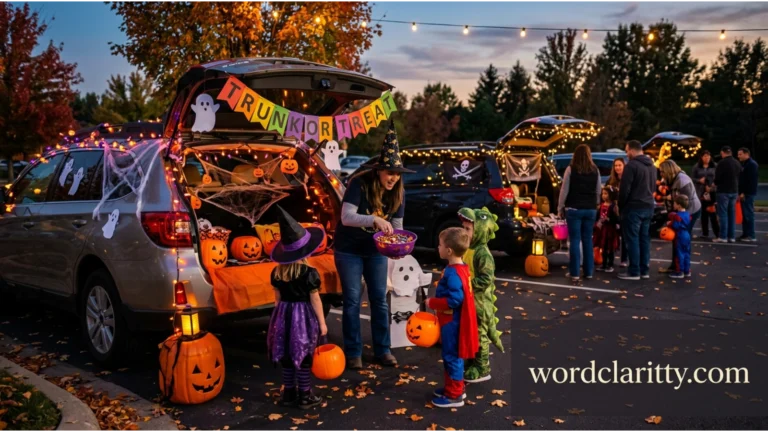
Have you ever searched for “trunk or treat clipart” and wondered how it differs from the familiar Halloween expression “trick or treat”? These phrases may look similar, but they describe different things. “Trick or treat” is a traditional Halloween expression, while “trunk or treat” refers to an organized event where children collect candy from decorated car trunks.
Adding “clipart” means you are looking for illustrations or graphics related to that event. For English learners, understanding these expressions is useful when reading Halloween invitations, creating decorations, or discussing holiday traditions. This guide explains their meanings, spelling, pronunciation, and correct usage through simple examples.
Why “Trunk or Treat Clipart” and “Trick or Treat” Are Confusing
The phrases “trunk or treat clipart” and “trick or treat” can confuse English learners because they share Halloween-related vocabulary and similar sentence structures.
However, they are not interchangeable.
1. Similar Pronunciation
The expressions “trunk or treat” and “trick or treat” sound somewhat similar.
Their pronunciations are approximately:
- Trunk or treat: /trʌŋk ɔːr triːt/
- Trick or treat: /trɪk ɔːr triːt/
The words “trunk” and “trick” both begin with the consonant sounds “tr” and end with a “k” sound.
However, they have different vowel sounds, and “trunk” also contains an additional nasal sound.
The expressions are therefore similar-sounding phrases, not homophones.
2. Similar Spelling
Both expressions contain the words “or treat.”
The main difference is the first word:
- Trunk: The storage compartment of a car, especially in American English.
- Trick: A playful action intended to surprise or deceive someone.
The phrase “trunk or treat clipart” also includes the word “clipart,” which refers to illustrations or graphic images.
3. Context Confusion
Both phrases appear in Halloween-related discussions.
For example:
“Our school is organizing a trunk-or-treat event.”
“The children shouted, ‘Trick or treat!’”
Although both sentences involve Halloween activities, they describe different situations.
The first refers to an organized event involving decorated vehicles. The second describes a traditional Halloween greeting.
4. Common Learner Mistakes
English learners may:
- Confuse “trunk” with “trick.”
- Assume that trunk-or-treat and trick-or-treat activities are identical.
- Use “clipart” when they mean an actual Halloween event.
- Forget that “trunk” refers to a car’s storage compartment.
- Search for the wrong type of Halloween illustrations.
Understanding the meaning of each expression helps avoid these mistakes.
Trunk or Treat Clipart vs. Trick or Treat Explained Simply
The difference is easy to understand once you know what each expression describes.
Trunk or treat clipart means digital illustrations related to a Halloween event involving decorated car trunks, while trick or treat refers to the traditional Halloween activity of asking for candy.
Simple Explanation
Trunk or treat clipart: Drawings, icons, or digital graphics showing decorated cars, Halloween candy, costumes, pumpkins, and other elements associated with trunk-or-treat events.
Trick or treat: A traditional Halloween phrase spoken by children when visiting homes to request candy or other treats.
The related term trunk-or-treat describes the organized activity itself, not the artwork.
One-Line Distinction
Trunk or treat clipart is Halloween-themed artwork, while trick or treat is a traditional Halloween greeting and activity.
Two Example Sentences
Example 1: Trunk or Treat Clipart
“The teacher downloaded trunk or treat clipart to decorate the school’s Halloween invitation.”
Here, the phrase refers to digital illustrations used in a design.
Example 2: Trick or Treat
“The children walked through the neighborhood shouting, ‘Trick or treat!’”
Here, the phrase refers to the traditional Halloween custom.
Both expressions are correct when used in the appropriate context.
Understanding Homophones in English
Homophones are an important part of English vocabulary. Learning about them helps students understand pronunciation, spelling, and word meanings.
What Are Homophones?
Homophones are words that sound the same but have different meanings and often different spellings.
For example, “night” and “knight” are homophones.
- Night: The dark period between sunset and sunrise.
- Knight: A person who holds a particular historical title of honour.
Example sentences:
- “The children went trick-or-treating at night.”
- “The boy dressed as a knight for Halloween.”
Although “night” and “knight” sound identical, they have different meanings.
Other common homophones include:
- Here and hear
- Sea and see
- Right and write
- One and won
- Their and there
Why Homophones Cause Confusion
Homophones confuse learners because pronunciation alone does not reveal the intended spelling.
For example:
“I can see the sea.”
Both “see” and “sea” have the same pronunciation, but their meanings are different.
However, “trunk” and “trick” are not homophones. They have different pronunciations and meanings.
Their confusion comes from their similar sounds, shared Halloween context, and repeated phrase structure.
This distinction is important because not all confusing English expressions are homophones.
What Does “Trunk or Treat Clipart” Mean?
Definition and Core Meaning
Trunk or treat clipart refers to digital illustrations, drawings, or decorative graphics used to represent trunk-or-treat Halloween events.
A trunk-or-treat event is a Halloween gathering where people decorate their car trunks and distribute candy to children.
These events often take place in parking lots at schools, churches, community centers, or other organized locations.
Clipart associated with these events commonly includes:
- Cars with decorated trunks
- Halloween pumpkins
- Candy bags and buckets
- Friendly ghosts
- Witches and bats
- Children wearing costumes
- Halloween signs and banners
- Colorful autumn decorations
These illustrations can be used in invitations, posters, flyers, classroom activities, and digital announcements.
Origin and Historical Use
The phrase “trunk or treat” developed as a variation of the traditional Halloween expression “trick or treat.”
The word “trunk” refers to the enclosed storage area of a car in American English.
Trunk-or-treat events became increasingly familiar in the United States during the late twentieth century and early twenty-first century.
They offered communities a way to organize Halloween candy distribution in a shared location rather than having children visit individual houses.
The term “clipart” has a different history.
Originally, clip art referred to printed illustrations that could be physically cut out and placed into documents or layouts.
As computers became common, clipart came to describe ready-made digital illustrations used in documents, presentations, posters, and other designs.
Today, “trunk or treat clipart” is a common search phrase for Halloween graphics related to decorated-car events.
Modern Usage and Synonyms
In modern English, the phrase is mainly used when discussing graphic design, Halloween decorations, school activities, and event promotion.
Related search terms include:
- Trunk or treat graphics
- Halloween car clipart
- Trunk or treat illustrations
- Halloween event images
- Decorated car drawings
- Trunk or treat PNG
- Halloween flyer graphics
- Printable trunk or treat decorations
These terms may refer to different image formats or styles, but they share a similar purpose.
For example, a transparent PNG illustration can be placed on a Halloween invitation without a visible rectangular background.
An SVG illustration may be useful when a designer needs to resize artwork without losing sharpness.
Example Sentences
- “The teacher used trunk or treat clipart to decorate the classroom poster.”
- “We need colorful trunk or treat clipart for our Halloween flyer.”
- “The designer created a pumpkin-themed trunk or treat illustration.”
- “Our school newsletter includes trunk or treat graphics.”
- “She searched for free trunk or treat clipart for a community invitation.”
- “The Halloween poster featured a cartoon car filled with candy.”
In each example, the phrase refers to artwork rather than the event itself.
What Does “Trick or Treat” Mean?
Definition and Core Meaning
“Trick or treat” is a traditional Halloween expression used by children when asking for candy or other treats.
It is also associated with the activity of visiting houses in costume on Halloween.
The phrase contains three words:
- Trick: A playful action, joke, or surprise.
- Or: A word used to present alternatives.
- Treat: Something enjoyable, especially candy or sweets.
Traditionally, the expression playfully suggests that a person should offer a treat rather than face a trick.
Today, it is generally understood as a friendly Halloween greeting rather than a serious threat.
Origin and Historical Context
Trick-or-treating developed from several older traditions involving costumes, seasonal celebrations, and visits to homes.
Historical customs such as souling and guising influenced later Halloween practices in Britain, Ireland, and North America.
In these traditions, people sometimes visited houses to receive food, gifts, or other rewards.
Modern trick-or-treating became widely established in North America during the twentieth century.
Children began wearing costumes, visiting neighborhood homes, and asking for candy.
The expression “trick or treat” became closely associated with Halloween on October 31.
Today, the tradition remains popular in many communities, although customs differ by region and country.
Modern Usage and Synonyms
The phrase “trick or treat” is commonly used in conversations about Halloween celebrations.
Related terms include:
- Halloween candy collecting
- Trick-or-treating
- Halloween neighborhood visits
- Costume celebrations
- Halloween activities
- Candy gathering
These expressions are related, but they do not always mean exactly the same thing.
For example, “trick-or-treating” describes the activity, while “trick or treat” is the greeting.
Example Sentences
- “The children shouted, ‘Trick or treat!’ when the door opened.”
- “We bought candy for the trick-or-treaters.”
- “My younger brother wants to go trick-or-treating this Halloween.”
- “The neighbors decorated their houses for trick-or-treating.”
- “Everyone wore colorful costumes and collected treats.”
- “The children said, ‘Trick or treat!’ and received small bags of candy.”
These examples show how the expression works in everyday Halloween conversations.
Trunk or Treat Clipart vs. Trick or Treat: Key Differences at a Glance
The following table summarizes the most important differences.
| Word or Phrase | Part of Speech | Meaning | Example Context |
|---|---|---|---|
| Trunk or treat clipart | Noun phrase | Digital illustrations related to trunk-or-treat events | “We used trunk or treat clipart on the flyer.” |
| Trunk-or-treat | Noun or adjective | An organized Halloween candy event involving decorated cars | “Our school hosted a trunk-or-treat event.” |
| Trick or treat | Fixed expression | A Halloween greeting used to request candy | “The children shouted, ‘Trick or treat!’” |
| Trick-or-treating | Noun | The activity of visiting homes to collect Halloween treats | “They went trick-or-treating after sunset.” |
| Clipart | Noun | Ready-made illustrations used in designs | “She added Halloween clipart to the invitation.” |
Which Expression Is Correct?
All these expressions can be correct, but their uses are different.
Use “trunk or treat clipart” when referring to illustrations for a decorated-car Halloween event.
For example:
- “I downloaded trunk or treat clipart.”
- “Our community organized a trunk-or-treat event.”
- “The children said, ‘Trick or treat!’”
Each sentence uses the appropriate expression.
How to Remember the Difference Between Trunk or Treat Clipart and Trick or Treat
You can remember these phrases by connecting them with familiar Halloween images.
1. Remember That Trunk Means Car Storage
Think of the trunk at the back of a car.
At a trunk-or-treat event, people decorate this area and distribute candy.
Memory trick: Trunk → Car → Decorated Car Event
For example:
“The family decorated their car trunk with pumpkins and lights.”
2. Remember That Trick Means a Playful Action
The word “trick” often describes a playful surprise or joke.
In the Halloween expression “trick or treat,” children playfully ask for candy.
Memory trick: Trick → Halloween Greeting → Candy
For example:
“The children knocked on the door and shouted, ‘Trick or treat!’”
3. Connect Clipart with Pictures
The word “clipart” refers to illustrations or ready-made graphics.
Think about images used in posters, invitations, and classroom materials.
Memory trick: Clipart → Picture → Decoration
If someone asks for trunk or treat clipart, they are asking for pictures, not necessarily information about the event.
4. One Memorable Example
Imagine a school organizing a Halloween celebration.
A teacher downloads colorful pictures of decorated cars and pumpkins to make an invitation.
The pictures are trunk or treat clipart.
At the event, children walk from car to car collecting candy.
This is a trunk-or-treat event.
When children visit neighborhood houses and say “Trick or treat!”, they are taking part in the traditional Halloween custom.
This example makes the three related ideas easier to distinguish.
Common Mistakes and Confusions
The following mistakes are common when people write about Halloween events and graphics.
Mistake 1: Using “Trick” Instead of “Trunk”
✘ Incorrect: “Our school is organizing a trick-or-treat event in the parking lot with decorated car trunks.”
✔ Better: “Our school is organizing a trunk-or-treat event in the parking lot.”
Explanation: When the event specifically involves decorated cars, “trunk-or-treat” is the clearer term.
Mistake 2: Using “Clipart” to Mean the Event
✘ Incorrect: “We attended a trunk or treat clipart last night.”
✔ Correct: “We attended a trunk-or-treat event last night.”
Explanation: Clipart means illustrations, not an actual gathering.
Mistake 3: Confusing Halloween Greetings with Graphics
✘ Incorrect: “The children shouted, ‘Trunk or treat clipart!’ at the door.”
✔ Correct: “The children shouted, ‘Trick or treat!’ at the door.”
Explanation: “Trick or treat” is the traditional Halloween greeting.
Mistake 4: Using the Wrong Search Phrase
✘ Less suitable: “Trick or treat pictures” when you specifically need decorated-car illustrations.
✔ Better: “Trunk or treat clipart with decorated cars.”
Explanation: A more specific search phrase helps identify the exact type of Halloween artwork needed.
Mistake 5: Confusing Trunk-or-Treat with Traditional Trick-or-Treating
✘ Incorrect assumption: “Trunk-or-treating always involves visiting houses.”
✔ Correct understanding: “Trunk-or-treating usually involves collecting candy from decorated vehicles at an organized location.”
Explanation: Both activities involve Halloween treats, but their usual settings are different.
Examples Section: Correct and Incorrect Usage
Here are practical examples to help you choose the appropriate expression.
Example 1: Designing a Halloween Flyer
✔ Correct: “I need trunk or treat clipart for our school flyer.”
✘ Incorrect: “I need a trunk-or-treat event for our school flyer.”
Why? The speaker needs illustrations for a design, not the event itself.
Example 2: Talking About a Halloween Greeting
✔ Correct: “The children shouted, ‘Trick or treat!’”
✘ Incorrect: “The children shouted, ‘Trunk or treat clipart!’”
Why? “Trick or treat” is the traditional greeting used when requesting candy.
Example 3: Describing an Organized Event
✔ Correct: “The community hosted a trunk-or-treat event in the parking lot.”
✘ Incorrect: “The community hosted a trunk or treat clipart in the parking lot.”
Why? Clipart refers to pictures, not a gathering.
Example 4: Searching for Halloween Graphics
✔ Correct: “She downloaded free trunk or treat clipart for the invitation.”
✘ Incorrect: “She downloaded a trunk-or-treat celebration for the invitation.”
Why? Digital artwork can be downloaded, but a physical celebration cannot.
Example 5: Discussing Traditional Halloween Activities
✔ Correct: “We went trick-or-treating around our neighborhood.”
✘ Incorrect: “We went trunk or treat clipart around our neighborhood.”
Why? “Trick-or-treating” describes the activity of collecting candy.
Example 6: Describing a Decorated Car
✔ Correct: “The family decorated their car for the trunk-or-treat event.”
✘ Incorrect: “The family decorated their car for the clipart.”
Why? The first sentence clearly identifies the event for which the car was decorated.
Self-Assessment: Test Your Knowledge
Choose the correct expression to complete each sentence.
Question 1: The teacher downloaded colorful ___ for the Halloween invitation.
a) Trunk or treat clipart
b) Trick or treat
Question 2: The children knocked on the door and shouted, “___!”
a) Trunk or treat clipart
b) Trick or treat
Question 3: Our community organized a ___ event with decorated cars and candy.
a) Trunk-or-treat
b) Clipart
Question 4: The graphic designer used Halloween ___ to create a colorful poster.
a) Clipart
b) Trick-or-treating
Self-Assessment Answers
Answer 1: a) Trunk or treat clipart
The teacher needs digital illustrations for a Halloween invitation.
Answer 2: b) Trick or treat
This is the traditional greeting used by children when asking for Halloween candy.
Answer 3: a) Trunk-or-treat
The sentence describes an organized Halloween event involving decorated vehicles.
Answer 4: a) Clipart
Clipart refers to illustrations that can be used in graphic designs.
How Did You Do?
- 4 correct: Excellent! You understand the differences.
- 3 correct: Great work. Review the question you missed.
- 1–2 correct: Practise using the phrases in Halloween-related sentences.
- 0 correct: Remember the basic connections: trunk means car, trick relates to the Halloween greeting, and clipart means pictures.
FAQs:
1. What Is Trunk or Treat Clipart?
Trunk or treat clipart refers to illustrations or digital graphics associated with Halloween events where people decorate car trunks and distribute candy. These images are often used in invitations, posters, and school announcements.
2. What Is the Difference Between Trunk or Treat and Trick or Treat?
Trunk-or-treat is an organized Halloween event where children collect candy from decorated cars. Traditional trick-or-treating usually involves children visiting neighborhood homes and asking for treats.
3. Is It “Trunk or Treat” or “Trick or Treat”?
Both expressions are correct, but they describe different activities. Use “trunk-or-treat” for a decorated-car Halloween event and “trick or treat” for the traditional Halloween greeting.
4. Where Can Trunk or Treat Clipart Be Used?
Trunk or treat clipart can be used in school flyers, Halloween invitations, community posters, social media announcements, classroom decorations, and printable activity sheets. Always check the image’s license before using it.
5. What Are Common Trunk or Treat Clipart Designs?
Popular designs include decorated cars, pumpkins, ghosts, witches, bats, candy buckets, smiling monsters, and children wearing costumes. These illustrations often use orange, black, purple, and other Halloween-themed colors.
6. Is Trunk or Treat the Same as Trick-or-Treating?
Not exactly. Both activities involve Halloween costumes and candy, but trunk-or-treat events usually take place in organized parking areas, while traditional trick-or-treating typically involves visiting houses.
7. Is “Trunk or Treat Clipart” Correct English?
Yes. “Trunk or treat clipart” is a natural search phrase and noun phrase for artwork related to trunk-or-treat events. In polished writing, you may also see “trunk-or-treat clipart,” with hyphens joining the event name when it describes the artwork.
Conclusion:
Understanding the difference between “trunk or treat clipart” and “trick or treat” can help English learners communicate more clearly when discussing Halloween celebrations, decorations, and activities. Although the expressions share similar words and are connected to the same holiday, they describe different ideas. “Trunk or treat clipart” refers to illustrations or digital graphics showing decorated cars, Halloween candy, pumpkins, costumes, and other features of trunk-or-treat events. In contrast, “trick or treat” is the traditional Halloween greeting children use when asking for candy at neighborhood homes.
It is also useful to remember that “trunk-or-treat” describes an organized event where people decorate car trunks and distribute treats. This distinction matters when creating school invitations, searching for Halloween graphics, writing community announcements, or explaining holiday customs to someone unfamiliar with them.A simple memory trick can make everything easier: trunk means car, trick connects to the Halloween greeting, and clipart means pictures. Imagine a decorated car filled with candy to remember trunk-or-treat, and picture children knocking on a front door to remember traditional trick-or-treating.
As you continue learning English, pay attention to how familiar words combine to form new expressions. Practise using these phrases in complete sentences and notice their meanings in different situations. With regular reading, writing, and a little curiosity, you will become more confident in recognizing and using Halloween vocabulary correctly.