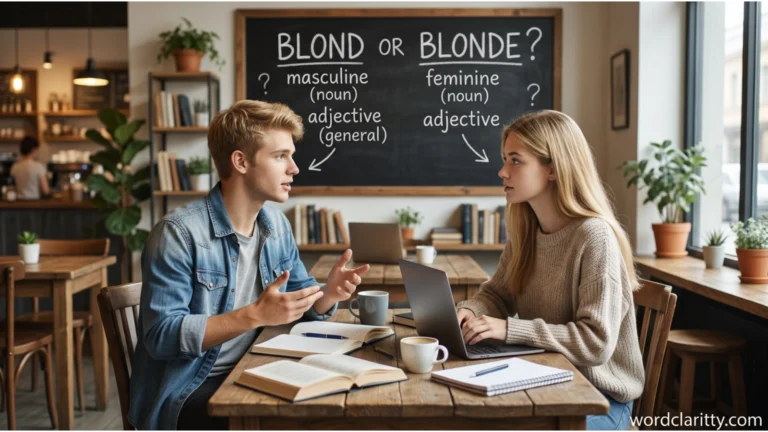
Have you ever wondered whether to write “blond” or “blonde” when describing someone’s hair? You are not alone. These two words confuse many English learners because they sound exactly the same, have almost identical spellings, and describe the same hair color. However, their traditional usage is slightly different, especially when referring to men and women.
The distinction also changes depending on whether you are using American or British English. Understanding these differences can help you write more naturally, avoid common spelling mistakes, and communicate confidently. This guide explains the meaning of blond and blonde, their origins, grammatical rules, everyday examples, and easy memory tricks.
Why “Blond” and “Blonde” Are Confusing
The words “blond” and “blonde” are confusing because they describe the same general hair color but follow different spelling traditions.
Unlike many confusing English word pairs, their meanings are not completely different. Instead, the main distinction involves traditional gender usage, grammar, and regional spelling preferences.
1. Similar Pronunciation
Both “blond” and “blonde” are pronounced the same way.
Their pronunciation is:
- Blond: /blɒnd/ in British English or /blɑːnd/ in American English.
- Blonde: The same pronunciation as “blond.”
The final letter “e” in “blonde” is silent.
For example:
- “He has blond hair.”
- “She has blonde hair.”
When spoken aloud, the difference between the two spellings cannot be heard.
This makes the words especially confusing for English learners who learn vocabulary through listening.
2. Similar Spelling
The only spelling difference is the final letter “e.”
- Blond: Five letters.
- Blonde: Six letters.
Because the extra letter does not change pronunciation, learners may wonder why English uses both forms.
The explanation comes from French, where masculine and feminine forms of adjectives often have different endings.
3. Context Confusion
Traditionally, “blond” describes a male person or masculine noun, while “blonde” describes a female person or feminine noun.
However, modern English does not always follow this distinction.
In American English, “blond” is commonly used as a gender-neutral adjective, particularly when describing hair.
For example:
“Her blond hair looked golden in the sunlight.”
This sentence is perfectly acceptable in American English.
Therefore, context and regional writing conventions both influence spelling choices.
4. Common Learner Mistakes
English learners frequently make these mistakes:
- Assuming that “blond” and “blonde” have different hair-color meanings.
- Believing that the final “e” changes pronunciation.
- Thinking “blonde” is always required when describing a woman’s hair.
- Using the gender distinction as an absolute rule in all varieties of English.
- Switching between spellings inconsistently within the same article.
- Confusing “blond” with other light hair colors, such as light brown or gray.
Understanding traditional and modern usage makes these words much easier to use correctly.
Blond vs Blonde Explained Simply
Both “blond” and “blonde” describe light-colored hair, usually ranging from pale yellow to golden. The traditional difference is that “blond” is masculine and “blonde” is feminine, but modern English often uses “blond” as a gender-neutral adjective.
Simple Explanation
Blond: A word describing light-colored hair. Traditionally associated with males, it is also widely used for people of any gender, especially as an adjective in American English.
Blonde: Another spelling describing the same hair color. Traditionally associated with females, it is especially common when referring to a woman with light-colored hair.
One-Line Distinction
Blond and blonde mean the same hair color, but blond is traditionally masculine or gender-neutral, while blonde is traditionally feminine.
Two Example Sentences
Example 1: Blond
“The young boy had short blond hair and blue eyes.”
Here, “blond” describes the boy’s light-colored hair.
Example 2: Blonde
“The actress was known for her long blonde hair.”
Here, “blonde” follows the traditional feminine spelling.
Both examples are correct. However, “the actress had blond hair” would also be acceptable, particularly in American English.
Understanding Homophones in English
English contains many words that sound alike but have different spellings or meanings. Learning about these words can help improve vocabulary and writing accuracy.
What Are Homophones?
Homophones are words that have the same pronunciation but different meanings, and often different spellings.
For example, “right” and “write” are homophones.
- Right: Correct or opposite to left.
- Write: To form words using letters.
Consider these sentences:
- “You gave the right answer.”
- “Please write your name.”
Although the words sound identical, their meanings are different.
Other common homophones include:
- Hear and here
- Sea and see
- Sun and son
- Flour and flower
- One and won
Why Homophones Cause Confusion
Homophones cause confusion because pronunciation alone does not tell you which spelling to use.
For example:
“I can hear the music from here.”
The words “hear” and “here” sound identical but perform different functions.
“Blond” and “blonde” present a related but slightly different spelling problem. They are pronounced identically and share the same basic meaning, so they are better understood as spelling variants with traditional gender distinctions, rather than a classic pair of homophones with different meanings.
The important lesson is that English pronunciation does not always reveal spelling.
When choosing between “blond” and “blonde,” pay attention to grammar, context, regional usage, and the writing style you want to follow.
What Does “Blond” Mean?
Definition and Core Meaning
The word “blond” describes hair that is naturally or artificially light in color, usually pale yellow, golden, or yellowish-brown.
It is most commonly used as an adjective, although it can also function as a noun.
Traditionally, the noun “blond” refers to a male person with light-colored hair. However, as an adjective, it is widely used without regard to gender in modern American English.
Common uses include:
- Hair color: “He has blond hair.”
- Physical description: “The blond child stood near the window.”
- Hair shades: “She chose a warm blond shade.”
- Gender-neutral adjective: “Both children have blond hair.”
- Noun: “The blond was standing beside the door,” traditionally referring to a male person.
The adjective is generally more common and less potentially awkward than using the word as a noun to identify a person.
Origin and Historical Use
The word “blond” entered English through French, where blond is the masculine form and blonde is the feminine form.
French adjectives often change their endings according to the grammatical gender of the noun they describe.
English borrowed both forms, which explains why two spellings exist.
Historically, writers often used “blond” for males and “blonde” for females.
However, English does not generally assign grammatical gender to adjectives. As a result, the distinction has become less strict, especially in American English.
Today, many dictionaries and style guides recognize “blond” as a standard adjective for light-colored hair regardless of the person’s gender.
Modern Usage and Synonyms
In modern English, “blond” is common in fashion, beauty, literature, and everyday descriptions.
It appears in expressions such as:
- Blond hair: Light yellow or golden hair.
- Ash blond: A cooler, less golden blond shade.
- Golden blond: A warm, golden-yellow shade.
- Platinum blond: A very pale, almost white blond shade.
- Dirty blond: A darker blond shade with brownish tones.
- Strawberry blond: A light blond shade with reddish tones.
Related descriptive terms include “fair-haired,” “light-haired,” and “golden-haired.”
These alternatives are not always exact synonyms because they may describe different shades or appearances.
Example Sentences
- “The little boy had curly blond hair.”
- “Her blond hair became lighter during the summer.”
- “The actor dyed his hair blond for the film.”
- “Both sisters have naturally blond hair.”
- “He chose a dark blond color at the salon.”
- “The artist painted a portrait of a blond child.”
Notice that several sentences use “blond” to describe female characters. This is acceptable in modern American English.
What Does “Blonde” Mean?
Definition and Core Meaning
The word “blonde” also describes light-colored hair, generally ranging from pale yellow to golden.
Traditionally, “blonde” is the feminine form of “blond.”
It is commonly used as an adjective or a noun.
For example:
- Adjective: “She has beautiful blonde hair.”
- Noun: “The blonde in the photograph is my sister.”
As a noun, “blonde” traditionally refers to a woman or girl with light-colored hair.
However, referring to someone only by their hair color may sound impersonal in certain situations. When possible, using “woman,” “person,” or someone’s name is often clearer.
Origin and Historical Context
Like “blond,” the word “blonde” comes from French.
In French grammar, adding an “e” often creates the feminine form of an adjective.
For example:
- Blond: Masculine form.
- Blonde: Feminine form.
When English borrowed these words, it retained the distinction in some contexts.
This explains why traditional English writing may describe a “blond man” and a “blonde woman.”
Over time, however, English usage became more flexible.
In American English, “blond” is frequently used as a gender-neutral adjective, while “blonde” remains common as a feminine noun and as an adjective in many contexts.
British English often retains the traditional distinction more strongly, although usage varies between writers and publications.
Modern Usage and Synonyms
Today, “blonde” appears frequently in beauty products, fashion writing, entertainment, and personal descriptions.
Common expressions include:
- Blonde hair: Light yellow or golden hair.
- Platinum blonde: Very pale blonde hair.
- Honey blonde: A warm golden shade.
- Ash blonde: A cool-toned blonde shade.
- Strawberry blonde: Blonde hair with reddish tones.
- Bleached blonde: Hair made lighter through chemical treatment.
Related expressions include “fair-haired,” “light-haired,” and “golden-haired.”
The spelling “blonde” is particularly common in beauty marketing and hair-color product names.
Example Sentences
- “The singer has long blonde hair.”
- “She decided to dye her hair blonde.”
- “The blonde actress appeared in several popular films.”
- “Her natural hair color is dark blonde.”
- “The stylist recommended a honey blonde shade.”
- “The blonde woman was waiting near the entrance.”
These examples show how “blonde” is traditionally associated with women and feminine descriptions.
Blond vs Blonde: Key Differences at a Glance
The following comparison table summarizes the most important differences.
| Word | Part of Speech | Meaning | Example Context |
|---|---|---|---|
| Blond | Adjective | Light-colored hair; often gender-neutral in American English | “She has blond hair.” |
| Blond | Noun | Traditionally a male person with blond hair | “He is a blond.” |
| Blonde | Adjective | Light-colored hair; traditionally feminine | “She has blonde hair.” |
| Blonde | Noun | Traditionally a female person with blond hair | “The blonde is my cousin.” |
Which Spelling Is Correct?
Both “blond” and “blonde” are correct English spellings.
The best choice depends on context and writing conventions.
Traditional usage:
- Blond man
- Blonde woman
In modern American English:
- Blond hair on a man
- Blond hair on a woman
- Blond hair on a child of any gender
In British English, the traditional gender distinction is often more noticeable.
American English vs British English
| Context | Common American Usage | Traditional British Usage |
|---|---|---|
| Man with light hair | Blond man | Blond man |
| Woman with light hair | Blond woman or blonde woman | Blonde woman |
| Hair color in general | Blond hair | Blond or blonde hair, depending on context and style |
| Female person as a noun | Blonde | Blonde |
| Male person as a noun | Blond | Blond |
These are common tendencies rather than strict rules followed by every writer.
How to Remember the Difference Between Blond and Blonde
Remembering the distinction becomes easier when you connect the spelling with its historical background.
1. Remember the Extra “E”
The simplest memory trick is to associate the extra “e” in “blonde” with its traditional feminine form.
- Blond: Traditionally masculine.
- Blonde: Traditionally feminine.
This helps you remember the older distinction, although modern English does not always require it.
2. Think About French Grammar
Both words come from French, where adjectives can have masculine and feminine endings.
The feminine form often adds an “e.”
Therefore:
Blond → Traditional masculine form
Blonde → Traditional feminine form
This association explains why both spellings exist.
3. Use “Blond Hair” as a Safe Default
If you are writing in American English and are unsure which adjective to use, “blond hair” is a reliable choice.
For example:
- “He has blond hair.”
- “She has blond hair.”
- “The children have blond hair.”
All three sentences are acceptable.
This approach is particularly useful when describing people without emphasizing gender.
4. One Memorable Example
Imagine a brother and sister who both have light golden hair.
You could write:
“The blond boy stood beside his blonde sister.”
This sentence follows the traditional gender distinction.
You could also write:
“The blond boy stood beside his blond sister.”
The second sentence is acceptable in modern American English.
Remembering both examples helps you understand the traditional rule and its modern flexibility.
Common Mistakes and Confusions
English learners sometimes assume that the difference between “blond” and “blonde” is stricter than it actually is.
Here are several common mistakes.
Mistake 1: Assuming the Words Have Different Meanings
✘ Incorrect assumption: “Blond means yellow hair, while blonde means golden hair.”
✔ Correct understanding: “Blond” and “blonde” describe the same general range of light hair colors.
Explanation: The difference is mainly grammatical and stylistic, not a difference in hair shade.
Mistake 2: Pronouncing “Blonde” Differently
✘ Incorrect: Pronouncing “blonde” with an extra syllable because of the final “e.”
✔ Correct: Pronouncing “blond” and “blonde” identically.
Explanation: The final “e” in “blonde” is silent.
Mistake 3: Treating Traditional Gender Usage as an Absolute Rule
✘ Incorrect assumption: “She has blond hair” is always grammatically wrong.
✔ Correct: “She has blond hair.”
Explanation: “Blond” is widely accepted as a gender-neutral adjective, especially in American English.
Mistake 4: Using the Wrong Noun in Traditional Usage
✘ Traditionally incorrect: “He is a blonde.”
✔ Traditionally correct: “He is a blond.”
Explanation: When used as nouns, “blond” traditionally refers to a male person and “blonde” to a female person. This distinction is more established for nouns than for adjectives.
Mistake 5: Switching Spellings Without a Clear Style
✘ Inconsistent style: “The actress had blond hair. Her blonde hair shone in the sunlight.”
✔ Consistent style: “The actress had blond hair. Her blond hair shone in the sunlight.”
Explanation: Both adjective spellings can be acceptable, but consistent usage makes your writing clearer and more professional.
Examples Section: Correct and Incorrect Usage
The following examples show correct spelling, traditional usage, and common misconceptions.
Example 1: Describing a Man
✔ Correct: “The man has short blond hair.”
✘ Incorrect spelling: “The man has short blondd hair.”
Why? “Blond” is the standard spelling traditionally associated with men, while “blondd” is not a standard English word.
Example 2: Describing a Woman
✔ Correct: “The woman has long blonde hair.”
✘ Incorrect assumption: “The woman has blond hair” must always be wrong.
Why? Both adjective spellings can be correct, especially in American English.
Example 3: Talking About Hair Color
✔ Correct: “She dyed her hair blond.”
✘ Incorrect: “She dyed her hair blound.”
Why? “Blond” is a correct spelling, while “blound” is not.
Example 4: Traditional Noun Usage
✔ Correct: “The blonde in the photograph is my aunt.”
✘ Traditionally incorrect: “The blond in the photograph is my aunt.”
Why? As a noun referring to a woman, “blonde” is the traditional spelling.
Example 5: Describing Children
✔ Correct: “Both children have blond hair.”
✘ Incorrect assumption: “Blond” can only describe boys.
Why? In modern American English, “blond” works as a gender-neutral adjective.
Example 6: Beauty and Fashion Writing
✔ Correct: “The salon offers several shades of blonde hair color.”
✘ Incorrect: “The salon offers several shades of blonnde hair color.”
Why? “Blonde” is a standard spelling commonly used in beauty and fashion contexts.
Self Assessment: Test Your Knowledge
Choose the best answer for each sentence. Some questions focus on traditional usage, while others test modern English spelling.
Question 1: The young boy had short ___ hair.
a) Blond
b) Blondd
Question 2: In traditional English usage, the woman with light-colored hair is described as a ___.
a) Blond
b) Blonde
Question 3: Which word is widely accepted as a gender-neutral adjective in American English?
a) Blond
b) Blonnde
Question 4: Both sisters have naturally ___ hair. Choose the common gender-neutral American English spelling.
a) Blond
b) Blound
Self Assessment Answers
Answer 1: a) Blond
“The young boy had short blond hair.”
“Blond” is the standard spelling traditionally associated with males.
Answer 2: b) Blonde
“In traditional English usage, the woman with light-colored hair is described as a blonde.”
The feminine noun traditionally ends in “e.”
Answer 3: a) Blond
“Blond” is widely accepted as a gender-neutral adjective in American English.
Answer 4: a) Blond
“Both sisters have naturally blond hair.”
The adjective “blond” is acceptable regardless of gender in modern American English.
How Did You Do?
- 4 correct: Excellent! You understand both traditional and modern usage.
- 3 correct: Great work. Review the question you missed.
- 1–2 correct: Practise the difference between adjectives and nouns.
- 0 correct: Start with the simple rule: both spellings describe the same hair color, but “blonde” is traditionally feminine.
FAQs :
1. Is It Blond or Blonde?
Both spellings are correct. “Blond” is traditionally masculine and commonly gender-neutral as an adjective in American English. “Blonde” is traditionally feminine and remains common when describing women or referring to a woman with light-colored hair.
2. What Is the Difference Between Blond and Blonde?
The main difference is traditional gender usage. “Blond” was historically associated with males, while “blonde” was associated with females. Modern English often uses “blond” as an adjective for people of any gender.
3. Is It Blond Hair or Blonde Hair?
Both “blond hair” and “blonde hair” can be correct. “Blond hair” is a common gender-neutral form, especially in American English. “Blonde hair” is also widely used, particularly in feminine descriptions and beauty-related contexts.
4. Do Americans Use Blond or Blonde?
American English commonly uses “blond” as a gender-neutral adjective. However, “blonde” is also used, especially as a noun referring to a woman and in beauty or fashion writing.
5. Is Blonde Only Used for Women?
Traditionally, “blonde” is the feminine form. However, it can also appear in general descriptions of hair color, product names, and beauty terminology. Usage depends on context and style.
6. Are Blond and Blonde Pronounced Differently?
No. Both words have the same pronunciation. The final “e” in “blonde” is silent, so there is no spoken difference between the two spellings.
7. Which Spelling Should I Use in Formal Writing?
Follow the style guide or regional convention used in your writing. In American English, “blond” is a reliable gender-neutral adjective. When using the word as a noun, the traditional distinction between “a blond” and “a blonde” remains common.
Conclusion:
Understanding the difference between “blond” and “blonde” can make your English writing more accurate, natural, and consistent. Although these words have identical pronunciations and describe the same general range of light hair colors, they developed from different grammatical forms in French. Traditionally, “blond” was used for males, while “blonde” was used for females. However, modern English is more flexible, particularly in American English, where “blond” is widely accepted as a gender-neutral adjective.
In everyday writing, you can confidently describe someone as having “blond hair” regardless of gender, especially when following American English conventions. The spelling “blonde” also remains correct and is particularly common in descriptions of women, beauty products, fashion articles, and traditional noun usage. Neither spelling refers to a completely different hair color, and both are pronounced exactly the same way.
To remember the distinction, think about the extra “e” in “blonde” and its historical connection with the feminine form in French. At the same time, remember that English does not always follow French grammatical rules. Choosing a consistent spelling style is often more important than applying the traditional distinction in every sentence.
As you continue learning English, pay attention to how these words appear in books, articles, advertisements, and everyday conversations. Practise using them in your own sentences, and do not be afraid to review the rules when necessary. With regular reading and writing, the difference between “blond” and “blonde” will become easier to understand, helping you communicate with greater confidence and accuracy.