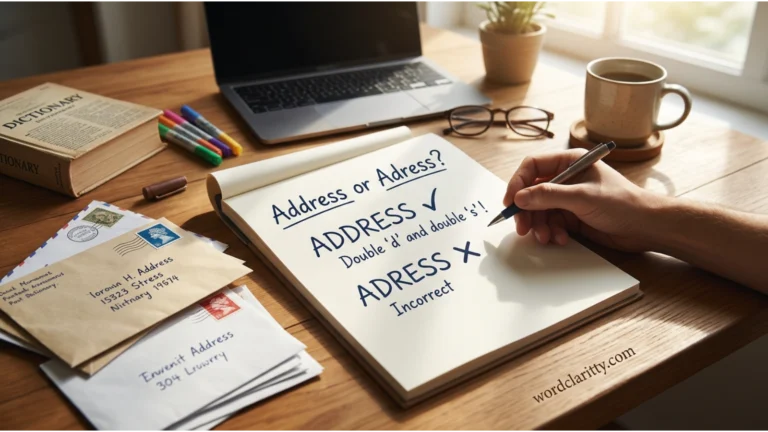
Have you ever typed “adress” and wondered whether it should be “address”? You are not alone. Many English learners confuse these spellings because they look almost identical, and the difference is just one letter.
However, only one spelling is correct in standard English. “Address” is the correct spelling, while “adress” is a common spelling mistake. The word “address” is used in everyday situations, including writing home addresses, sending emails, giving speeches, and discussing problems.
Learning its correct spelling and different meanings can help you communicate more confidently. This guide explains the difference between “adress” and “address” with definitions, examples, memory tricks, and practical exercises.
Why “Adress” and “Address” Are Confusing
The confusion between “adress” and “address” mainly comes from their similar appearance and the way English words are pronounced. Since English spelling does not always match pronunciation exactly, learners may find it difficult to remember when letters should be doubled.
1. Similar Pronunciation
When someone writes “adress,” they usually intend to write “address.” As a result, both spellings are generally read with the same intended pronunciation.
The correct word “address” has two syllables.
Common pronunciations include:
- Noun: /əˈdres/ in many British and American pronunciations, although /ˈæd.res/ is also common, particularly in American English.
- Verb: /əˈdres/.
For example:
“Please write your address on the form.”
The double “d” does not create an extra syllable, which makes it easy to forget one of the letters.
2. Similar Spelling
The main spelling difference is the number of letters “d.”
- Adress: One “d” — incorrect in standard English.
- Address: Two “d” letters — correct.
Both forms contain the same remaining letters, so the mistake can be difficult to notice during quick writing.
3. Context Confusion
The word “address” has several meanings, which can confuse learners who are familiar with only one.
It can refer to:
- A home or business location.
- An email or website address.
- A formal speech.
- The act of speaking to someone.
- The act of dealing with a problem.
Although these meanings differ, the spelling remains “address” in every case.
4. Common Learner Mistakes
Common errors include:
- Writing “adress” instead of “address.”
- Forgetting the second “d” while typing.
- Assuming that different meanings require different spellings.
- Confusing “address” with “addressee.”
- Using the wrong pronunciation in formal speech.
The easiest solution is to remember that address always contains two consecutive “d” letters in standard English.
Adress vs Address Explained Simply
The difference between “adress” and “address” is simple: one is a spelling mistake, and the other is a correct English word.
Simple Explanation
Adress: A common misspelling of “address.” It is not the standard English spelling.
Address: A noun or verb used to describe a location, contact information, a speech, speaking to someone, or dealing with a situation.
Unlike word pairs such as “their” and “there,” these two spellings do not represent different standard English meanings.
One-Line Distinction
“Adress” is an incorrect spelling, while “address” is the correct English word used for locations, speeches, communication, and dealing with issues.
Two Example Sentences
Example 1: Address as a noun
“Please write your home address clearly on the application form.”
Here, “address” refers to the location where someone lives.
Example 2: Address as a verb
“The manager will address the employees during tomorrow’s meeting.”
In this sentence, “address” means to speak formally to a group of people.
Both examples use the same correct spelling.
Understanding Homophones in English
Homophones are an important part of English vocabulary. Understanding them helps learners improve spelling, pronunciation, and communication.
What Are Homophones?
Homophones are words that sound the same but have different meanings and often different spellings.
For example, “write” and “right” are homophones.
- Write: To form letters, words, or sentences.
- Right: Correct or opposite to left.
Consider these sentences:
“I will write a letter.”
“You gave the right answer.”
The words sound identical, but their meanings and spellings are different.
Other common homophones include:
- Hear and here
- Sea and see
- Sun and son
- Flour and flower
- One and won
However, “adress” and “address” are not true homophones because “adress” is not a separate standard English word with its own meaning.
Why Homophones Cause Confusion
Homophones confuse learners because pronunciation alone may not reveal the correct spelling.
For example:
“I can hear the music.”
“Please come here.”
The words “hear” and “here” sound alike, but their meanings depend on context.
The confusion between “adress” and “address” is different. It is a spelling problem involving a missing letter rather than two correctly spelled words with different meanings.
Understanding this distinction helps learners identify the type of mistake and correct it more easily.
What Does “Adress” Mean?
Definition and Core Meaning
In standard English, “adress” is a misspelling of “address.”
It does not have an independent meaning in ordinary modern English writing.
When people type “adress,” they usually intend to refer to a location, an email address, a speech, or the action of speaking to someone.
For example:
Incorrect: “What is your email adress?”
Correct: “What is your email address?”
The meaning is understandable, but the spelling needs correction.
Origin and Historical Use
The confusion between these spellings is partly connected to the development of English spelling.
The correct English word “address” developed through French from older linguistic forms related to directing or making something straight.
Historical English spelling was not always as standardized as it is today. However, modern English dictionaries recognize “address” as the standard spelling.
The form “adress” may appear in older texts, informal messages, typing mistakes, or other languages. For example, Swedish uses “adress” as a word for an address.
That does not make “adress” correct in ordinary modern English.
Modern Usage and Synonyms
In modern English writing, “adress” should generally be replaced with “address.”
Depending on the intended meaning, related words include:
- Location: The place where someone or something is situated.
- Residence: The place where someone lives.
- Contact details: Information used to contact a person.
- Speech: A formal talk given to an audience.
- Discuss: To talk about a subject.
- Handle: To deal with a problem or situation.
These are alternatives for particular meanings of “address,” not synonyms for the misspelling itself.
Example Sentences
Here are common spelling mistakes and their corrections.
- Incorrect: “Please send me your home adress.”
Correct: “Please send me your home address.” - Incorrect: “I forgot the company’s adress.”
Correct: “I forgot the company’s address.” - Incorrect: “The principal gave an adress to the students.”
Correct: “The principal gave an address to the students.” - Incorrect: “We must adress this problem immediately.”
Correct: “We must address this problem immediately.” - Incorrect: “Enter your email adress below.”
Correct: “Enter your email address below.”
Each correction uses the double “d” spelling.
What Does “Address” Mean?
Definition and Core Meaning
“Address” is a standard English word that functions as both a noun and a verb.
Its meaning depends on how it is used in a sentence.
As a noun, it can describe a physical location, contact information, or a formal speech.
As a verb, it can mean to speak to someone, direct communication toward someone, or deal with a problem.
Common Meanings of Address
- Physical address: The location of a home, office, or building.
- Email address: The information used to send an email.
- Website address: The location of a website or online resource.
- Formal address: A speech delivered to an audience.
- To address someone: To speak directly to a person or group.
- To address a problem: To take action to deal with an issue.
For example:
“The teacher addressed the students before the examination.”
Here, “addressed” means spoke to.
Origin and Historical Context
The word “address” entered English through French, ultimately developing from Latin elements associated with directing or making something straight.
Its earlier meanings were connected with directing, guiding, and preparing.
Over time, the word developed several related uses.
It came to describe the directions needed to locate a person or place. It also developed meanings connected with directing speech toward an audience and giving attention to a problem.
Today, “address” is used in everyday communication, technology, business, education, and government.
Despite these different meanings, the standard spelling remains unchanged.
Modern Usage and Synonyms
The word “address” appears frequently in modern English.
Its synonyms depend on context.
When referring to a location:
- Location
- Residence
- Place
- Contact information
When referring to a speech:
- Speech
- Talk
- Presentation
- Formal remarks
Referring to dealing with a problem:
- Handle
- Tackle
- Deal with
- Consider
- Respond to
For example:
“We need to address the issue.”
This can also be expressed as:
“We need to deal with the issue.”
However, “address” does not always mean that a problem has been completely solved. It may simply mean giving the problem attention or taking steps to handle it.
Example Sentences
- “Please confirm your mailing address before placing the order.”
- “The president delivered an address to the nation.”
- “The teacher addressed the class politely.”
- “We must address the problem before it becomes worse.”
- “I entered the wrong email address.”
- “The company updated its business address last month.”
- “The speaker addressed several important questions.”
These examples demonstrate how one correctly spelled word can have several meanings.
Adress vs Address: Key Differences at a Glance
The following table explains the main differences between “adress” and “address.”
| Word | Part of Speech | Meaning | Example Context |
|---|---|---|---|
| Adress | Nonstandard spelling | Common misspelling of “address” | Incorrect: “Enter your adress.” |
| Address | Noun | Location of a person or building | “What is your home address?” |
| Address | Noun | Email or website contact/location information | “Please check the email address.” |
| Address | Noun | A formal speech | “She delivered an inspiring address.” |
| Address | Verb | To speak to someone | “The principal will address the students.” |
| Address | Verb | To deal with an issue | “We must address the problem.” |
Which One Is Correct?
“Address” is the correct spelling in both British and American English.
“Adress” is not an accepted alternative spelling in standard English.
Remember that the correct word has seven letters:
A-D-D-R-E-S-S
It contains two “d” letters and two “s” letters.
How to Remember the Difference Between Adress and Address
Remembering the correct spelling becomes easier when you connect the word with a simple pattern.
1. Remember the Double D
The most useful memory trick is:
Address = A + DD + RESS
The word contains two “d” letters together.
Whenever you write it, check whether both letters are present.
2. Remember the Double S
The correct spelling also ends with two “s” letters.
Break the word into parts:
AD + DRESS = ADDRESS
The familiar word “dress” helps you remember the ending.
Although “address” and “dress” have different meanings, this visual connection is useful for spelling practice.
3. Associate Address with Directions
Think of an address as information that directs someone to a particular location.
For example:
“My address helps the delivery driver find my house.”
The connection between “address” and directions can help you remember its meaning.
4. Use One Memorable Example
Imagine writing your address on an envelope.
You write:
“Please send the letter to my address.”
Now picture yourself checking the spelling before mailing it.
Remember:
An address needs two D’s and two S’s.
This simple association can help prevent spelling mistakes in emails, forms, and everyday writing.
Common Mistakes and Confusions
Many spelling errors involving “address” occur because writers forget one of its repeated letters.
Mistake 1: Writing “Adress” Instead of “Address”
✘ Incorrect: “Please write your adress.”
✔ Correct: “Please write your address.”
Explanation: The correct spelling contains two “d” letters.
Mistake 2: Writing “Addres” Instead of “Address”
✘ Incorrect: “I forgot your addres.”
✔ Correct: “I forgot your address.”
Explanation: The word contains two “s” letters at the end.
Mistake 3: Using “Adress” as a Verb
✘ Incorrect: “The manager will adress the problem.”
✔ Correct: “The manager will address the problem.”
Explanation: The verb has the same spelling as the noun.
Mistake 4: Confusing Address with Addressee
✘ Incorrect: “The address opened the letter.”
✔ Correct: “The addressee opened the letter.”
Explanation: An “address” identifies a location or contact destination, while an “addressee” is the person to whom a letter or message is sent.
Mistake 5: Confusing Address with Residence
✘ Incorrect: “My address is a beautiful house with three bedrooms.”
✔ Better: “My residence is a beautiful house with three bedrooms.”
Explanation: “Address” usually refers to the information identifying a location, while “residence” refers to the place where someone lives.
Mistake 6: Assuming Different Meanings Require Different Spellings
✘ Incorrect: “The president delivered an adress.”
✔ Correct: “The president delivered an address.”
Explanation: Whether the word refers to a speech, location, or action, its spelling remains “address.”
Examples Section: Correct and Incorrect Usage
These examples demonstrate the correct spelling in different situations.
Example 1: Home Location
✔ Correct: “Please write your home address on the form.”
✘ Incorrect: “Please write your home adress on the form.”
Why? “Address” requires two “d” letters.
Example 2: Email Communication
✔ Correct: “I sent the document to the wrong email address.”
✘ Incorrect: “I sent the document to the wrong email adress.”
Why? The spelling does not change when referring to electronic communication.
Example 3: Formal Speech
✔ Correct: “The principal delivered an address during the school ceremony.”
✘ Incorrect: “The principal delivered an adress during the school ceremony.”
Why? The noun “address” can mean a formal speech.
Example 4: Solving Problems
✔ Correct: “The company must address customer complaints quickly.”
✘ Incorrect: “The company must adress customer complaints quickly.”
Why? The verb “address” means to deal with or give attention to an issue.
Example 5: Speaking to People
✔ Correct: “The teacher addressed the students before the examination.”
✘ Incorrect: “The teacher adressed the students before the examination.”
Why? The correct past-tense spelling is “addressed.”
Example 6: Business Information
✔ Correct: “The business address is printed on the invoice.”
✘ Incorrect: “The business adress is printed on the invoice.”
Why? The correct noun spelling always includes double “d” and double “s.”
Self Assessment: Test Your Knowledge
Choose the correct word to complete each sentence.
Question 1: Please enter your email ___ before submitting the form.
a) Adress
b) Address
Question 2: The manager will ___ the employees during the meeting.
a) Adress
b) Address
Question 3: I forgot to write the delivery ___ on the package.
a) Address
b) Adress
Question 4: The government must ___ the growing traffic problem.
a) Adress
b) Address
Self Assessment Answers
Answer 1: b) Address
“Please enter your email address before submitting the form.”
“Address” is the correct spelling when referring to email contact information.
Answer 2: b) Address
“The manager will address the employees during the meeting.”
Here, “address” means to speak to a group of people.
Answer 3: a) Address
“I forgot to write the delivery address on the package.”
The noun refers to the location where the package should be delivered.
Answer 4: b) Address
“The government must address the growing traffic problem.”
Here, “address” means to deal with or take action regarding a problem.
Check Your Score
- 4 correct: Excellent! You understand the correct spelling.
- 3 correct: Very good. Review the question you missed.
- 1–2 correct: Keep practising the double-letter spelling.
- 0 correct: Remember the pattern: A-D-D-R-E-S-S.
FAQs:
1. Is It Adress or Address?
Address is the correct spelling in standard English. “Adress” is a common misspelling and should be avoided in formal and everyday writing.
2. Why Is Address Spelled with Two D’s?
The spelling developed through the history of the English word, which came through French. Modern standard English uses two “d” letters in “address,” and this spelling is recognized in dictionaries.
3. Is Adress a Real English Word?
“Adress” is not the standard spelling of an English word meaning a location, speech, or the action of dealing with something. It is generally treated as a spelling mistake, although it may be a valid word in another language.
4. What Does Address Mean in English?
“Address” can mean a physical location, an email or website address, a formal speech, speaking to someone, or dealing with a problem. Its meaning depends on the sentence.
5. Is Address a Noun or a Verb?
“Address” can function as both a noun and a verb.
As a noun: “What is your address?”
As a verb: “We need to address the issue.”
6. Is the Spelling Address the Same in British and American English?
Yes. Both British and American English use the spelling “address.” However, pronunciation and stress patterns can vary depending on the speaker and whether the word is used as a noun or verb.
7. How Can I Remember the Correct Spelling of Address?
Remember that “address” contains two D’s and two S’s. You can also break it into “AD + DRESS” to make the spelling easier to remember.
Conclusion:
Understanding the difference between “adress” and “address” is an easy but important step toward improving your English spelling, grammar, and communication skills. Although these two forms look almost identical, only “address” is correct in standard English. The spelling “adress” is a common mistake caused by leaving out one of the two “d” letters. Whether you are writing about a home location, email contact information, a formal speech, or dealing with a problem, the correct spelling remains the same: A-D-D-R-E-S-S.
In everyday communication, you will encounter “address” in many situations. You may need to provide your mailing address when ordering a package, enter an email address when creating an online account, or address an important concern during a meeting. Understanding these different meanings helps you choose the word naturally and use it correctly in sentences.
A useful memory trick is to remember that address has two D’s and two S’s. You can also divide the word into “AD + DRESS” to reinforce the correct letter pattern. Practising sentences such as “Please confirm your address” and “We need to address this issue” can make the spelling easier to remember.
Small spelling mistakes are common when learning English, but consistent practice makes a difference. Keep reading, writing, and checking unfamiliar words whenever you are unsure. Over time, correct spelling will become more natural, helping you communicate with greater clarity, accuracy, and confidence.