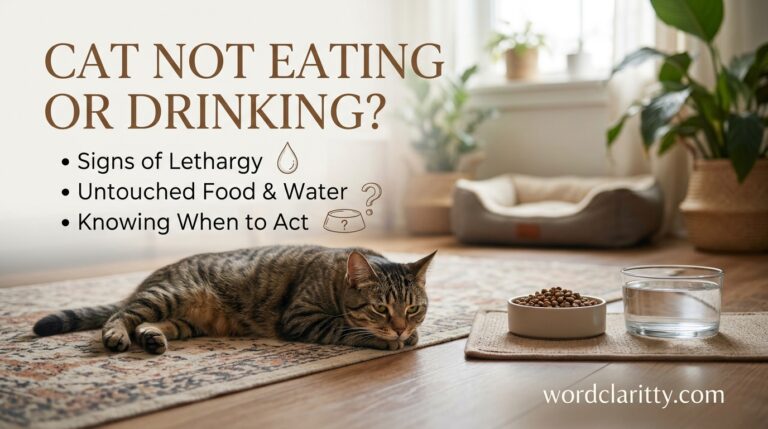
Have you ever heard someone say, “My cat is not eating or drinking,” and wondered what the sentence means? English learners sometimes confuse the words “eating” and “drinking” because both describe important daily activities. However, these words refer to different actions. Eating means consuming food, while drinking means taking in liquids such as water.
Understanding the difference helps you describe animal behavior clearly and communicate important information to a veterinarian. A cat refusing food or water may also have a health problem that needs attention. In this guide, you will learn the meanings, grammar, pronunciation, common mistakes, and correct usage of these expressions.
Why “Cat Not Eating” and “Cat Not Drinking” Are Confusing
The expressions “cat not eating” and “cat not drinking” are closely related because both describe changes in a cat’s normal behaviour. However, they do not mean exactly the same thing.
1. Similar Pronunciation
The words “eating” and “drinking” are not pronounced the same way.
- Eating: /ˈiːtɪŋ/
- Drinking: /ˈdrɪŋkɪŋ/
Both words end with the “-ing” sound, which is common in English verbs.
Although their pronunciation is different, learners may associate them because they frequently appear together in sentences about food, water, and daily routines.
2. Similar Spelling
The words have different spellings but share the ending “-ing.”
- Eating comes from the verb eat.
- Drinking comes from the verb drink.
The “-ing” ending is used to form the present participle of each verb.
For example:
“The cat is eating.”
“The cat is drinking.”
Both sentences use the present continuous tense to describe an action happening around the present moment.
3. Context Confusion
Eating and drinking are both necessary activities for animals, including cats. Because these actions are closely connected, people sometimes discuss them together.
For example:
“My cat is not eating or drinking.”
This sentence means that the cat is refusing or not consuming both food and liquids.
However, a cat may stop eating while still drinking water. Another cat may eat normally but drink less water than expected.
These situations are different and should be described accurately.
4. Common Learner Mistakes
Common mistakes include:
- Using “eating” when referring to water.
- Using “drinking” when referring to solid food.
- Forgetting the helping verb “is” in complete sentences.
- Assuming that not eating and not drinking mean the same thing.
- Using “and” or “or” incorrectly when describing a cat’s behaviour.
Understanding the separate meanings helps you avoid these mistakes.
Cat Not Eating vs Cat Not Drinking Explained Simply
The difference between “cat not eating” and “cat not drinking” is straightforward.
“Cat not eating” means a cat is not consuming food, while “cat not drinking” means a cat is not taking in water or other liquids.
Simple Explanation
Cat not eating: Describes a cat that refuses food or consumes much less food than usual.
Cat not drinking: Describes a cat that refuses water or is not observed drinking liquids.
Both expressions are understandable, especially in search queries and short notes. However, complete English sentences usually require a subject and helping verb.
For example:
- “My cat is not eating.”
- “My cat is not drinking.”
One-Line Distinction
Eating refers to consuming food, while drinking refers to consuming liquids.
Two Example Sentences
Example 1:
“My cat is not eating her usual food, but she is still drinking water.”
This sentence explains that the cat has stopped eating but continues to drink.
Example 2:
“My cat is eating normally, but I have not seen him drinking water today.”
This sentence describes a different situation: the cat is eating, but the owner has not observed it drinking.
The second sentence does not necessarily prove that the cat has consumed no water, especially if it eats wet food.
If a cat stops eating and drinking, contact a veterinarian promptly. A cat that is weak, vomiting repeatedly, unable to urinate, or showing other serious symptoms needs urgent veterinary attention.
Understanding Homophones in English
Homophones are an important part of English vocabulary. Learning about them helps improve pronunciation, spelling, and communication.
What Are Homophones?
Homophones are words that sound the same but have different meanings and often different spellings.
For example, “see” and “sea” are homophones.
- See: To notice something using your eyes.
- Sea: A large body of salt water.
Consider these sentences:
“I can see the mountains.”
“The boat sailed across the sea.”
The words sound alike but have different meanings.
Other examples include:
- Hear and here
- Right and write
- One and won
- Sun and son
- Flour and flower
However, “eating” and “drinking” are not homophones because they have different pronunciations and meanings.
Why Homophones Cause Confusion
Homophones can cause confusion because listeners must rely on context to understand which word is intended.
For example:
“I can hear the birds.”
“The birds are here.”
The words “hear” and “here” sound identical in most English accents, but their meanings are different.
The confusion between “eating” and “drinking” is not caused by identical pronunciation. Instead, it comes from their related meanings and frequent use together.
For English learners, understanding this difference makes it easier to describe food intake, water consumption, and animal behaviour accurately.
What Does “Cat Not Eating” Mean?
Definition and Core Meaning
The expression “cat not eating” describes a situation in which a cat is not consuming food or is eating significantly less than usual.
In complete English, we usually say:
“My cat is not eating.”
The word “eating” is the present participle of the verb “eat,” which means to consume food.
The expression can describe several situations:
- A cat refuses its usual food.
- A cat shows little interest in meals.
- A cat approaches food but does not eat.
- A cat eats much smaller portions than normal.
- A cat has stopped eating completely.
These situations may have different causes, so it is important to describe exactly what you observe.
Origin and Historical Use
The verb “eat” comes from Old English etan, meaning to consume food.
It is one of the oldest and most common verbs in English.
Over time, the verb developed different grammatical forms:
- Eat — base form
- Eats — third-person singular
- Ate — simple past
- Eaten — past participle
- Eating — present participle
The expression “not eating” uses a negative construction to show that the action is not happening.
For example:
“The cat is not eating.”
Here, “is not” makes the present continuous verb negative.
Modern Usage and Synonyms
Today, “cat not eating” is commonly used in conversations with veterinarians, pet-care articles, and online searches.
Related expressions include:
- Loss of appetite: Reduced interest in food.
- Refusing food: Not accepting food when offered.
- Not feeding: Sometimes used informally, although it can also mean that someone is not giving food to an animal.
- Eating less than usual: Consuming smaller portions.
- Anorexia: A medical term describing a loss of appetite or absence of eating.
These expressions are related, but they do not always describe exactly the same situation.
Example Sentences
- “My cat is not eating her breakfast.”
- “The kitten has been eating less than usual.”
- “My cat is refusing food but still drinking water.”
- “The veterinarian asked how long the cat had not been eating.”
- “My cat approaches the food bowl but walks away without eating.”
A cat may stop eating because of dental pain, nausea, stress, illness, or other problems. A cat that has eaten nothing for around 24 hours needs prompt veterinary assessment, and kittens or medically vulnerable cats may need help much sooner. Prolonged food refusal can lead to serious complications, including hepatic lipidosis, especially in overweight cats.
What Does “Cat Not Drinking” Mean?
Definition and Core Meaning
The expression “cat not drinking” describes a cat that is not consuming water or other liquids.
In a complete sentence, we usually say:
“My cat is not drinking water.”
The word “drinking” comes from the verb “drink,” meaning to take liquid into the mouth and swallow it.
The expression may describe:
- A cat refusing water.
- A cat drinking less than usual.
- A cat avoiding its water bowl.
- A cat showing little interest in liquids.
- An owner who has not observed the cat drinking.
However, not seeing a cat drink does not always mean it has consumed no water.
Cats that eat wet food may obtain a substantial amount of their daily water intake from their meals.
Origin and Historical Context
The verb “drink” comes from Old English drincan, meaning to swallow liquid.
Like “eat,” it has been part of the English language for centuries.
Its main grammatical forms include:
- Drink — base form
- Drinks — third-person singular
- Drank — simple past
- Drunk — past participle
- Drinking — present participle
In the sentence “My cat is not drinking,” the verb is used in the negative present continuous tense.
This structure describes an action that is not occurring during the relevant period.
Modern Usage and Synonyms
In modern English, “cat not drinking” often appears in pet-care discussions and veterinary conversations.
Related expressions include:
- Refusing water: Not accepting water when offered.
- Reduced water intake: Drinking less water than usual.
- Not drinking from the bowl: Avoiding a particular water source.
- Poor fluid intake: Consuming too little liquid overall.
- Dehydration: A condition in which the body does not have enough water.
It is important to remember that dehydration and not drinking are not identical. A cat may become dehydrated because of vomiting, diarrhoea, or illness, even if it drinks some water.
Example Sentences
- “My cat is not drinking from her water bowl.”
- “The kitten has been drinking less than usual.”
- “My cat eats wet food, so I rarely see him drinking water.”
- “The veterinarian asked whether the cat was drinking normally.”
- “My cat has stopped drinking and seems unusually weak.”
A cat that is truly not taking in fluids may become dehydrated. If your cat refuses water, especially alongside food refusal, lethargy, vomiting, or other symptoms, seek veterinary advice promptly rather than waiting for the condition to worsen.
Cat Not Eating vs Cat Not Drinking: Key Differences at a Glance
The following table explains the main differences between these expressions.
| Word or Expression | Part of Speech | Meaning | Example Context |
|---|---|---|---|
| Eat | Verb | To consume food | “Cats eat meat-based diets.” |
| Drink | Verb | To consume liquids | “Cats drink water.” |
| Eating | Present participle | Consuming food | “The cat is eating dinner.” |
| Drinking | Present participle | Consuming liquid | “The cat is drinking water.” |
| Cat not eating | Shortened descriptive phrase | A cat is not consuming food | “My cat is not eating today.” |
| Cat not drinking | Shortened descriptive phrase | A cat is not consuming liquid | “My cat is not drinking water.” |
| Cat not eating or drinking | Shortened descriptive phrase | A cat is consuming neither food nor liquids | “My cat is not eating or drinking.” |
Which Expression Is Correct?
Both expressions are understandable, but complete sentences are usually better in standard English.
For example:
- Correct: “My cat is not eating.”
- Correct: “My cat is not drinking.”
- Correct: “My cat is not eating or drinking.”
The shortened forms are common in search engine queries and informal notes.
How to Remember the Difference Between Cat Not Eating and Cat Not Drinking
You can remember the difference by connecting each verb with something familiar.
1. Eating Means Food
Think about a cat eating from a food bowl.
Memory trick: Eat → Food → Meal
Example:
“The cat is eating chicken.”
If the cat refuses food, say:
“The cat is not eating.”
2. Drinking Means Water
Imagine a cat drinking water from a bowl.
Memory trick: Drink → Water → Liquid
Example:
“The cat is drinking fresh water.”
If the cat refuses water, say:
“The cat is not drinking.”
3. Remember the Grammar Pattern
Both expressions use the same sentence structure.
Subject + is + not + verb-ing
For example:
- “The cat is not eating.”
- “The cat is not drinking.”
- “My kitten is not eating.”
- “My kitten is not drinking.”
This pattern helps you form correct negative sentences in the present continuous tense.
4. One Memorable Example
Imagine two bowls beside a cat.
One bowl contains food, and the other contains water.
If the cat ignores the food bowl, you can say:
“My cat is not eating.”
If the cat ignores the water bowl, you can say:
“My cat is not drinking from the bowl.”
If the cat refuses both, you can say:
“My cat is not eating or drinking.”
This simple picture connects each word with its correct meaning.
Common Mistakes and Confusions
English learners sometimes make mistakes when describing animal behaviour because they confuse verbs, sentence structure, or the use of negative expressions.
Mistake 1: Forgetting the Helping Verb
✘ Incorrect: “My cat not eating.”
✔ Correct: “My cat is not eating.”
Explanation: In a complete present continuous sentence, the helping verb “is” is necessary.
Mistake 2: Using “Eating” for Water
✘ Incorrect: “My cat is eating water.”
✔ Correct: “My cat is drinking water.”
Explanation: We use “drink” for consuming liquids.
Mistake 3: Using “Drinking” for Solid Food
✘ Incorrect: “My cat is drinking dry food.”
✔ Correct: “My cat is eating dry food.”
Explanation: Dry cat food is eaten, not drunk.
Mistake 4: Confusing “And” with “Or”
✘ Incorrect for the intended meaning: “My cat is not eating and drinking.”
✔ Correct: “My cat is not eating or drinking.”
Explanation: When you want to say that neither activity is happening, “not eating or drinking” is clearer and more natural.
Mistake 5: Confusing Observation with Certainty
✘ Misleading: “My cat is not drinking any water because I never see him at the bowl.”
✔ More accurate: “I have not seen my cat drinking water.”
Explanation: The owner may not observe every drink, and wet food also supplies moisture. Precise wording helps avoid incorrect conclusions.
Examples Section: Correct and Incorrect Usage
Example 1: Describing Food Refusal
✔ Correct: “My cat is not eating her usual food.”
✘ Incorrect: “My cat not eating her usual food.”
Why? A complete present continuous sentence requires “is.”
Example 2: Describing Water Intake
✔ Correct: “My cat is not drinking water.”
✘ Incorrect: “My cat is not eating water.”
Why? Water is a liquid, so “drinking” is the correct verb.
Example 3: Describing Both Problems
✔ Correct: “My cat is not eating or drinking.”
✘ Incorrect: “My cat not eating or drinking.”
Why? The helping verb “is” is required in a complete sentence.
Example 4: Talking About Dry Food
✔ Correct: “The kitten is eating dry food.”
✘ Incorrect: “The kitten is drinking dry food.”
Why? Dry food is consumed by eating.
Example 5: Describing a Change in Behaviour
✔ Correct: “My cat has stopped eating and seems tired.”
✘ Incorrect: “My cat have stopped eating and seems tired.”
Why? The singular subject “cat” requires “has,” not “have.”
Example 6: Asking for Help
✔ Correct: “Why is my cat not eating or drinking?”
✘ Incorrect: “Why my cat not eating or drinking?”
Why? English questions normally require the correct helping verb and word order.
Self-Assessment: Test Your Knowledge
Choose the correct word or phrase to complete each sentence.
Question 1: My cat is not ___ her usual food.
a) Eating
b) Drinking
Question 2: The kitten is ___ water from a bowl.
a) Eating
b) Drinking
Question 3: My cat ___ not eating or drinking today.
a) Is
b) Are
Question 4: Which sentence is grammatically correct?
a) “Why my cat not eating?”
b) “Why is my cat not eating?”
Self-Assessment Answers
Answer 1: a) Eating
“My cat is not eating her usual food.”
We use “eating” when describing food consumption.
Answer 2: b) Drinking
“The kitten is drinking water from a bowl.”
We use “drinking” for liquids.
Answer 3: a) Is
“My cat is not eating or drinking today.”
The singular subject “cat” requires the helping verb “is.”
Answer 4: b) Why is my cat not eating?
This question uses the correct English word order.
How Did You Do?
- 4 correct: Excellent! You understand the expressions.
- 3 correct: Very good. Review the question you missed.
- 1–2 correct: Practise using “eating” and “drinking” in simple sentences.
- 0 correct: Remember that eating refers to food and drinking refers to liquids.
FAQs:
1. What Does “Cat Not Eating or Drinking” Mean?
It means that a cat is not consuming food or liquids. This can be a sign of illness or another problem. If a cat has stopped both activities, contact a veterinarian promptly, especially if it seems weak or unwell.
2. Is “My Cat Not Eating or Drinking” Grammatically Correct?
It is understandable as a search phrase or informal note, but it is not a complete standard English sentence. The correct sentence is “My cat is not eating or drinking.”
3. Why Is My Cat Not Eating but Still Drinking Water?
Possible causes include stress, dental pain, nausea, or illness. Drinking water does not rule out a serious problem. If your cat refuses food, seek veterinary advice promptly, particularly if it has eaten nothing for about 24 hours or has other symptoms.
4. Why Is My Cat Eating but Not Drinking Water?
Cats that eat wet food may drink less from their water bowls because their food contains moisture. However, reduced water intake can also have medical causes. If the change is unusual or accompanied by other symptoms, consult a veterinarian.
5. How Long Can a Cat Go Without Eating or Drinking?
There is no universally safe waiting period. Cats can develop serious complications from food refusal, and dehydration can become dangerous. Seek veterinary advice promptly when a cat stops eating or drinking rather than waiting for a fixed number of days.
6. What Should I Do If My Cat Is Not Eating or Drinking?
Contact a veterinarian promptly. You can offer fresh water and familiar food while arranging care, but do not force-feed or syringe water into the cat’s mouth unless specifically instructed by a veterinarian. If your cat is very weak, repeatedly vomiting, struggling to breathe, or unable to urinate, seek emergency veterinary care.
7. What Is the Difference Between “Not Eating” and “Loss of Appetite”?
“Not eating” describes the observable action of consuming no food. “Loss of appetite” means reduced or absent interest in food. A cat may want to eat but be unable to because of pain or another medical problem, so these expressions are related but not always identical.
Conclusion:
Understanding the difference between “cat not eating” and “cat not drinking” helps English learners describe animal behaviour clearly and use correct grammar in everyday communication. Although these expressions are closely related, they refer to different actions. Eating means consuming food, while drinking means consuming water or other liquids. Therefore, “my cat is not eating” describes a lack of food intake, while “my cat is not drinking” describes a lack of liquid intake. When both activities have stopped, the natural expression is “my cat is not eating or drinking.”
In real-world conversations, these phrases are especially useful when discussing pet care, explaining symptoms to a veterinarian, or asking questions about a cat’s behaviour. Using complete sentences with the helping verb “is” makes your meaning clearer and more grammatically accurate. You can also remember the difference with a simple association: eating connects to a food bowl, while drinking connects to a water bowl.
However, correct language is only one part of understanding the situation. A cat that stops eating or drinking may need prompt veterinary attention. It is important to describe exactly what you have observed rather than assuming the cause.
As you continue learning English, practise these expressions in simple sentences and pay attention to how verbs change in different grammatical structures. With regular practice, you will become more confident describing everyday activities, recognizing important differences in meaning, and communicating clearly and accurately.