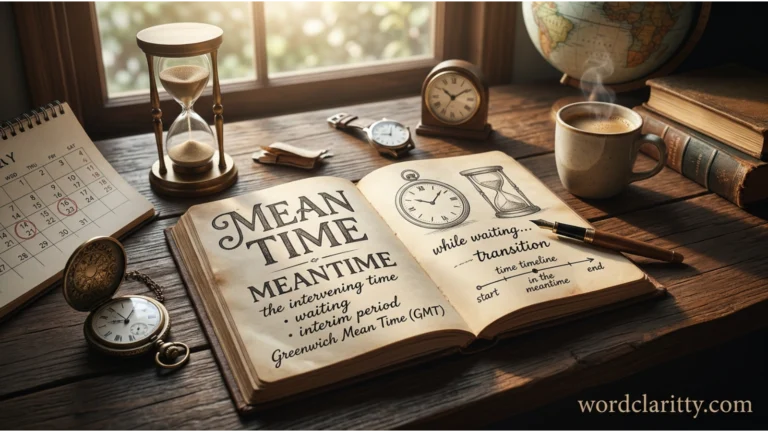
Have you ever wondered whether to write “mean time” or “meantime” in an English sentence? These expressions look almost identical and sound the same when spoken, making them confusing for English learners. However, they have different meanings and grammatical uses. “Meantime” usually refers to the period between two events, while “mean time” can refer to average time or a specific way of measuring time.
Both forms are correct, but choosing the right one depends on the context. Understanding this difference can improve your spelling, grammar, and everyday communication. This guide explains their meanings, origins, examples, common mistakes, and easy memory tricks.
Why “Mean Time” and “Meantime” Are Confusing
The expressions “mean time” and “meantime” are easily confused because they share the same letters and pronunciation. However, their meanings depend on whether they are written as one word or two.
1. Similar Pronunciation
Both expressions are generally pronounced /ˈmiːn taɪm/, sounding like “MEEN-time.”
When speaking, there is usually no noticeable difference between them.
For example:
- “The mean time between failures was calculated.”
- “In the meantime, we waited for the results.”
Although they sound alike, the first refers to a calculated average, while the second refers to an intervening period.
2. Similar Spelling
The only spelling difference is a space.
- Mean time: Two separate words.
- Meantime: One compound word.
This small difference can easily be missed when writing quickly.
However, it is important because the spelling helps indicate the intended meaning.
3. Context Confusion
Both expressions involve time, but they describe it differently.
“Mean time” commonly appears in technical, scientific, statistical, and timekeeping contexts.
“Meantime” is more common in everyday conversations and writing about events happening while something else is pending.
For example:
“The mean time between failures is 500 hours.”
“In the meantime, the engineers repaired another machine.”
The sentences discuss time, but the expressions serve different purposes.
4. Common Learner Mistakes
Common mistakes include:
- Writing “in the mean time” instead of the standard “in the meantime.”
- Using “meantime” when discussing statistical averages.
- Assuming the two expressions are always interchangeable.
- Confusing “mean time” with “meanwhile.”
- Forgetting that “mean” can mean “average” in mathematics.
- Using “meantime” as a replacement for every expression containing the word “time.”
Understanding the context is the easiest way to avoid these errors.
Mean Time vs Meantime Explained Simply
“Mean time” usually refers to an average or standardized measurement of time, while “meantime” refers to the period between two events.
Simple Explanation
Mean time: A two-word expression used when “mean” describes time as an average or as part of a technical timekeeping term.
Meantime: A single word meaning the period between events. It commonly appears in the expression “in the meantime,” meaning “while waiting” or “during the intervening period.”
One-Line Distinction
Use “mean time” for average or technical time measurements, and “meantime” for the period while something else is happening or pending.
Two Example Sentences
Example 1: Mean Time
“The researchers calculated the mean time required to complete the experiment.”
Here, “mean time” refers to the average duration.
Example 2: Meantime
“The doctor will arrive soon. In the meantime, please take a seat.”
Here, “meantime” refers to the period before the doctor’s arrival.
Which One Is Correct?
Both are correct English forms, but they are not normally interchangeable.
If you mean “while waiting,” use “in the meantime.”
If you mean “average time,” use “mean time.”
Understanding Homophones in English
Homophones are an important part of English vocabulary because they can create confusion in both writing and listening.
What Are Homophones?
Homophones are words that have the same pronunciation but different meanings and often different spellings.
For example:
- Right: Correct or the opposite of left.
- Write: To form words using letters.
Consider these sentences:
“You gave the right answer.”
“Please write your answer.”
The words sound the same but have different meanings.
Other common homophones include:
- Sea and see
- Hear and here
- Flour and flower
- One and won
- Sun and son
“Mean time” and “meantime” are similar in pronunciation, but the distinction is between a two-word phrase and a compound word rather than two unrelated single words.
Why Homophones Cause Confusion
Homophones cause confusion because spoken English does not always reveal how a word should be spelled.
For example:
“I can hear the music.”
“Come here and listen.”
The words “hear” and “here” sound identical, but their meanings differ.
Likewise, someone hearing “mean time” may not know whether the speaker intends the technical phrase or the everyday expression “meantime.”
The surrounding sentence usually provides the answer.
If the speaker discusses an average, the two-word form is likely appropriate. If the speaker discusses what happens while waiting, “meantime” is the natural choice.
What Does “Mean Time” Mean?
Definition and Core Meaning
“Mean time” is a two-word expression referring to average time or a technical measurement of time.
The word “mean” can function as an adjective meaning “average.”
Therefore, “mean time” often describes a calculated average duration.
It can also appear in established timekeeping expressions such as Greenwich Mean Time.
Common uses include:
- Average duration: The average time needed to complete an activity.
- Engineering: Mean time between failures, or MTBF.
- Maintenance: Mean time to repair, or MTTR.
- Timekeeping: Greenwich Mean Time, or GMT.
- Statistics: Calculating the average of several recorded times.
For example:
“The mean time to complete the task was 25 minutes.”
This means that the average completion time was 25 minutes.
Origin and Historical Use
The word “mean,” when used to describe an average, has historical roots in mathematical and scientific language.
In English, “mean” developed several meanings, including intention, significance, unkindness, and an intermediate or average value.
The mathematical meaning became especially important in statistics and scientific measurement.
The expression “mean time” also has a specific history in astronomy and timekeeping.
Mean solar time is based on a uniform measure of time associated with the average motion of the Sun, rather than the varying length of the apparent solar day.
Greenwich Mean Time developed as a standard connected to the mean solar time at the Greenwich meridian.
Over time, technical expressions containing “mean time” became common in engineering, science, and business.
Modern Usage and Synonyms
Today, “mean time” is especially useful in professional and technical contexts.
Related expressions include:
- Average time: A calculated average duration.
- Mean duration: The average length of an activity.
- Average completion time: The typical calculated time required to finish something.
- Mean time between failures: An engineering reliability measure.
- Mean time to repair: An average repair-time measure.
- Greenwich Mean Time: A historical time standard still commonly referenced as GMT.
These expressions are related but not interchangeable in every context.
For example, mean time between failures and mean time to repair measure different things.
Example Sentences
- “The mean time required to finish the test was 40 minutes.”
- “The company calculated the mean time between equipment failures.”
- “The engineer measured the mean time to repair the machine.”
- “The schedule lists the event time in Greenwich Mean Time.”
- “The mean time for the runners was slightly lower this year.”
- “Researchers compared the mean time needed by two groups of students.”
In each example, “mean” describes a calculated average or forms part of a technical timekeeping expression.
What Does “Meantime” Mean?
Definition and Core Meaning
“Meantime” refers to the period between two events or the time during which someone is waiting for something else to happen.
It is most commonly used in the phrase “in the meantime.”
For example:
“The food will be ready in 20 minutes. In the meantime, you can prepare the table.”
Here, “in the meantime” means “during the waiting period.”
“Meantime” can function as a noun, and it also appears in adverbial uses, although “in the meantime” is particularly common.
Its main meanings include:
- An intervening period: The time between two events.
- While waiting: The period before something expected happens.
- During another activity: A time when one action occurs while another situation continues.
- Temporary arrangement: Something done until a later event takes place.
Origin and Historical Context
“Meantime” developed from the combination of “mean” and “time.”
In this expression, “mean” historically relates to the idea of something intermediate or occurring between two points.
This is different from the mathematical meaning of “mean” as “average.”
The compound word became established in English to describe the time between events.
The related word “meanwhile” also expresses the idea of something happening during an intervening period.
Today, “in the meantime” remains a natural and widely accepted expression in both British and American English.
Modern Usage and Synonyms
“Meantime” is common in everyday English, especially when describing plans, delays, and activities happening while another event is pending.
Related expressions include:
- Meanwhile: During the same period.
- While waiting: During a delay.
- Until then: Before a future event.
- For now: At the present time, often temporarily.
- In the interim: During the period between events.
- In the intervening period: A more formal expression.
These alternatives are useful, but their meanings and grammatical patterns are not always identical.
For example:
“The manager will arrive soon. In the meantime, please wait here.”
You could also say:
“The manager will arrive soon. Meanwhile, please wait here.”
Both sentences communicate a similar idea.
Example Sentences
- “The train leaves in an hour. In the meantime, we can have coffee.”
- “The teacher is checking the papers. In the meantime, students can read quietly.”
- “The new computer will arrive tomorrow. In the meantime, I will use my laptop.”
- “Dinner is cooking. In the meantime, let’s set the table.”
- “The results will be announced next week. In the meantime, we should remain patient.”
- “The repairs may take several days. In the meantime, the office will use temporary equipment.”
All these sentences describe an intervening period rather than a statistical average.
Mean Time vs Meantime: Key Differences at a Glance
The following comparison table summarizes the most important differences.
| Word | Part of Speech | Meaning | Example Context |
|---|---|---|---|
| Mean time | Adjective + noun phrase | Average duration | “The mean time was 15 minutes.” |
| Mean time | Technical noun phrase | A standardized measurement of time | “The event begins at 10:00 Greenwich Mean Time.” |
| Meantime | Noun | The period between two events | “We waited during the meantime.” |
| Meantime | Used in an adverbial phrase | During the waiting or intervening period | “In the meantime, please relax.” |
Main Difference
The easiest distinction is:
Mean time = average or technical time measurement.
Meantime = the period between events.
Can They Be Used Interchangeably?
Generally, no.
Compare:
“The mean time to complete the task was 30 minutes.”
“In the meantime, the team prepared another report.”
The first sentence describes a measured average. The second describes what happened during an intervening period.
Replacing one form with the other would change the meaning or make the sentence unnatural.
How to Remember the Difference Between Mean Time and Meantime
A few easy memory tricks can help you choose the correct spelling.
1. Mean Time Means Average Time
Remember that “mean” often means “average” in mathematics.
Memory trick: Mean + Time = Average Time
For example:
“The mean time for the experiment was 12 minutes.”
Whenever you see a calculation involving average duration, think of the two-word form.
2. Meantime Means the Time Between Events
Think of “meantime” as one word describing one waiting period.
Memory trick: Meantime = The time in between
For example:
“The bus arrives soon. In the meantime, let’s sit down.”
The sentence refers to the time before the bus arrives.
3. Connect Each Form with a Different Situation
Imagine two situations.
Situation A: A scientist measures how long several experiments take.
The scientist calculates the mean time.
Situation B: A student waits for the teacher to return.
The student reads a book in the meantime.
These situations help you connect the spelling with the intended meaning.
4. One Memorable Example
“The engineer calculated the mean time needed for repairs. In the meantime, the workers prepared replacement parts.”
This sentence uses both forms correctly.
“Mean time” refers to an average measurement, while “meantime” describes the waiting period.
Common Mistakes and Confusions
Mistake 1: Writing “In the Mean Time”
✘ Incorrect in standard modern usage: “In the mean time, please wait outside.”
✔ Correct: “In the meantime, please wait outside.”
Explanation: When you mean “while waiting,” the established modern expression is “in the meantime.”
Mistake 2: Using “Meantime” for an Average
✘ Incorrect: “The meantime to complete the exam was 45 minutes.”
✔ Correct: “The mean time to complete the exam was 45 minutes.”
Explanation: A calculated average requires “mean time,” written as two words.
Mistake 3: Confusing “Meantime” with “Meanwhile”
✘ Incorrect: “In the meanwhile time, we prepared dinner.”
✔ Correct: “In the meantime, we prepared dinner.”
✔ Also correct: “Meanwhile, we prepared dinner.”
Explanation: “Meanwhile” and “in the meantime” can have similar meanings, but they follow different grammatical patterns.
Mistake 4: Using “Mean Time” for a Waiting Period
✘ Incorrect: “The doctor will arrive soon. In the mean time, sit here.”
✔ Correct: “The doctor will arrive soon. In the meantime, sit here.”
Explanation: The sentence describes a waiting period, not an average duration.
Mistake 5: Assuming Both Forms Have the Same Meaning
✘ Incorrect assumption: “Mean time and meantime always mean the same thing.”
✔ Correct understanding: “Mean time refers to an average or technical time measure, while meantime refers to an intervening period.”
Explanation: Their pronunciation is identical, but their meanings are different.
Examples Section: Correct and Incorrect Usage
Example 1: Waiting for Someone
✔ Correct: “The manager will arrive soon. In the meantime, please take a seat.”
✘ Incorrect: “The manager will arrive soon. In the mean time, please take a seat.”
Why? The sentence describes what happens while waiting.
Example 2: Scientific Measurement
✔ Correct: “The mean time required for the experiment was 20 minutes.”
✘ Incorrect: “The meantime required for the experiment was 20 minutes.”
Why? The sentence refers to a calculated average duration.
Example 3: Technical Maintenance
✔ Correct: “The engineer calculated the mean time between failures.”
✘ Incorrect: “The engineer calculated the meantime between failures.”
Why? “Mean time between failures” is an established engineering term.
Example 4: Everyday Conversation
✔ Correct: “Dinner will be ready soon. In the meantime, let’s watch television.”
✘ Incorrect: “Dinner will be ready soon. In the mean time, let’s watch television.”
Why? The phrase refers to the intervening period before dinner.
Example 5: Timekeeping
✔ Correct: “The announcement listed the time in Greenwich Mean Time.”
✘ Incorrect: “The announcement listed the time in Greenwich Meantime.”
Why? Greenwich Mean Time is the established name of the time standard.
Example 6: Temporary Arrangements
✔ Correct: “The new office opens next month. In the meantime, we will work from home.”
✘ Incorrect: “The new office opens next month. In the mean time, we will work from home.”
Why? “In the meantime” is the standard expression for a temporary period before a future event.
Self-Assessment: Test Your Knowledge
Choose the correct option to complete each sentence.
Question 1: The bus will arrive in ten minutes. In the ___, we can buy some water.
a) mean time
b) meantime
Question 2: The researchers calculated the ___ required to finish the experiment.
a) mean time
b) meantime
Question 3: The conference schedule uses Greenwich ___.
a) Meantime
b) Mean Time
Question 4: The repairs will take several hours. In the ___, employees can use another room.
a) mean time
b) meantime
Self-Assessment Answers
Answer 1: b) meantime
“The bus will arrive in ten minutes. In the meantime, we can buy some water.”
The sentence refers to a waiting period.
Answer 2: a) mean time
“The researchers calculated the mean time required to finish the experiment.”
The expression refers to an average duration.
Answer 3: b) Mean Time
“The conference schedule uses Greenwich Mean Time.”
Greenwich Mean Time is the correct name of the time standard.
Answer 4: b) meantime
“The repairs will take several hours. In the meantime, employees can use another room.”
The sentence describes a temporary arrangement during an intervening period.
How Did You Do?
- 4 correct: Excellent! You understand the difference.
- 3 correct: Great work. Review the question you missed.
- 1–2 correct: Practise identifying average measurements and waiting periods.
- 0 correct: Remember: mean time means average time; meantime means the time between events.
FAQs:
1. What Is the Difference Between Mean Time and Meantime?
“Mean time” refers to an average or technical time measurement, while “meantime” refers to the period between two events. Their meanings depend on context.
2. Is It “In the Mean Time” or “In the Meantime”?
The standard modern spelling is “in the meantime.” It means “while waiting” or “during the intervening period.”
3. Is “Meantime” One Word or Two?
“Meantime” is one word when referring to an intervening period. “Mean time” is written as two words when discussing average time or technical timekeeping.
4. Can I Use “Meanwhile” Instead of “Meantime”?
Often, yes. “Meanwhile” and “in the meantime” can express similar ideas. However, their sentence structures may differ, so they are not interchangeable in every situation.
5. What Does Mean Time Mean in Mathematics?
In mathematical or statistical contexts, “mean time” generally refers to the average of several recorded time values. It is calculated by adding the values and dividing by the number of observations.
6. What Is Greenwich Mean Time?
Greenwich Mean Time, or GMT, is a time standard historically based on mean solar time at the Greenwich meridian. It remains a familiar time reference, although Coordinated Universal Time (UTC) is the primary modern international time standard.
7. How Can I Remember Mean Time vs Meantime?
Remember that mean time relates to an average measurement, while meantime relates to the time between events. Think of a scientist calculating mean time and a person waiting in the meantime.
Conclusion:
Understanding the difference between “mean time” and “meantime” can make your English writing clearer and more accurate. Although both expressions sound identical and contain the same letters, they serve different purposes. “Mean time,” written as two separate words, generally refers to an average duration or a technical measurement of time. It commonly appears in mathematics, statistics, engineering, scientific research, and established expressions such as Greenwich Mean Time. On the other hand, “meantime,” written as one word, refers to the period between two events and is especially common in the phrase “in the meantime.”
In everyday conversations, you will probably use “in the meantime” more often. For example, you might say, “The food will be ready soon. In the meantime, let’s prepare the table.” However, when discussing measurements or calculations, “mean time” is the correct choice, as in “The mean time to complete the task was 15 minutes.”
To remember the difference, connect mean time with mathematical averages and meantime with waiting or the time in between. These simple associations can help you avoid spelling and grammar mistakes.Most importantly, pay attention to the meaning of your sentence rather than relying only on pronunciation. Reading examples, practising short sentences, and reviewing common expressions will strengthen your understanding. With consistent practice, choosing between “mean time” and “meantime” will become easier, helping you communicate naturally and confidently in English.