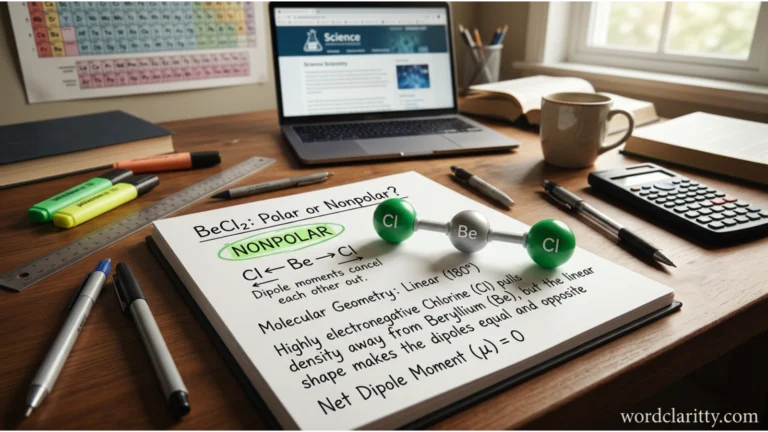
BeCl2 Polar or Nonpolar? This is a common chemistry question that confuses students because beryllium chloride contains polar bonds but is classified as a nonpolar molecule in its simple, linear molecular model. How can both statements be true? The answer lies in understanding electronegativity, molecular geometry, and dipole moments.
Although the words “polar” and “nonpolar” seem like opposites, identifying which one describes a molecule requires more than looking at its chemical formula. In this guide, you will learn why BeCl₂ is nonpolar in its isolated molecular form, how its bonds behave, and how to remember the difference using simple explanations, examples, and practical chemistry rules.
Why “BeCl2 Polar or Nonpolar” Are Confusing
The terms “polar” and “nonpolar” can be confusing because students often mix up bond polarity with molecular polarity. These concepts are related, but they are not identical.
1. Similar Pronunciation
The words share the same main sound, “polar.”
- Polar: POH-ler
- Nonpolar: non-POH-ler
The prefix “non-” changes the meaning to its opposite.
Students may overlook this small prefix when reading or listening to explanations.
2. Similar Spelling
The spelling difference is also small.
- Polar: Describes an uneven distribution of electrical charge.
- Nonpolar: Describes a molecule without a permanent overall separation of positive and negative charge.
The word “nonpolar” simply adds the negative prefix “non-” to “polar.”
However, the chemistry behind these terms is more complicated than their spelling suggests.
3. Context Confusion
In chemistry, a bond can be polar even when the entire molecule is nonpolar.
For example, BeCl₂ contains two polar Be–Cl bonds because chlorine attracts bonding electrons more strongly than beryllium.
However, an isolated BeCl₂ molecule has a straight, symmetrical shape.
As a result, the two bond dipoles point in opposite directions and cancel.
This makes the overall molecule nonpolar.
4. Common Learner Mistakes
Students frequently make these mistakes:
- Assuming that every molecule with polar bonds must be polar.
- Ignoring molecular shape when determining polarity.
- Thinking that BeCl₂ is bent rather than linear.
- Assuming that the central atom always follows the octet rule.
- Confusing electronegativity differences with the overall molecular dipole moment.
The key is to examine both the bonds and the three-dimensional arrangement of atoms.
BeCl2 Polar or Nonpolar Explained Simply
BeCl₂ is nonpolar as an isolated, linear molecule, even though each Be–Cl bond is polar.
Beryllium chloride contains one beryllium atom and two chlorine atoms.
Beryllium is the central atom, with one chlorine atom on each side.
The simple molecular arrangement is:
Cl — Be — Cl
The bond angle is 180 degrees.
Because the molecule is linear and symmetrical, the bond dipoles cancel each other.
Simple Explanation
Polar: A molecule is polar when its electrical charge is distributed unevenly, producing a permanent overall dipole moment.
Nonpolar: A molecule is nonpolar when it has no permanent overall dipole moment.
In BeCl₂, the chlorine atoms attract electrons more strongly than beryllium does.
Therefore, each Be–Cl bond has a partial negative end near chlorine and a partial positive end near beryllium.
However, the two bond dipoles are equal and opposite.
One-Line Distinction
Polar molecules have a net molecular dipole, while nonpolar molecules have no net molecular dipole; linear BeCl₂ is nonpolar because its bond dipoles cancel.
Two Example Sentences
Example 1:
“The Be–Cl bonds are polar because chlorine is more electronegative than beryllium.”
Example 2:
“An isolated BeCl₂ molecule is nonpolar because its linear geometry causes the two bond dipoles to cancel.”
Both statements are correct.
Understanding Homophones in English of BeCl2 Polar or Nonpolar
Although this article focuses on chemistry, understanding similar-looking English words can help learners interpret scientific terminology accurately.
What Are Homophones?
Homophones are words that sound the same but have different meanings and often different spellings.
For example:
- Pair: Two things considered together.
- Pear: A type of fruit.
Both words have the same pronunciation but different meanings.
Why Homophones Cause Confusion
Homophones can confuse English learners because pronunciation does not always reveal meaning.
For example:
“The scientist examined a pair of samples.”
Here, “pair” means two samples, not a fruit.
However, “polar” and “nonpolar” are not homophones because they do not have identical pronunciations.
Instead, they are opposite scientific terms created through the prefix “non-.”
This distinction is useful when learning scientific English. A small change in a word can completely change its meaning, especially in subjects such as chemistry, biology, and physics.
What Does “Polar” Mean?
Definition and Core Meaning
In chemistry, polar describes a bond or molecule that has an uneven distribution of electrical charge.
A polar covalent bond forms when two bonded atoms attract shared electrons with different strengths.
This difference is related to electronegativity.
Electronegativity is the ability of an atom to attract shared electrons in a chemical bond.
When one atom attracts electrons more strongly, it develops a partial negative charge, while the other develops a partial positive charge.
Important features of polar bonds include:
- Unequal sharing of bonding electrons.
- A difference in electronegativity between bonded atoms.
- Partial positive and negative charges.
- A bond dipole moment.
However, the presence of polar bonds does not automatically make the entire molecule polar.
Origin and Historical Use
The word “polar” comes from “pole,” a term associated with opposite ends or directions.
In science, polarity describes systems with two distinguishable ends or regions.
As chemistry developed, scientists used the idea of electrical polarity to explain uneven charge distribution in bonds and molecules.
Modern molecular polarity is described using dipole moments and molecular geometry.
These concepts help explain molecular interactions and many physical properties of substances.
Modern Usage and Synonyms
In chemistry, related expressions include:
- Polar bond: A bond with unequal electron sharing.
- Polar molecule: A molecule with a permanent net dipole moment.
- Bond dipole: A measure of charge separation along a bond.
- Dipole moment: A measure of the magnitude and direction of electrical charge separation.
- Electronegativity difference: A major factor influencing bond polarity.
These expressions describe related ideas, but they are not exact synonyms.
Is the Be–Cl Bond Polar?
Yes. The Be–Cl bond is polar.
On the Pauling electronegativity scale, approximate values are:
- Beryllium: 1.57
- Chlorine: 3.16
The difference is:
3.16 − 1.57 = 1.59
This difference indicates significant unequal sharing of electrons.
Chlorine attracts bonding electrons more strongly than beryllium.
Consequently:
- Chlorine develops a partial negative charge, δ−.
- Beryllium develops a partial positive charge, δ+.
- Each Be–Cl bond has a dipole directed toward chlorine.
Example Sentences
- “The Be–Cl bond is polar because the atoms have different electronegativities.”
- “Water is a polar molecule because its bond dipoles do not cancel.”
- “A polar bond contains an uneven distribution of bonding electrons.”
- “The polarity of a molecule depends on both its bonds and its geometry.”
What Does “Nonpolar” Mean?
Definition and Core Meaning
In chemistry, nonpolar describes a molecule that has no permanent overall electrical dipole moment.
This may happen because its bonds are nonpolar or because the dipoles of its polar bonds cancel through symmetry.
For example, carbon dioxide contains polar C=O bonds.
However, CO₂ is linear, so the bond dipoles cancel.
The same principle applies to isolated BeCl₂ molecules.
Important features of nonpolar molecules include:
- No permanent net molecular dipole.
- A symmetrical arrangement that may cancel polar bond dipoles.
- Sometimes, bonds between atoms with identical electronegativities.
- A molecular dipole moment of zero in the idealized symmetrical structure.
Origin and Historical Context
The term “nonpolar” combines the prefix “non-,” meaning “not,” with “polar.”
It is used to describe systems without the type of permanent overall charge separation associated with polarity.
In chemistry, the distinction became important for understanding molecular structure, intermolecular forces, and material properties.
Scientists use molecular geometry and electrical dipole calculations to determine whether molecules are polar or nonpolar.
Modern Usage and Synonyms
Related chemistry expressions include:
- Nonpolar molecule: A molecule without a permanent net dipole.
- Zero net dipole: A description of the overall dipole moment.
- Symmetrical molecule: A molecule with a balanced arrangement, which may cause dipole cancellation.
- Dipole cancellation: The process by which bond dipoles balance each other.
These are related descriptions rather than interchangeable terms in every situation.
Why Is BeCl₂ Nonpolar?
To understand the answer, examine its structure.
Step 1: Identify the central atom.
Beryllium is the central atom.
Step 2: Count the bonding regions.
Beryllium forms two Be–Cl bonds in the simple molecular model.
Step 3: Determine the geometry.
The central beryllium atom has two bonding regions and no lone pairs in the usual Lewis structure.
According to VSEPR theory, the molecular geometry is linear.
Step 4: Identify the bond angle.
The Cl–Be–Cl bond angle is 180 degrees.
Step 5: Examine the bond dipoles.
Both bonds are polar, but their dipoles point in opposite directions.
Step 6: Determine the net dipole.
Because the two equal dipoles cancel, the molecule has no permanent net dipole moment.
Therefore, isolated BeCl₂ is nonpolar.
Example Sentences
- “BeCl₂ is nonpolar in its linear molecular form.”
- “The symmetrical arrangement causes the bond dipoles to cancel.”
- “Carbon dioxide is another example of a nonpolar linear molecule.”
- “A molecule can be nonpolar even when it contains polar bonds.”
BeCl2 Polar or Nonpolar: Key Differences at a Glance
| Word | Part of Speech | Meaning | Example Context |
|---|---|---|---|
| Polar | Adjective | Having an uneven electrical charge distribution or a net dipole, depending on whether a bond or molecule is described | “Each Be–Cl bond is polar.” |
| Nonpolar | Adjective | Having no permanent net molecular dipole when describing a molecule | “Linear BeCl₂ is nonpolar.” |
| Polar bond | Noun phrase | A chemical bond with unequal electron sharing | “Chlorine makes the Be–Cl bond polar.” |
| Nonpolar molecule | Noun phrase | A molecule whose overall dipole moment is zero | “The two bond dipoles cancel in BeCl₂.” |
BeCl₂ Molecular Geometry and Polarity Summary
| Property | BeCl₂ |
|---|---|
| Chemical name | Beryllium chloride |
| Chemical formula | BeCl₂ |
| Central atom | Beryllium |
| Bonding regions around Be | 2 |
| Lone pairs on central Be | 0 |
| Molecular geometry | Linear |
| Bond angle | 180° |
| Be–Cl bond polarity | Polar |
| Net molecular dipole | Zero in the ideal linear molecule |
| Overall molecular polarity | Nonpolar |
Important note: This explanation applies to an isolated BeCl₂ molecule. Solid beryllium chloride has a polymeric, bridged structure rather than existing simply as separate linear molecules. The familiar polar-or-nonpolar classroom answer refers to the isolated molecular structure.
How to Remember the Difference BetweenBeCl2 Polar or Nonpolar
You can remember molecular polarity by combining electronegativity with shape.
1. Remember: Shape Matters
A molecule with polar bonds is not necessarily polar overall.
Ask yourself two questions:
- Are the individual bonds polar?
- Do the bond dipoles cancel because of molecular symmetry?
If the dipoles cancel, the molecule is nonpolar.
2. Think of a Tug-of-War
Imagine two people pulling a rope with equal force in opposite directions.
Neither side wins because the forces balance.
In linear BeCl₂, the two chlorine atoms attract bonding electrons in opposite directions.
Because the arrangement is symmetrical, the bond dipoles cancel.
3. Use the 180-Degree Rule Carefully
For a molecule with two identical outer atoms arranged linearly around a central atom, the two equal bond dipoles cancel.
This works for isolated BeCl₂ and CO₂.
However, not every linear molecule is nonpolar. A linear molecule with different outer atoms may have a net dipole.
4. One Memorable Example
Remember this sentence:
“BeCl₂ has polar bonds, but its straight shape makes the whole molecule nonpolar.”
It captures the key distinction between bond polarity and molecular polarity.
Common Mistakes and Confusions in BeCl2 Polar or Nonpolar
Mistake 1: Assuming Polar Bonds Always Make a Polar Molecule
✘ Incorrect: “BeCl₂ is polar because its Be–Cl bonds are polar.”
✔ Correct: “BeCl₂ has polar bonds, but the isolated molecule is nonpolar because the bond dipoles cancel.”
Explanation: Molecular polarity depends on the combined effect of all bond dipoles.
Mistake 2: Assuming BeCl₂ Is Bent
✘ Incorrect: “BeCl₂ has a bent molecular geometry.”
✔ Correct: “An isolated BeCl₂ molecule has a linear molecular geometry.”
Explanation: In the standard Lewis structure, beryllium has two bonding regions and no lone pairs.
Mistake 3: Ignoring the Bond Angle
✘ Incorrect: “The Cl–Be–Cl bond angle is approximately 109.5 degrees.”
✔ Correct: “The Cl–Be–Cl bond angle is 180 degrees in the isolated molecule.”
Explanation: Two electron-density regions around the central atom arrange themselves linearly.
Mistake 4: Applying the Octet Rule Incorrectly
✘ Incorrect: “Beryllium must have eight electrons around it in BeCl₂.”
✔ Correct: “Beryllium has four electrons around it in the usual Lewis structure of isolated BeCl₂.”
Explanation: Beryllium is a common exception to the octet rule.
Mistake 5: Ignoring Physical Structure
✘ Incorrect: “All forms of BeCl₂ consist only of separate linear molecules.”
✔ Correct: “Isolated BeCl₂ molecules are linear, while solid BeCl₂ has a polymeric structure.”
Explanation: The structure of a chemical substance can depend on its physical state.
Examples Section: Correct and Incorrect Usage of BeCl2 Polar or Nonpolar
Example 1: Molecular Polarity
✔ Correct: “An isolated BeCl₂ molecule is nonpolar.”
✘ Incorrect: “An isolated BeCl₂ molecule is polar because chlorine is electronegative.”
Why? Its two bond dipoles cancel.
Example 2: Bond Polarity
✔ Correct: “The Be–Cl bonds are polar.”
✘ Incorrect: “The Be–Cl bonds are nonpolar because the whole molecule is nonpolar.”
Why? Bond polarity and overall molecular polarity are different concepts.
Example 3: Molecular Geometry
✔ Correct: “BeCl₂ has a linear shape in its isolated molecular form.”
✘ Incorrect: “BeCl₂ has a trigonal pyramidal shape.”
Why? The central atom has two bonding regions and no lone pairs in the simple model.
Example 4: Dipole Moment
✔ Correct: “The net dipole moment of linear BeCl₂ is zero.”
✘ Incorrect: “The net dipole moment of linear BeCl₂ must be nonzero because its bonds are polar.”
Why? Equal, opposite dipoles cancel.
Example 5: Comparison with Water
✔ Correct: “Water is polar, while linear BeCl₂ is nonpolar.”
✘ Incorrect: “Water and BeCl₂ are both nonpolar because they contain two bonds.”
Why? Water has a bent geometry, so its bond dipoles do not cancel.
Self-Assessment of BeCl2 Polar or Nonpolar
Fill in each blank with the correct answer.
Question 1: An isolated BeCl₂ molecule is __________ because its bond dipoles cancel.
a) Polar
b) Nonpolar
Question 2: The individual Be–Cl bonds are __________ because chlorine attracts bonding electrons more strongly than beryllium.
a) Polar
b) Nonpolar
Question 3: The molecular geometry of isolated BeCl₂ is __________.
a) Bent
b) Linear
Question 4: The bond angle in an isolated BeCl₂ molecule is __________.
a) 180°
b) 109.5°
Self-Assessment Answers for BeCl2 Polar or Nonpolar
Answer 1: Nonpolar
An isolated BeCl₂ molecule is nonpolar because its symmetrical structure causes the bond dipoles to cancel.
Answer 2: Polar
Each Be–Cl bond is polar because the two atoms have different electronegativities.
Answer 3: Linear
BeCl₂ has two bonding regions around the central beryllium atom and no lone pairs in the usual Lewis structure.
Answer 4: 180°
The two chlorine atoms are positioned on opposite sides of beryllium, producing a linear geometry.
FAQs:
1. Is BeCl₂ Polar or Nonpolar?
BeCl₂ is nonpolar as an isolated, linear molecule. Although its Be–Cl bonds are polar, the two equal and opposite bond dipoles cancel.
2. Why Is BeCl₂ Nonpolar Despite Having Polar Bonds?
The molecule has a symmetrical linear shape with a 180-degree bond angle. Its bond dipoles point in opposite directions and cancel, leaving no net molecular dipole.
3. What Is the Molecular Geometry of BeCl₂?
The molecular geometry of isolated BeCl₂ is linear. Beryllium is the central atom, bonded to two chlorine atoms.
4. What Is the Bond Angle of BeCl₂?
The Cl–Be–Cl bond angle is 180 degrees in the isolated molecular form.
5. Is the Be–Cl Bond Ionic or Covalent?
The Be–Cl bond has substantial polar covalent character. Although beryllium is a metal and chlorine is a nonmetal, beryllium chloride exhibits significant covalent bonding characteristics.
6. Does BeCl₂ Have a Dipole Moment?
Each Be–Cl bond has a dipole moment, but the overall dipole moment of an isolated linear BeCl₂ molecule is zero because the bond dipoles cancel.
7. What Is the Difference Between BeCl₂ and H₂O Polarity?
BeCl₂ is linear and nonpolar in its isolated molecular form, while H₂O is bent and polar. Water’s bond dipoles do not cancel because of its molecular geometry.
Conclusion:
So, is BeCl₂ polar or nonpolar? The correct answer is that an isolated BeCl₂ molecule is nonpolar, even though its individual Be–Cl bonds are polar. This distinction is one of the most important ideas to understand when studying chemical bonding and molecular geometry. Chlorine is more electronegative than beryllium, so each Be–Cl bond has an uneven distribution of electrons. However, the molecule has a linear shape with a bond angle of 180 degrees. Because the two identical bond dipoles point in opposite directions, they cancel each other, producing no permanent net molecular dipole.
The easiest way to remember this concept is to think of a balanced tug-of-war. Both chlorine atoms pull equally in opposite directions, so the overall effect is zero. Whenever you are asked whether a molecule is polar or nonpolar, first identify its bond polarity, then examine its molecular shape, and finally determine whether the bond dipoles cancel.
It is also important to remember that this classroom explanation describes isolated BeCl₂ molecules. Solid beryllium chloride has a more complex polymeric structure, so its bonding cannot be fully described by a single linear molecule.
Understanding these ideas will help you answer chemistry questions about BeCl₂, CO₂, H₂O, and many other substances. Keep practising Lewis structures, VSEPR theory, electronegativity, and dipole moments. With regular practice, identifying molecular polarity will become much easier and more natural.