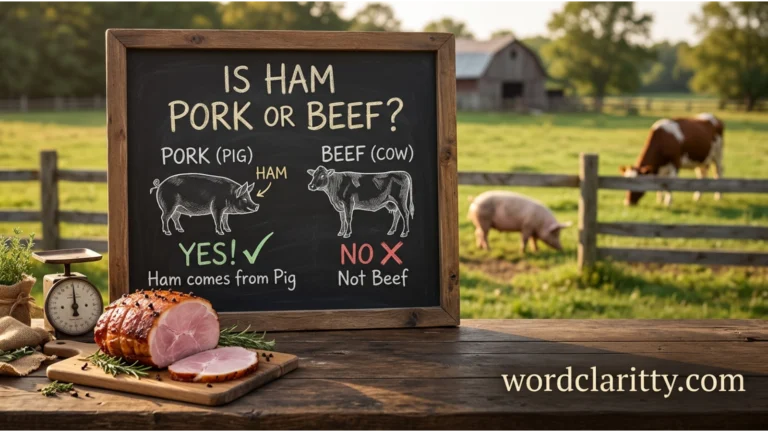
Have you ever looked at a sandwich menu or a food package and wondered, “Is ham pork or beef?” You’re not alone. Many English learners find these meat-related words confusing because ham, pork, and beef often appear together in recipes, restaurants, and grocery stores. Although they all refer to meat product, they do not mean the same thing. Traditional ham comes from pork, which is meat from a pig, while beef comes from cattle.
Understanding these differences helps you order food confidently, read ingredient labels, and communicate clearly about dietary preferences. This guide explains their meanings, origins, pronunciation, and correct usage with simple examples.
Why Ham, Pork, and Beef Are Confusing
The words “ham,” “pork,” and “beef” can confuse English learners because they all describe meat, but they refer to different things.
The biggest difference is that ham is a particular meat product, while pork and beef identify meat by the animal it comes from.
Let’s look at the most common reasons for confusion.
1. Similar Pronunciation
Ham, pork, and beef are not pronounced alike.
Their pronunciations are:
- Ham: /hæm/ — rhymes with “jam.”
- Pork: /pɔːrk/ in American English, with a similar vowel in many British accents.
- Beef: /biːf/ — rhymes with “leaf.”
All three are short, one-syllable words. However, they have different sounds.
The confusion usually comes from their meanings rather than their pronunciation.
2. Similar Spelling
These words do not have particularly similar spellings.
- Ham has three letters.
- Pork has four letters.
- Beef has four letters.
Nevertheless, English learners may associate them because they frequently appear together in food vocabulary lessons, recipes, and restaurant menus.
3. Context Confusion
You might see ham, pork, and beef listed as separate ingredients on a menu.
For example:
“This restaurant serves ham sandwiches, pork chops, and beef burgers.”
A learner might wonder why ham and pork are listed separately if both come from pigs.
The answer is that pork is the general name for pig meat, while ham refers to a particular cut or prepared product made from pig meat.
Beef, meanwhile, comes from cattle.
4. Common Learner Mistakes
Common mistakes include:
- Thinking that ham comes from cows.
- Believing that ham and pork are completely different types of animal meat.
- Assuming that every product called “ham” contains pork.
- Confusing a hamburger with a ham sandwich.
- Believing that all ham is smoked or fully cooked.
- Assuming that beef ham is the same as traditional pork ham.
These mistakes are understandable because food names do not always tell you exactly how a product is made.
Ham vs Pork vs Beef Explained Simply
The difference between these words becomes easy once you understand the animal source and the type of meat.
Simple Explanation
Ham: Traditionally, meat from the hind leg of a pig, often preserved by curing, smoking, or both. Fresh ham is an uncured cut from the same area.
Pork: The general English word for meat from a pig.
Beef: Meat from cattle, such as cows or steers.
One-Line Distinction
Ham is traditionally a specific pork cut or product, pork means meat from a pig, and beef means meat from cattle.
In other words, traditional ham is pork, but not all pork is ham.
Two Example Sentences
Example 1:
“She made a ham sandwich using slices of cured pork.”
Here, “ham” refers to a prepared pork product commonly used in sandwiches.
Example 2:
“The restaurant serves pork chops and beef steaks.”
In this sentence, pork chops come from pigs, while beef steaks come from cattle.
Is Ham Pork or Beef?
Traditional ham is pork, not beef. However, products labeled “beef ham,” “turkey ham,” or “chicken ham” may be made from other animals. In those cases, the additional word identifies the meat source.
Always check the ingredient label when the distinction matters.
Understanding Homophones in English
English contains many words that sound alike but have different meanings. These are called homophones.
Understanding homophones helps learners improve pronunciation, spelling, and vocabulary.
What Are Homophones?
Homophones are words that have the same pronunciation but different meanings and often different spellings.
For example, “meat” and “meet” are homophones.
- Meat: Animal flesh used as food.
- Meet: To come together with someone.
Consider these sentences:
“I bought fresh meat from the shop.”
“I will meet my friend after school.”
Both words sound alike, but their meanings are different.
Other common homophones include:
- Sea and see
- Hear and here
- Right and write
- Flour and flower
- One and won
However, ham, pork, and beef are not homophones because they have different pronunciations.
Why Homophones Cause Confusion
Homophones can confuse English learners because pronunciation alone does not reveal the correct meaning or spelling.
For example:
“I need to buy some meat.”
“I want to meet my teacher.”
The listener understands the intended meaning through context.
Ham, pork, and beef create a different kind of vocabulary confusion. Their meanings are related because they all describe meat, but they are not interchangeable.
Learning the animal source and common uses of each term is the best way to distinguish them.
What Does Ham Mean?
Definition and Core Meaning
Ham is traditionally meat from the hind leg of a pig. The word often refers to pork that has been cured, smoked, cooked, or prepared using a combination of these methods.
However, “ham” can also refer to the uncured hind-leg cut, sometimes called fresh ham.
Common types include:
- Cured ham: Pork preserved using salt or other curing ingredients.
- Smoked ham: Ham exposed to smoke for flavour and sometimes preservation.
- Cooked ham: Ham that has been heated during processing.
- Fresh ham: An uncured cut from the pig’s hind leg.
- Dry-cured ham: Ham preserved through salting and drying.
- Sliced deli ham: Prepared ham commonly used in sandwiches.
Not all ham is fully cooked, so preparation instructions are important.
Origin and Historical Use
The English word “ham” comes from Old English hamm, referring to the back of the leg or a related part of the body.
Historically, people preserved pork by salting, drying, and smoking it. These methods helped meat last longer before modern refrigeration became available.
Ham became a familiar food in many European culinary traditions.
Over time, different regions developed their own methods of preparing ham, including dry curing, smoking, and cooking.
Today, ham is widely used in sandwiches, breakfast dishes, holiday meals, and traditional recipes.
Modern Usage and Synonyms
In modern English, “ham” usually refers to a specific pork product rather than pig meat in general.
Related expressions include:
- Cured pork
- Smoked ham
- Cooked ham
- Deli ham
- Ham slices
- Fresh ham
- Dry-cured ham
These expressions describe particular products or preparations and are not exact synonyms in every situation.
You may also encounter “turkey ham” or “beef ham.” Such names describe products made to resemble traditional ham, but the animal source differs.
Example Sentences
- “She made a sandwich with cheese and ham.”
- “The family served roasted ham for dinner.”
- “He bought sliced ham from the supermarket.”
- “The chef prepared a fresh ham for roasting.”
- “The package contains smoked pork ham.”
- “They chose turkey ham instead of traditional pork ham.”
The final example shows why checking the full product name matters.
What Does Pork Mean?
Definition and Core Meaning
Pork is the general name for meat obtained from pigs.
It includes many different cuts and products, such as chops, ribs, shoulder, belly, and ham.
Unlike “ham,” which commonly refers to a particular cut or prepared product, “pork” describes the animal source.
Common pork products include:
- Pork chops: Cuts often taken from the loin.
- Pork ribs: Meat and bones from the rib area.
- Pork belly: A fatty cut from the underside of the pig.
- Pork shoulder: A cut often used for slow cooking.
- Pork tenderloin: A tender cut of pork.
- Pork ham: Meat from the pig’s hind leg, often cured or otherwise prepared.
Bacon and many sausages are also made from pork, although some versions use other meats.
Origin and Historical Use
The word “pork” entered English through Old French porc, ultimately from Latin porcus, meaning “pig.”
English has an interesting history of using different words for animals and their meat.
For example:
- Pig → Pork
- Cow or cattle → Beef
- Sheep → Mutton
This distinction developed partly through the influence of French vocabulary on English after the Norman Conquest.
As a result, English often uses one word for the living animal and another for its meat.
Modern Usage and Synonyms
Today, pork appears in many cuisines and cooking styles.
Common expressions include:
- Pork chops
- Roast pork
- Pulled pork
- Ground pork
- Pork ribs
- Pork belly
- Pork sausage
“Pig meat” is understandable, but “pork” is the normal culinary term.
Example Sentences
- “The chef cooked pork chops for dinner.”
- “Pork comes from pigs.”
- “She prepared roast pork with vegetables.”
- “The recipe requires ground pork.”
- “Some sausages contain pork.”
- “Traditional ham is a type of pork product.”
The last sentence explains the relationship between ham and pork clearly.
What Does Beef Mean?
Definition and Core Meaning
Beef is meat obtained from cattle.
It is commonly used in steaks, burgers, stews, roasts, and many other dishes.
Beef comes from cattle, not pigs.
Common beef products include:
- Beef steak: A cut of beef prepared by grilling, frying, or another cooking method.
- Ground beef: Beef that has been minced or ground.
- Beef roast: A larger cut prepared by roasting.
- Beef brisket: A cut from the breast or lower chest area.
- Beef ribs: Rib cuts from cattle.
- Beef stew meat: Pieces of beef used in slow-cooked dishes.
Origin and Historical Context
The word “beef” comes from Old French boef, ultimately from Latin bos, meaning an ox or cow.
Like “pork,” it entered English through French influence.
This explains why English uses “cow” or “cattle” for the animal but “beef” for the meat.
Historically, beef has been an important food in many regions, although its preparation varies widely between cultures.
Today, beef is used in dishes ranging from burgers and steaks to soups, curries, and stews.
Modern Usage and Synonyms
Common beef-related expressions include:
- Ground beef
- Minced beef
- Roast beef
- Beef steak
- Beef brisket
- Beef burger
- Beef stew
In British English, “minced beef” is common, while American English often uses “ground beef.”
The word “beef” also has an informal meaning: a complaint or disagreement. For example, “He has a beef with his neighbour.” That meaning is unrelated to meat.
Example Sentences
- “He ordered a beef burger for lunch.”
- “The restaurant serves grilled beef steaks.”
- “She used ground beef to prepare the meal.”
- “Beef comes from cattle.”
- “The chef cooked a beef stew with vegetables.”
- “The label says the product contains beef rather than pork.”
Ham, Pork, and Beef: Key Differences at a Glance
| Word | Part of Speech | Meaning | Example Context |
|---|---|---|---|
| Ham | Noun | Traditionally a cut or prepared product from a pig’s hind leg | “She ordered a ham sandwich.” |
| Pork | Noun | Meat from a pig | “We cooked pork chops.” |
| Beef | Noun | Meat from cattle | “He ordered a beef steak.” |
| Beef ham | Noun phrase | A beef product marketed or prepared in a ham-like style | “The package is labeled beef ham.” |
| Turkey ham | Noun phrase | A turkey product made to resemble ham | “She bought turkey ham for sandwiches.” |
Which One Is Correct?
All three words are correct English vocabulary, but their meanings differ.
Use ham when referring to traditional ham or a specifically labeled ham-style product.
Use pork when referring to pig meat generally.
Beef when referring to meat from cattle.
The important rule is that traditional ham belongs to the pork category, not the beef category.
How to Remember the Difference Between Ham, Pork, and Beef
A few simple memory tricks can make these food words easier to remember.
1. Remember: Ham Comes from Pork
Think of pork as the larger category and ham as one product within it.
Memory trick: Pig → Pork → Ham
This means traditional ham is pork, but pork can also be chops, ribs, shoulder, or other cuts.
2. Connect Beef with Cattle
Picture a cow whenever you see the word “beef.”
Memory trick: Cattle → Beef
This association helps you remember that beef and pork come from different animals.
3. Use the Hamburger Trick Carefully
A hamburger usually contains a ground-beef patty, even though the word includes “ham.”
The name “hamburger” is historically connected to Hamburg, Germany, rather than to ham as an ingredient.
This is a useful reminder that food names do not always identify their ingredients directly.
4. One Memorable Example
Imagine three labels at a grocery store:
- Ham sandwich
- Pork chops
- Beef steak
The ham sandwich and pork chops traditionally contain meat from pigs, while the beef steak comes from cattle.
Remembering this picture can help you choose the correct word.
Common Mistakes and Confusions
Mistake 1: Thinking Ham Is Beef
✘ Incorrect: “Traditional ham comes from cows.”
✔ Correct: “Traditional ham comes from pigs.”
Explanation: Ham is normally a pork product. Beef comes from cattle.
Mistake 2: Thinking Ham and Pork Are Unrelated
✘ Incorrect: “Ham and pork come from different animals.”
✔ Correct: “Traditional ham and other pork cuts come from pigs.”
Explanation: Ham is a particular pork cut or product.
Mistake 3: Assuming Every Hamburger Contains Ham
✘ Incorrect: “A hamburger must contain ham because of its name.”
✔ Correct: “A traditional hamburger usually contains ground beef.”
Explanation: The name does not mean that ham is an ingredient.
Mistake 4: Assuming All Products Called Ham Are Pork
✘ Incorrect: “Every product labeled ham must contain pork.”
✔ Correct: “Traditional ham is pork, but products such as turkey ham or beef ham may contain other meats.”
Explanation: The full name and ingredient list identify the meat source.
Mistake 5: Assuming All Ham Is Ready to Eat
✘ Incorrect: “All ham is fully cooked.”
✔ Correct: “Some ham is fully cooked, while other ham products require cooking.”
Explanation: Processing methods differ. Always follow the package’s food-safety instructions.
Examples Section: Correct and Incorrect Usage
Example 1: Identifying Ham
✔ Correct: “Traditional ham is made from pork.”
✘ Incorrect: “Traditional ham is made from beef.”
Why? Traditional ham comes from a pig.
Example 2: Describing Beef
✔ Correct: “Beef comes from cattle.”
✘ Incorrect: “Beef comes from pigs.”
Why? Meat from pigs is called pork.
Example 3: Talking About Pork Chops
✔ Correct: “The chef prepared pork chops for dinner.”
✘ Incorrect: “The chef prepared beef chops from a pig.”
Why? Pig meat is pork, not beef.
Example 4: Understanding Hamburgers
✔ Correct: “The hamburger contains a ground-beef patty.”
✘ Incorrect: “The hamburger must contain ham.”
Why? Hamburgers are not necessarily made with ham.
Example 5: Reading Food Labels
✔ Correct: “This turkey ham is made from turkey.”
✘ Incorrect: “This turkey ham must be pork because it says ham.”
Why? Some products use “ham” to describe a style of preparation rather than the traditional animal source.
Example 6: Describing Meat Categories
✔ Correct: “Ham is traditionally a type of pork product.”
✘ Incorrect: “All pork is ham.”
Why? Pork includes many cuts and products besides ham.
Self-Assessment: Test Your Knowledge
Choose the correct answer to complete each sentence.
Question 1: Traditional ham is made from ___.
a) Pork
b) Beef
Question 2: Meat from cattle is called ___.
a) Pork
b) Beef
Question 3: A ___ sandwich traditionally contains prepared meat from a pig’s hind leg.
a) Ham
b) Beef
Question 4: Pork chops and traditional ham both come from ___.
a) Pigs
b) Cattle
Self-Assessment Answers
Answer 1: a) Pork
Traditional ham is made from pork, which comes from pigs.
Answer 2: b) Beef
Beef is the English word for meat from cattle.
Answer 3: a) Ham
A traditional ham sandwich contains a prepared pork product commonly called ham.
Answer 4: a) Pigs
Both pork chops and traditional ham come from pigs, although they refer to different cuts or products.
FAQs:
1. Is Ham Pork or Beef?
Traditional ham is pork, not beef. It usually comes from the hind leg of a pig and is often cured, smoked, or cooked.
2. What Is the Difference Between Ham and Pork?
Pork is the general term for meat from pigs. Ham is a particular cut or prepared pork product, traditionally from the hind leg. Therefore, traditional ham is pork, but not all pork is ham.
3. Can Ham Be Made from Beef?
Some products are marketed as “beef ham.” These are made from beef and prepared in a ham-like style. However, traditional ham refers to pork.
4. Is a Hamburger Made from Ham?
Usually, no. A traditional hamburger contains a ground-beef patty. Its name comes from Hamburg, Germany, rather than the word “ham.”
5. Is Ham Always Smoked or Cooked?
No. Ham can be fresh, cured, smoked, cooked, or prepared using several methods. Some products require additional cooking before they are safe to eat.
6. Is Ham Halal?
Traditional pork ham is not halal. Some halal-certified products are marketed as beef ham, turkey ham, or chicken ham. Their halal status depends on the ingredients, sourcing, processing, and certification, so checking the label is important.
7. How Can I Tell Whether Ham Contains Pork?
Read the product’s ingredient list and meat-source description. Traditional ham usually contains pork, while products labeled “turkey ham” or “beef ham” may use different meats. If the ingredients are unclear, ask the manufacturer or food seller.
Conclusion:
Understanding whether ham is pork or beef becomes much easier once you know how English names different types of meat. Traditional ham is pork, meaning it comes from a pig, usually from the hind leg. Pork is the general name for pig meat, while beef refers to meat from cattle. Therefore, ham and pork are closely related, but beef belongs to a different meat category.
These distinctions are useful in everyday situations. Whether you are reading a restaurant menu, following a recipe, shopping for groceries, or discussing food preferences, knowing the correct terms helps you communicate clearly and make informed choices. It is also important to remember that products labeled “beef ham,” “turkey ham,” or “chicken ham” may use other meats, so the full product name and ingredient list matter.
A simple memory trick is to connect each word with its source: pig means pork, traditional ham is a pork product, and cattle means beef. You can also remember that a hamburger usually contains beef, despite having “ham” in its name.
For English learners, food vocabulary is especially useful because it appears so often in daily conversations. Practise these words in sentences, compare them when reading menus, and pay attention to ingredient labels. With a little practice, you will confidently understand and use “ham,” “pork,” and “beef” correctly in everyday English.

Bilal Hassan is a Master’s graduate, content writer, and author at WordClaritty.com. He specializes in creating clear, informative, and reader-friendly content focused on language, word meanings, and educational topics. With a passion for accuracy and simplicity, he helps readers expand their knowledge through engaging and easy-to-understand articles.