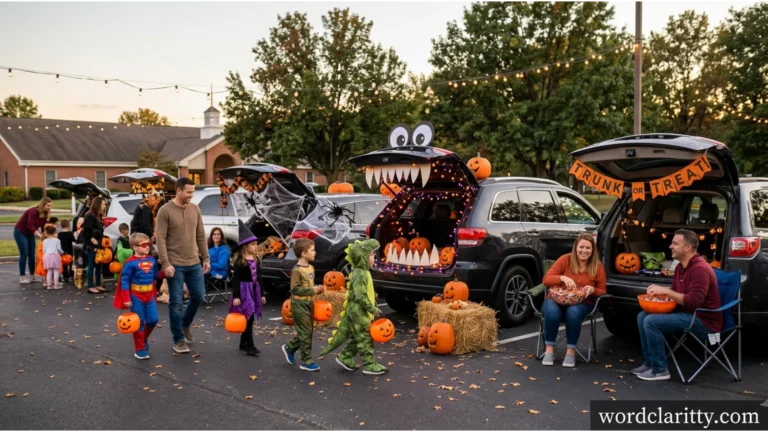
Have you ever heard someone say “trunk or treating” and wondered whether they meant “trick or treating”? These two Halloween expressions sound similar, but they describe different ways of celebrating the holiday. For English learners, the confusion is understandable because both activities involve costumes, candy, and Halloween fun.The main difference is simple: trunk or treating takes place around decorated car trunks, while trick or treating usually involves visiting houses to collect candy.
Understanding these expressions helps you use the correct words in conversations, invitations, and social media posts. In this guide, you will learn their meanings, origins, differences, and correct usage through simple explanations and practical examples.
Why “Trunk or Treating” and “Trick or Treating” Are Confusing
The expressions “trunk or treating” and “trick or treating” are closely connected to Halloween traditions. They share similar sounds, spelling patterns, and activities, making them easy to confuse.
1. Similar Pronunciation
Both expressions begin with a short word starting with the letters “tr.” Pronounced approximately “trungk or TREE-ting.”
- Trick or treating: Pronounced approximately “trik or TREE-ting.”
The words “trunk” and “trick” have different vowel and ending sounds, but the overall rhythm of the expressions is similar.
When spoken quickly, beginners may misunderstand which activity someone is describing.
2. Similar Spelling
Both expressions contain three words, and the last two words are identical.
The only difference is the first word:
- Trick or treating
“Trunk” refers to the storage compartment of a car in American English.
“Trick” refers to a playful action, joke, or prank.
This small spelling difference creates a major difference in meaning.
3. Context Confusion
Both activities involve children wearing Halloween costumes and receiving candy.
For example:
“We are going trunk or treating on Saturday.”
“We are going trick or treating on Halloween night.”
Both sentences describe Halloween activities, but the locations and methods are different.
4. Common Learner Mistakes
English learners sometimes:
- Use “trunk or treating” when describing visits to neighborhood houses.
- Assume “trick or treating” only happens at organized events.
- Believe “trunk or treating” is a spelling mistake.
- Think both expressions mean exactly the same thing.
The important point is that both expressions are correct, but they describe different Halloween activities.
Trunk or Treating vs. Trick or Treating Explained Simply
Trunk or treating means collecting Halloween candy from decorated car trunks, while trick or treating means visiting houses or other locations to ask for Halloween treats.
What Is Trunk or Treating?
Trunk or treating is an organized Halloween activity where people decorate their cars and distribute candy from their trunks.
These events often take place in parking lots at schools, churches, or community centers.
Children walk from car to car instead of visiting houses.
What Is Trick or Treating?
Trick or treating is a traditional Halloween custom in which children wear costumes and visit homes to collect candy.
They usually knock on doors and say:
“Trick or treat!”
Homeowners then give them candy or other small treats.
One-Line Distinction
Trunk or treating happens at decorated cars, while traditional trick or treating happens at neighborhood homes.
Two Example Sentences
- “Our school organized a trunk-or-treating event in the parking lot.”
- “The children went trick-or-treating around their neighborhood on Halloween.”
Both expressions are correct when used in the appropriate context.
Understanding Homophones in English
Learning about homophones can help English learners understand why similar-sounding expressions sometimes cause confusion.
What Are Homophones?
Homophones are words that sound the same but have different meanings. They may have different spellings.
For example:
- Night: The period of darkness after sunset.
- Knight: A historical warrior who held a special title.
Example sentences:
“The children went outside at night.”
“The knight carried a sword.”
Although these words sound alike, they have completely different meanings.
Why Homophones Cause Confusion
Homophones are confusing because listeners must use context to identify the correct meaning.
Consider these sentences:
“I bought two costumes.”
“The children went to the party too.”
“Two” and “too” sound the same but have different meanings.
However, “trunk” and “trick” are not true homophones because their pronunciations are different.
The confusion comes from their similar spelling, shared beginning sounds, and connection to Halloween.
Recognizing this difference can improve your English listening and vocabulary skills.
What Does “Trunk or Treating” Mean?
Definition and Core Meaning
Trunk or treating is a Halloween activity where people distribute candy from decorated vehicle trunks, usually during an organized community event.
The phrase comes from the combination of “trunk” and the traditional Halloween expression “trick or treat.”
In American English, a trunk is the storage area of a car, usually located at the back.
During a trunk-or-treat event, participants often park their cars together and decorate the open trunks with Halloween themes.
Children then walk between vehicles to receive candy.
Common features include:
- Decorated cars and vehicle trunks
- Halloween costumes
- Candy and small treats
- Organized parking-lot events
- Family-friendly games
- Community participation
For example, a school may organize a trunk-or-treat event so families can celebrate Halloween together in one location.
Origin and Historical Use
Trunk or treating developed in the United States as an alternative to traditional neighborhood trick or treating.
Organized trunk-or-treat events became increasingly familiar through churches, schools, and community groups during the late twentieth century and afterward.
The activity offered a convenient way for families to celebrate Halloween in a shared space.
Instead of walking through several neighborhood streets, children could visit decorated vehicles parked close together.
It is especially common at schools, churches, recreation centers, and neighborhood gatherings.
Modern Usage and Synonyms
Today, trunk or treating is widely used in American English to describe this specific type of Halloween celebration.
Related expressions include:
- Trunk-or-treat event
- Halloween parking-lot celebration
- Community candy event
- Car-to-car trick-or-treating
- Halloween car decorating event
These expressions are related, although not all are exact synonyms.
You may also see the spelling “trunk-or-treating” with hyphens.
“Trunk or treating” is common in informal writing, while “trunk-or-treating” is useful when treating the expression as a compound term.
Example Sentences Using Trunk or Treating
- “Our church is hosting a trunk-or-treating event this weekend.”
- “The children enjoyed trunk or treating at their school.”
- “We decorated our car for the community trunk-or-treat event.”
- “Trunk or treating is a popular Halloween activity for families.”
- “The parking lot was full of decorated cars during the trunk-or-treat celebration.”
These sentences show how the expression is used naturally in everyday American English.
What Does “Trick or Treating” Mean?
Definition and Core Meaning
Trick or treating is a traditional Halloween activity in which children dress in costumes and visit houses to ask for candy or other treats.
The expression comes from the familiar Halloween phrase “trick or treat.”
Traditionally, the phrase playfully suggests that a person may perform a trick if no treat is given.
However, in modern Halloween celebrations, children generally use the expression as a friendly request for candy.
Common features of trick or treating include:
- Halloween costumes
- Visiting neighborhood houses
- Knocking on doors
- Saying “trick or treat”
- Receiving candy
- Carrying candy bags or buckets
For example, children may dress as ghosts, superheroes, witches, or cartoon characters before visiting nearby homes.
Origin and Historical Context
Trick or treating has roots in older customs involving costumes, seasonal celebrations, and requests for food or gifts.
Some related historical traditions include souling and guising, which were practiced in parts of Europe.
Over time, Halloween customs developed in North America, where modern trick or treating became especially popular during the twentieth century.
By the mid-twentieth century, visiting homes for candy had become a familiar Halloween tradition in many American communities.
Today, trick or treating remains one of the most recognizable Halloween activities.
Modern Usage and Synonyms
The expression “trick or treating” is widely understood in American English and in many other English-speaking communities.
Related expressions include:
- Halloween candy collecting
- Going door to door for candy
- Halloween neighborhood visits
- Trick-or-treat activity
- Halloween costume outing
These phrases describe similar activities, although “trick or treating” is the standard expression.
The hyphenated spelling “trick-or-treating” is also common, particularly in edited writing.
Example Sentences Using Trick or Treating
- “The children went trick-or-treating after dinner.”
- “We bought candy for the trick-or-treaters.”
- “My daughter wore a pumpkin costume while trick or treating.”
- “Many families enjoy trick or treating on Halloween night.”
- “The neighborhood was busy with children collecting candy.”
These examples demonstrate how the expression is used in everyday conversations.
Trunk or Treating vs. Trick or Treating: Key Differences at a Glance
The following comparison table explains the main differences between these Halloween activities.
| Word or Expression | Part of Speech | Meaning | Example Context |
|---|---|---|---|
| Trunk or treating | Noun phrase / gerund phrase | Collecting candy from decorated vehicles | A school parking-lot event |
| Trick or treating | Noun phrase / gerund phrase | Visiting homes to request Halloween treats | A neighborhood Halloween outing |
| Trunk or treat | Noun phrase | An organized car-based Halloween candy event | A church trunk-or-treat |
| Trick or treat | Interjection / phrase | A traditional Halloween greeting requesting candy | Children speaking at a doorstep |
Additional Differences
| Feature | Trunk or Treating | Trick or Treating |
|---|---|---|
| Main location | Parking lots | Neighborhood streets |
| Candy distribution | From decorated vehicles | Usually from homes |
| Event organization | Usually organized | Often informal |
| Decorations | Cars and trunks | Houses and yards |
| Walking distance | Often shorter | Can be longer |
| Typical schedule | Often before or around Halloween | Commonly Halloween evening |
| Supervision | Often within a designated event area | Depends on families and neighborhoods |
| Main purpose | Community Halloween celebration | Traditional Halloween candy collecting |
Both activities involve costumes, treats, and seasonal fun.
The main difference is how the event is organized and where children collect candy.
Where to go for trunk-or-treating this Halloween – Forsyth News
Trunk or treatingChildren collect candy from decorated vehicles.
Trick or treatingChildren visit homes and ask for Halloween treats.
How to Remember the Difference Between Trunk or Treating and Trick or Treating
Remembering these two expressions is easy when you connect their meanings to familiar objects and activities.
1. Connect “Trunk” With a Car
The word “trunk” refers to the storage compartment of a car in American English.
Therefore:
Trunk → Car → Parking Lot → Trunk or Treating
Whenever you hear “trunk or treating,” imagine a decorated car filled with Halloween candy.
2. Connect “Trick” With the Halloween Greeting
The word “trick” is part of the traditional expression “trick or treat.”
Children say this phrase when visiting houses.
Therefore:
Trick → Trick or Treat → House → Trick or Treating
This association helps you remember the traditional activity.
3. Use a Location-Based Memory Trick
Think about the location first.
If children are collecting candy from cars, use “trunk or treating.”
If children are visiting houses, use “trick or treating.”
4. Remember the Different Decorations
Trunk-or-treat events usually feature decorated vehicles.
Traditional trick-or-treating neighborhoods often feature decorated houses.
This visual difference makes the expressions easier to distinguish.
One Memorable Example
“At trunk or treating, candy comes from car trunks; at trick or treating, candy usually comes from houses.”
Repeat this sentence whenever you feel confused about the two expressions.
Common Mistakes and Confusions
English learners sometimes use these expressions incorrectly because the activities share many features.
Mistake 1: Using Trunk or Treating for House Visits
✘ Incorrect: “We went trunk or treating by knocking on neighborhood doors.”
✔ Correct: “We went trick or treating by knocking on neighborhood doors.”
Explanation: Visiting houses is the traditional form of trick or treating.
Mistake 2: Using Trick or Treating for a Car-Based Event
✘ Incorrect: “The school organized a traditional door-to-door trick-or-treating event using decorated car trunks.”
✔ Correct: “The school organized a trunk-or-treating event using decorated car trunks.”
Explanation: Trunk or treating is the more specific expression for candy collection from vehicles.
Mistake 3: Assuming Trunk or Treating Is Incorrect English
✘ Incorrect: “Trunk or treating is not a real Halloween expression.”
✔ Correct: “Trunk or treating is an established expression for a car-based Halloween event.”
Explanation: Both expressions are used in American English.
Mistake 4: Confusing the Words “Trunk” and “Trick”
✘ Incorrect: “A trick is the storage compartment of a car.”
✔ Correct: “A trunk is the storage compartment of a car.”
Explanation: “Trick” and “trunk” are different English words.
Mistake 5: Assuming Both Activities Must Happen on October 31
✘ Incorrect: “Every trunk-or-treat event must take place on Halloween night.”
✔ Correct: “Trunk-or-treat events can take place before Halloween or on Halloween itself.”
Explanation: Organized events often follow community schedules rather than a fixed date.
Examples Section: Correct and Incorrect Usage
Here are practical examples to help you understand the correct use of both expressions.
Example 1: School Celebration
✔ Correct: “Our school is hosting a trunk-or-treat event in the parking lot.”
✘ Incorrect: “Our school is hosting a door-to-door trunk-or-treat event at neighborhood houses.”
Example 2: Neighborhood Activity
✔ Correct: “The children went trick-or-treating from house to house.”
✘ Incorrect: “The children went trunk-or-treating from house to house.”
Example 3: Decorated Vehicles
✔ Correct: “We decorated our car for trunk or treating.”
✘ Incorrect: “We decorated our car trunk for a traditional house-to-house trick-or-treating route.”
Example 4: Halloween Night
✔ Correct: “Many children go trick-or-treating on Halloween evening.”
✘ Incorrect: “Trick or treating always means collecting candy from parked cars.”
Example 5: Community Event
✔ Correct: “The community center organized a trunk-or-treating celebration.”
✘ Incorrect: “A trunk-or-treat event can only happen inside a house.”
Example 6: Word Meaning
✔ Correct: “The word ‘trunk’ refers to the car compartment used in trunk-or-treat events.”
✘ Incorrect: “The word ‘trick’ means the back storage compartment of a vehicle.”
These examples show that the location and activity determine which expression is most appropriate.
Self Assessment: Test Your Knowledge
Choose the correct expression to complete each sentence.
1. The children collected candy from decorated cars during ______.trunk or treatingtrick or treating
2. We walked from house to house while ______.trunk or treatingtrick or treating
3. Our church organized ______ in its parking lot.trunk or treatingtrick or treating
4. The children knocked on doors and shouted ‘Trick or treat!’ while ______.trunk or treatingtrick or treating
Check answersTry again
Self Assessment Answers
- Trunk or treating — Candy is collected from decorated cars.
- Trick or treating — Children visit houses to collect candy.
- Trunk or treating — A parking-lot celebration with decorated vehicles is a trunk-or-treat event.
- Trick or treating — Saying “trick or treat” while visiting neighborhood homes is the traditional activity.
If you answered all four questions correctly, you understand the main difference.
FAQs:
1. What is the difference between trunk or treating and trick or treating?
Trunk or treating involves collecting candy from decorated cars, usually in a parking lot. Trick or treating traditionally involves visiting neighborhood houses and asking for candy. Both are popular Halloween activities.
2. Is trunk or treating grammatically correct?
Yes. “Trunk or treating” is a recognized expression in American English. The hyphenated form “trunk-or-treating” is also commonly used. It describes an organized Halloween event involving decorated vehicles.
3. Why is it called trunk or treating?
The name comes from the word “trunk,” meaning the storage compartment of a car, and the Halloween phrase “trick or treat.” Participants decorate their trunks and distribute candy to children.
4. Is trunk or treating safer than trick or treating?
Trunk-or-treat events may offer a more controlled setting because they often take place in designated areas with organizers and adult supervision. However, safety depends on traffic management, lighting, supervision, and event planning. Neither activity is automatically safer in every situation.
5. When did trunk or treating become popular?
Trunk-or-treat events became increasingly popular in the United States during the late twentieth century and early twenty-first century, especially through churches, schools, and community organizations.
6. Do children wear costumes for trunk or treating?
Yes. Children usually wear Halloween costumes for trunk or treating, just as they do for traditional trick or treating. Costumes are an important part of both celebrations.
7. Is trunk or treating only celebrated on Halloween?
No. Trunk-or-treat events can take place on Halloween or during the days and weekends leading up to October 31. Schools and community groups often choose dates that work best for participating families.
Conclusion:
Understanding the difference between trunk or treating and trick or treating is easier when you focus on where the Halloween candy comes from. Both expressions are correct in English, but they describe different activities.Trunk or treating refers to an organized Halloween celebration where children collect candy from decorated car trunks. These events often take place in school, church, or community parking lots. Trick or treating, on the other hand, refers to the traditional Halloween custom of visiting neighborhood houses, knocking on doors, and saying “trick or treat” to receive candy.
Although the activities share costumes, decorations, and treats, their locations and organization make them different. This is why choosing the correct expression matters when writing Halloween invitations, describing family activities, or discussing holiday traditions.To remember the difference, connect “trunk” with a car and “trick” with the familiar Halloween greeting. A simple memory trick is: trunks mean cars, while traditional tricks or treats mean doors.
You may also see the hyphenated forms “trunk-or-treating” and “trick-or-treating” in English writing. Both are acceptable ways to describe these activities, depending on the sentence and writing style.The next time you hear either expression, pay attention to the setting. With these simple explanations and examples, you can confidently use both Halloween terms correctly and continue building your English vocabulary one useful expression at a time.