
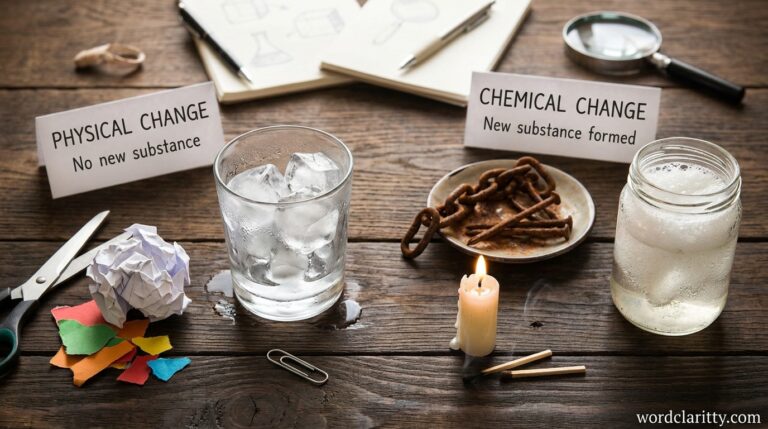
Have you ever wondered whether melting ice is a physical or chemical change? What about burning paper, cooking an egg, or dissolving sugar in water? These everyday examples can confuse English learners and science students because both physical and chemical changes describe how matter changes.
Although the terms sound scientific, their meanings are easy to understand once you know the main difference. A physical change affects the form or appearance of a substance, while a chemical change produces new substances. Learning this difference helps you use scientific vocabulary correctly, understand everyday reactions, and answer science questions with confidence.
Why Physical Change and Chemical Change Are Confusing
Physical change and chemical change are common terms in science, especially in chemistry. However, students often struggle to understand when to use each expression.
Several factors make these terms confusing.
1. Similar Pronunciation
The phrases “physical change” and “chemical change” have a similar structure.
Both begin with an adjective and end with the word “change.”
Their approximate pronunciations are:
- Physical change: FIZ-i-kul chaynj
- Chemical change: KEM-i-kul chaynj
The words “physical” and “chemical” sound different, but their similar endings and shared sentence structure can confuse beginners.
2. Similar Spelling
Both expressions contain the word “change,” and both adjectives end in “-ical.”
However, their first words have different meanings.
“Physical” relates to the physical properties or form of matter.
“Chemical” relates to substances, their composition, and chemical reactions.
Recognizing these meanings helps learners understand the difference.
3. Context Confusion
Both terms describe changes in matter.
For example:
- Ice melting involves a physical change.
- Wood burning involves a chemical change.
In both cases, something looks different afterward.
However, appearance alone does not determine whether a change is physical or chemical.
The important question is whether a new substance forms.
4. Common Learner Mistakes
Students often make these mistakes:
- Assuming every color change is chemical.
- Thinking every physical change is reversible.
- Believing that heating always causes a chemical change.
- Confusing melting with burning.
- Assuming that bubbles always indicate a chemical reaction.
Understanding the underlying process helps prevent these errors.
Physical Change vs Chemical Change Explained Simply
The main difference between a physical change and a chemical change is whether the substance’s chemical identity changes.
A physical change means matter changes its form, size, shape, or physical state without forming a new substance, while a chemical change means one or more substances are transformed into different substances.
For example, when ice melts, it becomes liquid water.
The substance remains water, so melting is a physical change.
However, when wood burns, chemical reactions produce substances such as carbon dioxide, water vapor, and ash.
Therefore, burning wood is a chemical change.
One-Line Distinction
Physical change = No new substance forms.
Chemical change = New substances form.
Two Example Sentences
1. “Cutting a piece of paper is a physical change because the paper’s chemical composition remains the same.”
2. “Burning a piece of paper is a chemical change because new substances form during combustion.”
Quick Answer: Which Is Correct?
Both expressions are correct English and scientific terms.
Use “physical change” when the chemical identity of the material stays the same.
Use “chemical change” when a chemical reaction produces different substances.
The correct choice depends on what happens to the matter.
Understanding Homophones in English
Learning science vocabulary also provides an opportunity to understand how English words can sound similar.
What Are Homophones?
Homophones are words that have the same pronunciation but different meanings. Their spellings may be different.
For example:
- Sea: A large body of salt water.
- See: To notice something using your eyes.
Example sentences:
“The sea looks beautiful today.”
“I can see the mountains.”
Although the words sound alike, their meanings are completely different.
Why Homophones Cause Confusion
Homophones can confuse learners because listening alone may not reveal which word is being used.
Consider these sentences:
“The teacher wrote the answer on the board.”
“The students were bored during the lesson.”
“Board” and “bored” sound the same in standard English, but they have different meanings.
However, physical change and chemical change are not homophones.
They have different pronunciations and meanings.
Their confusion comes from their similar grammatical structure and their close relationship in science.
What Does Physical Change Mean?
Definition and Core Meaning
A physical change is a change in matter that affects its physical properties without changing its chemical identity.
The material may change its shape, size, texture, or physical state, but no new substance is produced by the physical process.
For example, when water freezes, it changes from liquid water into solid ice.
However, both liquid water and ice consist of H₂O molecules.
Therefore, freezing water is a physical change.
Common Characteristics of Physical Changes
Physical changes may involve:
- Changes in shape or size
- Changes between solid, liquid, and gas
- Breaking or cutting materials
- Mixing substances without a chemical reaction
- Dissolving certain substances in liquids
- Changes in physical appearance
A physical change does not necessarily mean that everything stays visually identical.
For instance, a crushed aluminum can looks different from an uncrushed can, but it is still aluminum.
Origin and Historical Use
The word “physical” comes through Latin from the Greek word physikos, meaning “relating to nature.”
The word “change” has roots in Old French and Latin words connected with exchanging or altering something.
As modern science developed, scientists began distinguishing changes in physical properties from changes in chemical composition.
This distinction became especially important in chemistry and the study of matter.
It helped scientists describe whether a process simply changed the condition of a substance or transformed it into another substance.
Modern Usage and Synonyms
Today, “physical change” is a standard scientific expression used in classrooms, laboratories, and textbooks.
Related expressions include:
- Change of state
- Physical transformation
- Change in form
- Change in shape
- Change in physical properties
These expressions are related, but they are not always exact substitutes.
For example, “change of state” specifically refers to processes such as melting, freezing, boiling, and condensation.
Examples of Physical Changes
A Scientist Says He’s Found the Universal Melting Equation
Melting ice
Solid ice becomes liquid water. No new substance forms.
Cutting paper
Paper changes its size and shape, but remains the same material.
Dissolving sugar
Sugar molecules spread through water without becoming a new substance.
Example Sentences Using Physical Change
- “Melting chocolate is a physical change.”
- “Breaking a glass bottle is a physical change.”
- “Water freezing into ice is an example of a physical change.”
- “The teacher explained why cutting paper is a physical change.”
- “Boiling pure water is a physical change because the water molecules remain H₂O.”
These examples show how the expression is used naturally in English.
What Does Chemical Change Mean?
Definition and Core Meaning
A chemical change occurs when one or more substances undergo a chemical reaction and form new substances with different chemical compositions.
During a chemical reaction, atoms are rearranged as chemical bonds break or form.
For example, when iron reacts with oxygen and moisture, rust can develop.
Rust contains iron compounds that differ chemically from the original iron.
Therefore, rusting is a chemical change.
Common Characteristics of Chemical Changes
Chemical changes may involve:
- Formation of new substances
- Changes in chemical composition
- Production or absorption of energy
- Formation of a gas
- Formation of a solid precipitate
- Changes in color or smell
- Release of light or heat
However, these signs are not absolute proof of a chemical reaction.
For example, boiling water produces bubbles, but boiling is a physical change.
The strongest evidence of a chemical change is that new substances have formed.
Origin and Historical Context
The word “chemical” is related to “chemistry,” a term with historical roots connected to alchemy and the study of substances.
As chemistry developed into a modern science, researchers learned more about how substances react and how atoms combine.
The idea of chemical change became central to explaining combustion, oxidation, decomposition, and other reactions.
Today, scientists use chemical equations to describe these transformations.
Modern Usage and Synonyms
“Chemical change” is widely used in science education and laboratory discussions.
Related expressions include:
- Chemical reaction
- Chemical transformation
- Chemical process
- Change in chemical composition
- Chemical conversion
Although these terms are closely related, their meanings can vary depending on the context.
For beginners, “chemical reaction” is often the most useful related expression.
Examples of Chemical Changes
Rusting iron
Iron reacts with substances in its environment and forms rust.
Häkä – asiantuntija vastaa 6 kysymykseen | Meidän Mökki
Burning wood
Combustion produces gases, ash, and other substances.
top view of one fried egg in black frypan
Cooking an egg
Heat causes chemical changes in egg proteins, including reactions that create new bonds.
Example Sentences Using Chemical Change
- “Burning wood is a chemical change.”
- “Rusting iron is an example of a chemical change.”
- “Cooking an egg involves chemical changes in its proteins.”
- “The reaction between vinegar and baking soda is a chemical change.”
- “The teacher demonstrated a chemical change during the science experiment.”
These examples show how chemical change is used in scientific explanations.
Physical Change vs Chemical Change: Key Differences at a Glance
The following comparison table summarizes the main differences.
| Word | Part of Speech | Meaning | Example Context |
|---|---|---|---|
| Physical change | Noun phrase | A change that does not create a new substance | Ice melting into water |
| Chemical change | Noun phrase | A change that forms new substances | Iron rusting |
| Physical change | Noun phrase | A change in shape, size, or physical state | Cutting paper |
| Chemical change | Noun phrase | A change in chemical composition | Burning paper |
Detailed Comparison
| Feature | Physical Change | Chemical Change |
|---|---|---|
| New substance formed | No | Yes |
| Chemical identity | Remains the same | Changes |
| Shape or size | May change | May change |
| Chemical bonds | No net chemical transformation | Bonds rearrange |
| Reversibility | May be reversible or irreversible | May be reversible or irreversible |
| Common examples | Melting, freezing, cutting | Burning, rusting, cooking |
| Main focus | Physical properties | Chemical composition |
The most reliable distinction is whether new substances form, not whether the change can be reversed.
How to Remember the Difference Between Physical Change and Chemical Change
A few simple memory tricks can make the difference easier to remember.
1. Physical Means Form
Connect the word “physical” with the form or appearance of an object.
For example, cutting an apple into slices changes its shape.
The cutting itself is a physical change.
Memory trick: Physical = Form changes, substance stays.
2. Chemical Means New Substance
Connect “chemical” with chemical reactions and new substances.
For example, burning paper produces ash and gases.
These products are chemically different from the original paper.
Memory trick: Chemical = New substances form.
3. Think About Ice and Fire
Imagine two situations:
- Ice melts into water.
- Wood burns in a fire.
Melting ice is a physical change because the substance remains water.
Burning wood is a chemical change because new substances form.
4. Ask One Important Question
Whenever you are unsure, ask:
“Did a new substance form?”
If the answer is no, the process is a physical change.
If the answer is yes, a chemical change has occurred.
One Memorable Example
“Melting a candle’s wax is a physical change, but burning the candle’s wax vapor is a chemical change.”
This example is especially useful because both processes can happen in the same burning candle.
Common Mistakes and Confusions
Mistake 1: Thinking Melting Is Chemical
✘ Incorrect: “Melting ice is a chemical change.”
✔ Correct: “Melting ice is a physical change.”
Explanation: Ice changes from solid to liquid, but its chemical identity remains H₂O.
Mistake 2: Thinking Burning Is Physical
✘ Incorrect: “Burning paper is only a physical change.”
✔ Correct: “Burning paper is a chemical change.”
Explanation: Combustion produces new substances.
Mistake 3: Assuming All Physical Changes Are Reversible
✘ Incorrect: “Every physical change can be reversed easily.”
✔ Correct: “Some physical changes are reversible, while others are difficult or impossible to reverse in practice.”
Explanation: Breaking a glass is a physical change, but restoring it to its original condition is difficult.
Mistake 4: Thinking Bubbles Always Mean Chemical Change
✘ Incorrect: “Any process that produces bubbles must be chemical.”
✔ Correct: “Bubbles can appear during both physical and chemical changes.”
Explanation: Boiling water creates vapor bubbles without changing the water’s chemical identity.
Mistake 5: Thinking All Color Changes Are Chemical
✘ Incorrect: “Every color change proves a chemical reaction.”
✔ Correct: “A color change can suggest a chemical reaction, but it does not always prove one.”
Explanation: Mixing food coloring into water changes its appearance without necessarily producing a new substance.
Examples Section: Correct and Incorrect Usage
Example 1: Freezing Water
✔ Correct: “Freezing water is a physical change.”
✘ Incorrect: “Freezing water is a chemical change because ice forms.”
Example 2: Rusting Iron
✔ Correct: “Rusting iron is a chemical change.”
✘ Incorrect: “Rusting iron is only a physical change because its color changes.”
Example 3: Cutting Wood
✔ Correct: “Cutting wood into smaller pieces is a physical change.”
✘ Incorrect: “Cutting wood is a chemical change because its shape changes.”
Example 4: Burning Wood
✔ Correct: “Burning wood is a chemical change because new substances form.”
✘ Incorrect: “Burning wood is a physical change because it becomes smaller.”
Example 5: Dissolving Sugar
✔ Correct: “Dissolving ordinary sugar in water is a physical change.”
✘ Incorrect: “Dissolving sugar in water always creates a new chemical substance.”
Example 6: Cooking an Egg
✔ Correct: “Cooking an egg involves chemical changes.”
✘ Incorrect: “Cooking an egg is only a physical change because it becomes solid.”
Example 7: Boiling Water
✔ Correct: “Boiling pure water is a physical change.”
✘ Incorrect: “Boiling pure water is a chemical change because bubbles appear.”
These examples demonstrate why observing the result carefully is more useful than judging a process by appearance alone.
Self Assessment: Test Your Knowledge
Choose the correct term to complete each sentence.
1. Melting butter is a ______.Physical changeChemical change
2. Rusting iron is a ______.Physical changeChemical change
3. Breaking a glass bottle is a ______.Physical changeChemical change
4. Burning paper is a ______.Physical changeChemical change
Check answersTry again
Self Assessment Answers
- Physical change — Butter melts, but its chemical identity does not change simply because it becomes liquid.
- Chemical change — Iron reacts to form rust.
- Physical change — Glass breaks into smaller pieces without forming a new substance.
- Chemical change — Burning paper produces new substances through combustion.
Remember that the most important clue is whether a new substance forms.
FAQs:
1. What is the main difference between a physical and chemical change?
A physical change alters the form or physical properties of matter without creating a new substance. A chemical change produces new substances through chemical reactions.
2. Is melting ice a physical or chemical change?
Melting ice is a physical change. Solid ice becomes liquid water, but both contain H₂O molecules.
3. Is burning paper a physical or chemical change?
Burning paper is a chemical change because combustion produces new substances, including gases and ash.
4. Is boiling water a physical or chemical change?
Boiling pure water is a physical change. Liquid water becomes water vapor without changing its chemical identity.
5. Is cooking an egg a physical or chemical change?
Cooking an egg involves chemical changes. Heat causes egg proteins to unfold and form new interactions and bonds, changing their structure and properties.
6. Can a physical change be irreversible?
Yes. Some physical changes are difficult to reverse. For example, breaking a ceramic plate changes its shape without producing a new substance, but restoring it perfectly is difficult.
7. Can physical and chemical changes happen together?
Yes. A burning candle provides a good example. Wax melting is a physical change, while wax vapor reacting with oxygen is a chemical change.
Conclusion:
Understanding the difference between a physical change and a chemical change is an important part of learning science vocabulary and describing everyday events accurately. Although both expressions refer to changes in matter, they describe different processes.A physical change affects the form, size, shape, or physical state of a substance without producing a new substance. Common examples include melting ice, freezing water, cutting paper, and breaking glass. In these situations, the material’s chemical identity remains unchanged.
A chemical change, however, occurs when a chemical reaction produces new substances. Burning wood, rusting iron, cooking an egg, and reacting vinegar with baking soda are familiar examples.In everyday life, both types of changes happen around us. Water boiling in a kettle is a physical change, while food browning during cooking often involves chemical changes. Understanding these differences helps students interpret observations and choose the correct scientific terms.
To remember the distinction, use one simple rule: physical change means the substance stays the same, while chemical change means new substances form. Do not rely only on color changes, bubbles, heat, or reversibility, because these clues can sometimes be misleading.Both expressions are correct in English. The right choice depends on the process you are describing. Keep practicing with familiar examples, and identifying physical and chemical changes will become easier and more natural.

