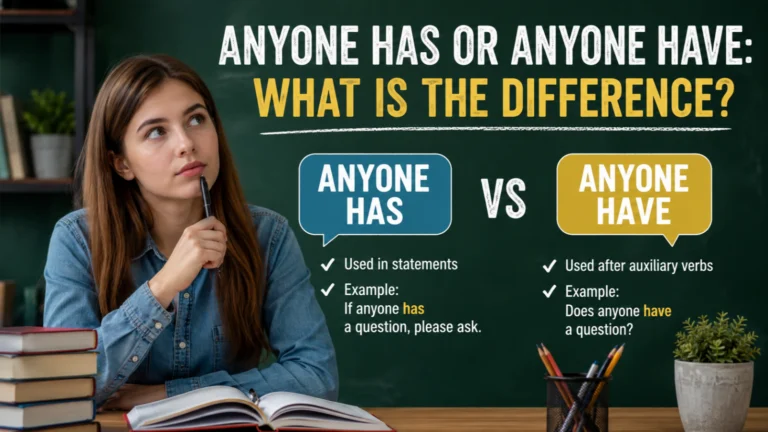
Anyone Has or Anyone Have is a common grammar question that often confuses English learners and even fluent speakers. Since the word anyone refers to a singular indefinite pronoun, choosing the correct verb depends on standard subject-verb agreement rules. Many people mistakenly switch between “has” and “have” because they associate anyone with a group rather than a single person. Understanding this difference will help you write more accurately and speak with greater confidence in both formal and informal situations. In this guide, you’ll learn the correct usage, simple grammar rules, practical examples, and common mistakes to avoid. By the end, you’ll clearly understand Anyone Has or Anyone Have and know which form to use in everyday English.
Why “Anyone Has” and “Anyone Have” Are Confusing
Many learners mix up these expressions because English verb forms change depending on sentence structure rather than meaning alone.
Here are the main reasons for the confusion:
Similar Pronunciation
In everyday speech, has and have often sound similar, especially when spoken quickly.
Similar Spelling
Both words come from the verb to have, making it easy to assume they can always be used interchangeably.
Context Confusion
The correct choice depends on grammar.
For example:
- If anyone has questions, please ask.
- Does anyone have questions?
The subject is the same, but the verb changes because the second sentence uses the helping verb does.
Common Learner Mistakes
Learners often write:
- ✘ Does anyone has a pen?
- ✘ If anyone have questions…
These mistakes happen because they focus on the subject instead of the sentence structure.
Anyone Has vs Anyone Have Explained Simply
1- “Anyone has” is used when anyone is the subject of a statement.
2- “Anyone have” is usually used after helping verbs like does, did, will, can, could, should, may, might, and others.
One-Line Distinction
“Anyone has” is used in statements, while “anyone have” is used after modal or auxiliary verbs.
Examples
Anyone has
- If anyone has information, please contact us.
- Anyone who has experience may apply.
Anyone have
- Does anyone have a charger?
- Can anyone have access to this file?
Understanding Homophones in English
What Are Homophones?
Homophones are words that sound alike but have different meanings or spellings.
Example:
- Sea
- See
Although they sound the same, they have different meanings.
Why Homophones Cause Confusion
Because many English words sound similar, learners often confuse spelling and grammar.
For example:
- Their
- There
- They’re
Even though has and have are not homophones, they create similar confusion because they are different forms of the same verb.
What Does “Anyone Has” Mean?
Definition and Core Meaning
Anyone has means that an unspecified person possesses something or experiences something.
It appears when anyone is the subject of the sentence.
Examples:
- If anyone has a question, raise your hand.
- Anyone has the right to ask for help.
(Note: The second example is grammatically possible but less common than “Anyone who has the right…”. Most natural uses appear in conditional clauses like “If anyone has…”)
Origin and Historical Use
The verb has comes from Old English and has been used for centuries as the third-person singular form of have.
Since anyone is treated as singular, it normally takes has.
Modern Usage and Synonyms
Modern uses include:
- possession
- ownership
- experience
- condition
Related expressions:
- possesses
- owns
- holds
- contains
Example Sentences
- If anyone has extra tickets, let me know.
- Anyone who has completed the course may register.
- If anyone has concerns, please email us.
What Does “Anyone Have” Mean?
Definition and Core Meaning
Anyone have is normally used after auxiliary or modal verbs.
Examples include:
- Does anyone have…
- Did anyone have…
- Can anyone have…
- Will anyone have…
The helping verb carries the tense, so the main verb returns to its base form have.
Origin and Historical Context
English grammar requires the base verb after helping verbs.
This rule has existed throughout Modern English grammar.
Modern Usage and Synonyms
Common helping verbs include:
- does
- did
- can
- could
- should
- will
- may
- might
Example Sentences
- Does anyone have a calculator?
- Did anyone have trouble logging in?
- Can anyone have access to this document?
- Will anyone have enough time?
Anyone Has vs Anyone Have: Key Differences at a Glance
| Word | Part of Speech | Meaning | Example Context |
|---|---|---|---|
| Anyone has | Subject + third-person singular verb | Shows that anyone possesses or experiences something | If anyone has questions, ask now. |
| Anyone have | Base verb after auxiliary verb | Used after helping verbs | Does anyone have questions? |
How to Remember the Difference Between Anyone Has and Anyone Have
Here are some simple memory tricks.
Easy Memory Tricks
- No helping verb → has
- Helping verb present → have
Association Technique
Remember this sentence:
Does = Have
Whenever you see does, the next verb stays in its base form.
Examples:
- Does anyone have…
- Did anyone have…
- Can anyone have…
Memorable Example
✔ If anyone has a map, we can continue.
✔ Does anyone have a map?
Common Mistakes and Confusions
Mistake 1
✘ Does anyone has a phone?
✔ Does anyone have a phone?
Explanation: After does, always use have.
Mistake 2
✘ If anyone have questions…
✔ If anyone has questions…
Explanation: Here, anyone is the subject, so use has.
Mistake 3
✘ Did anyone has dinner?
✔ Did anyone have dinner?
Explanation: Did requires the base verb.
Mistake 4
✘ Can anyone has permission?
✔ Can anyone have permission?
Explanation: Modal verbs take the base form have.
Examples Section: Correct and Incorrect Usage
Example 1
✔ Correct: If anyone has suggestions, please share them.
✘ Incorrect: If anyone have suggestions, please share them.
Example 2
✔ Correct: Does anyone have a pencil?
✘ Incorrect: Does anyone has a pencil?
Example 3
✔ Correct: Did anyone have trouble finding the venue?
✘ Incorrect: Did anyone has trouble finding the venue?
Example 4
✔ Correct: If anyone has the answer, raise your hand.
✘ Incorrect: If anyone have the answer, raise your hand.
Self Assessment: Test Your Knowledge
Fill in the blanks.
- If anyone _____ questions, ask now.
- Does anyone _____ a notebook?
- Did anyone _____ any problems yesterday?
- If anyone _____ extra information, please email us.
Self Assessment Answers
- has
- have
- have
- has
FAQs About “Anyone Has” and “Anyone Have”
1. Is “anyone has” grammatically correct?
Yes. It is correct when anyone is the subject of the sentence.
2. Is “does anyone has” correct?
No. The correct form is does anyone have.
3. Why is “have” used after “does”?
Because helping verbs require the base form of the main verb.
4. Is “anyone” singular or plural?
Grammatically, anyone is singular.
5. Can I say “if anyone have”?
In standard English, no. The correct form is if anyone has.
6. Which form is more common?
Both are common, but they appear in different sentence structures.
7. How can I remember the rule?
If there is a helping verb such as does, did, or can, use have. Otherwise, when anyone is the singular subject, use has.
Final Conclusion: Using “Anyone Has” and “Anyone Have” Correctly
Understanding the difference between “anyone has” and “anyone have” becomes much easier once you know the grammar rule behind them. The word anyone is treated as a singular subject, so when it stands alone as the subject of a statement or a conditional clause, it takes the third-person singular verb has. That’s why sentences such as “If anyone has a question, please ask” are correct. However, when a helping or modal verb like does, did, can, could, will, or should comes before the main verb, English grammar requires the base form have. This is why “Does anyone have a question?” is the correct choice instead of “Does anyone has a question?”
A simple way to remember this rule is to look for a helping verb. If you see one, use have. If there isn’t a helping verb and anyone is the singular subject, use has. Reading, listening, and practicing with real-life examples will make this pattern feel natural over time. Although the two forms may look similar, they are not interchangeable. By applying this rule consistently, you’ll write and speak more accurately and confidently. Keep practicing with everyday sentences, and before long, choosing between “anyone has” and “anyone have” will become second nature.