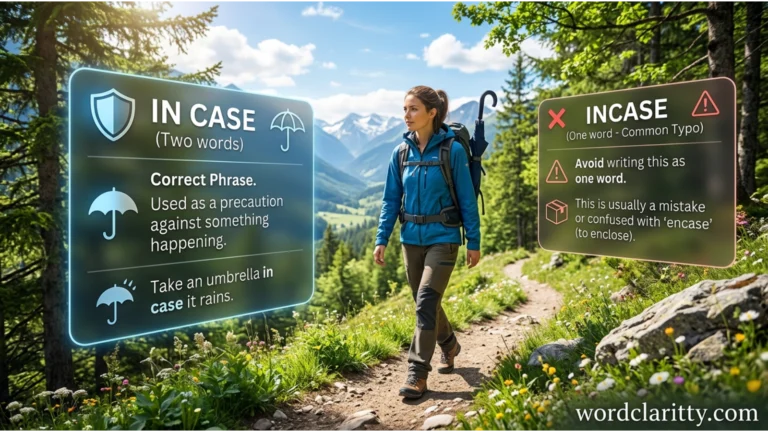
“Incase or in case”—which spelling is correct? If you have ever hesitated before writing this phrase, you are not alone. English learners often confuse in case with incase because the words look and sound very similar. However, they do not have the same status in standard English. In case is the correct expression when you mean “if something happens” or “as a precaution.
” Incase, written as one word, is generally considered a spelling mistake when used with this meaning. Understanding the difference will help you write clearer emails, messages, essays, and everyday English without second-guessing yourself.
Why “Incase” and “In Case” Are Confusing
English learners frequently mix up incase and in case because they are visually and phonetically close. The main difficulty is knowing when the two words should be separated.
Here are the most common reasons for the confusion:
- Similar pronunciation: In normal speech, “in case” can sound almost like one word.
- Similar spelling: The letters are exactly the same, except for the space.
- Context confusion: Learners may know the meaning but not remember whether the phrase needs a space.
- Common learner mistakes: People sometimes write “incase” because many English expressions are written as single words, such as “inside,” “instead,” or “indeed.”
For example:
Take an umbrella in case it rains.
A learner might incorrectly write:
Take an umbrella incase it rains.
The meaning is easy to understand, but the spelling is not standard English. In this context, in case must be written as two words.
It is also important to note that in case and incase are not ordinary homophones. The main issue is spelling and word formation rather than two standard words with different meanings that happen to sound alike.
Incase vs In Case Explained Simply
The easiest way to understand the difference is this:
“In case” is the standard phrase used when talking about a possible future situation or taking precautions. “Incase” is generally incorrect when used as a spelling of “in case.”
One-line distinction
Use “in case” as two words when you mean “if something happens” or “as a precaution.”
Examples
- Bring some extra money in case you need a taxi.
- I saved her phone number in case I need to contact her later.
In both sentences, in case introduces a possible situation.
Quick answer: Is “incase” correct?
For everyday English, academic writing, business writing, and most other contexts, use “in case,” not “incase.”
So:
- ✔ in case — correct
- ✘ incase — incorrect when intended to mean “in case”
Understanding Homophones in English
What Are Homophones?
Homophones are words that sound the same, or nearly the same, but have different meanings and often different spellings.
For example:
- right — correct or opposite of left
- write — to put words on paper or a screen
Consider:
You are right.
and:
Please write your name here.
The pronunciation is the same, but the meanings and spellings are different.
Why Homophones Cause Confusion
Homophones can be difficult because English learners cannot always identify the correct word from pronunciation alone.
For example, if someone says “write,” you need the context to know whether they mean write or right.
However, in case and incase are slightly different. In standard modern English, in case is the normal phrase for expressing a condition or precaution. Incase is not simply another standard spelling of the same expression.
Therefore, the important lesson is not to treat incase as an alternative spelling of in case.
What Does “Incase” Mean?
Definition and Core Meaning
When learners write incase, they usually intend to write in case. In that situation, incase is considered a misspelling.
For example:
✘ Take a jacket incase it gets cold.
The correct version is:
✔ Take a jacket in case it gets cold.
There is an additional point worth knowing: incase can occasionally appear in specialized or historical uses connected with the verb encase, but this does not make “incase” an acceptable replacement for the everyday phrase in case.
If your intended meaning is “if something happens” or “as a precaution,” write the expression as two words:
in case
Origin and Historical Use
The word case has a long history in English and ultimately comes through French from Latin roots associated with a situation, circumstance, or occurrence. The phrase in case developed as a way of referring to a particular circumstance or possible event.
The important point for modern learners is that the expression has traditionally been written as two words.
Modern Usage and Synonyms
In modern English, incase is most often encountered as an error caused by combining the two words in in case.
Depending on the sentence, possible alternatives to in case include:
- if
- should
- as a precaution
- to be prepared for
- because something might happen
For example:
Take an umbrella in case it rains.
can sometimes become:
Take an umbrella because it might rain.
However, these alternatives are not always interchangeable. In case often emphasizes preparation for a possible situation.
Example Sentences
Here are some examples of incorrect “incase” usage:
- ✘ Please call me incase you are late.
- ✘ Take your passport incase you need identification.
- ✘ Save this file incase your computer crashes.
- ✘ Bring a sweater incase the room is cold.
In every example, write in case instead.
What Does “In Case” Mean?
Definition and Core Meaning
In case is a standard English phrase that usually means if something happens or because something is possible and you want to be prepared for it.
It is commonly used when one event is possible and another action is taken as a precaution.
For example:
Bring an umbrella in case it rains.
This means you should bring an umbrella because rain is possible.
Another example is:
I wrote down the address in case I forgot it.
The person wrote down the address as a precaution against forgetting it.
Origin and Historical Context
The expression in case developed from the noun case, which has historically referred to a situation, circumstance, or event. The phrase therefore carries the basic idea of being prepared for a particular circumstance.
Today, in case is a common grammatical expression used in everyday conversation and formal writing.
Modern Usage and Synonyms
You will often see in case in sentences involving:
- possible future events
- preparation
- precautions
- emergencies
- uncertainty
- instructions
- warnings
Common patterns include:
in case + subject + verb
Take your phone in case you need help.
just in case + subject + verb
I’ll bring some cash just in case the card machine doesn’t work.
in case of + noun
In case of fire, use the emergency exit.
Notice that in case of is followed by a noun rather than a complete clause.
For example:
In case of emergency, call the security office.
Example Sentences
- Take a jacket in case it gets cold.
- I’ll save a copy in case the original is lost.
- Keep my number in case you need assistance.
- Bring some water in case the shop is closed.
- We left early in case there was heavy traffic.
- Just in case you forget, the meeting starts at nine.
Incase vs In Case: Key Differences at a Glance
| Word | Part of Speech | Meaning | Example Context |
|---|---|---|---|
| incase | Not normally used as the standard form of this expression | Generally a misspelling when intended to mean “in case” | ✘ “Take an umbrella incase it rains.” |
| in case | Phrase/conjunction; also used in the phrase “in case of” | If something happens; as a precaution | ✔ “Take an umbrella in case it rains.” |
The key point
If you are asking whether to write incase or in case in ordinary English, choose in case.
How to Remember the Difference Between Incase and In Case
Remembering the correct spelling is easier when you connect it to the meaning.
1. Think “possible situation”
Whenever you are talking about something that might happen, think:
in case
For example:
Bring a charger in case your phone battery dies.
The phone battery might die, so you prepare for that possibility.
2. Remember the space
A useful memory trick is:
Possible situation = two words
Think of the space as a small pause:
in | case
You are mentally preparing for a particular case, or situation.
3. Connect “in case” with “just in case”
If you know that just in case is written as three words, it becomes easier to remember that in case also needs a space.
I brought an umbrella just in case.
The shorter version is:
I brought an umbrella in case it rains.
4. Use the “if” test
Try replacing in case with if.
Take an umbrella in case it rains.
The idea is similar to:
Take an umbrella if it rains.
The exact meaning and grammar are not always identical, but the connection can help you remember the correct expression.
One memorable example
I packed an extra shirt in case I spilled coffee on mine.
You are preparing for something that might happen. Therefore, the correct spelling is always in case.
Common Mistakes and Confusions
Mistake 1
✘ I’ll call you incase I need help.
✔ I’ll call you in case I need help.
Explanation: The phrase meaning “if I need help” is in case, written as two words.
Mistake 2
✘ Take some cash incase the restaurant doesn’t accept cards.
✔ Take some cash in case the restaurant doesn’t accept cards.
Explanation: The speaker is preparing for a possible situation.
Mistake 3
✘ Save my number incase you lose your phone.
✔ Save my number in case you lose your phone.
Explanation: Again, in case introduces a possible circumstance.
Mistake 4: Confusing “in case” with “if”
These two expressions can sometimes communicate similar ideas, but they do not always have exactly the same meaning.
Compare:
Take an umbrella in case it rains.
This suggests taking the umbrella now as a precaution.
Compare that with:
Take an umbrella if it rains.
This can suggest that the action of taking the umbrella depends on whether it actually rains.
The distinction is small but useful for advanced English learners.
Mistake 5: Forgetting “in case of”
English also uses the structure in case of + noun.
✔ In case of fire, use the stairs.
✔ In case of emergency, contact the manager.
Do not write:
✘ Incase of fire, use the stairs.
The correct form remains in case of.
Examples Section: Correct and Incorrect Usage
Example 1
✔ Correct: Take an umbrella in case it rains.
✘ Incorrect: Take an umbrella incase it rains.
Why? The standard phrase is in case, meaning “because rain is possible.”
Example 2
✔ Correct: I’ll keep the receipt in case I need to return the item.
✘ Incorrect: I’ll keep the receipt incase I need to return the item.
Why? The receipt is being kept as a precaution.
Example 3
✔ Correct: Bring your identification in case they ask for it.
✘ Incorrect: Bring your identification incase they ask for it.
Why? The speaker is preparing for a possible situation.
Example 4
✔ Correct: In case of emergency, press the red button.
✘ Incorrect: Incase of emergency, press the red button.
Why? The fixed expression is in case of, with a space between “in” and “case.”
Example 5
✔ Correct: I saved the document just in case my computer stopped working.
✘ Incorrect: I saved the document just incase my computer stopped working.
Why? The standard expression is just in case, not “just incase.”
Example 6
✔ Correct: Keep some water with you in case you get thirsty.
✘ Incorrect: Keep some water with you incase you get thirsty.
Why? The sentence describes preparation for a possible future event.
Self Assessment: Test Your Knowledge
Fill in each blank with in case or incase.
- Take your phone charger ________ your battery runs out.
- I’ll write down the address ________ I forget it.
- Keep an umbrella in your car ________ it rains later.
- ________ of emergency, leave the building immediately.
Self Assessment Answers
- in case — Take your phone charger in case your battery runs out.
- in case — I’ll write down the address in case I forget it.
- in case — Keep an umbrella in your car in case it rains later.
- in case — In case of emergency, leave the building immediately.
Score yourself
- 4/4: Excellent! You understand the difference.
- 3/4: Very good. Review the examples once more.
- 1–2/4: No problem. Remember: when the meaning is “if something happens” or “as a precaution,” use in case as two words.
FAQs:
Is “incase” one word or two?
When you mean “if something happens” or “as a precaution,” the correct form is in case, written as two words. Incase should not be used as a one-word replacement in standard English.
Is “in case” correct English?
Yes. In case is a common and completely correct English expression. It is used to talk about a possible situation or something you do as a precaution.
Should I write “in case” or “incase”?
Write in case. For example: Bring an umbrella in case it rains.
Is “incase” a spelling mistake?
If you use incase when you mean the normal phrase in case, it is generally a spelling mistake. The standard form is two separate words.
What is the difference between “in case” and “if”?
Both can relate to possible situations, but they often have slightly different purposes. In case commonly describes preparation for a possibility, while if more directly introduces a condition.
Take an umbrella in case it rains.
Here, you take the umbrella now because rain is possible.
Is “just in case” correct?
Yes. Just in case is a very common expression meaning “as a precaution because something might happen.”
I saved a backup copy just in case.
Is “in case of” correct?
Yes. In case of + noun is a standard structure, especially in instructions and warnings.
In case of fire, use the emergency exit.
Conclusion:
The difference between incase and in case is simple once you know the rule. In standard modern English, use in case as two words when you mean “if something happens,” “because something is possible,” or “as a precaution.” For example, Take an umbrella in case it rains means that you should take the umbrella because rain is a possibility. The same rule applies to just in case and in case of.
By contrast, incase should not normally be used as a one-word spelling of this expression. When writing emails, school assignments, professional documents, social media posts, or everyday messages, choosing in case will keep your English clear and grammatically standard.
A simple memory trick is to connect in case with preparation. If you are doing something now because something might happen later, write in case: Save the file in case your computer crashes. Also remember the related expressions just in case and in case of emergency. Seeing these patterns repeatedly will make the correct spelling feel natural.
English has many confusing word combinations, so making occasional mistakes is normal. The important thing is to notice the pattern and practice it. The next time you wonder whether to write incase or in case, remember: possible situation or precaution = in case. Keep practicing, and this common English confusion will soon become an easy one to avoid.